Quick Info
At a glance
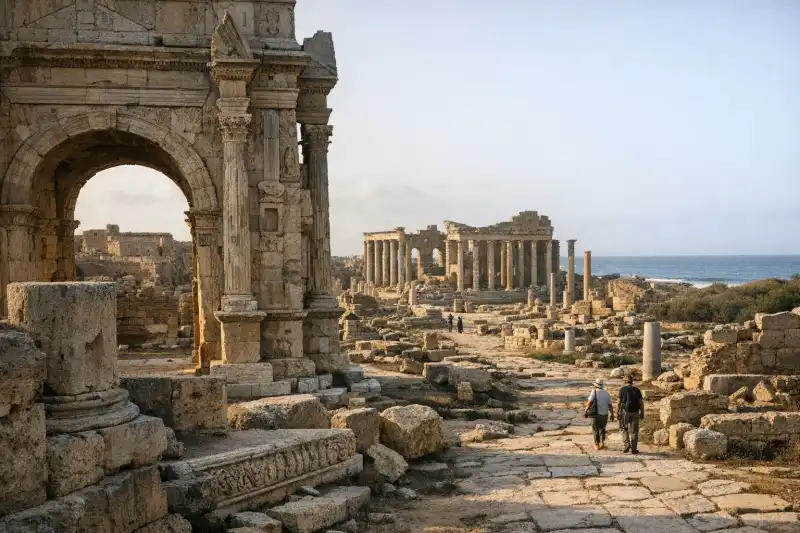
Leptis Magna in Libya is one of the most astonishing ancient cities anywhere on the Mediterranean coast, a place where grand Roman ambition still seems to echo in stone. Set near modern Al Khums, east of Tripoli, the site opens across a wide stretch of sea light and sandy ground, where triumphal arches, colonnaded streets, market halls, and public monuments survive in extraordinary detail. Many archaeological sites impress through fragments and imagination; Leptis Magna often does something rarer. It allows you to feel the shape of a whole city.
What makes the experience so memorable is not simply the quantity of ruins, though the scale is immense, but the quality of preservation and the setting. Here, the Roman world appears at the edge of Africa with a confidence that is both imperial and local. The city’s development reflects Phoenician foundations, Carthaginian influence, and a later transformation into one of the Roman Empire’s most splendid provincial centers. Emperors, merchants, sailors, and administrators all left their mark here, especially Septimius Severus, the native-born emperor whose patronage helped elevate his hometown into a showcase of Roman urbanism.
Walking through Leptis Magna today, you encounter not just isolated monuments but a coherent urban landscape: paved streets, ceremonial gateways, civic squares, bath complexes, warehouses, and a harbor district. It is a destination for travelers who care about ancient history, Roman architecture, and the wider cultural story of North Africa. Even by the standards of famous classical sites, Leptis Magna feels exceptional.
History
Phoenician beginnings
Leptis Magna began as a Phoenician settlement, probably in the 7th century BCE, when traders from the eastern Mediterranean established outposts along North Africa’s coast. Its position was advantageous: it sat on a shoreline connected to both maritime routes and inland trade networks. This gave the city early economic importance as a point where goods, people, and cultural influences met. In its earliest phases, Leptis was part of the broad web of Phoenician commercial activity that linked the Levant, North Africa, Sicily, and Iberia.
As Carthage rose to dominance in the western Mediterranean, Leptis came within the Punic sphere. The city retained local importance, benefiting from agricultural wealth in the surrounding hinterland as well as overseas commerce. Even before Roman rule, it had the characteristics that would define it for centuries: a prosperous port, fertile territory, and an ability to absorb and adapt different political and cultural influences.
Under Carthaginian and Numidian influence
During the later first millennium BCE, Leptis Magna developed under strong Carthaginian influence, though local elites and traditions remained significant. Punic language and institutions shaped urban life, and the city became one of several important coastal centers in what is now Libya. It also interacted with inland polities and neighboring peoples, making it more than just a maritime enclave.
After the fall of Carthage in 146 BCE, regional power balances shifted across North Africa. Leptis Magna moved through periods of Numidian and then increasingly Roman influence. Rather than experiencing a sudden rupture, the city seems to have evolved gradually, preserving elements of its Punic identity while integrating into new political structures. This continuity helps explain why Leptis later flourished so strongly under Rome: it already possessed urban traditions, mercantile connections, and a wealthy landowning class.
Roman incorporation and rise
Leptis Magna entered the Roman orbit more fully during the late Republic and early Empire. By the 1st century BCE and 1st century CE, it had become an increasingly Romanized city while still retaining aspects of its older heritage. Roman institutions, architecture, and civic culture took firmer root, and the city prospered from trade in olive oil, grain, and other regional products. Its agricultural base was particularly important. North Africa became one of Rome’s great productive zones, and Leptis benefited directly from that prosperity.
Public building projects expanded the city’s ceremonial and practical spaces. Forums, temples, markets, and bath complexes reflected both civic pride and imperial connection. Yet Leptis Magna was not merely imitating Rome. It was participating in a wider Roman Mediterranean culture from a distinctly African setting. This blend is one of the reasons the site remains so historically important.
The Severan golden age
The peak of Leptis Magna came in the late 2nd and early 3rd centuries CE, above all under Emperor Septimius Severus, who was born in the city in 145 CE. When Severus became emperor in 193 CE, Leptis gained a powerful patron in the highest office of the empire. He lavished attention and resources on his hometown, transforming it into one of the grandest cities in Roman Africa.
This was the era of major urban expansion. The Severan Forum, Basilica, and monumental arch are among the most striking remains from this phase. These buildings were not just practical additions; they were statements of status. Leptis Magna was presenting itself as a city of imperial importance, fully aligned with Rome’s monumental language yet distinct in style and regional context. Rich sculptural decoration, large colonnaded spaces, and ambitious planning all belong to this flowering.
The harbor was improved, the city center enlarged, and public architecture reshaped on a grand scale. For a time, Leptis Magna stood as a symbol of how provincial cities could become central to the story of the empire.
Decline, transformation, and burial
Like many Roman cities, Leptis Magna did not remain at its peak indefinitely. Economic disruption, political instability, and environmental pressures affected the city from the 3rd century onward. Silting in the harbor likely undermined trade. As imperial fortunes shifted and regional insecurity increased, urban maintenance became harder to sustain.
The city survived into Late Antiquity and passed through changing political hands, including the Vandal and Byzantine periods. Some monumental structures were reused, altered, or abandoned. Over time, the once-flourishing urban core diminished in importance. Following the Arab conquest of North Africa in the 7th century, settlement patterns changed further, and Leptis Magna gradually faded from active urban life.
Its later preservation owes much to abandonment and encroaching sand. Rather than being continuously quarried or built over on a large scale, much of the city lay partly buried for centuries. Modern archaeology, especially from the 19th and 20th centuries onward, brought Leptis Magna back into view. What emerged was one of the most complete Roman cities ever excavated, a place where the ancient Mediterranean can still be read with unusual clarity.
Key Features
Leptis Magna’s greatest strength as a destination is the completeness of its urban fabric. You are not visiting a single temple or isolated monument but moving through an entire ancient city whose districts still make sense on the ground. The scale becomes apparent quickly. Broad avenues, plazas, and public buildings are arranged in ways that reveal the rhythms of civic life, commerce, religion, and spectacle.
Among the most celebrated monuments is the Severan Arch, a tetrapylon built at a major intersection and richly decorated to honor Septimius Severus and his dynasty. Its relief sculpture, though worn by time, still conveys imperial ceremony and the political message of belonging to Rome’s ruling world. Nearby, the Severan Forum is one of the site’s most impressive spaces, designed with monumental elegance and framed by columns and sculptural ornament. It feels ceremonial even in ruin, the kind of place meant to impress visitors and affirm civic identity.
The Basilica, connected to this Severan complex, is another highlight. It was one of the city’s principal civic buildings and still communicates grandeur through its scale and surviving architectural lines. Carved details and the arrangement of the interior suggest a city wealthy enough to invest not only in function but also in visual magnificence. Even fragmentary surfaces hint at the artistry once present throughout the complex.
Leptis Magna’s theater is especially memorable because of its location near the sea. Roman theaters often impress through acoustics and form, but here the coastal setting adds something more atmospheric. Sitting among the stone seating and stage remains, you can sense how performance, public life, and landscape once came together. The nearby market area, with its organized plan and surviving stalls or market structures, offers a different but equally valuable glimpse into daily life. Grand monuments tell one story; commercial spaces tell another, and at Leptis Magna both are unusually legible.
The old forum and associated temples preserve traces of earlier phases of the city, allowing visitors to see that Leptis Magna was not built in one burst but developed across centuries. This layering is part of its appeal. Punic roots, early Roman growth, and Severan grandeur all exist within the broader layout. The bath complexes further enrich that picture. Roman baths were social as much as hygienic spaces, and the surviving halls, passages, and engineering features show how urban sophistication reached deep into everyday routines.
One of the site’s most striking aspects is the street planning. Colonnaded avenues and paved roads still define movement through the city. Walking these routes gives a sense of proportion and orientation that many ancient sites no longer offer. You can understand where people entered, where they traded, where officials worked, and where ceremonial processions might have passed. This makes Leptis Magna particularly rewarding for travelers who enjoy reading ruins as lived space rather than isolated art objects.
The harbor district, though less dramatically preserved than some inland monuments, is historically significant. Leptis Magna’s prosperity depended heavily on maritime connections, and the remains of warehouses and port-related infrastructure remind visitors that this was not simply a ceremonial city. It was a functioning commercial center integrated into Mediterranean exchange.
Finally, the site’s atmosphere deserves mention as a feature in itself. The pale stone, open sky, and coastal air create a visual experience very different from inland Roman ruins. Light changes quickly across the columns and arches, especially in the early morning and late afternoon. Leptis Magna can feel both monumental and strangely quiet, an immense city returned to wind, sea, and sun.
Getting There
Leptis Magna lies near Al Khums, about 120 kilometers east of Tripoli, and most visitors approach from the capital. In straightforward driving conditions, the journey by road usually takes around 1.5 to 2 hours each way. For most travelers, the most practical option is to arrange a private car, driver, or guided excursion in advance. In Libya, transport arrangements can depend heavily on current security conditions, checkpoints, and local permissions, so organized travel is often the simplest route.
A private round-trip car from Tripoli to Leptis Magna may cost roughly $80 to $180 depending on vehicle type, waiting time, and whether guiding is included. Full-day guided excursions can be higher, often in the $150 to $300+ range per person for small groups or bespoke arrangements. Prices vary widely based on logistics, permits, and market conditions. If you are traveling as part of a specialist tour of Libya’s archaeological sites, Leptis Magna is often included as a major stop.
Shared taxis or local transport may sometimes be available between Tripoli and Al Khums, with lower fares that can range approximately from $5 to $15 equivalent for the intercity segment, but these are less predictable for international visitors and may not be ideal if you need flexible timing or direct access to the archaeological zone. Once in Al Khums, a short taxi ride to the site may add another small fare.
Because entry procedures, opening hours, and on-site services can change, it is wise to confirm details with a local operator, hotel, or cultural contact before departure. Bring water, cash, identification, and sun protection. Even if the distance from Tripoli looks manageable on a map, Leptis Magna is best treated as a full-day outing rather than a quick stop.
When to Visit
The best time to visit Leptis Magna is generally during the cooler months, especially from October to April. During this period, daytime temperatures are usually more comfortable for walking across a large exposed archaeological site. Winter in coastal Libya can be mild and pleasant, making it easier to spend several hours exploring the forum, theater, baths, and harbor area without excessive heat. Light at this time of year is also often excellent for photography, especially in the morning.
Spring can be particularly attractive. The weather is often warm but not yet punishing, and visibility across the site can be beautifully clear. Autumn offers similar advantages after the peak summer heat has faded. In both seasons, early arrival is recommended to make the most of softer light and quieter conditions.
Summer visits, especially from June through September, can be challenging. Temperatures can climb high, and shade across the ruins is limited. If you must go in summer, plan for the earliest possible start, wear a hat, apply strong sunscreen, and carry more water than you think you will need. The stone surfaces and open spaces can intensify heat, making even moderate walking tiring by midday.
Rain is not usually a major obstacle, but winter weather can occasionally bring wind or brief showers from the Mediterranean. These rarely overshadow the benefits of cooler temperatures, though they may affect comfort at the more open parts of the site.
Whenever you visit, aim to give yourself enough time. Leptis Magna rewards slow exploration, and the most memorable impressions often come when the light is low, the crowds are sparse, and the city’s monumental geometry begins to stand out against the coast.
| Quick Facts | Details |
|---|---|
| Location | Near Al Khums, northwestern Libya |
| Country | Libya |
| Ancient Origins | Phoenician foundation, later Punic and Roman city |
| Best Known For | Exceptionally preserved Roman urban ruins |
| UNESCO Status | World Heritage Site |
| Peak Period | Late 2nd to early 3rd century CE |
| Signature Monuments | Severan Arch, Severan Forum, Basilica, theater, baths, market |
| Nearest Major Gateway | Tripoli |
| Typical Visit Length | Half day to full day |
| Terrain | Expansive open ruins with uneven stone surfaces |
Leptis Magna stands among the great archaeological experiences of the Mediterranean not only because of what survives, but because so much of an ancient city’s logic remains visible. You can trace power in its arches and forums, commerce in its market and harbor, leisure in its baths and theater, and memory in the way imperial ambition transformed a long-inhabited African port into a monumental Roman showcase. It is a destination that rewards historical curiosity, architectural attention, and patience.
For travelers interested in the ancient world beyond the standard circuit of Italy and Greece, Leptis Magna offers something extraordinary: a city at the edge of empire that was never truly peripheral. Its stones tell a story of continuity, adaptation, and prestige across many centuries. Few sites combine that depth with such dramatic preservation. Even after you leave, the image tends to remain: columns against sea light, a basilica open to the sky, and the sense of walking through a place where history is not abstract but spatial, tangible, and immense.
Guided tours: worth it?
Self-guided works here, but a guide can add real value if you want the ruins explained as a living place rather than just a sequence of monuments.
Best for
- First-time visitors who want context, not just photos
- Short visits where a planned route saves time
When to go self-guided
Go independently if you prefer setting your own pace, reading as you go, and checking official hours or ticket rules directly before you arrive.
What I’d avoid
Skip paid tours that bundle unrelated stops you do not actually want. The best option should either save meaningful planning time or add historical context you would miss on your own.
Leptis Magna tours
Useful when: you want to compare guided formats before deciding
Libya ancient sites tours
Useful when: you want to compare guided formats before deciding
Tripoli to Leptis Magna tours
Useful when: you want to compare guided formats before deciding
Some tour links are affiliate links, which may earn Ancient Travel a small commission at no extra cost to you. I try to surface options that make practical sense for the site—not just anything bookable.
Frequently Asked Questions
Where is Leptis Magna located?
Leptis Magna is on the Mediterranean coast of Libya near the modern city of Al Khums, roughly 120 kilometers east of Tripoli.
Why is Leptis Magna famous?
Leptis Magna is famous for being one of the best-preserved Roman cities in the Mediterranean, with monumental streets, forums, a basilica, baths, market buildings, and a large amphitheater.
Is Leptis Magna a UNESCO World Heritage Site?
Yes. Leptis Magna is recognized as a UNESCO World Heritage Site for its exceptional Roman urban remains and historical importance.
How much time should I spend at Leptis Magna?
Most visitors should allow at least half a day, though a full day is ideal if you want time to explore the forum, basilica, theater, market, harbor area, and museum at a relaxed pace.
Can you visit Leptis Magna independently?
Independent travel may be limited by current security and visa arrangements in Libya, so many visitors arrange transport, permits, and guidance through licensed local operators.
What should I bring when visiting Leptis Magna?
Bring water, sun protection, sturdy walking shoes, and a hat, since the site is expansive, largely open to the sun, and involves walking on uneven ancient stone.
Nearby Ancient Sites
Carthage
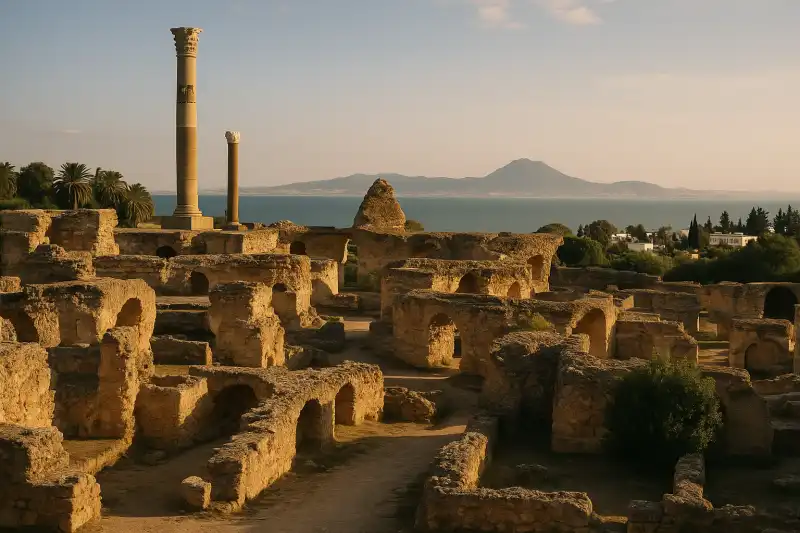
Phoenician / Carthaginian / RomanCarthage in Tunisia preserves the ruins of a once-mighty Phoenician empire and Roman provincial capi...
Alexandria Catacombs
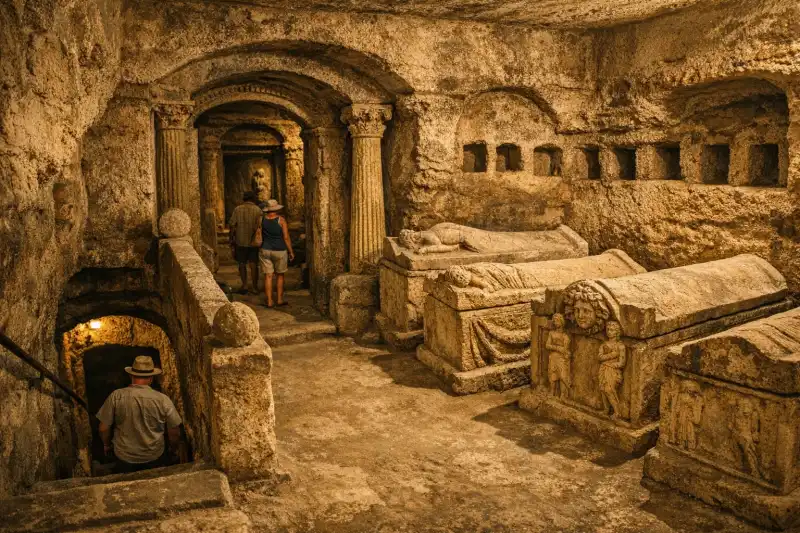
Greco-Roman EgyptExplore Alexandria Catacombs in Egypt, a remarkable Roman-era underground necropolis blending Egypti...
Abu Simbel
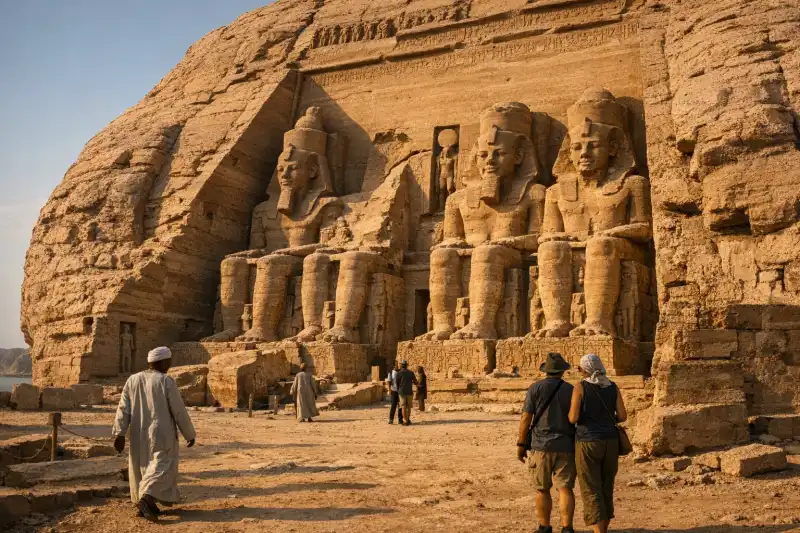
Ancient EgyptianDiscover Abu Simbel in Egypt, where colossal rock-cut temples of Ramses II rise above Lake Nasser ne...