Quick Info
Curated Experiences
Alexandria Egyptian Museum and Ancient Library Tour
Guided Full-Day Alexandria City Tour
Discover Ancient Alexandria—Private Archaeological Tour
Walking along the corniche of Alexandria, Egypt’s breezy northern city that hugs the Mediterranean, you’re treading the footpaths of ancient philosophers, historians, and scientists. Here, in what was once the most cosmopolitan metropolis of antiquity, stood the fabled Library of Alexandria—an unparalleled repository of human knowledge and the heartbeat of the ancient intellectual world. Mentioned with awe by poets and scholars around the Mediterranean, the Library was more than a building; it was the beacon of learning between 3rd century BCE and the early centuries CE, drawing wisdom-seekers from Greece, Persia, Egypt, India, and beyond.
While the original structure has long since vanished, its myth and legacy remain interwoven in Alexandria’s modern identity, subtly shaping each arch and avenue. Today, visitors to Alexandria can still sense the intellectual vibrancy that once animated this ancient port. At the modern Bibliotheca Alexandrina—boldly designed as an homage to its predecessor—scholarly pursuits and global dialogues continue, echoing the Library’s spirit. Whether you’re a history enthusiast or an eager traveler in search of legendary ruins, the tale of the Library of Alexandria beckons with a blend of mystery, melancholy, and hope. The very air still seems to stir with stories of lost scrolls, brilliant minds, ancient languages, and the ever-burning quest for knowledge. Stand on this hallowed ground, and you step straight into the living legend of Egypt’s—and humanity’s—greatest ancient library.
History
Foundation under the Ptolemies
The story of the Library of Alexandria begins in the wake of Alexander the Great’s death. Following his conquest of Egypt, Alexander founded the city of Alexandria in 331 BCE, envisioning it as a crossroads of cultures and ideas. After his death, his general Ptolemy I Soter took the reins of Egypt and initiated a dynasty that would transform Alexandria into the cultural capital of the ancient world. Around the dawn of the 3rd century BCE, Ptolemy laid the groundwork for an ambitious project: a universal library meant to gather all the world’s knowledge in one place. His son, Ptolemy II Philadelphus, expanded this vision, establishing the Mouseion—a temple to the Muses, which housed the Library.
From the beginning, the Library was connected to the Mouseion, a vast complex that combined research institutions, living quarters for scholars, and lush gardens. The very concept of organized, state-supported research originated here, fueled by the competitive ambitions of the Ptolemaic rulers. Staffed by priests, scholars, and scribes, the Library’s mission was clear: collect every book ever written, in every language. Agents were dispatched across the Mediterranean to acquire works from Athens, Persia, India, Carthage, and beyond—sometimes copying the originals and keeping them for their own archives.
Golden Age of Learning
During the 3rd and 2nd centuries BCE, the Library and Mouseion attracted a dazzling array of intellectuals. Eratosthenes, who famously calculated the earth’s circumference; Euclid, the “father of geometry”; and the polymath Aristarchus were among the luminaries working or teaching here. The Library’s holdings, estimated by some ancient sources at hundreds of thousands of scrolls, covered philosophy, science, literature, medicine, and more. The prestige of the institution was such that foreign scholars and leaders sent rare works as diplomatic gifts.
Translations became a specialty, with the first Greek version of the Hebrew Bible—the Septuagint—produced here. This commitment to multi-lingual acquisition and translation spurred a heady exchange of ideas across cultures. Under the early Ptolemies, the Library flourished as the intellectual powerhouse of the Hellenistic age.
Challenges and Decline
The Library’s fortunes began to waver in the shadow of political upheavals. The Ptolemaic dynasty weathered wars, intrigue, and the ever-increasing influence of Rome. In 48 BCE, during Julius Caesar’s Alexandrian campaign, a large part of the city is said to have caught fire—ancient writers debate whether the Library itself was destroyed at this time, partially or in full. Nevertheless, the institution lingered for centuries thereafter, facing waves of adversity.
The Library may have endured in various forms, including a later “daughter” library in the Serapeum temple, but the original Mouseion complex gradually fell into disrepair. Successive Roman emperors—sometimes supportive, sometimes indifferent—saw Alexandria’s scholarly glories dimming. In the third century CE, civil unrest and imperial neglect likely accelerated the decline, and by the end of late antiquity, the original Library had disappeared into legend. Its myth grew all the larger in the absence of its shelves and scrolls.
The Modern Renaissance
Centuries after its loss, the spirit of the Library was revived with the creation of the modern Bibliotheca Alexandrina. Opened in 2002 near the ancient site by the Mediterranean, its sun-disc architecture and international collections echo the open-minded pursuit of universal knowledge. The new institution keeps the legend alive, inviting scholars and the public to reflect on the enduring value of learning, dialogue, and cultural exchange that made the original Library so legendary.
Key Features
Though the original Library of Alexandria has left no visible remains, imagination—supported by scattered ancient descriptions and archaeological hints—paints a vivid picture of its majesty. Contemporary writers such as Strabo, Plutarch, and Galen highlight multiple grand halls, lined with rows upon rows of papyrus scrolls and illuminated by shafts of sunlight filtering through high colonnades. The Mouseion complex likely encompassed scholarly living quarters, lecture halls, gardens, and sanctuaries to the Muses—the goddesses of inspiration and the arts.
Historians believe the Library could have housed up to 400,000 scrolls at its peak, making it the most comprehensive collection in the ancient world. Its system of cataloging, attributed to Callimachus, represented an early effort at organizing information in a scientific manner, paving the way for future libraries.
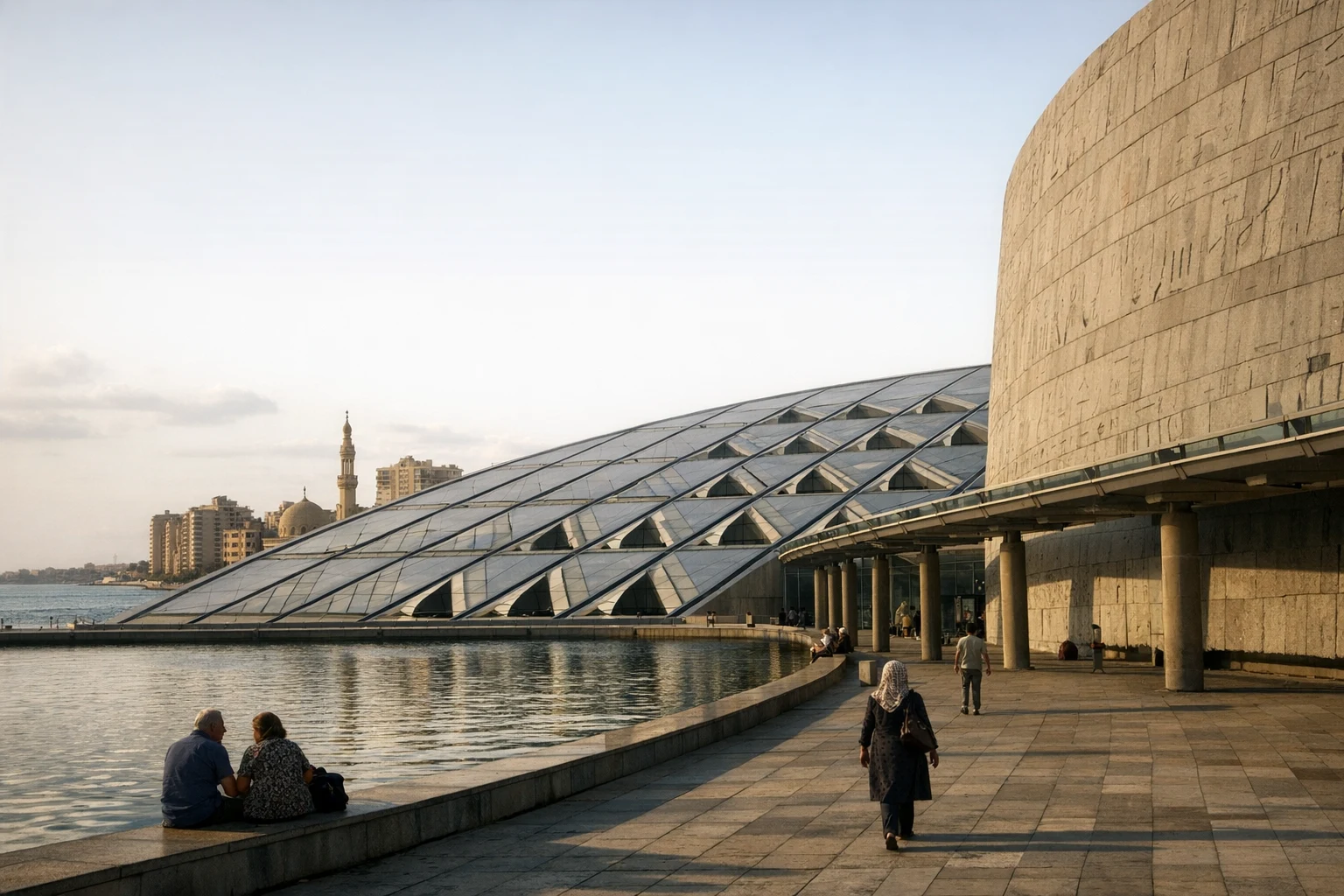
Visitors to today’s Alexandria encounter a living tribute in the Bibliotheca Alexandrina. Designed by Norwegian architectural firm Snøhetta, the building’s massive circular form symbolizes the rising sun of knowledge. The main reading room—a breathtaking, sloping disc nearly 70,000 square meters in area—holds millions of books in dozens of languages, with terraces bathed in natural light. Along its outer walls, characters from over 120 world scripts are engraved, underscoring the inclusivity and intellectual breadth sought by the original Library.
The modern library is more than a homage. Beyond its reading rooms, it houses several specialized museums—such as the Antiquities Museum, Manuscripts Museum, and Science Museum—where visitors can explore displays about the history of libraries, ancient scripts, and the development of scientific thought. Exhibits reconstruct Alexandria’s intellectual journey, with models, digital archives, and interactive displays that bring the vanished scrolls to life.
One of the Bibliotheca’s most poignant features is its commitment to education for all. Visitors, whether academics or curious travelers, can attend lectures, film screenings, and exhibitions. The complex also houses a planetarium and multiple art galleries. Together, these facilities echo the spirit of the ancient Library as a living, evolving center of discourse and discovery. Walking its halls, you’re not only revisiting history, but also participating in the ongoing renaissance of human knowledge.
Outdoors, the Library’s plaza offers sweeping views of Alexandria’s seaside boulevards, where the ghosts of the ancient city intermingle with the vibrancy of modern Egyptian life. Though time has erased the ivory scrolls and marble corridors of the Library of antiquity, the city’s new centerpiece radiates the same ideals: reverence for learning, dialogue, and the awe-inspiring accumulation of human achievement.
Getting There
Travelers arriving in Egypt can reach Alexandria by a number of comfortable and affordable options. The city is about 220 kilometers northwest of Cairo and is well-connected by road, rail, and air.
The most popular way is by train—Egypt’s state-run railway offers frequent service from Cairo’s Ramses Station to Alexandria. The journey takes about 2.5 to 3 hours, with first-class tickets costing around 100 to 150 EGP (roughly $3–5 USD as of 2024). Trains arrive at Alexandria’s Misr Station, from where a short taxi ride (20–40 EGP) brings you to the Corniche and the modern Bibliotheca Alexandrina.
For those preferring road travel, regular air-conditioned buses operate between major Egyptian cities and Alexandria. Companies such as Go Bus and Super Jet offer comfortable buses for 90–150 EGP one way. If you’d like a more flexible route or wish to explore the coastline, hiring a private car or taxi from Cairo is also possible—expect to pay 1000–1500 EGP ($33–50 USD) for a one-way trip, depending on negotiation and vehicle quality.
Alexandria’s small international airport, Borg El Arab, serves limited regional and charter flights from cities in the Middle East and Mediterranean, making it a possible gateway for those arriving from abroad. From the airport, taxis or app-based rideshares (Careem or Uber) provide direct access to the city for about 200–300 EGP ($6–10 USD).
Once within Alexandria, public transport is plentiful, with yellow-blue trams (2–5 EGP per ride), minibuses, and local taxis offering easy access to the Corniche and central attractions. The Library complex itself is located a few minutes’ walk from the Mediterranean waterfront, making it easily accessible for both day-trippers and overnight visitors.
When to Visit
The Mediterranean climate of Alexandria makes it a pleasant destination year-round, though certain seasons offer a more comfortable experience. The best time to visit is during the spring (March to May) and autumn (September to early November), when temperatures range between 18°C and 26°C (64°F to 79°F), and the sea breeze keeps the city refreshingly cool. During these months, the city hosts fewer crowds, hotel rates are reasonable, and you can stroll the Corniche or explore the Library comfortably.
Summer (June to August) brings higher temperatures—often reaching 30°C (86°F) and above—along with increased humidity, especially in July and August. Although the Mediterranean mitigates extreme heat, the city fills with Egyptian holidaymakers, so expect livelier streets and bustling waterfronts. Cultural events at the Bibliotheca are frequent during summer but booking ahead is advisable due to local demand.
Winter (December to February) sees cooler, sometimes rainy conditions, with temperatures dropping to 12–18°C (54–64°F). While the chance of showers and wind increases, this period offers a quieter experience and the chance to see Alexandria’s urban life without crowds. The Library itself, being an indoor attraction, makes for a comfortable retreat regardless of weather.
Keep in mind that the Bibliotheca Alexandrina closes on major public holidays and may reduce hours during Ramadan or national celebrations. It is best to check the official website for updated hours and special exhibitions before planning your visit.
| Quick Facts | |
|---|---|
| Country | Egypt |
| Region | Alexandria Governorate |
| Location | Alexandria, on the Mediterranean coast |
| Coordinates | 31.2089° N, 29.9092° E |
| Original Established | early 3rd century BCE |
| Modern Library Opened | 2002 |
| Legendary Scroll Count | up to 400,000 |
| Main Language of Ancient Library | Greek |
| Modern Bibliotheca Architect | Snøhetta (Norwegian firm) |
| Closest Major City | Alexandria |
| Must-See Today | Bibliotheca Alexandrina Museums |
| Admission Fee (2024) | 70 EGP (approx. $2.30 USD) main library |
| Opening Hours | Sun–Thu: 10am–7pm; Fri–Sat: 2–7pm |
| UNESCO Tentative List | Yes |
| Transportation from Cairo | Train (2.5–3 hrs, $3–5 USD) |
| Suggested Visit Duration | 2–3 hours |
Frequently Asked Questions
Can I visit the original site of the Library of Alexandria?
The original Library no longer exists, but you can visit the modern Bibliotheca Alexandrina, inspired by the ancient wonder, located near the original site.
Is the modern Bibliotheca Alexandrina a museum or functioning library?
It is both—a working research library, cultural center, and museum with exhibitions on the history of the ancient library.
Are there any original artifacts from the ancient Library of Alexandria?
No original scrolls or artifacts remain, but several ancient manuscripts and exhibits related to Alexandria’s intellectual legacy are displayed in the modern library.
What languages were used in the Library of Alexandria?
Greek was the main language, but the library also collected works in Egyptian, Hebrew, Persian, Sanskrit, and others.
How long does an average visit to the site take?
Most visitors spend 2–3 hours exploring the modern Bibliotheca Alexandrina, museums, and nearby archaeological remains.
Nearby Ancient Sites
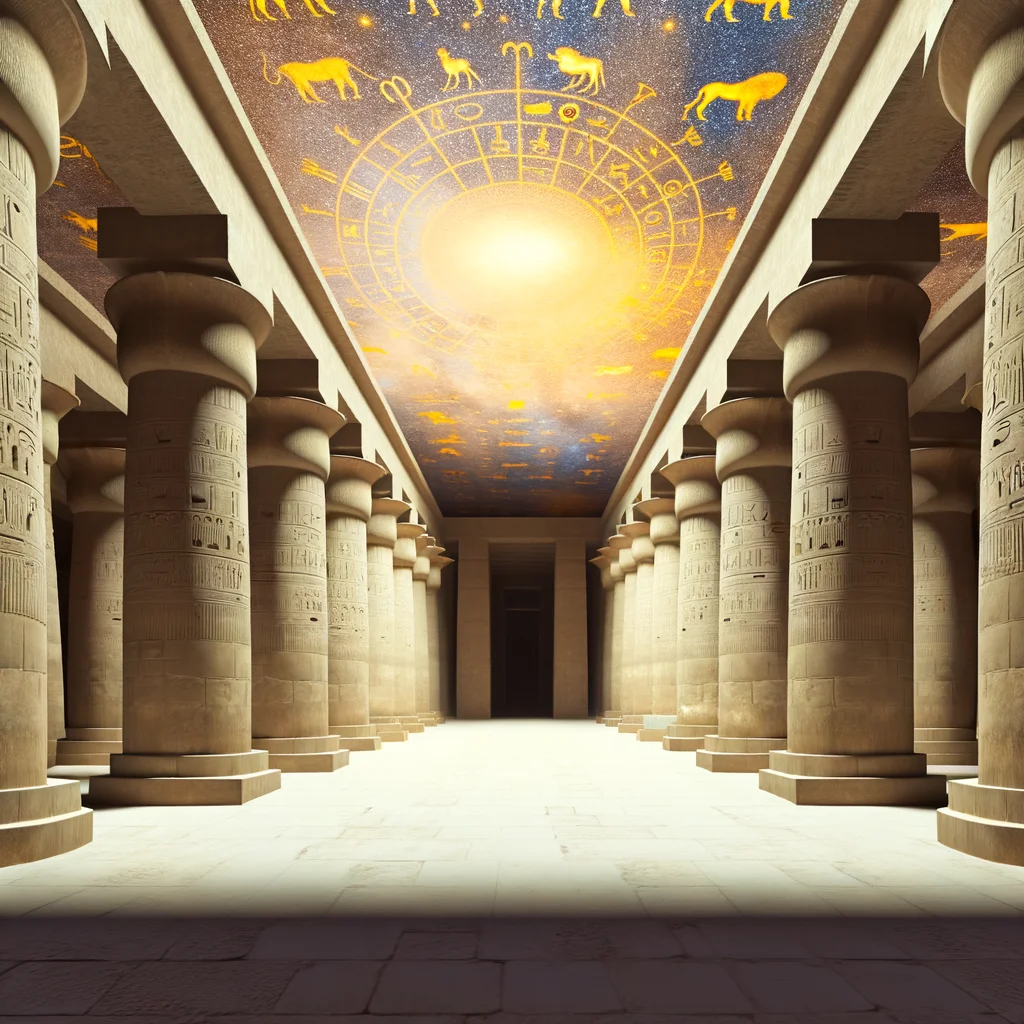
Dendera Temple Complex Egypt Guide 2026: Temple of Hathor & Zodiac Ceiling
Ptolemaic-RomanExplore Dendera's magnificent Temple of Hathor near Luxor. Star-mapped zodiac ceiling, Ptolemaic arc...
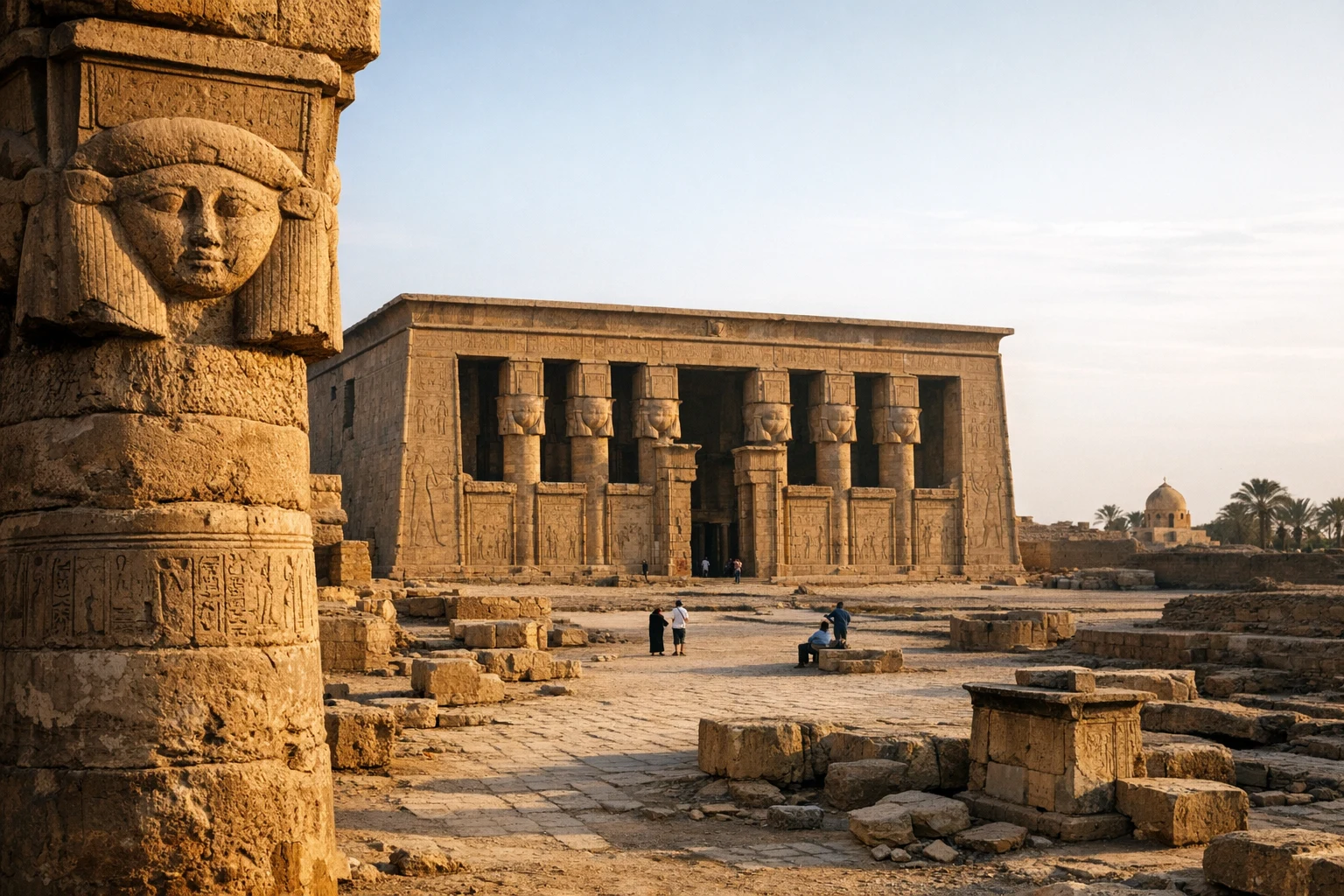
Dendera Temple Complex
The Dendera Temple Complex in Egypt is a remarkably preserved ancient site renowned for its grand Te...
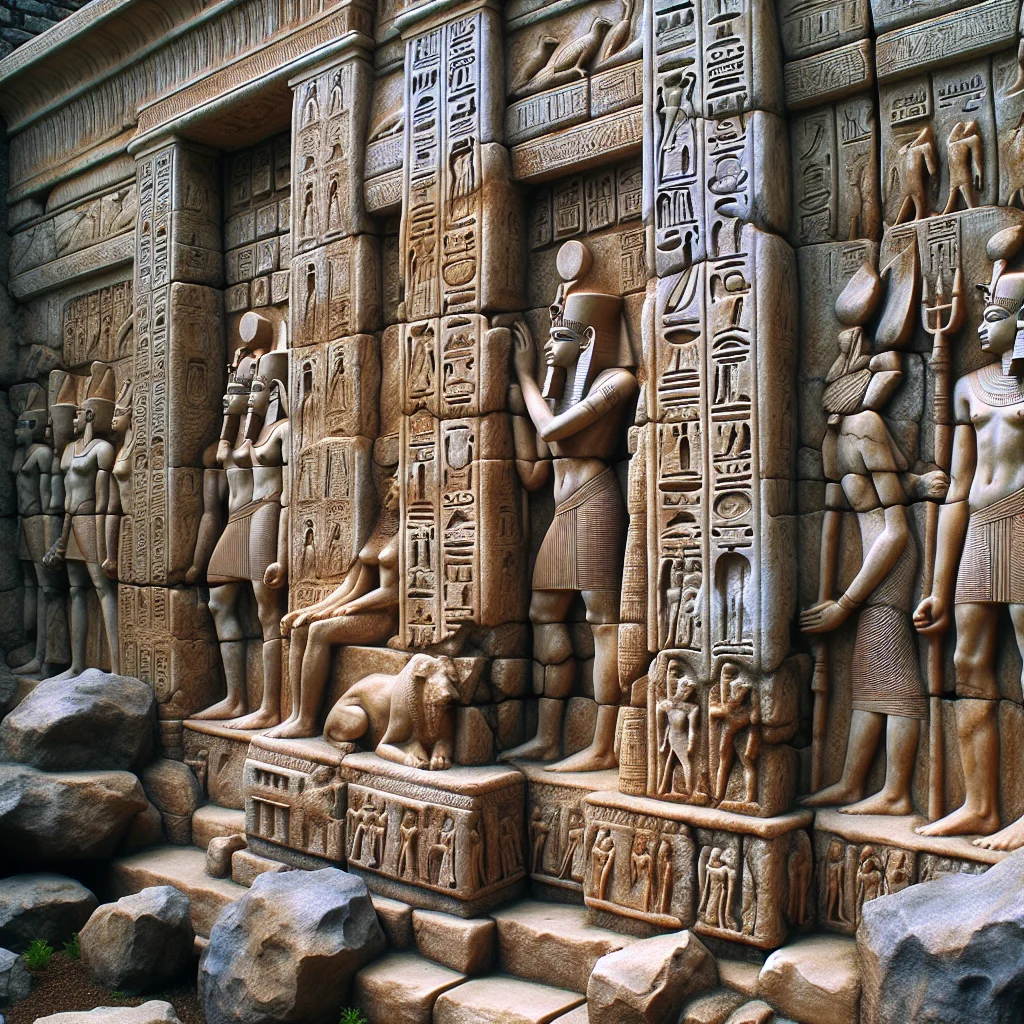
Abydos Temple Egypt Guide 2026: Temple of Seti I & King List
New Kingdom-PtolemaicAbydos Temple near Luxor: magnificent Temple of Seti I with war reliefs, ancient king list, and vibr...