Quick Info
At a glance
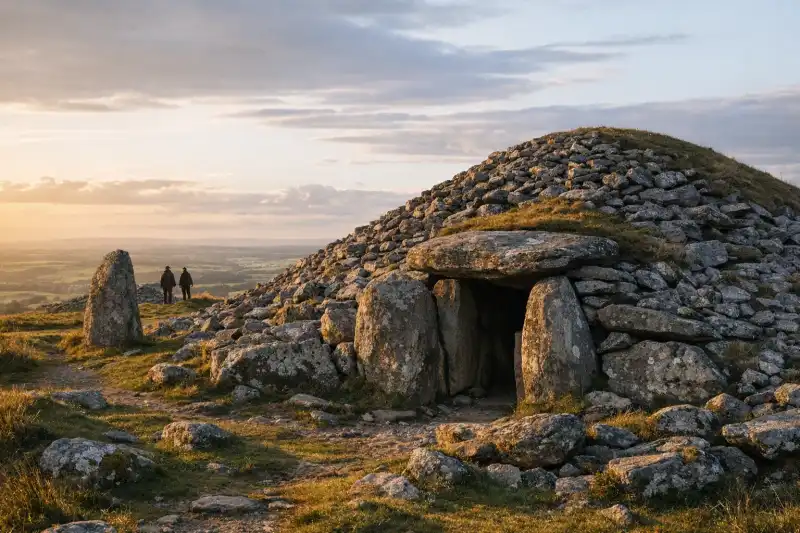
Loughcrew Cairns in Ireland rises over the rolling farmland of County Meath with a quiet authority that feels older than memory. Set across the heights of Sliabh na Calliagh, often translated as the Hill of the Witch, this remarkable Neolithic cemetery is not a single monument but a landscape of stone, sky, and ceremony. Visitors who make the climb are rewarded with broad views over the Irish midlands and with a sense that these hills were chosen for reasons far deeper than convenience. Here, passage tombs crown the ridges, their chambers still preserving ancient carvings and their alignments still catching light in ways that connect earth to cosmos.
Unlike some archaeological sites that reveal themselves slowly, Loughcrew makes an immediate impression. The setting is dramatic, the monuments tactile, and the atmosphere unusually intimate. You are close enough to the stones to study the spirals, lozenges, and abstract patterns pecked into their surfaces, yet far enough from modern bustle to imagine how a prehistoric community might have approached the hill in ritual procession. Though often overshadowed by the more famous monuments of the Boyne Valley, Loughcrew offers something equally compelling: a vivid encounter with Ireland’s Neolithic imagination. It is a place where burial, astronomy, belief, and landscape design meet on the highest points of the county, creating one of the country’s most evocative ancient destinations.
History
Neolithic origins
The story of Loughcrew Cairns begins in the Neolithic period, around 3300 BCE, when farming communities in Ireland were building some of the most sophisticated ceremonial and funerary monuments in Atlantic Europe. The complex consists of multiple cairns and passage tombs spread across several hilltops. Archaeologists believe this elevated setting was deliberate. These communities did not simply bury their dead wherever space allowed; they selected commanding points in the landscape that carried symbolic weight, places where sky, horizon, and visibility mattered.
The passage tombs at Loughcrew were built from large local stones and earth, arranged to create narrow entrances leading into inner chambers. Some of these chambers are cruciform in plan, with side recesses opening from the main space. Inside, the stones were decorated with megalithic art, including circles, spirals, stars, arcs, and geometric motifs. This decoration was not incidental embellishment. It formed part of the meaning of the tombs, perhaps encoding cosmological ideas, marking sacred space, or guiding ritual action.
The dead deposited in such tombs were likely not ordinary individuals chosen at random. Passage tombs in Ireland are generally understood as collective monuments associated with powerful lineages or communities. At Loughcrew, as at Newgrange or Knowth, the labor required to build on hilltops points to organized social effort and a society capable of long-term planning and ceremonial investment.
Ritual landscape and solar alignment
Loughcrew was more than a cemetery. It functioned as a ritual landscape in which movement, visibility, and celestial events mattered. One of its best-known tombs, often called Cairn T, contains an equinox alignment. Around the spring and autumn equinoxes, the rising sun can send a shaft of light into the passage to illuminate the rear chamber and its decorated stones. This phenomenon suggests that the builders had a sophisticated awareness of seasonal cycles and incorporated that knowledge into monument design.
Such alignments have led scholars to see Loughcrew as a place where the boundaries between burial and ceremony were blurred. The tombs could have served as venues for communal gatherings timed to key points in the agricultural year. The light entering the chamber may have symbolized renewal, transformation, or communication between worlds. Even if the exact beliefs remain unknowable, it is clear that the architecture was intended to perform under specific natural conditions.
The wider spread of cairns across the hills reinforces this impression of an interconnected sacred zone rather than an isolated tomb. Individual monuments likely had distinct roles, perhaps linked to particular groups, rites, or episodes of construction over generations. The landscape itself became a ceremonial map.
Survival, folklore, and early antiquarian interest
As centuries passed and the social world that created Loughcrew disappeared, the cairns remained as prominent fixtures in the Meath countryside. Their visibility ensured they entered local folklore. The Irish name Sliabh na Calliagh connects the hills with the Cailleach, a figure from Gaelic tradition often associated with sovereignty, weather, winter, and mythic antiquity. Stories grew around the cairns, helping preserve their significance even after their original function was forgotten.
During the early modern and nineteenth-century periods, antiquarians began to document the monuments. Their descriptions were not always precise by modern standards, but they played an important role in drawing scholarly attention to the site. Excavations and surveys revealed human remains, artifacts, and details of the carvings. Unfortunately, like many archaeological places, Loughcrew also suffered disturbance, stone robbing, and incomplete recording in earlier eras.
The naming of individual cairns with letters, such as Cairn T and Cairn L, reflects this more systematic period of study. It allowed researchers to map the complex and compare monuments across the hills.
Modern conservation and interpretation
In the twentieth and twenty-first centuries, Loughcrew Cairns came to be recognized as one of Ireland’s major prehistoric sites. Conservation efforts have focused on stabilizing monuments, managing access, and protecting the decorated stones from weathering and damage. Though less monumental in reconstructed appearance than some sites in the Boyne Valley, Loughcrew benefits from a more open, less mediated encounter with the ancient landscape.
Today it is valued by archaeologists, heritage travelers, photographers, and people drawn to seasonal gatherings at the equinox. Its significance lies not only in its age but in the way it preserves a whole ceremonial hillscape. Loughcrew continues to remind visitors that Neolithic Ireland was capable of complex architecture, symbolic art, and a powerful fusion of land and sky.
Key Features
The defining feature of Loughcrew Cairns is its setting. The monuments sit on summits rather than in valleys, and that choice changes the entire visitor experience. Approaching the site involves a short climb, and as you rise, the countryside opens in every direction. This elevated perspective helps explain why the builders chose these hills. From here, the tombs feel connected to the horizon, to sunrise, and to the wider patterns of the land below. It is not just a collection of old stones but a designed encounter with place.
Among the several cairns, Cairn T is the standout for most visitors. It is the most accessible and the one most closely associated with the equinox sunrise. Inside, the passage leads into a chamber whose stones carry some of the finest megalithic art in Ireland. The carvings are deeply compelling because they resist simple interpretation. Spirals recur, but so do radiating shapes, concentric circles, lines, and complex abstract forms that seem almost modern in their confidence. Standing in the chamber, you become aware of how deliberately these motifs were placed. They interact with surfaces, shadows, and the narrowness of the interior space.
Cairn L is another important monument, larger in overall footprint and suggestive of the scale the Loughcrew complex once possessed. Though not all cairns are equally preserved or accessible in the same way, their distribution across the ridges encourages visitors to think beyond one famous chamber. The site works best when understood as a network of monuments, each contributing to a broader ceremonial landscape.
The megalithic art is one of Loughcrew’s greatest treasures. Ireland has several major concentrations of prehistoric stone carving, but the art here is especially striking because of the hilltop context and because some motifs are visible at close range. The decorated orthostats, lintels, and chamber stones reveal a visual language that was both patterned and inventive. Scholars debate whether the carvings were symbolic maps, religious signs, astronomical references, or part of trance-inducing ritual environments. For visitors, the power lies partly in that uncertainty. The stones communicate intent and meaning without offering easy translation.
Another memorable aspect is the relationship between monument and light. While not every traveler will visit on an equinox morning, the site’s reputation for solar alignment shapes how people experience it year-round. Even on an ordinary day, you notice the orientation of passages, the changing sky, and the way sunlight shifts over stone. Loughcrew teaches you to pay attention to direction and season. This sensitivity to the natural world is built into the architecture.
The atmosphere at Loughcrew is also distinct from more urban or heavily managed heritage attractions. There is no sense of ancient remains hemmed in by modern infrastructure. Wind, birdsong, open grass, and broad skies dominate the setting. The site feels exposed in the best sense: honestly part of the landscape rather than detached from it. Weather matters here. A clear day brings sweeping views and warm light on the stones; mist can transform the cairns into ghostly presences emerging from cloud. That capacity to change with conditions gives repeat visits real value.
Finally, there is the emotional quality of the place. Loughcrew does not overwhelm through sheer size in the way some monumental complexes do. Instead, it draws visitors into a more reflective encounter. The chambers are intimate, the carvings invite close study, and the hilltop stillness encourages silence. It is a site where archaeology and atmosphere reinforce each other, making it one of Ireland’s most rewarding ancient landscapes for travelers willing to look slowly.
Getting There
Loughcrew Cairns is located near Oldcastle in County Meath, in the northwestern part of the county. The easiest way to reach it is by car. From Dublin, the drive usually takes around 1 hour 30 minutes to 2 hours depending on traffic and your starting point. Car rental from Dublin can begin at roughly €35 to €70 per day for a small vehicle, while fuel costs for a round trip may add another €20 to €35. Parking is typically available near the access point, from which you continue on foot uphill to the cairns.
Public transport is possible but less straightforward. There is no direct train to the site itself. Travelers usually take a bus from Dublin to a nearby town such as Kells, Navan, or Oldcastle, then continue by local taxi. Bus fares from Dublin to County Meath towns are often in the €10 to €20 range each way, depending on route and booking time. A taxi onward from Oldcastle or Kells may cost approximately €15 to €35 each way, though prices can vary by distance and time of day. If you rely on taxis, it is wise to pre-arrange your return.
Guided day tours from Dublin occasionally include County Meath’s prehistoric sites, especially when paired with the Boyne Valley. These can be convenient for travelers who prefer not to drive, with prices commonly ranging from €60 to €140 depending on the itinerary and group size. Once on site, expect a short but steep walk over uneven ground, so comfortable shoes are essential.
When to Visit
Loughcrew Cairns can be visited throughout the year, but the experience changes noticeably with the seasons. Spring is one of the best times to go. The hills are greener, the weather is often crisp rather than hot, and the site’s equinox association gives late March special appeal. Some visitors come specifically for the sunrise alignment, though demand and weather can both affect the experience. If you hope to witness it, check local access arrangements well in advance and prepare for an early, cold start.
Summer offers the longest days and generally the easiest conditions for the uphill walk. This is the most comfortable season for many travelers, especially those combining Loughcrew with other Meath sites in a single day. Early morning or late afternoon is best in summer, when the light is softer and the hilltop atmosphere feels calmer. Midday can still be rewarding, but bright overhead light flattens some of the subtler textures on the carved stones.
Autumn is another excellent season, especially around the September equinox. The lower sun and shifting weather can make the site especially photogenic, with dramatic skies over the midlands. Temperatures are often mild, though wind and rain become more likely. Winter visits are perfectly possible and can be deeply atmospheric, but conditions on the hill can feel exposed and slippery, so waterproof layers and sturdy footwear are important.
Whatever the month, the best advice is simple: choose a dry day if possible, arrive with time to walk unhurriedly, and allow the landscape to shape the visit. Loughcrew rewards patience more than speed.
| Quick Facts | Details |
|---|---|
| Location | Near Oldcastle, County Meath, Ireland |
| Type | Neolithic passage tomb cemetery |
| Date | c. 3300 BCE and later |
| Irish Name | Sliabh na Calliagh |
| Best-Known Monument | Cairn T |
| Famous For | Equinox sunrise alignment and megalithic art |
| Terrain | Short uphill walk on uneven ground |
| Time Needed | 1 to 2 hours |
| Nearest Practical Base | Oldcastle or Kells |
| Best For | Archaeology, landscape views, photography, sacred sites |
Guided tours: worth it?
Most travelers can visit Loughcrew Cairns independently. Compare a tour only if you want a tighter history-focused visit, easier logistics, or a guide who can answer questions on the spot.
Best for
- Short visits where a planned route saves time
When to go self-guided
Go independently if you prefer setting your own pace, reading as you go, and checking official hours or ticket rules directly before you arrive.
What I’d avoid
Skip paid tours that bundle unrelated stops you do not actually want. The best option should either save meaningful planning time or add historical context you would miss on your own.
Loughcrew Cairns and Boyne Valley Tours
Useful when: you want to compare guided formats before deciding
County Meath Ancient Sites Tours
Useful when: you want to compare guided formats before deciding
Ireland Megalithic Tombs Day Tours
Useful when: you want to compare guided formats before deciding
Some tour links are affiliate links, which may earn Ancient Travel a small commission at no extra cost to you. I try to surface options that make practical sense for the site—not just anything bookable.
Frequently Asked Questions
What are Loughcrew Cairns?
Loughcrew Cairns are a group of Neolithic passage tombs and cairns spread across the hills of Sliabh na Calliagh in County Meath, Ireland.
How old is Loughcrew Cairns?
The main monuments at Loughcrew date to around 3300 BCE, making them older than Stonehenge and broadly contemporary with other major Irish passage tomb sites.
Is there an entrance fee for Loughcrew Cairns?
Access to the hilltop cairns is generally free, though nearby visitor facilities or guided experiences may have separate charges.
Can you see a solar alignment at Loughcrew Cairns?
Yes. One of the passage tombs is known for its equinox sunrise alignment, when sunlight enters the chamber and illuminates interior carvings under suitable conditions.
How difficult is the walk to Loughcrew Cairns?
The walk is short but uphill, with uneven ground near the monuments, so sturdy footwear is recommended.
Are the Loughcrew Cairns suitable for children?
Yes, many families visit, but children should be supervised closely because of slopes, stone structures, and exposed hilltop conditions.
Nearby Ancient Sites
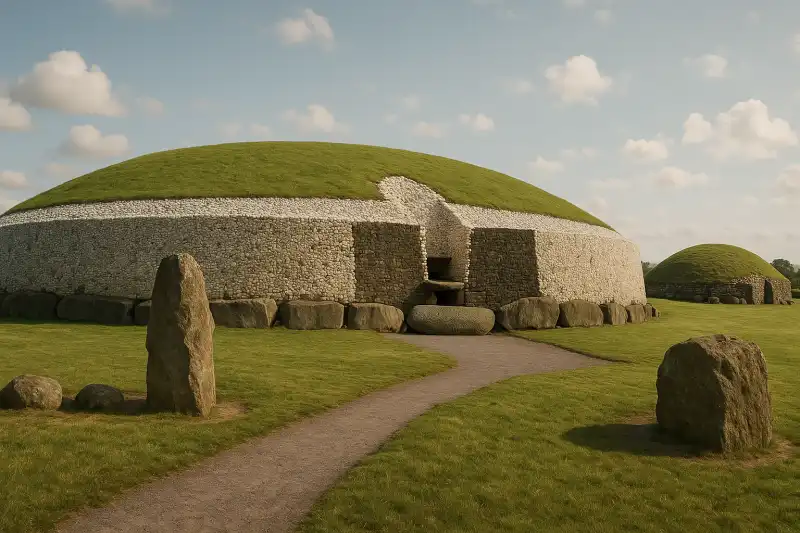
Boyne Valley Passage Tombs Travel Guide 2026: Newgrange, Knowth, and Dowth Visit Strategy
Neolithic IrelandPlan your first Boyne Valley passage tombs visit with practical timing, Brú na Bóinne access flow, a...
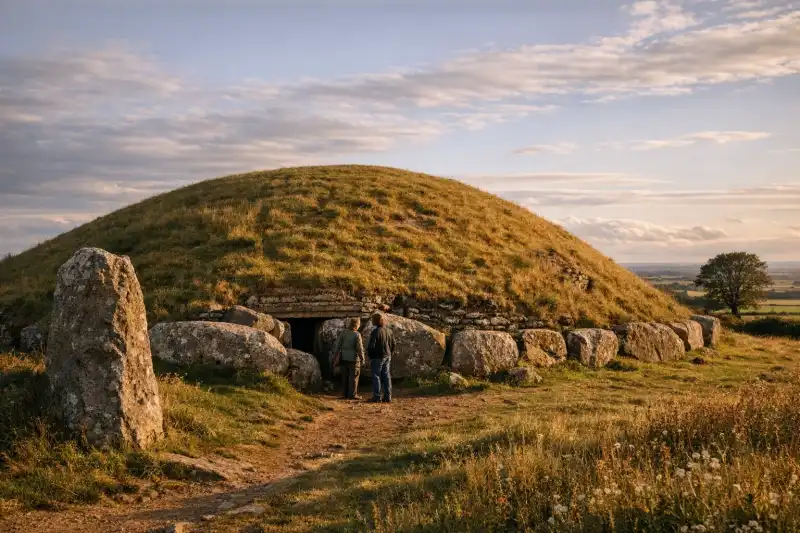
Dowth
Neolithic communities of Brú na BóinneAncient passage tomb in Ireland's Boyne Valley, famed for Neolithic art, winter light, and sweeping ...
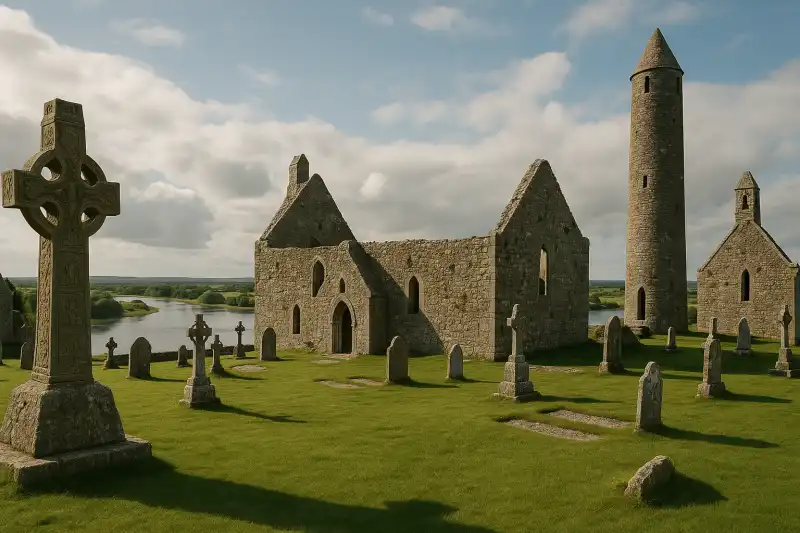
Clonmacnoise Travel Guide 2026: Monastic Ruins, High Crosses, and River Shannon Context
Early Medieval IrelandPlan a first visit to Clonmacnoise with practical timing, monastic-site context, and clear route adv...
Dublin Castle Travel Guide 2026: State Apartments, Viking Layers, and City-Center Route
Medieval and Early Modern IrelandPlan a first visit to Dublin Castle with practical timing, ticket strategy, and clear context on the...