Quick Info
At a glance
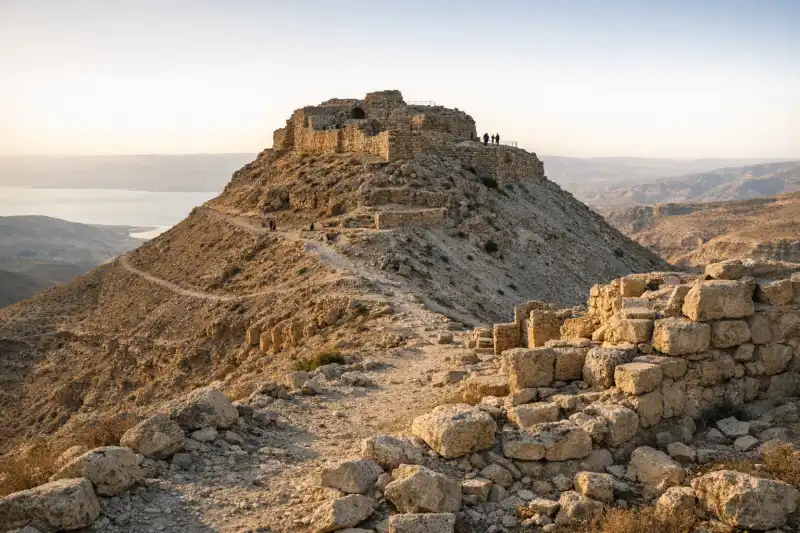
Machaerus (Mukawir) in Jordan rises from a lonely ridge above the eastern side of the Dead Sea, a place where desert silence, biblical memory, and royal politics meet in one dramatic landscape. Even before you reach the summit, the setting feels theatrical: steep ravines fall away on every side, chalky hills unfold into the hazy distance, and the blue-gray line of the Dead Sea glints below. It is easy to understand why ancient rulers chose this mountain for a fortress and palace. The position commands both attention and awe.
Today, Machaerus is one of Jordan’s most evocative archaeological sites, though it remains less crowded than many of the country’s headline destinations. Visitors come for several reasons at once. Some are drawn by its connection to Herod Antipas and the story of John the Baptist. Others come for the archaeology of a desert stronghold rebuilt in the Herodian age. Many simply want to stand on a summit where history, scripture, and topography seem inseparable. The ruined walls, terraces, and palace remains do not overwhelm with sheer size; instead, they impress through setting and atmosphere. A visit here is as much about looking outward as examining stones underfoot. The fortress crowns a mountain like an island in the sky, and from its heights Jordan’s central plateau and the Dead Sea basin feel startlingly close, as if the ancient world has not entirely receded.
History
Hasmonean origins
The earliest known fortified occupation at Machaerus dates to the late 2nd or early 1st century BCE, when the Hasmonean rulers of Judea strengthened a chain of strongholds east of the Jordan. The mountain’s natural defensibility made it an obvious military asset. Surrounded by deep wadis and approached by narrow ridges, it could be held by a relatively small force while monitoring movement across the surrounding region. In this period, frontier fortresses were not just defensive points; they also projected authority into contested landscapes where trade, taxation, and political influence mattered.
The exact early appearance of Machaerus is still reconstructed through archaeology and historical texts, but its strategic role is clear. Like other fortified sites in the Dead Sea sphere, it stood at the intersection of power, surveillance, and symbolic control. Holding Machaerus meant holding a commanding lookout over the eastern approaches to the Dead Sea.
Herod the Great’s reconstruction
After regional upheaval and the destruction of earlier defenses, Herod the Great rebuilt Machaerus in the late 1st century BCE as part of his broader program of monumental architecture. Herod was famous for transforming strongholds into refined royal complexes, and Machaerus followed that pattern. It was both fortress and palace: a place of security, but also one capable of hosting elite life with courtyards, baths, and carefully planned architecture.
Herod’s builders took advantage of the summit plateau, shaping it into a fortified enclosure while also creating a sophisticated residence. The design balanced military strength with dynastic display. The mountain itself was a defensive wall, while towers and built fortifications strengthened vulnerable points. At the same time, the palace reflected Roman-influenced luxury adapted to a desert environment.
Herod’s death in 4 BCE led to the division of his kingdom among his sons. Machaerus passed into the orbit of Herod Antipas, tetrarch of Galilee and Perea. Under Antipas, the fortress retained its political value and gained a particularly powerful place in later tradition.
Herod Antipas and John the Baptist
Machaerus is most famous from the account preserved in ancient sources linking the site to John the Baptist. According to the Jewish historian Josephus, John was imprisoned and executed at Machaerus under Herod Antipas. Christian tradition connected this event with the story of Salome’s dance and the beheading of John, making the fortress one of the most charged biblical sites in Jordan.
Whatever details one emphasizes, Machaerus was exactly the sort of place where a politically sensitive prisoner might be confined. It was secure, remote, and tied directly to the authority of Antipas. John the Baptist had become an influential preacher, and his criticism of Antipas’s marriage had political as well as moral implications. In that sense, Machaerus was not just a backdrop to a religious story. It was an active instrument of power, a place where state authority could isolate opponents and stage decisions with lasting consequences.
This association transformed the site’s legacy. Even as dynasties fell and buildings collapsed, Machaerus remained alive in memory because it linked the material world of a palace-fortress with one of the most enduring narratives of the early 1st century.
Revolt, Roman destruction, and later memory
The fortress continued into the Roman period, but the First Jewish Revolt against Rome changed its fate. In 72 CE, Roman forces under Lucilius Bassus moved against Machaerus after campaigns elsewhere in the region. Ancient accounts describe negotiations, resistance, and eventual Roman capture. As with many rebellious strongholds, the site’s military importance made it a target, and its destruction marked the end of its political role as a major fortress.
After the Roman conquest, Machaerus faded from prominence. The palace no longer functioned as a royal seat, and the summit gradually became a ruin. Yet unlike places that disappeared entirely from local awareness, Machaerus survived in textual tradition, pilgrimage interest, and regional memory under the name Mukawir. Scholars, explorers, and archaeologists in the modern era returned to identify and study the remains, correlating them with ancient descriptions.
Excavation and conservation over recent decades have clarified the plan of the site and made it more intelligible to visitors. What stands today is fragmentary, but the history of Machaerus is unusually vivid because physical remains, literary sources, and sacred tradition reinforce one another. The mountain still conveys what the ancient builders understood from the beginning: this was a place meant to dominate both landscape and imagination.
Key Features
The first great feature of Machaerus is the mountain itself. Many ancient sites impress through architecture alone, but here the topography does much of the work. The summit rises sharply from the surrounding valleys, creating a natural citadel whose isolation remains immediately obvious. As you approach, the fortress appears to float above the ridges. This drama is essential to understanding Machaerus. Its builders selected a site where nature had already begun the fortification.
Once on the summit, visitors encounter the remains of the Herodian palace-fortress spread across a relatively compact area. Rather than endless ruins, Machaerus offers a legible high place: terraces, walls, foundations, and reconstructed outlines that help you visualize the former plan. Archaeological work has identified elements of the royal complex, including a central courtyard area and spaces associated with ceremonial and domestic use. Even where only low stone courses survive, the geometry of the summit reveals a carefully organized architectural program. This was not an improvised military camp but a designed residence for a ruler operating within the political culture of the Roman East.
One of the most interesting aspects of the site is how palace and fortress overlap. The remains suggest defensive installations integrated with spaces of prestige. This combination reflects the nature of Herodian kingship. Royal life in the region was never far from military necessity, and Machaerus demonstrates that vividly. The same mountain that protected a ruler could also stage his authority. Looking over the courtyards and retaining walls, you sense how architecture controlled movement, framing who could enter, gather, or remain apart.
The panoramic views are another defining feature, and in practical terms they are among the strongest reasons to visit. On a clear day, the Dead Sea spreads below like a sheet of metal, and the surrounding hills create a layered horizon of browns, ochres, and violet-gray shadows. These views are not incidental scenery. They explain the fortress’s strategic power and enrich the emotional experience of the site. Standing at the edge of the summit, you see why Machaerus mattered to rulers monitoring Perea and the routes around the Dead Sea basin.
The approach path also forms part of the experience. Reaching the ruins requires a short but memorable ascent over exposed ground. This walk gives a sense of separation from the modern world and prepares visitors for the summit’s atmosphere. The final stretch makes the site feel earned, which suits a fortress long associated with imprisonment, royal ceremony, and dramatic historical events.
For many travelers, the biblical association remains Machaerus’s most compelling feature. The fortress is traditionally linked to the imprisonment and execution of John the Baptist, and that narrative lends unusual gravity to the stones. Even visitors who come primarily for archaeology often find that the site’s emotional power lies in this intersection of history and faith. The mountain does not offer a single preserved chamber that can be definitively pointed to as “the prison,” but that uncertainty can deepen rather than diminish the experience. It reminds you that ancient memory often attaches itself to landscapes as much as to rooms.
Finally, Machaerus stands out because it still feels quiet. Compared with Jordan’s busiest destinations, it retains a sense of remoteness. That quiet allows the site’s scale, wind, and vistas to register more fully. You are not only visiting ruins; you are entering a strategic mountain setting where the relationship between architecture and terrain remains remarkably intact. In that sense, Machaerus is less about monumental abundance than concentration: a dramatic hill, a charged story, and a fortress-palace whose setting still tells its history.
Getting There
Machaerus is usually visited by road from Amman, Madaba, or the Dead Sea area. From Amman, the drive typically takes around 1.5 to 2 hours depending on traffic and your exact route. From Madaba, expect roughly 1 hour to 1 hour 20 minutes. A private taxi from Amman for a round trip with waiting time often costs about 50 to 80 Jordanian dinars, while a day driver covering Machaerus with other sites such as Mount Nebo or the Dead Sea can range from 70 to 120 dinars. If you rent a car, fuel and flexibility make self-driving one of the easiest options, especially for travelers already exploring central Jordan.
Public transport is limited and indirect. You may be able to find service taxis or local minibuses toward nearby towns from Madaba or Amman, but schedules can be sparse and may not line up well for a same-day archaeological visit. For most international travelers, relying entirely on public transit is inconvenient unless you are comfortable with local transport logistics and flexible timing.
Road conditions are generally manageable, but the final approach involves smaller roads and a rural landscape. Signage has improved, though offline maps are still useful. Once you arrive at the visitor area, expect some walking to the site itself, including an uphill path and uneven terrain. Comfortable shoes are important. Bring water, especially in warmer months, since facilities may be limited and shade on the summit is minimal. Many visitors combine Machaerus with Bethany Beyond the Jordan, Madaba, or a Dead Sea stop to make the journey more efficient.
When to Visit
Spring and autumn are the best seasons to visit Machaerus. From March to May, the temperatures are usually pleasant, the air can be clearer, and the surrounding hills sometimes show brief seasonal greenery that softens the desert palette. September through November also offers comfortable conditions, with warm days but less punishing heat than midsummer. These shoulder seasons are ideal if you want to enjoy the walk up to the fortress and spend time at the viewpoints without feeling rushed by the sun.
Summer visits are possible, but they require planning. From June through August, midday temperatures can become intense, and the summit is exposed with little natural shade. If you visit in summer, aim for early morning or late afternoon. Carry more water than you think you need, wear a hat, and avoid treating the site as a quick stop where preparation does not matter. Even a relatively short uphill walk feels much harder under direct sun.
Winter can be atmospheric, especially when cooler air sharpens the Dead Sea views, but conditions vary. Some days are crisp and beautiful, while others can be windy, chilly, or hazy. Rain is less common than in greener parts of Jordan, yet slippery paths and reduced visibility are possible after bad weather. The best time of day year-round is usually morning, when temperatures are lower and the light across the ridges is especially striking. Late afternoon can also be rewarding for photography, with softer light and long shadows that emphasize the fortress’s contours.
| Quick Facts | Details |
|---|---|
| Location | Mukawir, Madaba Governorate, Jordan |
| Site Type | Hilltop fortress and palace complex |
| Historical Period | Late Hellenistic, Herodian, Roman |
| Best Known For | Association with Herod Antipas and John the Baptist |
| Elevation Experience | Summit reached by a short uphill walk |
| Typical Visit Length | 1.5 to 3 hours |
| Best Season | Spring and autumn |
| Closest Useful Base | Madaba or Amman |
| What to Bring | Water, sun protection, sturdy shoes, camera |
| Combine With | Dead Sea, Madaba, Mount Nebo, Bethany Beyond the Jordan |
Machaerus rewards travelers who enjoy places where landscape is inseparable from history. It is not Jordan’s largest ruin, nor its easiest site to fit into a rushed itinerary, but it offers something rarer: a strong sense of ancient purpose still written into the land. The mountain, the palace remains, and the Dead Sea views all reinforce one another. Add the site’s biblical associations and the result is a destination that feels unusually layered. Whether you arrive as a history enthusiast, a pilgrim, or a traveler seeking quieter archaeological experiences in Jordan, Machaerus leaves a lasting impression because it remains what it always was: a high, dramatic place where power, memory, and isolation came together.
Guided tours: worth it?
Self-guided works here, but a guide can add real value if you want the ruins explained as a living place rather than just a sequence of monuments.
Best for
- First-time visitors who want context, not just photos
- Short visits where a planned route saves time
When to go self-guided
Go independently if you prefer setting your own pace, reading as you go, and checking official hours or ticket rules directly before you arrive.
What I’d avoid
Skip paid tours that bundle unrelated stops you do not actually want. The best option should either save meaningful planning time or add historical context you would miss on your own.
Machaerus Mukawir Jordan tours
Useful when: you want to compare guided formats before deciding
Madaba and Machaerus day tours
Useful when: you want to compare guided formats before deciding
Dead Sea and Machaerus tours
Useful when: you want to compare guided formats before deciding
Some tour links are affiliate links, which may earn Ancient Travel a small commission at no extra cost to you. I try to surface options that make practical sense for the site—not just anything bookable.
Frequently Asked Questions
What is Machaerus (Mukawir) known for?
Machaerus is best known as the hilltop fortress associated with Herod Antipas and, in later Christian tradition, the imprisonment and execution of John the Baptist.
Where is Machaerus located?
Machaerus, also called Mukawir, is in central Jordan in Madaba Governorate, east of the Dead Sea and south-west of Madaba.
How long should I spend at Machaerus?
Most visitors spend 1.5 to 3 hours exploring the approach path, summit ruins, viewpoints, and interpretation areas.
Is Machaerus difficult to visit?
The site is manageable for many travelers, but it involves uphill walking on uneven ground and limited shade, so sturdy shoes and water are important.
Can I visit Machaerus on a day trip from Amman?
Yes. Machaerus is commonly visited as a day trip from Amman, often combined with Madaba, Mount Nebo, the Dead Sea, or Bethany Beyond the Jordan.
What should I bring to Machaerus?
Bring water, sun protection, comfortable walking shoes, and a camera, as the site is exposed and the views across the Dead Sea region are exceptional.
Nearby Ancient Sites
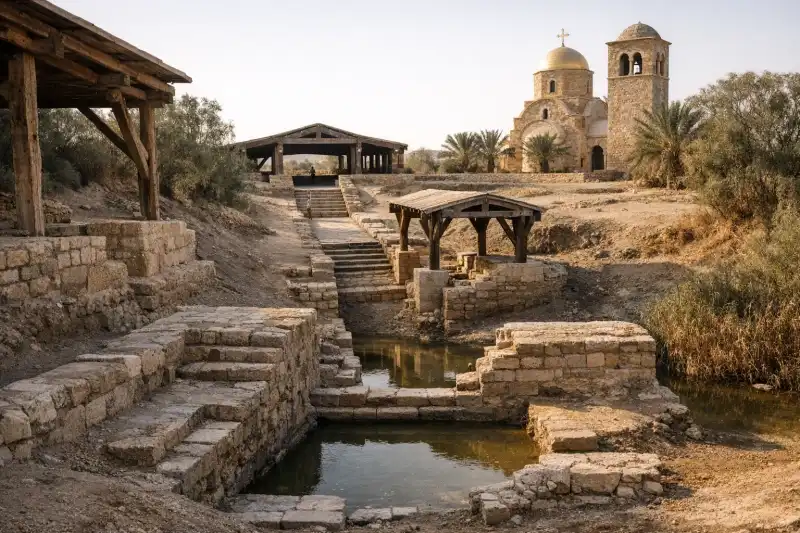
Bethany Beyond the Jordan
Bethany Beyond the Jordan in Jordan is an archaeological and religiously significant site believed t...
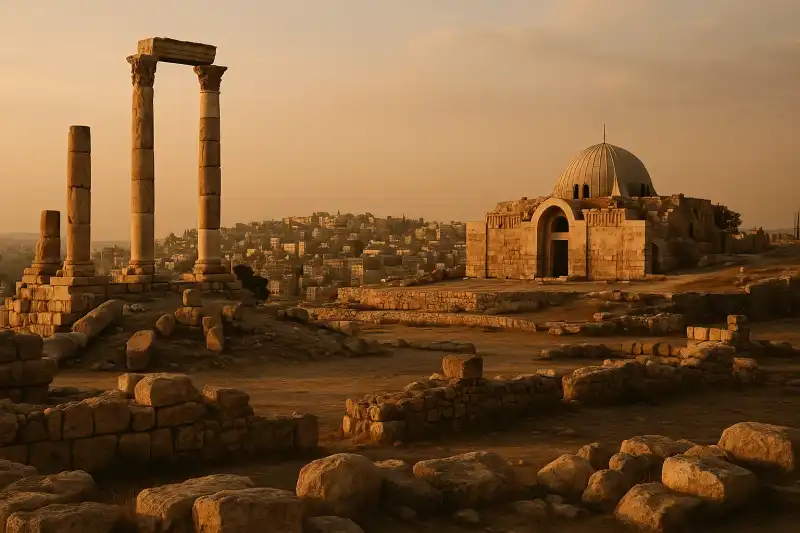
Amman Citadel Jordan Guide 2026: Temple of Hercules & Ancient Rabbah
Ammonite-Roman-UmayyadExplore Jordan's ancient citadel overlooking modern Amman. Discover the Temple of Hercules, Umayyad ...
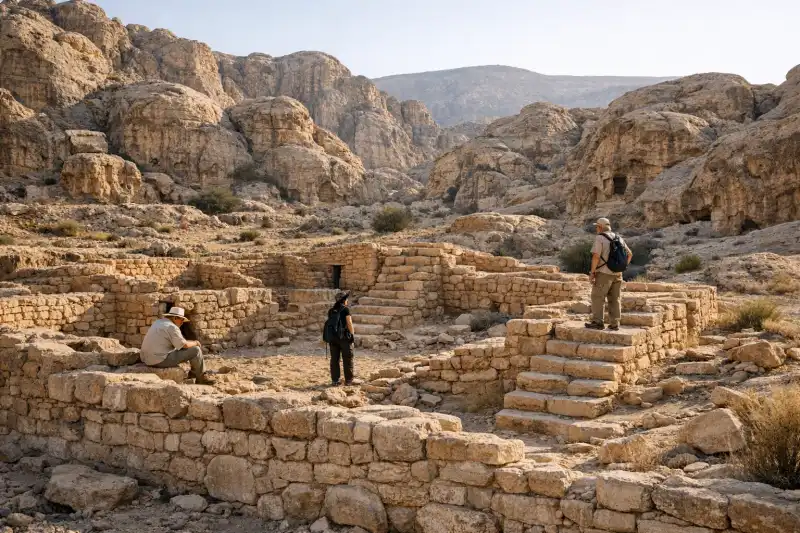
Beidha
Pre-Pottery Neolithic communities of the southern LevantExplore Beidha, a remarkable Neolithic village near Petra in Jordan, known for early farming, stone ...