Quick Info
At a glance
Beidha, Jordan, sits in a rugged landscape of sandstone outcrops and dry valleys just beyond the better-known wonders of Petra. At first glance, it may seem understated compared with the grand façades and rock-cut tombs nearby, yet this small archaeological site preserves something even older and in many ways more foundational: the traces of one of the earliest settled communities in the southern Levant. Here, long before Nabataean caravans crossed the desert, people were building homes, organizing village life, experimenting with farming, and reshaping the human relationship with the land.
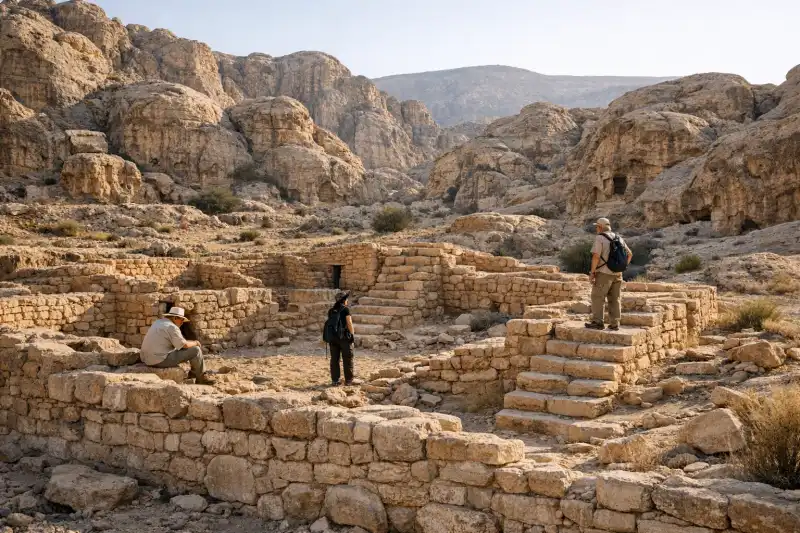
The setting contributes much of Beidha’s quiet power. The site lies in an arid basin framed by pale rock and broken ridges, where the desert light sharpens every contour. Unlike monumental ruins that overwhelm with scale, Beidha rewards slow attention. Low walls, circular and rectangular house plans, and excavated living spaces reveal a story of daily life rather than imperial ambition. This was a place of hearths, storage, work, and community. For travelers exploring southern Jordan, especially those already visiting Petra and Little Petra, Beidha offers a deeper timeline and a very different kind of encounter with the past. It is not simply an ancient site near a famous destination; it is a rare window into the Neolithic world, when settled life was still new and the routines that would shape later civilization were only beginning to take form.
Plan a wider route: Read the Little Petra guide for nearby Nabataean rock-cut spaces, or the Petra guide for the main archaeological site. Our 10-day Jordan itinerary treats Beidha as an optional Day 8 stop alongside Little Petra, with the main Petra visit the following day. The official Petra site descriptions distinguish Beidha’s Neolithic village from those later Nabataean monuments.
History
Early settlement in the Pre-Pottery Neolithic
Beidha is best known as a major settlement from the Pre-Pottery Neolithic period, with occupation beginning around the 8th millennium BCE. This places it among the early communities that emerged in the Near East during a crucial transition in human history: the shift from mobile foraging to more permanent village life. The people who lived at Beidha occupied a landscape that was challenging but strategically valuable, with access to local resources, grazing zones, and routes through the highlands around what is now Petra.
Archaeological evidence suggests that the earliest inhabitants built circular structures, a form often associated with early Neolithic communities across the Levant. These houses were modest but deliberate, constructed with stone foundations and superstructures likely made of lighter materials. Their shape hints at continuity with older traditions, when communities were becoming more settled but had not yet fully adopted the rectilinear architecture that would later dominate village planning. Beidha’s earliest phases therefore capture a society in transition, balancing inherited ways of living with new forms of permanence.
From village experiment to organized community
Over time, Beidha developed into a more complex settlement. One of the most important changes visible in the archaeology is the transition from round houses to rectangular buildings. This was not simply an architectural preference. Rectilinear layouts made it easier to divide interior space, add storage, and organize households in ways that reflected increasingly structured social and economic life. At Beidha, these changes suggest a community becoming more confident in permanent settlement and more invested in long-term occupation.
Excavations have revealed evidence for domestic activity, storage, tool production, and communal organization. This indicates that the village was not a temporary camp but a functioning, socially coordinated settlement. The people of Beidha likely cultivated early crops and managed animal resources while still relying to some degree on hunting and gathering. In this sense, the site represents neither a purely agricultural village nor a purely foraging camp, but a mixed economy during a period of profound experimentation.
The village also sheds light on social relationships in the Neolithic. Houses were often clustered in ways that imply neighborhood units or family-based occupation. Shared spaces and repetitive building techniques suggest communication and collective planning. Beidha was part of a wider regional pattern of Neolithic life, yet it developed with local characteristics shaped by the landscape of southern Jordan.
Abandonment and changing lifeways
Like many early settlements, Beidha was not occupied continuously forever. Archaeologists believe the site went through different phases and was eventually abandoned, likely due to a combination of environmental, economic, and social factors. Neolithic communities were highly sensitive to shifts in climate, access to water, and the long-term sustainability of local resources. Even a settlement that had succeeded for generations could become difficult to maintain.
The abandonment of Beidha should not be seen as failure so much as part of a broader pattern of adaptation. Prehistoric communities in the Levant often shifted location, reorganized, or changed subsistence strategies as conditions evolved. What matters historically is that Beidha records a chapter in this larger story: the testing of settled life in a marginal but connected landscape.
Rediscovery and archaeological significance
Modern archaeological work at Beidha transformed the site into one of Jordan’s most important prehistoric locations. Excavations in the 20th century documented houses, occupation layers, hearths, artifacts, and architectural transitions that have made Beidha central to the study of early village life in the Near East. The findings helped scholars compare southern Jordan’s Neolithic communities with better-known sites elsewhere in the Levant and Anatolia.
Today, Beidha is especially valuable because it complements Jordan’s more famous classical and biblical-era places with a much older chronology. It reminds visitors that the country’s human story extends far beyond Nabataean Petra, Roman Jerash, or Crusader castles. In Beidha, the past reaches back to the dawn of settled society itself, preserving evidence of people who were among the earliest to build enduring homes and reshape their environment in lasting ways.
Key Features
What makes Beidha memorable is not grandeur but intimacy. The site’s remains are low to the ground, and that very modesty is part of their significance. Visitors are looking directly at the footprint of one of the earliest experiments in village living. The foundations of houses, some circular and others rectangular, are among the most important features. They illustrate a key transition in prehistoric architecture and social organization. Standing among these outlines, it becomes easier to imagine households forming around storage, cooking, sleeping, and shared labor rather than temporary shelter alone.
The circular structures are especially evocative because they feel ancient in a very immediate way. Their plans suggest a community still close to earlier traditions of building, before the widespread adoption of angular rooms and more segmented domestic space. The later rectangular buildings tell a different story. They imply evolving concepts of property, planning, and interior function. For anyone interested in archaeology, this contrast is one of Beidha’s great strengths: the site does not merely preserve buildings, it preserves change.
Another defining feature is the village layout itself. Although time and erosion have reduced the remains, the organization of the settlement can still be read in the arrangement of structures and spaces between them. This was not random occupation. The houses suggest a community with shared knowledge of construction and patterns of everyday life. There is a sense of neighbors living in relation to one another, of activity moving between homes and outdoor work areas, of routines repeated over many seasons. Beidha’s importance lies as much in these spatial relationships as in any single structure.
The surrounding landscape is also integral to the site. Beidha sits near the Petra region’s broken sandstone environment, where dry valleys, escarpments, and desert vegetation frame the archaeological remains. This setting helps visitors understand both the opportunities and constraints faced by Neolithic inhabitants. Water management, food production, grazing, and movement across the terrain would all have shaped life here. The village was not isolated from nature; it was embedded in a delicate ecological balance. Looking out across the hills, it becomes easier to appreciate the ingenuity required to settle this environment thousands of years ago.
Excavated features such as hearths, storage areas, and work spaces contribute further depth. These traces may seem subtle compared with standing temples or palaces, but they are precisely what make Beidha so human. They speak of meals prepared, tools fashioned, resources stored against uncertainty, and decisions made within households. Archaeology at Beidha has also produced artifacts that illuminate daily life, including stone tools and material evidence for subsistence activities. Even when these objects are not all visible on site, the physical context of the village gives them meaning.
For many travelers, Beidha’s quiet atmosphere becomes one of its most distinctive qualities. It lacks the crowds and drama of Petra, allowing a more reflective visit. The site invites imagination, but not fantasy; its remains are grounded, practical, and closely tied to the realities of survival and community. Rather than monumental power, Beidha conveys endurance, adaptation, and the beginnings of settled society. That makes it an ideal companion to nearby Little Petra and Petra itself: together, these places present different eras of Jordan’s long history, from the Neolithic to the Nabataean world, all within the same wider landscape.
Getting There
Beidha is easiest to reach from Wadi Musa, the town that serves as the main base for visiting Petra. By car or taxi, the journey usually takes around 15 to 25 minutes depending on your starting point and traffic. A local taxi from central Wadi Musa to Beidha typically costs about 10 to 20 Jordanian dinars one way, though it is wise to agree on the fare before departure. If you want the driver to wait while you visit or combine Beidha with Little Petra, the total may be closer to 25 to 40 dinars.
Self-driving is the most flexible option. Roads in the Petra region are generally straightforward, and rental cars are common for travelers exploring Jordan independently. Parking conditions can vary, but access is usually manageable for standard vehicles. If you are coming from Amman, expect a drive of roughly three to three and a half hours, with rental car costs varying widely but often starting around 25 to 40 dinars per day before fuel and insurance. From Aqaba, the drive is usually around two hours.
Some travelers visit Beidha as part of a guided Petra-region itinerary. Private day tours from Amman or Wadi Musa often include transport and a driver, sometimes with a guide, and prices can range from around 70 dinars for basic local arrangements to well over 150 dinars for private full-day services. Public transport is limited for reaching the site directly, so buses are best used only to get to Wadi Musa first. From there, taxi or private car is the practical choice.
When to Visit
Spring and autumn are the best times to visit Beidha. From March to May, temperatures are usually pleasant, wildflowers may appear in parts of the Petra region, and the light is excellent for walking and photography. September through November also offers comfortable conditions, with warm days and cooler mornings and evenings. These seasons make it easier to appreciate the site without the fatigue that can come from Jordan’s peak summer heat.
Summer visits are possible, but midday conditions can be intense. The exposed landscape around Beidha provides limited shade, so early morning is strongly recommended from June through August. Bring water, a hat, sunscreen, and sturdy shoes. Heat can flatten the subtle details of the ruins, while low-angle morning or late-afternoon light makes walls and features easier to read.
Winter can be surprisingly appealing for visitors who prefer cooler weather and fewer people. Daytime temperatures are often comfortable for walking, but mornings can be cold, and rain or occasional harsher weather may affect conditions in the Petra highlands. The site’s desert setting means temperatures can shift quickly, so layered clothing is useful.
Whenever you go, it is worth pairing Beidha with Little Petra on the same day and leaving Petra for either the previous or following day. Beidha is best appreciated when you have enough time and energy to slow down and notice subtle archaeological details. Visiting early, especially outside the busiest Petra hours, gives the site its strongest sense of stillness and space.
| Quick Facts | Details |
|---|---|
| Location | Near Petra and Little Petra, southern Jordan |
| Governorate | Ma’an Governorate |
| Nearest City | Wadi Musa |
| Period | Pre-Pottery Neolithic |
| Earliest Occupation | c. 7200 BCE |
| Known For | Early settled village life, stone house foundations, transition from round to rectangular architecture |
| Best For | Archaeology enthusiasts, Petra-region travelers, prehistoric history |
| Typical Visit Length | 45 minutes to 1.5 hours |
| Best Season | Spring and autumn |
| Access | Best reached by taxi, rental car, or guided tour from Wadi Musa |
Beidha may not announce itself with towering ruins or famous façades, but that is exactly why it deserves attention. It tells a story from far deeper in time, when settled life was fragile, innovative, and still being invented. In the shadow of Petra’s later splendor, this Neolithic village offers an earlier vision of human community: practical, experimental, and enduring. For travelers interested in how civilization begins—not in legend, but in houses, hearths, and shared spaces—Beidha is one of Jordan’s most quietly profound destinations.
Guided tours: worth it?
A guide can be genuinely useful at Beidha, especially if you want help with transport, timing, tickets, or understanding a large site without losing half the day to logistics.
Best for
- Travelers who want transport, timing, or entry logistics handled
- Trips where tickets, circuits, or timed entry can shape the day
- Short visits where a planned route saves time
When to go self-guided
Go independently if you already have transport and tickets sorted, enjoy moving at your own pace, and are comfortable checking the latest official rules before you arrive.
What I’d avoid
Skip paid tours that bundle unrelated stops you do not actually want. The best option should either save meaningful planning time or add historical context you would miss on your own.
Petra and Little Petra Tours
Useful when: you want to compare guided formats before deciding
Wadi Musa and Petra Day Trips
Useful when: transport or pickup logistics matter
Jordan Archaeology and Petra Tours
Useful when: you want to compare guided formats before deciding
Some tour links are affiliate links, which may earn Ancient Travel a small commission at no extra cost to you. I try to surface options that make practical sense for the site—not just anything bookable.
Frequently Asked Questions
What is Beidha?
Beidha is an important Neolithic archaeological site in southern Jordan, near Petra, where archaeologists uncovered one of the region's earliest settled farming communities.
How far is Beidha from Petra?
Beidha lies just north of Petra and close to Little Petra, making it an easy stop when exploring the wider Petra region from Wadi Musa.
Why is Beidha historically important?
It preserves evidence of the transition from mobile hunter-gatherer life to settled village life, including early architecture, communal spaces, and farming practices.
Can you visit Beidha independently?
Yes, many travelers visit independently by car or taxi from Wadi Musa, though a guide can help explain the site's Neolithic remains, which are less visually obvious than Petra's monuments.
How much time should I spend at Beidha?
Most visitors spend 45 minutes to 1.5 hours at Beidha, depending on their interest in archaeology and whether they combine it with Little Petra.
Is Beidha suitable for casual visitors?
Yes, but it is best appreciated by travelers interested in early human history, as the site consists mainly of foundations and excavated remains rather than standing monumental buildings.
Nearby Ancient Sites
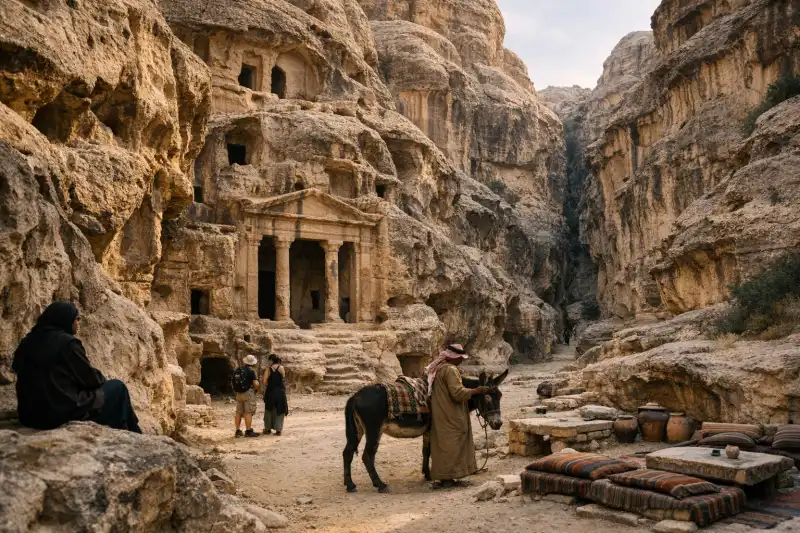
Little Petra (Siq al-Barid)
Discover the Nabataean rock-cut marvel of Little Petra (Siq al-Barid) in Jordan, a hidden archaeolog...
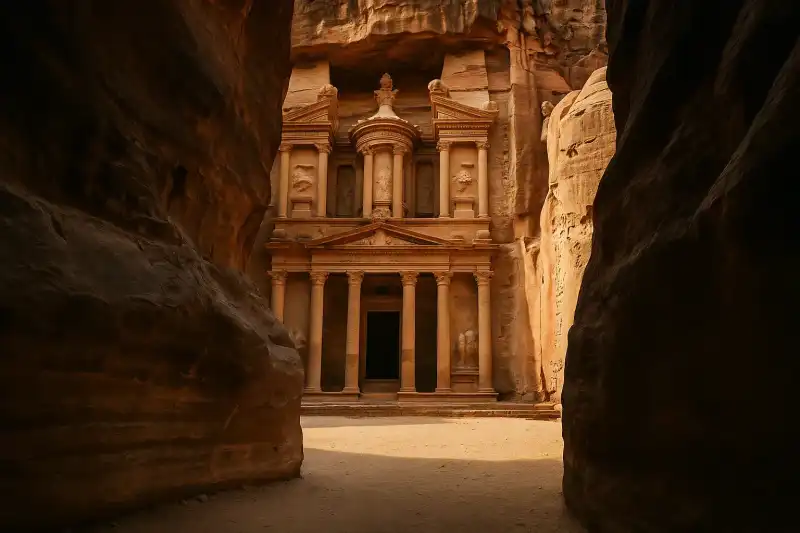
Petra Jordan Travel Guide: Treasury, Monastery & Best Hikes
NabataeanUnlock the secrets of Petra with our comprehensive guide. Walk the Siq to the Treasury, hike to the ...