Quick Info
Curated Experiences
Magnesia Temple of Artemis Tour from Söke
Caria Ancient Cities Multi-Day Tour
Remote Turkish Archaeological Sites Tour
Quick Facts
- Location: Remote mountains near Söke, southwestern Caria
- Best for: Temple architecture enthusiasts, quiet archaeology, mountain views
- When to visit: April-June, September-October
- Entry fee: Around 60 Turkish Lira
- Crowds: Very low - one of Turkey’s most isolated major sites
- What to see: Temple of Artemis, sanctuary precinct, theater remnants, marble fragments
A Sanctuary in the Mountains
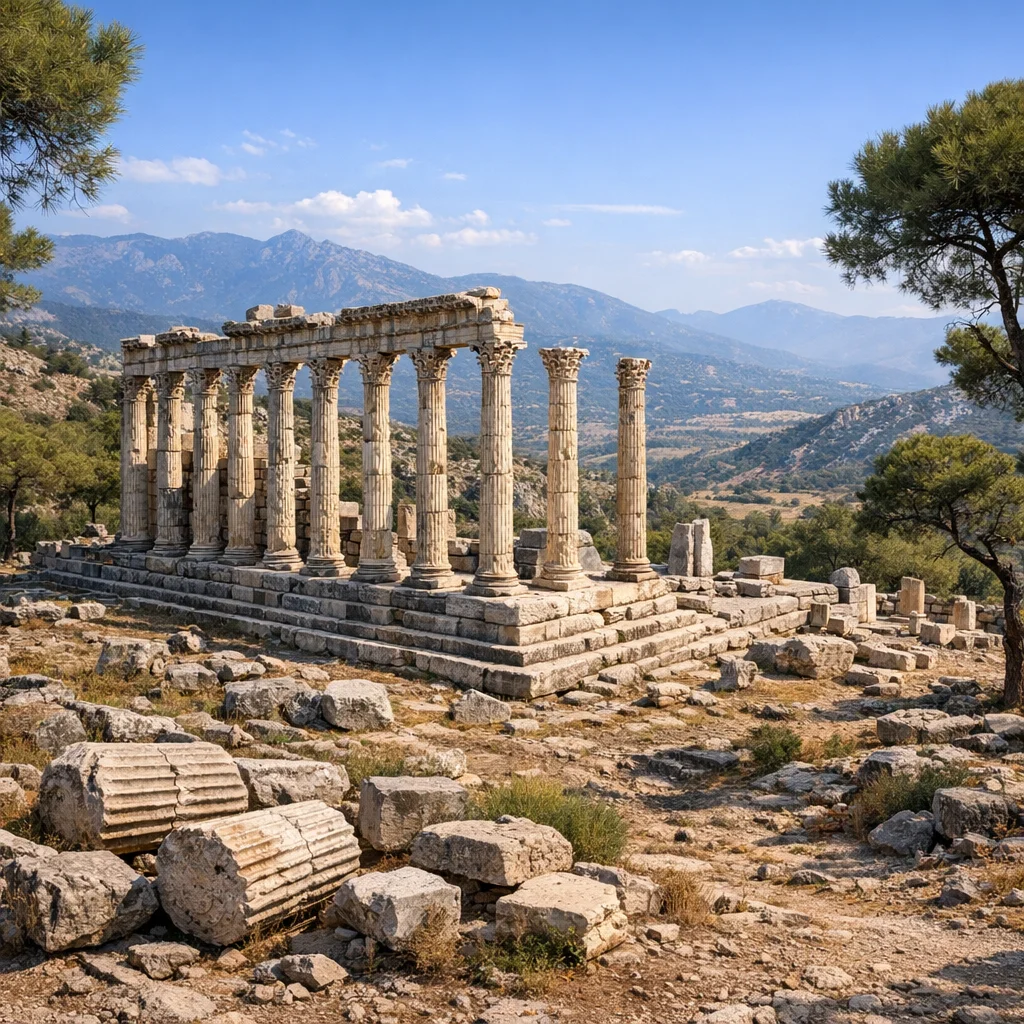
You navigate narrow roads into increasingly remote mountains near Söke, passing through villages that seem untouched by tourism. The landscape grows wilder: pine forests, stone walls, shepherd paths. Then, abruptly, you emerge into a plateau and see it: a marble temple rising impossibly from the wilderness, its columns still upright, its proportions perfect, its survival against all odds a testament to its quality and isolation.
Magnesia ad Maeandrum (Magnesia on the Maeander River) is one of Turkey’s most remarkable archaeological sites, rarely visited because it’s difficult to reach and widely unknown even among serious archaeology travelers. Yet the temple of Artemis stands as one of the finest Hellenistic temples anywhere—comparable in architectural significance to far more famous sites.
The Temple of Artemis
The temple is what brings you to Magnesia, and it rewards the effort of reaching this remote location. Designed by the famous architect Hermogenes in the 2nd century BCE, the temple is a masterclass in Hellenistic architectural proportion and refinement. It’s smaller than the great temples of Ephesus or Pergamon, but the proportion and detail are arguably superior.
The temple has eight columns on the short sides and fifteen on the long sides—a layout called “octastyle.” The columns are Corinthian, carved with the elaborate acanthus-leaf capitals that characterize the Hellenistic style at its most refined. The entablature is carved with precision, and fragments of sculptural decoration remain—testament to the skills of the craftspeople who built this temple.
What makes Magnesia’s temple exceptional is its proportions. Hermogenes was a mathematician as well as an architect, and the temple reflects calculated ratios and harmonies. The width-to-length relationship, the column height-to-diameter relationship, the space between columns—all follow mathematical principles designed to create visual harmony. Stand in front of the temple and you feel that harmony physically, even if you don’t understand the mathematical principles behind it.
The Cult of Artemis
The temple was dedicated to Artemis, the goddess of the hunt and the protector of cities. Artemis maintained several major cult centers around the Mediterranean—but Magnesia was not among the most famous. Yet the investment in a marble temple designed by a celebrated architect suggests that Magnesia’s Artemis cult was significant to the Carian population.
Pilgrimages brought offerings and income. The sanctuary probably hosted festivals and contests. Craftspeople and merchants profited from pilgrims’ needs. But the primary purpose was religious—the belief that Artemis was present here in a particular way, that her sanctuary deserved the best architecture that human skill and resources could produce.
The Sanctuary Precinct and Town
Beyond the temple, you can trace the boundaries of the sanctuary precinct—the sacred zone surrounding the religious center. Walls, gates, and foundation stones indicate administrative and commercial buildings that served pilgrims. The sanctuary was not simply a temple but a landscape designed for ritual and worship.
Below the sanctuary, the city of Magnesia developed. A theater, now mostly ruined, occupies a nearby hillside. Scattered foundations indicate residential and commercial areas. The city was prosperous enough to build in marble and stone, to hire famous architects, to participate in broader Mediterranean trade networks.
But Magnesia never achieved the prominence of Pergamon or Miletus. It remained a secondary city—significant enough for investment in magnificent architecture, but not important enough to preserve detailed historical records or maintain continuous settlement into later periods.
Decline and Abandonment
Like many inland Carian cities, Magnesia declined as trade routes shifted toward coastal ports. The economic basis for supporting a city in the mountains eroded. Over centuries, the population moved away. The city was abandoned. Only the temple, built to last, survived.
Medieval travelers occasionally noted the temple’s existence. But until archaeological work began in the 19th century, Magnesia was largely forgotten—which is precisely why it survived. Cities that remained important were continuously rebuilt and modified. Magnesia, abandoned and remote, was left alone.
Visiting Magnesia
Access: Magnesia is reached from Söke, a town on the coast. From Söke, it’s a 30-40 kilometer drive into the mountains—narrow roads, minimal signage. A local guide or detailed directions are essential. Most travel from Söke should take 45 minutes to over an hour depending on road conditions.
Best time: April-June or September-October. Summers are hot in the lowlands but cooler at elevation; winters can bring rain and occasional snow.
Duration: 1-2 hours to explore the temple and sanctuary precinct. The isolation and beauty reward longer visits.
Physical demands: Moderate. The site is on a hillside with uneven terrain. Comfortable shoes are essential.
Facilities: None at the site. Bring water, sun protection, and supplies.
What to bring: Water, sun protection, comfortable walking shoes, camera for the remarkable light and views.
Photography: The mountain setting and stone temples photograph beautifully. Late afternoon light casts dramatic shadows. Wide-angle lenses capture the isolation and landscape context.
Connecting to Other Carian Sites
Magnesia should be part of a broader exploration of Caria’s temple culture. Euromos, another Carian sanctuary with a marble temple, offers a different architectural approach to similar problems. Stratonikeia shows how Carian cities developed civic institutions alongside religious ones. Together, these sites show how interior Caria supported significant cultural and religious life despite the prominence of coastal port cities.
The Solitude of Architectural Excellence
Magnesia teaches that great achievement often occurs far from centers of power. A remote Carian city invested in hiring the finest architect of the age to design a temple of mathematical proportion and visual refinement. Why? Because Artemis was worshipped here. Because the community believed her presence was worth the expense. Because human beings, regardless of geography, create beauty.
The temple stands alone now, surrounded by mountains, visited by few. But its proportions remain perfect. Its architecture remains sophisticated. The mathematics that governed its design still create visual harmony. Hermogenes succeeded in creating something that endures and speaks across two thousand years.
Magnesia rewards the effort of reaching it. You stand before marble columns carved with precision, carved to last, and you understand that ancient civilizations were capable of extraordinary achievement in circumstances far less advantageous than those that produced the famous sites.
The remoteness is not a disadvantage. It’s an advantage—it means Magnesia survives nearly unchanged, allows you to encounter ancient architecture on its own terms, not mediated by tourism infrastructure or historical narratives. You bring only your own capacity to witness and understand.
Hermogenes and Hellenistic Architecture
The Temple of Artemis at Magnesia was designed by Hermogenes, one of the most celebrated architects of the Hellenistic period. Hermogenes was not merely a skilled builder but a theorist of architecture who developed systematic principles of proportion and harmony. His surviving works, though few, are celebrated for their mathematical sophistication and visual refinement.
Hermogenes’ approach to architecture was innovative. He experimented with column proportions, with the relationships between structural elements, and with the overall proportions of buildings. The temple at Magnesia demonstrates these principles in practice. The columns are perfectly proportioned, the spacing between columns creates visual rhythm, the relationships between different elements follow mathematical ratios that create harmony.
This mathematical approach to architecture was not arbitrary but deliberate and conscious. Hermogenes wrote about architecture, developing theories that influenced later architects and theorists. His work at Magnesia exemplifies these principles, creating a structure that feels not merely functional but harmonious, proportioned according to principles that the eye recognizes as beautiful even if the viewer doesn’t understand the mathematical ratios underlying the beauty.
The Decline and Abandonment
Magnesia’s decline is instructive for understanding ancient economic history. The city never suffered conquest or disaster. Rather, it gradually lost economic importance as trade patterns shifted and political authority reorganized. The expense of maintaining a prosperous city in the mountains became unjustifiable when resources could be devoted to coastal ports where maritime trade was more profitable.
The abandonment was slow and gradual, not sudden. Population declined over centuries as people migrated to coastal cities or different regions. Eventually the city was largely deserted, though local shepherds may have continued using the area. The temples, no longer actively used for worship, weathered and declined. Yet the quality of construction meant they endured, standing as monuments to past prosperity.
Nearby Ancient Sites
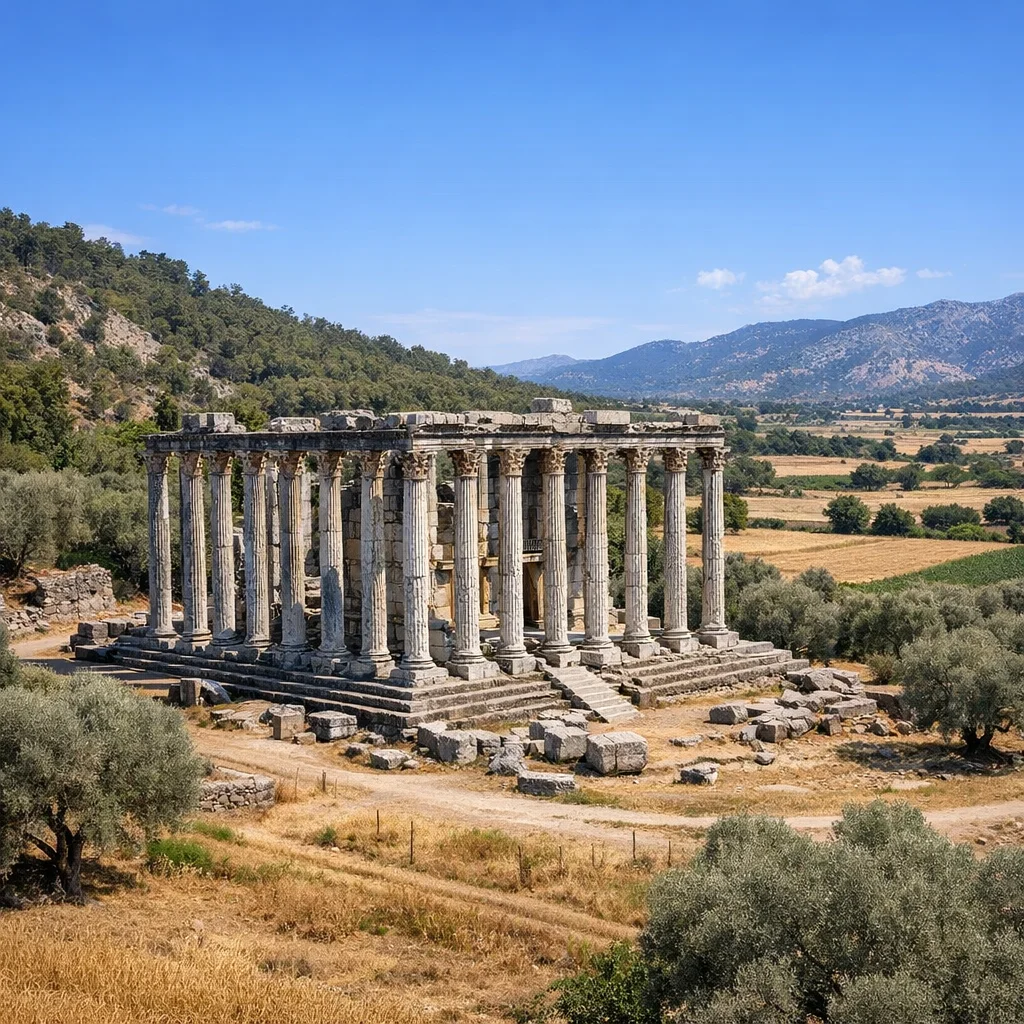
Euromos Turkey Travel Guide: Marble Temple in the Wilderness
Carian, Hellenistic, RomanDiscover Euromos, a remote Carian city with one of Turkey's finest standing marble temples in the mi...
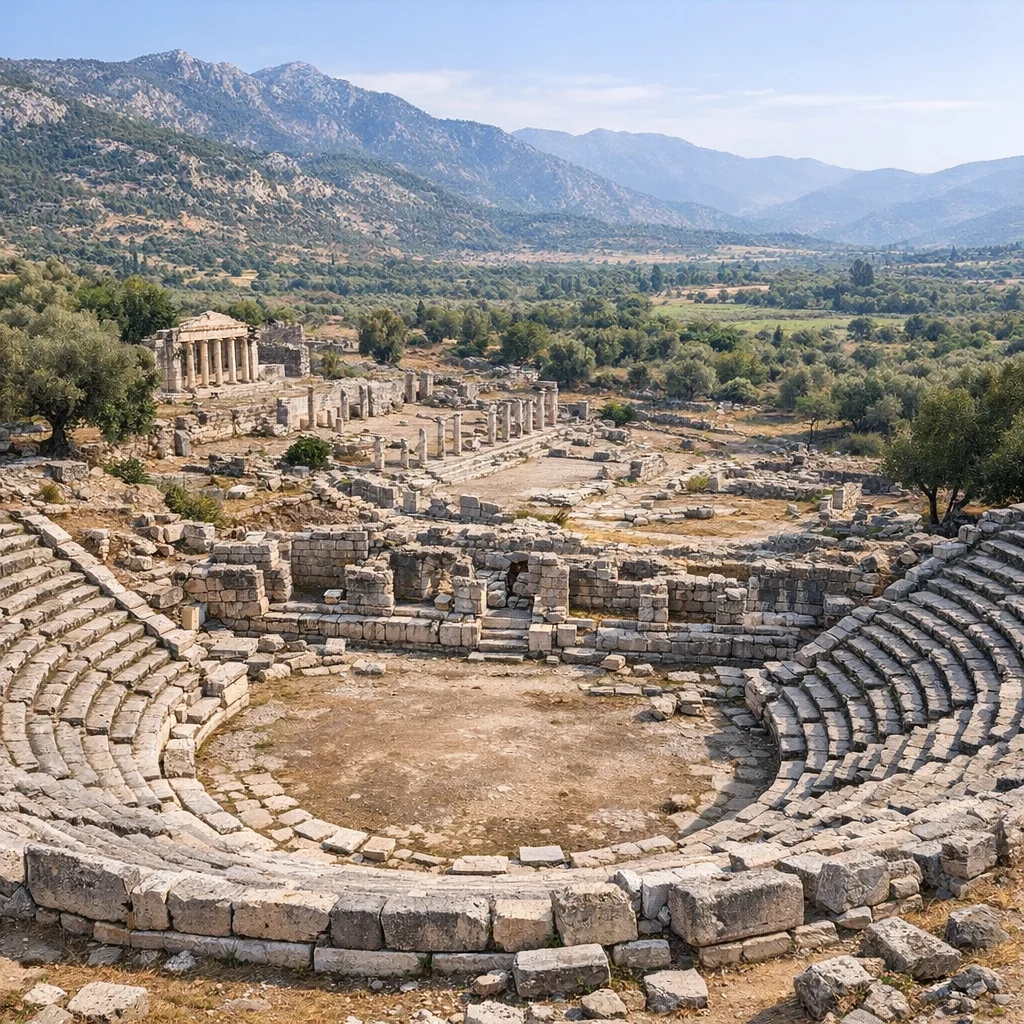
Stratonikeia Turkey Travel Guide: Carian City & Theater Ruins
Carian, Hellenistic, RomanExplore Stratonikeia, a prosperous Carian city with well-preserved theater, civic monuments, and a t...
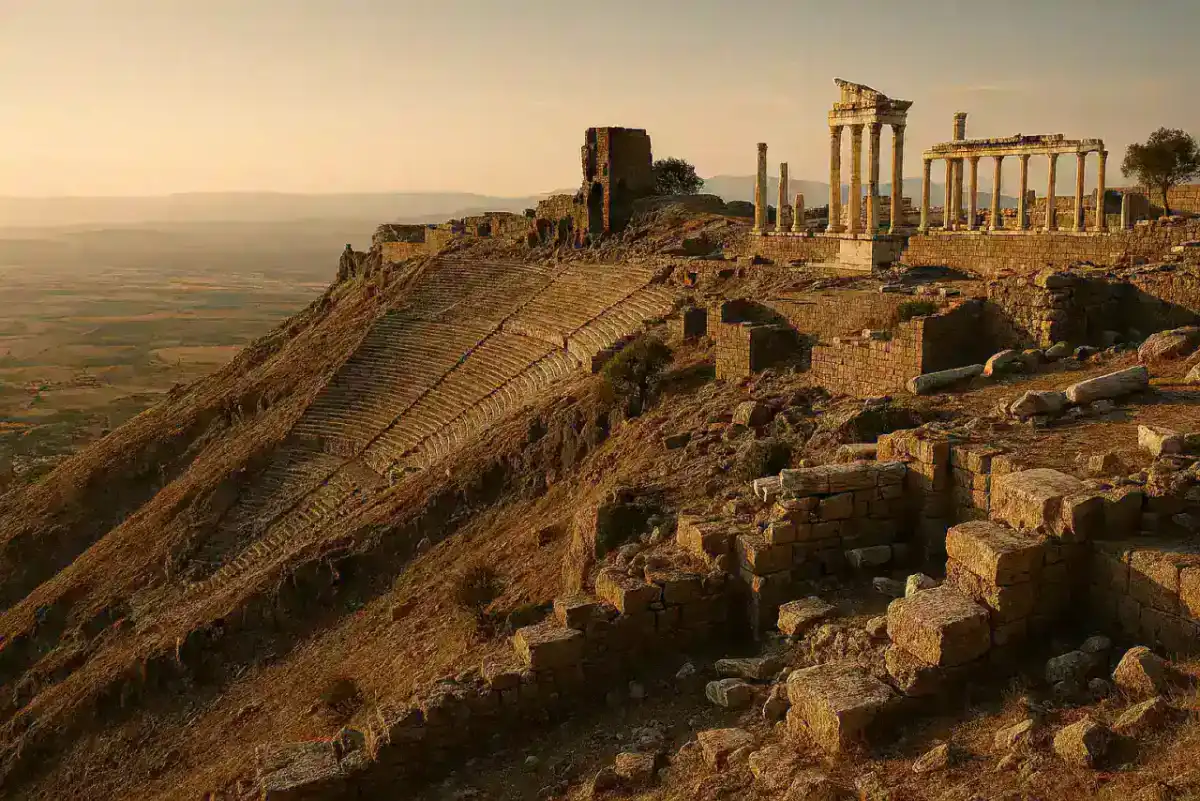
Pergamon Turkey Travel Guide: Ancient Acropolis & Library
Explore Pergamon, one of Turkey's greatest ancient cities. A hilltop acropolis with temples, theater...