Quick Info
At a glance
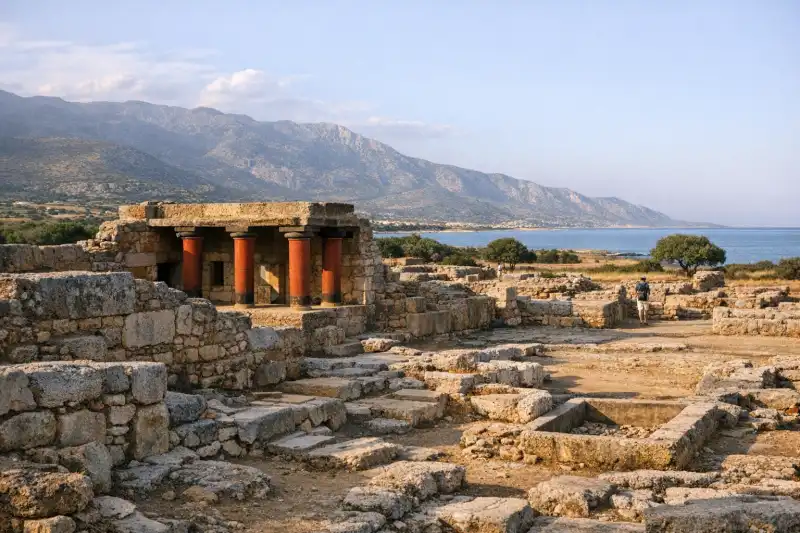
Malia Palace in Greece sits just inland from the north coast of Crete, where low stone walls, broad courts, and the outlines of storerooms still hold the shape of a Bronze Age world. Compared with more famous Minoan sites, Malia often feels quieter and more spacious, allowing visitors to read the ruined architecture with fewer distractions. The sea is close, the mountains rise in the distance, and the dry Cretan light makes every threshold, paving slab, and column base stand out sharply. Walking here, it is easy to imagine the rhythms of a palace center that was not only ceremonial but also administrative, economic, and deeply connected to the surrounding landscape.
This was one of the great palatial sites of Minoan Crete, alongside Knossos, Phaistos, and Zakros. Yet Malia has a character all its own. Its remains are less dominated by modern reconstruction, so the experience is often more archaeological than theatrical. You see the site as a complex urban and ceremonial center, not just as a set of iconic rooms. The central court, storage magazines, workshops, and elite spaces reveal a society that was sophisticated, organized, and tied into far-reaching networks across the Aegean and eastern Mediterranean. For travelers interested in the ancient world, Malia Palace offers something rare: a chance to stand inside a major Bronze Age complex and sense both its grandeur and its practical, everyday life.
History
Early settlement and the rise of Malia
The area around Malia was occupied long before the great palace took shape. Fertile land, access to the sea, and a strategic position on Crete’s north coast helped make it attractive from an early date. During the Bronze Age, communities across the island grew in wealth and complexity, supported by agriculture, craft production, trade, and increasingly centralized systems of authority. Malia emerged within this broader Minoan world as an important settlement with access to both inland resources and maritime routes.
By around 1900 BCE, the first palace at Malia was established. This was part of the period scholars often call the Protopalatial era, when several large centers appeared on Crete. These were not merely royal residences in the later sense. They were hubs of administration, storage, ritual, and redistribution. Goods such as grain, oil, wine, and crafted objects could be collected, recorded, stored, and distributed from such complexes. At Malia, the early palace likely served the communities of the surrounding plain while also projecting power and religious authority.
Destruction and rebuilding
Like other Cretan palaces, Malia did not remain unchanged. The first palace was destroyed, probably around 1700 BCE, during a period of widespread disruption that affected major sites across the island. Archaeologists continue to debate the exact causes, which may have included earthquakes, internal upheaval, or a combination of stresses. What matters for the visitor is that the palace visible today belongs largely to the rebuilding that followed.
The new palace, constructed in the Neopalatial period, was larger, more complex, and more refined. This was the high point of Minoan architectural planning. At Malia, the rebuilt complex included an expansive central court, carefully organized magazines, ceremonial halls, workshops, and open areas linked by corridors and thresholds that controlled movement. The palace was integrated with the surrounding town, showing that the center was not isolated from daily life but deeply embedded in a broader urban landscape.
This rebuilt phase reflects the maturity of Minoan civilization. Administrative systems became more elaborate, craft production more specialized, and external connections more active. Objects found at Malia point to trade and cultural contact with other regions of the Aegean and beyond. The palace was a place where wealth was managed, rituals were performed, and social hierarchy was made visible in architecture.
The Late Bronze Age decline
Malia’s prosperity did not last forever. Around 1450 BCE, many major Minoan sites were destroyed or abandoned during another major crisis. The reasons remain debated. Some historians connect these events to Mycenaean expansion from mainland Greece, while others emphasize internal instability or wider disruptions in the eastern Mediterranean. Whatever the exact sequence, the great palatial system on Crete was severely weakened.
At Malia, the palace ceased to function in its former role. Some parts of the area continued to be used, but the site no longer operated as one of the island’s main administrative and ceremonial centers. The urban life associated with the palace changed as political and cultural patterns shifted across Crete. The later Bronze Age and early Iron Age brought new forms of settlement and power that no longer depended on the same palatial model.
Rediscovery and archaeology
Modern understanding of Malia Palace comes through archaeology, especially excavations led by French teams from the early 20th century onward. Their work revealed not only monumental architecture but also smaller details that illuminate daily life: storage jars, tools, workshops, drainage systems, and elite objects. Among the famous finds from the wider Malia area is the gold pendant of two bees, one of the most celebrated masterpieces of Minoan jewelry, though it was found in a nearby burial context rather than inside the palace itself.
Archaeological work has shown Malia to be one of the key sites for understanding Minoan administration, economy, and urban organization. Unlike places heavily reconstructed for visual impact, Malia often presents the ruins in a more restrained state, allowing visitors to follow the evidence with a clearer sense of authenticity. Today, it remains central to the study of Bronze Age Crete and to the broader story of early complex societies in Europe.
Key Features
The first thing many visitors notice at Malia Palace is the scale of its central court. This broad open space organized much of the palace around it and likely played an important role in ceremonies, processions, and public gatherings. Standing here helps make sense of the surrounding architecture. The court was not an empty middle but the heart of the complex, a place where movement, ritual, and authority converged. From this central area, different sectors of the palace could be reached, creating an ordered plan that balanced access and control.
Around the court, the storerooms are among the most revealing remains. These magazines once held large pithoi, the massive ceramic jars used to store agricultural products and other goods. Their presence makes the economic function of the palace immediately visible. Malia was not simply a symbolic center; it was a machine for managing resources. The storerooms show how carefully goods were gathered and safeguarded, and they suggest a bureaucracy capable of organizing production over a wide territory. Even in ruin, these spaces communicate the practical backbone of Minoan power.
Visitors are also struck by the site’s workshops and service areas. Archaeological evidence points to specialized production, including craft activity tied to metal, stone, and ceramics. This matters because it shows that the palace was connected to the making of valuable items, not only to their storage or consumption. Malia functioned as an economic node where raw materials, labor, and skill were brought together. Such spaces remind us that palatial centers were sustained by workers and artisans as much as by elites and ritual specialists.
Another important feature is the system of circulation. Corridors, doorways, thresholds, and stairways reveal how carefully movement was structured. Some rooms were relatively accessible, while others appear to have been restricted or intended for more formal use. This control of access is a hallmark of complex architecture, and at Malia it helps visitors imagine social hierarchy in physical terms. Where you could go, and how you passed from one zone to another, mattered.
Malia also preserves important traces of water management and planning. Drains, channels, and built surfaces show a level of engineering skill that is easy to underestimate when looking at low walls and broken stones. Yet these practical systems are among the clearest indicators of a highly organized society. They reflect long-term planning, technical knowledge, and concern for the maintenance of densely used spaces. In a climate where seasonal rains could be intense, such infrastructure was essential.
One of Malia’s greatest strengths as a site is its relationship to the surrounding town. The palace was not isolated in splendid separation. Instead, it formed the center of a larger settlement, linking formal architecture with residential and economic zones beyond the core complex. This gives the site a more urban feel than visitors sometimes expect. The palace was part of a living network of streets, houses, workspaces, and open areas. It anchored a community while also expressing centralized power.
The building materials themselves deserve attention. The stone foundations, surviving pavements, column bases, and wall lines show a combination of practicality and monumentality. Though much of the upper structure is lost, enough remains to convey the original complexity. Visitors who slow down can often distinguish broader open spaces from intimate chambers, and administrative areas from circulation zones. The remains demand a little imagination, but they reward that effort with a deeper understanding of how ancient architecture worked.
Unlike heavily restored sites, Malia asks you to read the ruin rather than consume a finished visual narrative. For many travelers, that is exactly its appeal. The site feels grounded in excavation and evidence. You are not just seeing a postcard image of Minoan civilization; you are walking through the outlines from which historians reconstruct an entire world. That quieter, more interpretive experience is one of Malia Palace’s defining features and one of the reasons it remains so compelling.
Getting There
Malia Palace is on Crete’s north coast, near the modern resort town of Malia and about 35 kilometers east of Heraklion. The most convenient arrival point for most travelers is Heraklion International Airport. From there, a rental car is often the easiest option. Driving usually takes around 35 to 45 minutes depending on traffic, and car rental prices commonly start around €30 to €50 per day in lower season, rising in summer. Parking availability can vary, but access by car is generally straightforward via the main coastal road.
Public transport is also practical. Intercity KTEL buses run regularly from Heraklion to Malia, with one-way fares often in the range of €5 to €8. Journey times are typically around 45 minutes to an hour. From Malia town or the bus stop area, you may need a short taxi ride to the archaeological site, usually around €8 to €15 depending on distance and season, or a longer walk if temperatures are moderate and you are comfortable on foot.
Taxis from Heraklion directly to Malia Palace are the fastest non-driving option but cost much more, often around €45 to €70 one way. Organized day tours from Heraklion and other north-coast resorts are another option, especially for travelers who want transport arranged in advance. These can range widely in price, often from €40 to €90 or more depending on whether the excursion includes other Minoan sites, guides, or museum visits.
If you are staying in Hersonissos, Stalis, or Agios Nikolaos, Malia Palace is especially easy to reach as part of a half-day outing.
When to Visit
The best times to visit Malia Palace are spring and autumn, when Crete offers warm light, comfortable temperatures, and fewer crowds than the height of summer. From April to early June, the landscape can still hold some greenery, and daytime conditions are ideal for walking among open ruins. September and October are similarly pleasant, with warm seas nearby and a more relaxed atmosphere after the busiest holiday peak.
Summer, especially July and August, brings strong sun and high temperatures that can make exposed archaeological sites tiring by midday. Malia Palace has limited shade, so if you visit in high season, aim for early morning or late afternoon. Bring water, sunscreen, and a hat, and wear shoes with good grip for uneven surfaces. The summer advantage is long daylight and reliable transport frequency, but the heat can reduce how long you want to stay on site.
Winter can be rewarding for travelers who prefer quiet and do not mind cooler or occasionally wet weather. Crete remains milder than much of Europe, but opening hours may be shorter and conditions less predictable. The lower visitor numbers can make the ruins feel especially atmospheric, though practical planning becomes more important.
In terms of timing within the day, early morning is generally best. The light is softer, the stones radiate less heat, and the site feels calmer. Photographers often appreciate the clearer shadows and gentler tones. Midday can flatten the landscape visually and make walking harder. If your schedule allows, combine Malia Palace with a beach break or museum visit later in the day, especially in summer when the archaeological site is most intense under the sun.
| Quick Facts | Details |
|---|---|
| Location | Near Malia, north coast of Crete, Greece |
| Civilization | Minoan |
| Main period | Middle to Late Bronze Age |
| First palace | c. 1900 BCE |
| Major rebuilding | After destruction around 1700 BCE |
| Site character | Palatial, administrative, ceremonial, and urban center |
| Best visit length | 1 to 2 hours |
| Nearest major city | Heraklion |
| Best seasons | Spring and autumn |
| Ideal time of day | Early morning or late afternoon |
Malia Palace rewards the traveler who wants more than a famous name checked off a list. It offers a quieter but richer encounter with Bronze Age Crete, one in which the logic of an ancient palace slowly becomes visible through space, stone, and sunlight. Here, the Minoan world feels both impressive and tangible: a place of storerooms and ceremony, planning and production, ritual and routine. For anyone exploring Crete’s ancient heritage, Malia is not just an alternative to better-known sites. It is an essential stop in its own right.
Guided tours: worth it?
Self-guided works here, but a guide can add real value if you want the ruins explained as a living place rather than just a sequence of monuments.
Best for
- First-time visitors who want context, not just photos
- Short visits where a planned route saves time
When to go self-guided
Go independently if you prefer setting your own pace, reading as you go, and checking official hours or ticket rules directly before you arrive.
What I’d avoid
Skip paid tours that bundle unrelated stops you do not actually want. The best option should either save meaningful planning time or add historical context you would miss on your own.
Crete Archaeology Tours
Useful when: you want to compare guided formats before deciding
Heraklion and Minoan Sites Tours
Useful when: you want to compare guided formats before deciding
Knossos and Eastern Crete Day Trips
Useful when: transport or pickup logistics matter
Some tour links are affiliate links, which may earn Ancient Travel a small commission at no extra cost to you. I try to surface options that make practical sense for the site—not just anything bookable.
Frequently Asked Questions
What is Malia Palace?
Malia Palace is one of the major Minoan palatial centers on Crete, dating mainly to the Bronze Age and known for its large central court, storage areas, workshops, and ceremonial spaces.
Where is Malia Palace located?
The site lies near the modern town of Malia on the north coast of Crete, Greece, roughly east of Heraklion and close to the island's main coastal road.
How much time should I allow for a visit?
Most travelers spend 1 to 2 hours exploring the ruins, though visitors with a strong interest in Minoan archaeology may want longer to study the layout and exhibits in detail.
Is Malia Palace suitable for families?
Yes, families can visit comfortably, but the site is open, sunny, and uneven in places, so water, hats, and sturdy footwear are especially useful.
What makes Malia Palace different from Knossos?
Malia feels less reconstructed than Knossos and gives many visitors a clearer sense of the original archaeological remains, especially its storerooms, court, and urban setting.
Can I visit Malia Palace without a car?
Yes, buses from Heraklion and other north-coast towns reach Malia, and from the town you can continue by taxi or on foot depending on your starting point and the weather.
Nearby Ancient Sites
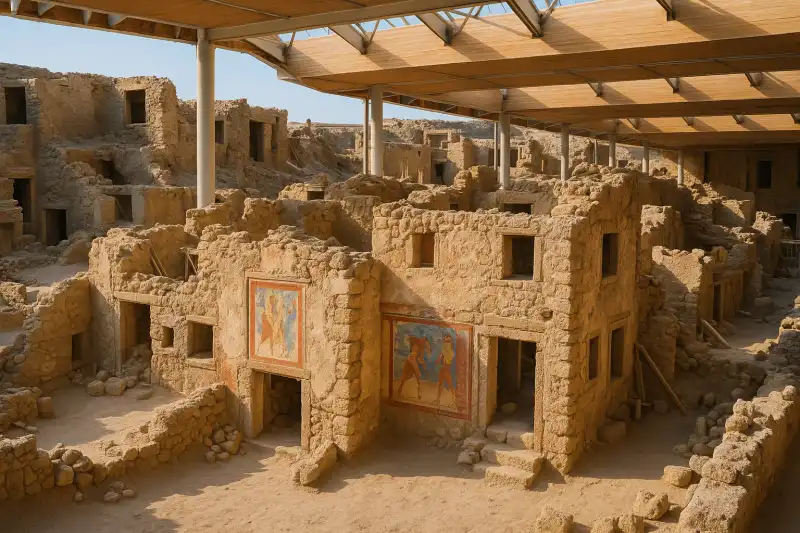
Akrotiri
Minoan / CycladicExplore Akrotiri, the Bronze Age Minoan city buried under volcanic ash on Santorini around 1613 BCE ...
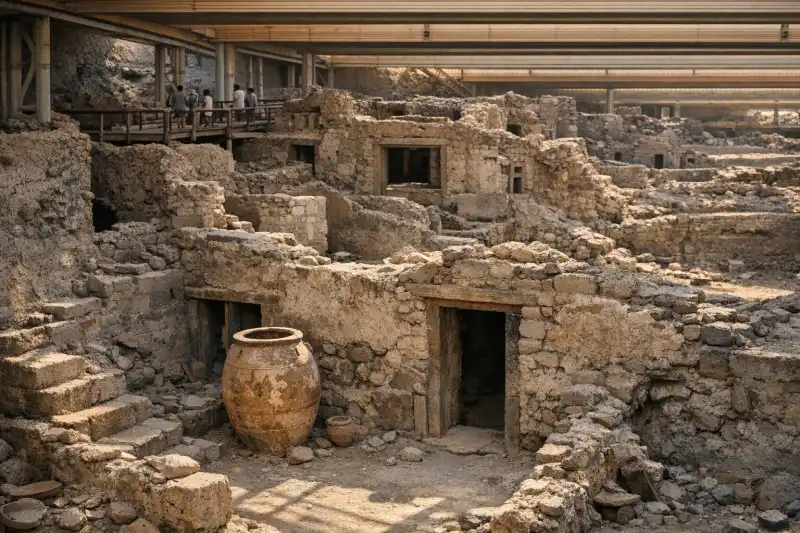
Ancient Akrotiri (Santorini)
Explore Ancient Akrotiri, the breathtaking Bronze Age settlement preserved in volcanic ash on Santor...
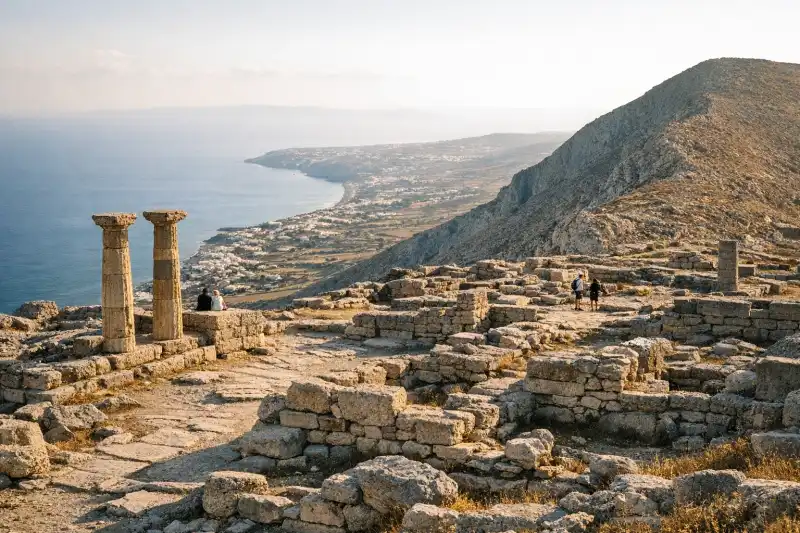
Ancient Thera
Ancient Greek, Roman, ByzantineExplore Ancient Thera in Greece, a dramatic mountaintop city on Santorini with Hellenistic, Roman, a...