Quick Info
At a glance
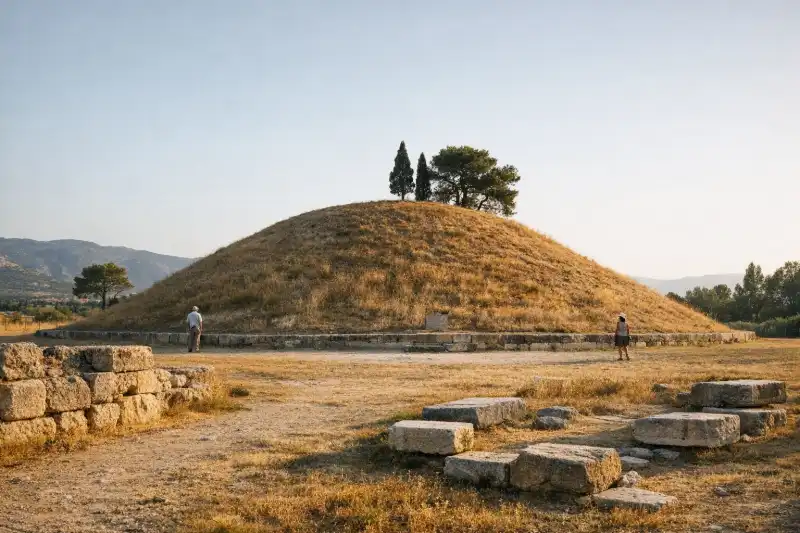
Marathon Tomb in Greece sits quietly on the wide coastal plain of Attica, far from the dense noise of central Athens yet inseparable from the story of the ancient city. At first glance it is simply an earthen mound rising from a cultivated landscape, modest in height and easy to miss if you arrive expecting a monumental ruin of marble columns or towering walls. But this is one of the most resonant places in Greek history. The tomb, often called the Soros of Marathon, marks the burial place traditionally associated with the Athenian dead who fell in the Battle of Marathon in 490 BCE, when a citizen army faced the invading Persians in a clash that later generations would remember as a turning point.
What makes the site so moving is its restraint. The Marathon Tomb does not overwhelm the visitor through size or ornament. Instead, its power comes from context: the open plain, the nearby sea routes, the distant mountains framing the battlefield, and the knowledge that this landscape once held the tension of an encounter that shaped the political and cultural confidence of the Greek world. To stand here is to experience ancient history in a grounded, physical way. The tomb is both memorial and landscape marker, a place where myth, patriotism, archaeology, and historical memory meet. For travelers interested in battlefields, ancient Greece, or quieter places of remembrance, Marathon Tomb offers a visit of unusual depth.
History
The Battle of Marathon in 490 BCE
The story of Marathon Tomb begins with one of the most famous battles of antiquity. In 490 BCE, the Persian Empire sent an expedition across the Aegean to punish Athens and Eretria for their support of the Ionian Revolt in Asia Minor. The Persian force landed on the plain of Marathon, northeast of Athens, where cavalry and infantry could deploy effectively. The Athenians, joined by a small contingent from Plataea, marched out to meet them rather than allow a direct advance toward the city.
Ancient sources, especially Herodotus, describe a battle in which the Greek hoplite phalanx charged the Persians and won a decisive victory despite being outnumbered. The exact details remain debated by historians, but the broad significance is clear. Marathon became a symbol of citizen courage, tactical intelligence, and the defense of autonomy against imperial power. The dead from the Athenian side were honored in a highly unusual way: rather than being taken back to Athens for burial, they were interred on the battlefield itself.
That act gave the site its extraordinary historical weight. Burial at the place of combat transformed the battlefield into sacred ground. The mound was not just a grave but a permanent statement that those who died here belonged to a collective civic memory.
The Creation of the Burial Mound
The Marathon Tomb is generally identified with the burial mound raised over the Athenian war dead, known in antiquity as the soros. Ancient testimony indicates that 192 Athenians were killed in the battle, and tradition held that they were buried beneath this tumulus. The Plataeans and enslaved people who fought alongside them were likely commemorated separately, though the archaeological and literary record is more complex on that point.
The decision to erect a mound rather than a more elaborate monument reflects early Classical commemorative practice while also emphasizing communal sacrifice. A tumulus was an ancient form with deep roots in Greek memory, echoing heroic burials from earlier eras. By using this style, the Athenians may have linked their fallen to the epic past, elevating the dead of Marathon into a near-heroic register.
Excavations in the nineteenth century strengthened the identification of the mound as a cremation burial. Archaeologists found ashes and remains consistent with funerary use, though like many famous ancient sites, interpretation has developed over time and not every question is settled beyond doubt. Even so, the mound’s association with the Athenian dead has remained central to both scholarship and public understanding.
Marathon in Classical and Later Memory
In the centuries after the battle, Marathon became far more than a military event. It was woven into Athenian identity and repeatedly invoked in speeches, public art, and historical writing. For Athenians of the fifth and fourth centuries BCE, the men buried at Marathon represented a model of civic virtue. Their memory could be called upon in times of political debate, war, or cultural self-definition.
The site likely received visitors in antiquity who came not merely to observe a grave but to honor a foundational episode in the city’s past. Marathon’s memory was also shaped by the broader Greek habit of hero cult and battlefield commemoration, where the dead of exceptional conflicts were given a lasting place in public consciousness.
Under Roman rule and into later eras, the prestige of Marathon continued. Educated travelers knew the name from classical literature, and the battlefield remained part of the mental map of Hellenic greatness. The symbolic afterlife of Marathon expanded even further in modern Europe, where the battle was often interpreted through romantic and nationalist lenses as a defense of “Western civilization,” a simplification but one that contributed to the site’s long cultural reach.
Rediscovery, Archaeology, and Modern Preservation
Modern archaeological interest in Marathon increased in the nineteenth and early twentieth centuries, when Greek antiquities and battlefields became central to the young Greek state’s connection with the classical past. Excavations at the tomb and the broader plain aimed to match literary accounts with physical remains. These efforts helped establish the mound as a major memorial destination rather than merely a local landmark.
Today, Marathon Tomb is preserved as a historic and archaeological site within a landscape that has changed over millennia but still retains something of its ancient openness. Roads, modern settlements, and agriculture shape the area, yet the mound remains legible as a place of remembrance. Its significance now combines archaeology, education, public history, and national memory. Visitors often come in connection with the Marathon Archaeological Museum or with wider explorations of Attica, but the tomb itself remains the emotional core of the battlefield story.
Key Features
The central feature of Marathon Tomb is the burial mound itself, a broad earthen rise rather than an architectural ruin. This simplicity is precisely what gives the site its distinctive atmosphere. Unlike many classical destinations where the eye is drawn to carved stone, broken temples, or reconstructed façades, here the landscape carries the meaning. The mound rises gently from the plain, grass-covered and compact, with a form that feels both natural and intentional. Because it is built from earth, it seems part of the land while also standing apart from it, as if memory itself has been shaped into terrain.
Around the tomb, the surrounding plain is essential to the experience. Marathon is one of those rare ancient battlefields where geography still matters to what a visitor sees. The openness of the ground helps explain why armies met here. You can sense the corridor between hills and sea, the practical reasons the Persians landed on this coast, and the strategic problem faced by the Athenians. Even if the exact positions of troops remain debated, the physical setting gives coherence to the historical narrative in a way museum displays alone cannot.
Another important feature is the commemorative character of the site. The Marathon Tomb is not only archaeological; it is memorial. Visitors tend to lower their voices here. There is a solemnity in the absence of theatrical ruins. The site asks for reflection rather than spectacle. That emotional quality makes it especially meaningful for travelers interested in remembrance landscapes, military history, or the ways ancient societies honored collective sacrifice.
The tomb is also closely connected to the Marathon Archaeological Museum nearby, which helps interpret the wider region. While the mound itself offers minimal visual information on its own, the museum provides context through artifacts from the Marathon area, including finds that illuminate local cults, burial customs, and settlement history. Taken together, the museum and the tomb allow visitors to move between object-based understanding and place-based understanding, which is one of the best ways to grasp ancient history.
A further feature of the site is its relationship to enduring cultural myths. The word “marathon” is globally known because of the modern long-distance race associated with the legendary run from the battlefield to Athens. Although the precise ancient story is more complicated than popular retellings suggest, the connection has made Marathon one of the few battlefields from antiquity instantly recognizable worldwide. Visiting the tomb places that modern symbolic layer alongside the ancient one. You see not just where soldiers were buried, but where one of history’s most powerful narratives of endurance and civic duty took root.
Finally, the visual character of the place deserves attention. Depending on the season, the plain may appear bright green, golden, dry, or wind-brushed under changing light from the Aegean side. Morning and late afternoon are especially evocative, when the mound casts a soft contour against the field and the wider topography becomes easier to read. There may be fewer architectural details to photograph than at larger classical sites, but there is a rare integrity to the setting. It feels like an intact historical landscape rather than an isolated monument.
Getting There
Marathon Tomb is easiest to reach from Athens, which lies about 40 kilometers to the southwest. By car, the journey usually takes around 60 to 90 minutes depending on traffic and your starting point. Renting a car gives the most flexibility, especially if you want to combine the tomb with the Marathon Archaeological Museum, the wider battlefield area, or coastal stops in northeastern Attica. Daily car rental rates from Athens often start around €30 to €60, with fuel and toll considerations depending on your route.
Public transport is possible, though less direct. Regional KTEL buses run from Athens toward Marathon and nearby towns. Fares are usually modest, often in the range of €4 to €7 one way, but exact schedules and stop locations should be checked in advance because services can vary by season and day. From the bus stop, you may need a short taxi ride to the tomb if you are not comfortable walking. Local taxi fares within the Marathon area commonly begin around €5 to €10 for short distances.
Organized day tours from Athens are another convenient option, especially for travelers who want historical commentary. Prices vary widely, but shared excursions often begin around €50 to €100 per person, while private tours are considerably more expensive. If you plan to use taxis from Athens directly, expect a much higher cost, often €60 to €90 each way depending on time, traffic, and booking method. For most visitors, a rental car or guided day trip is the most practical choice.
When to Visit
The best time to visit Marathon Tomb is generally spring or autumn, when the weather in Attica is mild and the plain is pleasant for walking and quiet contemplation. From March to May, the landscape is often greener, temperatures are comfortable, and the light can be particularly beautiful in the morning. September through early November is similarly appealing, with warm but usually manageable conditions and fewer of the intense heat spells common in midsummer.
Summer visits are certainly possible, especially if you are combining Marathon with beach time or a broader Attica itinerary, but midday temperatures can be high. Because the site is open and exposed, heat and sun can become tiring quickly. If you go in June, July, or August, it is wise to arrive early in the morning or later in the afternoon, bring water, and wear sun protection. The reduced shade means even a short visit can feel demanding under strong sun.
Winter offers a different kind of experience. Rain is more likely, and some days can feel windswept, but the cooler temperatures make the open landscape easier to explore. The quieter season can also enhance the reflective mood of the memorial. If your main interest is historical atmosphere rather than photography in bright conditions, winter can be rewarding.
If possible, avoid arriving only at the hottest part of the day. The site’s subtlety becomes clearer in softer light, when the mound’s contours and the broader plain are easier to appreciate. Early morning is especially good for visitors seeking a calm, contemplative experience.
| Quick Facts | Details |
|---|---|
| Site name | Marathon Tomb |
| Greek historical name | Soros of Marathon |
| Location | Marathon, Attica, Greece |
| Historical significance | Burial mound for the Athenian dead of the Battle of Marathon |
| Date associated with site | 490 BCE |
| Civilization | Ancient Greek |
| Best base for visitors | Athens or Marathon |
| Typical visit length | 30–60 minutes at the tomb; longer with museum stops |
| Best season | Spring and autumn |
| Nearest major city | Athens |
| Good combined visit | Marathon Archaeological Museum and battlefield area |
| Atmosphere | Quiet, reflective, landscape-focused |
Guided tours: worth it?
Most travelers can visit Marathon Tomb independently. Compare a tour only if you want a tighter history-focused visit, easier logistics, or a guide who can answer questions on the spot.
Best for
- Short visits where a planned route saves time
When to go self-guided
Go independently if you prefer setting your own pace, reading as you go, and checking official hours or ticket rules directly before you arrive.
What I’d avoid
Skip paid tours that bundle unrelated stops you do not actually want. The best option should either save meaningful planning time or add historical context you would miss on your own.
Marathon Greece Tours
Useful when: you want to compare guided formats before deciding
Athens to Marathon Day Trips
Useful when: transport or pickup logistics matter
Ancient Athens and Marathon Tours
Useful when: you want to compare guided formats before deciding
Some tour links are affiliate links, which may earn Ancient Travel a small commission at no extra cost to you. I try to surface options that make practical sense for the site—not just anything bookable.
Frequently Asked Questions
What is the Marathon Tomb?
The Marathon Tomb is a burial mound at Marathon in Attica, Greece, traditionally identified as the collective grave of the Athenian soldiers who died in the Battle of Marathon in 490 BCE.
How far is Marathon Tomb from Athens?
Marathon Tomb is roughly 40 kilometers northeast of central Athens, and the trip usually takes about 1 to 1.5 hours depending on traffic and your mode of transport.
Is there an entrance fee for Marathon Tomb?
Access policies can change, but the tomb mound itself is often viewed from the surrounding site area without a major ticketed setup; check current local information before visiting.
How much time should I spend at Marathon Tomb?
Most travelers spend 30 to 60 minutes at the tomb itself, though history enthusiasts often combine it with the Marathon Archaeological Museum and other battlefield landmarks for a half-day visit.
Why is Marathon Tomb important?
It commemorates the Athenians who died defeating the Persian invasion at Marathon, a battle that became a defining moment in Greek history and later in wider European historical memory.
Can I visit Marathon Tomb without a car?
Yes, it is possible by regional bus from Athens to Marathon, followed by a short taxi ride or walk depending on your stop, though a car or organized tour is generally the easiest option.
Nearby Ancient Sites
Acropolis Travel Guide 2026: Parthenon, Tickets, and Best Time
Ancient GreecePlan an efficient Acropolis visit with practical ticket timing, key monuments, and museum pairing ti...
The Complete Acropolis Athens Travel Guide: Temples
Ancient GreecePlan the perfect visit to the Acropolis of Athens with our 2026 guide. Discover the Parthenon, best ...
Ancient Agora of Athens Travel Guide 2026: Route, Tickets, and Context
Classical GreekPlan a better Ancient Agora visit with practical timing, monument priorities, and clear historical c...