Quick Info
At a glance
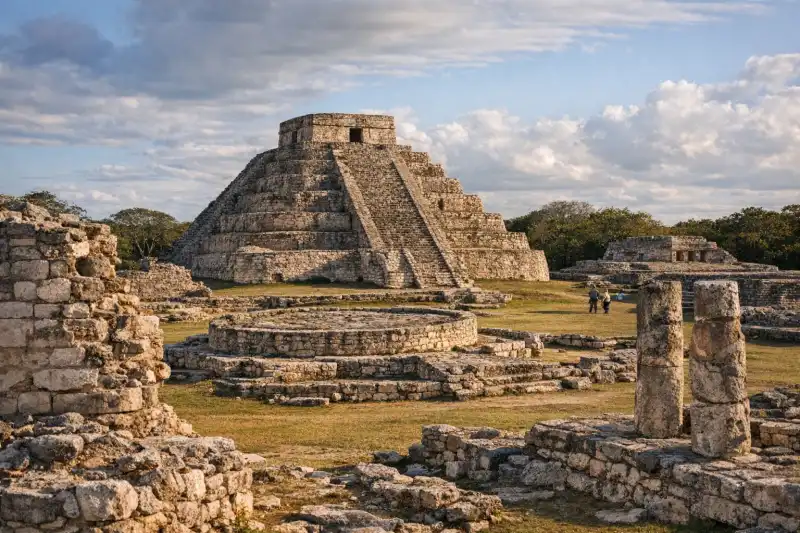
Mayapán, in Mexico, is one of the most important yet often overlooked ancient cities of the Maya world. Standing in the dry interior of Yucatán, away from the coastal resorts and the busiest archaeological circuits, it offers something increasingly rare in major heritage travel: the chance to walk through a former capital in relative quiet. Its broken walls, low stone platforms, shrines, and commanding central pyramid do not overwhelm by sheer height in the way some better-known sites do. Instead, Mayapán impresses through scale, density, and historical weight. This was not a ceremonial outpost on the margins. It was the political center of a late Maya state, a city whose influence extended across much of northern Yucatán after the decline of earlier powers.
For travelers based in Mérida, Mayapán feels both accessible and removed. The road in passes through contemporary Yucatecan towns and open countryside before the ruins emerge in a landscape of scrub vegetation and bright, exposed light. Once inside, the site reveals the plan of a compact but formidable city enclosed by walls and filled with temples, colonnaded halls, altars, elite residences, and ordinary dwellings. That urban texture matters. Visiting Mayapán is not only about seeing one famous structure. It is about stepping into the remains of a functioning capital where religion, trade, administration, and everyday life were tightly packed together. For anyone interested in the final centuries of independent Maya political power in the north, Mayapán is one of Mexico’s most rewarding archaeological destinations.
History
Origins and the rise of a new capital
Mayapán rose to prominence during the Late Postclassic period, after the political fragmentation that followed the decline of earlier great centers in northern Yucatán. Although the region remained full of active settlements, power no longer concentrated in the same way it had during the florescence of cities such as Chichén Itzá. Into this changing landscape came Mayapán, which likely began as a significant settlement before expanding into a dominant regional capital around the 13th century CE.
Maya traditions recorded in later colonial-period sources connect Mayapán with shifting alliances among powerful lineages. While such texts must be handled carefully, they suggest a period of political reorganization in which noble houses competed for influence across the peninsula. Archaeology supports the view that Mayapán became a major center during this era, developing into a walled city with dense occupation and substantial ceremonial architecture. Its rulers drew on earlier Maya traditions while also adapting to the realities of a more militarized and factional political world.
The city’s architecture reflects this historical moment. Some of its buildings echo forms associated with older centers, especially Chichén Itzá, revealing both cultural continuity and deliberate political symbolism. By invoking respected architectural precedents, Mayapán’s elites may have sought legitimacy in a region where authority was constantly negotiated.
Political power and urban life
At its peak, Mayapán was the leading capital of northern Yucatán. It was not simply a ceremonial hub but a true urban center, containing thousands of inhabitants within and around its walls. Archaeologists have documented a remarkably dense settlement pattern, with houses, family shrines, and administrative buildings spread across the enclosed city. This suggests a capital where elite power was physically close to the broader population, and where daily life unfolded in the shadow of state ritual.
Trade played an important role in Mayapán’s success. The city occupied a strategic place in regional exchange networks linking inland communities with coastal routes. Goods moving through the peninsula likely included salt, cotton textiles, obsidian, ceramics, foodstuffs, and ritual items. As a political capital, Mayapán was well positioned to tax, regulate, or benefit from this movement of goods.
Religious life was equally central. Temples and shrines punctuated the cityscape, and mural fragments, sculptural elements, and offerings show a vibrant ritual culture. The city’s main ceremonial buildings demonstrate that public ceremonies remained essential to the performance of power. The rulers of Mayapán did not govern through administration alone; they staged authority through sacred space, ancestor veneration, and collective rites.
Conflict, instability, and decline
Despite its power, Mayapán was never a completely secure state. The defensive wall surrounding the city hints at a tense political environment, one in which warfare or the threat of attack was taken seriously. Historical traditions and archaeological evidence together suggest that internal rivalries among noble factions eventually weakened the city. As in many capitals built on alliances rather than unchallenged dynastic control, the mechanisms that created power also carried the seeds of instability.
By the 15th century, those tensions appear to have erupted into open conflict. Later accounts describe struggles between major lineages, especially the Cocom and their rivals. Though the precise sequence remains debated, the broad picture is clear: Mayapán experienced violent political breakdown. Parts of the city show evidence of burning and disruption, and its centralized authority collapsed before the arrival of the Spanish in the region.
This decline did not mean the end of Maya civilization in Yucatán. Rather, power dispersed among numerous smaller polities. Communities continued to thrive across the peninsula, and Maya cultural traditions remained strong. In that sense, Mayapán’s fall marks not a civilizational disappearance but the end of the last large, dominant capital in northern Yucatán’s pre-Hispanic political history.
Rediscovery and archaeological importance
In the modern era, Mayapán became increasingly important to archaeologists because it offers a rare, well-preserved window into late Maya urbanism. Earlier scholarship often focused most heavily on the Classic period, but Mayapán helped demonstrate that the Postclassic Maya world was dynamic, sophisticated, and politically complex. Excavations and surveys have revealed the extent of the city’s residential zones, defensive works, ceremonial architecture, and artistic remains.
Today, Mayapán is valued not only for individual monuments but for the completeness of its urban plan. It helps scholars understand how Maya cities functioned in the centuries just before European contact. For visitors, that means the site is more than a collection of ruins. It is a crucial chapter in the long history of Mesoamerica, one that reshapes how the late Maya world is understood.
Key Features
The most striking feature of Mayapán is its sense of enclosure. Unlike many archaeological sites where ceremonial buildings seem to dissolve into endless forest, Mayapán retains the logic of a defended capital. The city wall, though not uniformly preserved to full height, still defines the outline of an urban center built with protection in mind. This wall gives the site a distinct personality. It suggests anxiety, organization, and political centralization all at once, reminding visitors that this was a capital in an era of competition.
At the heart of the site stands the Temple of Kukulcán, the principal pyramid and the monument most visitors remember. It is often noted for its resemblance to the more famous Castillo at Chichén Itzá, though on a smaller scale. That comparison is useful, but the building should not be seen merely as an imitation. In Mayapán’s context, it represents continuity with prestigious traditions and a deliberate visual statement about legitimacy. Rising above the surrounding plaza, it anchors the city’s ceremonial core and helps orient the visitor within the broader layout.
Around the central pyramid are plazas, platforms, colonnaded structures, and temples that reveal how public life was staged. Some buildings likely hosted gatherings, administrative functions, or elite ceremonies. Others seem more narrowly ritual in character. Walking through this area, you can sense that Mayapán’s political system depended on repeated public performances in carefully arranged space. Architecture here was not decorative background. It was active political theater.
One of the site’s great strengths is the survival of so many smaller structures. Across Mayapán, low house mounds and neighborhood shrines create a picture of urban density that many major ruins no longer convey so clearly. Instead of seeing only a handful of monumental buildings, visitors encounter the fabric of a real city. This is where Mayapán becomes especially rewarding for those who like to imagine how ancient places functioned day to day. The site lets you trace the relationship between elite compounds and ordinary residences, between sacred precincts and domestic space.
Several structures preserve traces of painted decoration and sculptural detail, reminding visitors that the ancient city was once far more colorful than its weathered stone now suggests. Murals and painted interiors, where preserved, hint at a ceremonial environment rich in symbolism. Such details also reinforce the importance of Mayapán as a center of ritual life rather than just military or political administration.
The site’s compactness is another advantage. Large enough to feel significant but manageable enough to explore without exhaustion, Mayapán allows visitors to grasp an entire ancient city in a single visit. From raised points, especially near the central precinct, the repeated pattern of platforms and mounds stretches outward, making the former scale of occupation more legible. This visual field is essential to the experience. You do not just look at isolated monuments; you see the footprint of a capital.
Vegetation and light also shape the visit. The Yucatán landscape around Mayapán is relatively open, and the sun can be intense. This exposure enhances the geometry of the ruins, casting sharp lines across stone surfaces and emphasizing the low-rise spread of the city. Early morning and late afternoon are especially atmospheric, when softer light brings relief to carved edges and creates a more dramatic sense of space.
Ultimately, Mayapán’s key feature is not one building but a combination of qualities: a walled layout, a symbolic central pyramid, dense residential remains, and the palpable identity of a late Maya capital. It offers a more urban, more historically textured experience than many travelers expect. For those willing to move slowly and look beyond the headline monument, it is among the most intellectually satisfying archaeological sites in Mexico.
Getting There
Mayapán is most easily reached from Mérida, the capital of Yucatán, which lies roughly 45 to 50 kilometers away depending on route. By car, the drive usually takes about one hour. Renting a car in Mérida is the simplest option if you want flexibility, and daily rental rates commonly start around MXN 700 to 1,200 before insurance, depending on season and vehicle type. Roads in the region are generally straightforward, and combining Mayapán with nearby towns or cenotes makes self-driving especially practical.
Taxis and private transfers are another convenient choice. A one-way taxi from Mérida to Mayapán may cost approximately MXN 700 to 1,200, while a round-trip with waiting time or arranged pickup can run higher. Prices vary by negotiation, fuel costs, and whether you book through your hotel or directly with a driver. For small groups, this can be an efficient and comfortable option.
Budget travelers can often use buses or colectivos part of the way, though service patterns can change and may require asking locally in Mérida. Expect lower fares, often under MXN 100 to 200 each way, but longer travel times and less certainty on return schedules. If using public transport, start early and confirm the latest return departure before entering the site.
Organized tours from Mérida are also available through local operators, especially those combining Mayapán with other Yucatán attractions. Prices commonly begin around MXN 1,000 to 2,500 per person depending on group size, transport style, guide services, and included stops. This is a good option if you want historical interpretation without the logistics of independent travel.
When to Visit
The best time to visit Mayapán is during the drier and slightly cooler months from November to March. During this period, daytime temperatures are usually more manageable, skies are often clear, and walking through the exposed ruins is significantly more comfortable. This is also the most popular season for travel in Yucatán, but Mayapán still tends to remain much quieter than the peninsula’s marquee archaeological attractions.
April and May can be especially hot, with intense midday sun and limited shade across the site. If you visit in late spring, arrive as close to opening time as possible, carry plenty of water, and plan to be done before the early afternoon heat peaks. The ruins are beautiful in strong light, but comfort and safety become real concerns in these months.
The rainy season, roughly from June through October, brings greener surroundings and sometimes dramatic skies. Showers are often intermittent rather than all-day events, so a rainy-season visit can still work well if you monitor the forecast and bring light rain protection. Humidity, however, can be high, and paths may feel more slippery after storms. Tropical weather systems can occasionally affect the region, especially later in the season.
Time of day matters almost as much as season. Early morning is ideal for photography, cooler temperatures, and a stronger sense of solitude. Late afternoon can also be rewarding if the site schedule allows enough time. Midday visits are the least pleasant due to heat and glare. If possible, avoid Sundays and major holiday periods when domestic travel rises, though even then Mayapán is usually calmer than larger sites.
| Quick Facts | Details |
|---|---|
| Location | Yucatán, Mexico |
| Nearest major city | Mérida |
| Civilization | Maya |
| Main period | Late Postclassic |
| Founded / rose to prominence | c. 13th century CE |
| Known for | Walled capital city, Temple of Kukulcán, dense urban ruins |
| Best visit length | 2–3 hours |
| Best season | November to March |
| Access style | Easy day trip by car or organized tour from Mérida |
| Visitor tip | Bring water, a hat, and sun protection due to limited shade |
Mayapán rewards travelers who care about historical depth as much as monumental spectacle. It may not have the instant global recognition of Chichén Itzá, but that is part of its appeal. Here, the late Maya world feels close and legible. You can walk the avenues of a former capital, trace the outline of its defenses, and imagine the dense life once contained inside its walls. For visitors exploring Yucatán beyond the most famous names, Mayapán is not a secondary stop. It is one of the peninsula’s essential ancient places.
Guided tours: worth it?
Self-guided works here, but a guide can add real value if you want the ruins explained as a living place rather than just a sequence of monuments.
Best for
- First-time visitors who want context, not just photos
- Short visits where a planned route saves time
When to go self-guided
Go independently if you prefer setting your own pace, reading as you go, and checking official hours or ticket rules directly before you arrive.
What I’d avoid
Skip paid tours that bundle unrelated stops you do not actually want. The best option should either save meaningful planning time or add historical context you would miss on your own.
Mayapán and Yucatán Maya Ruins Tours
Useful when: you want to compare guided formats before deciding
Mérida to Mayapán Day Tours
Useful when: you want to compare guided formats before deciding
Yucatán Archaeological Sites Tours
Useful when: you want to compare guided formats before deciding
Some tour links are affiliate links, which may earn Ancient Travel a small commission at no extra cost to you. I try to surface options that make practical sense for the site—not just anything bookable.
Frequently Asked Questions
What is Mayapán known for?
Mayapán is known as the last major political capital of the northern Maya world, with a defensive wall, ceremonial temples, murals, and dense urban ruins.
Where is Mayapán located?
Mayapán is in the Mexican state of Yucatán, southeast of Mérida, in the interior of the Yucatán Peninsula.
How much time do you need at Mayapán?
Most visitors spend 2 to 3 hours exploring the main plaza, temple pyramid, wall circuit, and surrounding residential remains.
Can you climb the pyramid at Mayapán?
Access rules can change, so check current site regulations on arrival; climbing may be restricted for conservation or safety reasons.
Is Mayapán worth visiting instead of Chichén Itzá?
Mayapán offers a quieter, less crowded experience and is especially rewarding for travelers interested in late Maya history, urban planning, and atmosphere.
What should I bring to Mayapán?
Bring water, sun protection, sturdy shoes, cash for tickets or local purchases, and a hat since shade can be limited across the site.
Nearby Ancient Sites
Chichen Itza Travel Guide 2026: Maya Secrets, Sacred Cenote, and Smart Timing
MayaChichen Itza stands as the most visited ancient site in Mexico, showcasing the architectural genius ...
Coba Travel Guide 2026: Ruins Route, Timing, and Practical Day Planning
MayaPlan a better Coba visit with route strategy, realistic timing from Tulum or Cancun, and practical t...
Calakmul
MayaExplore Calakmul, a vast Maya city deep in the forests of Campeche, Mexico, known for towering pyram...