Quick Info
Curated Experiences
Ming Tombs & Great Wall Combo Day Tour from Beijing
Ming Tombs Guided Tour from Beijing
Beijing Imperial Sites Full Day Tour
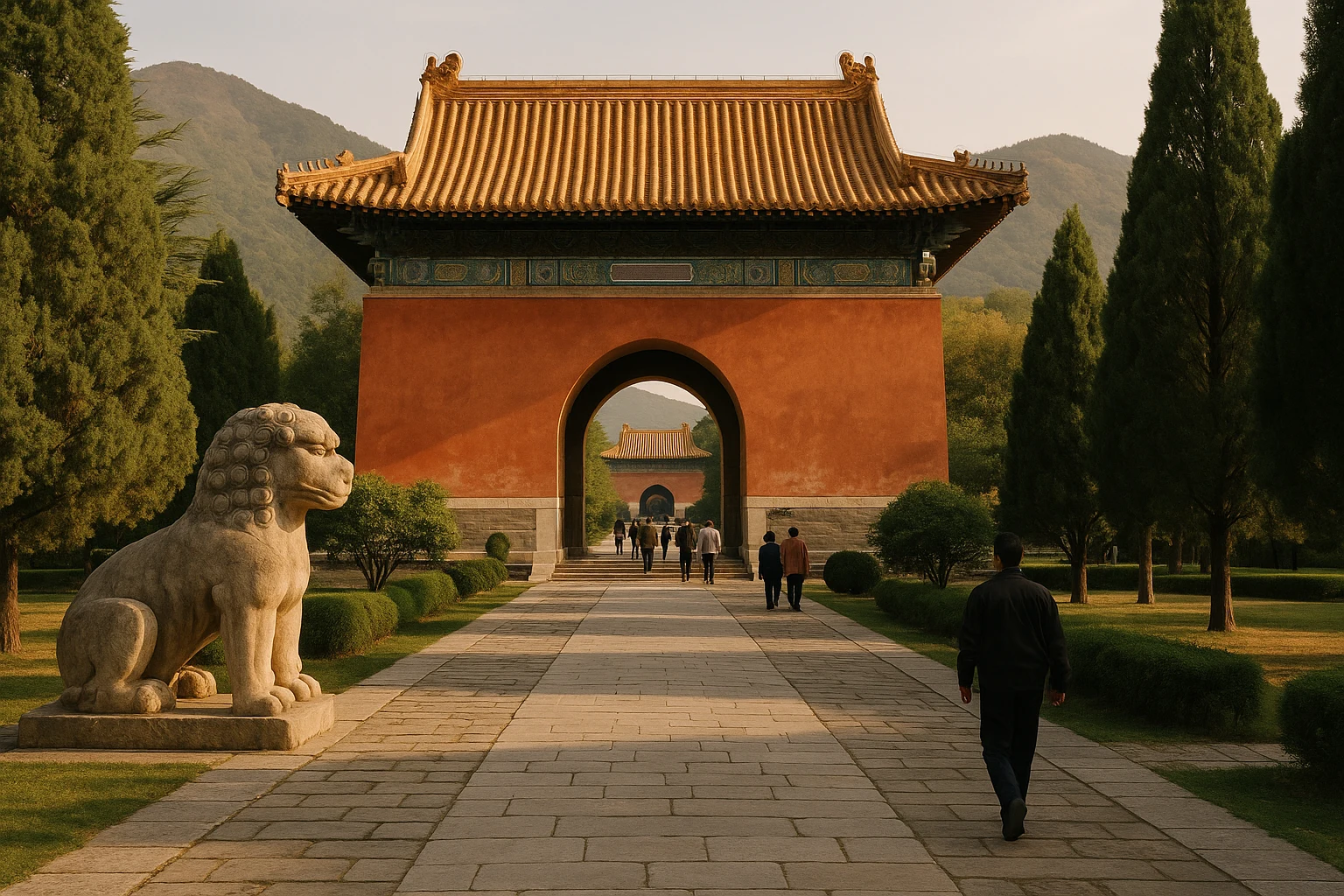
Forty kilometers north of Beijing, where the Tianshou Mountains curve into a sheltered natural basin, thirteen emperors of China’s most celebrated dynasty sleep beneath earthen mounds that have endured for six centuries. The Ming Tombs — known in Chinese as Shísān Líng, the Thirteen Mausoleums — are among the most intact imperial burial complexes anywhere in the world. The site spreads across roughly 40 square miles of valley floor and hillside, its sacred geometry still legible in the arc of surrounding peaks, the procession of stone guardians along the Spirit Way, and the soaring yellow-tiled gate towers that announce each emperor’s resting place.
What makes the Ming Tombs exceptional is not simply their scale or their age, though both are remarkable. It is the deliberate coherence of the entire ensemble. Unlike royal burial grounds in many other cultures, where individual rulers competed to outshine one another in isolation, the Ming emperors understood their necropolis as a single, unified landscape. Every tomb shares an orientation, a ritual vocabulary, and an implicit conversation with the mountains behind it. The result is a place where imperial ambition, cosmological belief, and extraordinary craftsmanship converge — and where visitors today can feel the accumulated weight of five dynasties and 200 years of continuous funerary tradition pressing gently on the air.
A Dynasty in Stone: The History of the Ming Imperial Cemetery
The Ming dynasty ruled China from 1368 to 1644, a span of 276 years marked by extraordinary cultural production, international trade, naval exploration, and the construction of infrastructure on a scale rarely matched in human history. It was under the Ming that the Great Wall reached its most elaborate form, that the Forbidden City rose in Beijing, and that China’s imperial bureaucracy achieved its most sophisticated expression. The tombs of the Ming emperors reflect all of this ambition.
The dynasty’s founder, the Hongwu Emperor Zhu Yuanzhang, was buried at the Ming Xiaoling Mausoleum in Nanjing, the original imperial capital. But when his son, the Yongle Emperor, seized the throne and moved the capital north to Beijing in 1403, he immediately began searching for an appropriate burial site in the vicinity of the new capital. In 1407, following the death of his empress, Yongle dispatched geomancers to survey the region north of Beijing. They selected a valley in Changping where the mountains formed a protective horseshoe shape — exactly the feng shui configuration considered ideal for an imperial burial ground. Construction of Changling, the first and largest tomb, began in 1409.
Over the next two centuries, each succeeding emperor chose a location within the same valley for his own mausoleum. The site accumulated its tombs incrementally, always following the precedents established at Changling in terms of orientation, spatial hierarchy, and ritual architecture. The last emperor interred here was the Chongzhen Emperor, who died in 1644 when the dynasty fell to the advancing Manchu forces — and who was buried, fittingly, in a tomb originally prepared for a favorite concubine.
The Qing dynasty, which replaced the Ming, treated the tombs with a complex mixture of reverence and political calculation. Maintaining the Ming tombs helped the new Manchu rulers demonstrate that they were legitimate successors to Chinese imperial tradition. Qing emperors periodically ordered repairs and sent officials to conduct ritual offerings. This careful stewardship partly explains why so much of the complex survives today, though periods of neglect, looting during the Republican era, and the political turbulence of the twentieth century all left their marks.
In 2003, UNESCO inscribed the complex as part of the broader World Heritage Site designation covering the Imperial Tombs of the Ming and Qing Dynasties, recognizing the exceptional universal value of the site’s architecture, landscape setting, and historical significance.
The Spirit Way, Changling, and the Underground Palace of Dingling
Any visit to the Ming Tombs properly begins at the Great Red Gate (Dàhóngmén), the monumental southern entrance to the entire complex, where a stone tortoise carries a stele recording the site’s sacred status. From here, the Spirit Way extends northward for seven kilometers — a processional road of extraordinary gravity.
The most arresting section of the Spirit Way is its Avenue of Stone Statues, where eighteen pairs of colossal carved figures stand watch in two facing rows. Lions, camels, elephants, mythical qilin, and horses alternate in kneeling and standing poses, followed by military officials in full armor and civil officials in court dress. Carved from single blocks of stone and dating primarily to the fifteenth century, these figures were intended to serve the emperors in death as their living counterparts had served them in life. Walking between the two rows at dawn or dusk, with mist collecting in the distant mountain folds, produces an atmosphere unlike almost any other ancient site in China.
Changling is the tomb of the Yongle Emperor himself and the largest of the thirteen mausoleums. Its Hall of Eminent Favors (Ling’en Dian) is one of the most impressive wooden structures in China — a vast ceremonial hall supported by sixty pillars of nanmu hardwood, each carved from a single tree trunk, with a floor area comparable to the Hall of Supreme Harmony in the Forbidden City. The interior houses a large statue of Yongle and exhibitions of Ming artifacts. The burial mound behind the hall, a grassed earthen tumulus roughly 31 meters high, has never been excavated, a decision Chinese authorities have deliberately maintained to preserve what may be extraordinary undisturbed contents.
Dingling, the tomb of the Wanli Emperor who reigned from 1572 to 1620, is the only mausoleum in the complex whose underground chambers have been opened to the public. Excavated between 1956 and 1958, the underground palace consists of five marble-vaulted rooms extending 27 meters below the surface, covering an area of over 1,000 square meters. Visitors descend into an anteroom and then pass through towering stone doors — still on their original pivots — into the burial chamber itself, where replicas of the stone thrones of the Wanli Emperor and his two empresses are displayed. The original burial treasures, including gold crowns and silk garments of extraordinary quality, are exhibited in the surface buildings of Dingling. The excavation was not without controversy: many of the organic materials deteriorated rapidly upon exposure, a loss that has made Chinese archaeologists cautious about opening any other imperial tomb.
Zhaoling, the mausoleum of the Longqing Emperor, is smaller and less visited but has been carefully restored and offers a more intimate encounter with Ming funerary architecture. Its forecourt, ceremonial stele, and soul tower are well-preserved, and the site’s relative quietude makes it appealing to visitors who want to absorb the atmosphere away from crowds.
Getting There
The Ming Tombs sit in Changping District, roughly 42 kilometers north-northwest of central Beijing. Several routes connect the city to the complex.
By subway and bus: Take Beijing Subway Line 13 (Batong Line) to Longze or Shahe station, then board Bus 345 Express or one of the dedicated tourist buses northward toward Changling. The full journey from central Beijing takes approximately 90 minutes to two hours depending on traffic.
By taxi or ride-hail: A direct taxi or DiDi ride from central Beijing costs between 120 and 200 yuan one-way and takes around an hour without heavy traffic. Many visitors arrange a round-trip fare with a driver who waits at the complex.
By organized day tour: The most popular option combines the Ming Tombs with the Great Wall at Badaling or Mutianyu. Dozens of operators in Beijing offer this itinerary daily. The convenience is substantial — pickup from central hotels, guided commentary, and no navigation stress — though the tradeoff is a compressed schedule at each site.
By high-speed rail to Changping North: Suburban rail services connect Beijing North Station to Changping, from which local buses reach the tombs, though this route requires more transfers and is less intuitive for first-time visitors.
There is an entrance fee for each individual tomb (typically 45 yuan for Changling and Dingling as of recent years; verify current pricing before visiting). The Spirit Way has a separate ticket.
When to Visit
The Ming Tombs reward visits in spring and autumn above all other seasons. April and May bring mild temperatures, clear skies, and the first greenery on the surrounding hills — conditions that accentuate the contrast between the stone statues and the living landscape. September and October offer the added drama of autumn foliage, when the hillsides behind the burial mounds turn amber and gold.
Summer (June–August) is the most crowded period, as Beijing tourism peaks and tour groups descend on the site daily. Heat and humidity can be intense. If visiting in summer, arrive early — the complex opens at 8:00 AM — to reach the underground chambers of Dingling before the main crowds arrive.
Winter visits are underrated. Cold weather keeps crowds thin, snow on the stone guardians of the Spirit Way creates a remarkably evocative atmosphere, and the bare trees reveal the topographic geometry of the valley more clearly than any other season. Layering is essential; bring a warm base layer even on days that seem mild in the city.
Weekdays are dramatically quieter than weekends regardless of season. If your schedule allows any flexibility, a Tuesday or Wednesday visit will yield a noticeably more contemplative experience.
Combining Ming Tombs with Other Sites
The Ming Tombs are almost always visited in combination with the Great Wall, which lies within the same northern corridor of Beijing. The sections at Badaling (the most accessible, and the most crowded) and Mutianyu (better preserved, fewer visitors, with a cable car option) are both reachable in under an hour from Changling. A combined itinerary — Spirit Way and Changling or Dingling in the morning, Great Wall section in the afternoon — is the classic Beijing day out and makes geographical sense.
Within central Beijing, the Forbidden City (Palace Museum) and the Temple of Heaven sit at opposite ends of the traditional imperial axis and represent the living counterparts to the tombs: where emperors governed and performed heaven-mandated rituals in life, the Ming Tombs mark where they transitioned to the afterlife. Pairing a morning at the Forbidden City with an afternoon or following day at the tombs creates a coherent arc through Ming dynasty imperial culture.
The Summer Palace offers another complement — a landscape garden of equal sophistication that the same dynasty began and the Qing emperors later expanded, demonstrating how Chinese imperial culture translated its cosmological values into different kinds of planned space.
Why the Ming Tombs Matter
The Ming Tombs are among the world’s great examples of how a civilization chose to articulate its deepest beliefs in permanent form. At their core, the mausoleums embody a cosmological conviction — that the emperor, as the Son of Heaven, occupied a position between the human world and the divine, and that his death required a physical infrastructure commensurate with that role: mountains aligned to conduct cosmic energy, a road guarded by supernatural figures, underground palaces mirroring the courts above ground.
But they are also a record of extraordinary craftsmanship sustained across two centuries. The nanmu pillars in Changling’s Hall of Eminent Favors required the felling of ancient forests in Sichuan and Yunnan and transport across thousands of kilometers. The stone carvings on the Spirit Way represent the accumulated skill of generations of imperial workshops. The underground vaulting of Dingling was engineered without mortar — its stones are held in place purely by their own geometry — and has survived intact for over four centuries.
That so much of this survives is not simply the result of material durability. It reflects the choices made by successive dynasties, governments, and communities to maintain and protect a landscape that encodes something essential about Chinese civilization’s understanding of power, mortality, and the relationship between the human and the cosmic.
Quick Facts
| Detail | Information |
|---|---|
| Location | Changping District, Beijing, China |
| UNESCO Status | World Heritage Site (2003, Imperial Tombs of Ming & Qing Dynasties) |
| Period | 1409–1644 (Ming dynasty) |
| Number of Tombs | 13 imperial mausoleums |
| Key Structures | Spirit Way, Changling, Dingling underground palace |
| Nearest City | Beijing (42 km south) |
| Entrance Fee | Approx. 45 yuan per main tomb (verify current pricing) |
| Opening Hours | 8:00 AM – 5:30 PM (seasonal variation) |
| Best Seasons | Spring (Apr–May) and Autumn (Sep–Oct) |
Explore More
Walking the Spirit Way at the Ming Tombs is one of those rare experiences that feels genuinely unmediated — just you, six centuries of stone, and the quiet presence of the mountains that the geomancers selected to guard China’s emperors forever. Use the tour links above to find guided options that make the most of a day in this extraordinary valley.
Frequently Asked Questions
How many tombs are at the Ming Tombs site?
Thirteen of the sixteen Ming dynasty emperors are buried at the site, giving it the Chinese name Shísān Líng (十三陵), meaning 'Thirteen Mausoleums'. The remaining three emperors are buried elsewhere — one in Nanjing, one whose tomb was destroyed, and one whose burial place is uncertain.
Which Ming Tomb can visitors enter underground?
Dingling is the only tomb at the complex where the underground burial palace has been excavated and is open to the public. Visitors can descend into the marble-vaulted burial chambers where the Wanli Emperor and his two empresses once lay, seeing the original stone thrones and ceremonial artifacts.
What is the Spirit Way at the Ming Tombs?
The Spirit Way (Shéndào) is a 7-kilometer ceremonial road that serves as the main entrance to the entire complex. It is lined with 36 pairs of stone statues — lions, camels, elephants, mythical qilin, military officials, and civil officials — intended to guard and honor the emperors in the afterlife.
Is a UNESCO World Heritage Site designation shared with other Ming tombs?
Yes. In 2003, UNESCO inscribed the Ming Tombs near Beijing as part of the broader designation 'Imperial Tombs of the Ming and Qing Dynasties,' which also includes the Ming Xiaoling Mausoleum in Nanjing and tombs associated with the Qing dynasty in Hebei and Liaoning provinces.
How do I get from central Beijing to the Ming Tombs?
The most convenient option is the Beijing Subway Line 13 to Longze or Shahe stations, followed by a bus or taxi north to Changping District — roughly a 90-minute journey in total. Many visitors join an organized day tour that combines the Ming Tombs with the Great Wall, which simplifies transport considerably.
How long does it take to visit the Ming Tombs?
Most visitors spend two to four hours at the main cluster. Seeing Changling, Dingling, and the Spirit Way comfortably requires at least three hours. Visitors who want to explore lesser-visited tombs such as Zhaoling or Yongling should budget a half day or full day at the complex.
Are all thirteen tombs open to visitors?
Only a handful of tombs are fully open to the public. Changling and Dingling receive the most visitors and have the most developed facilities. Zhaoling has been partially restored. The remaining tombs are in various states of preservation and some are accessible only on the exterior or with special access.
Nearby Ancient Sites
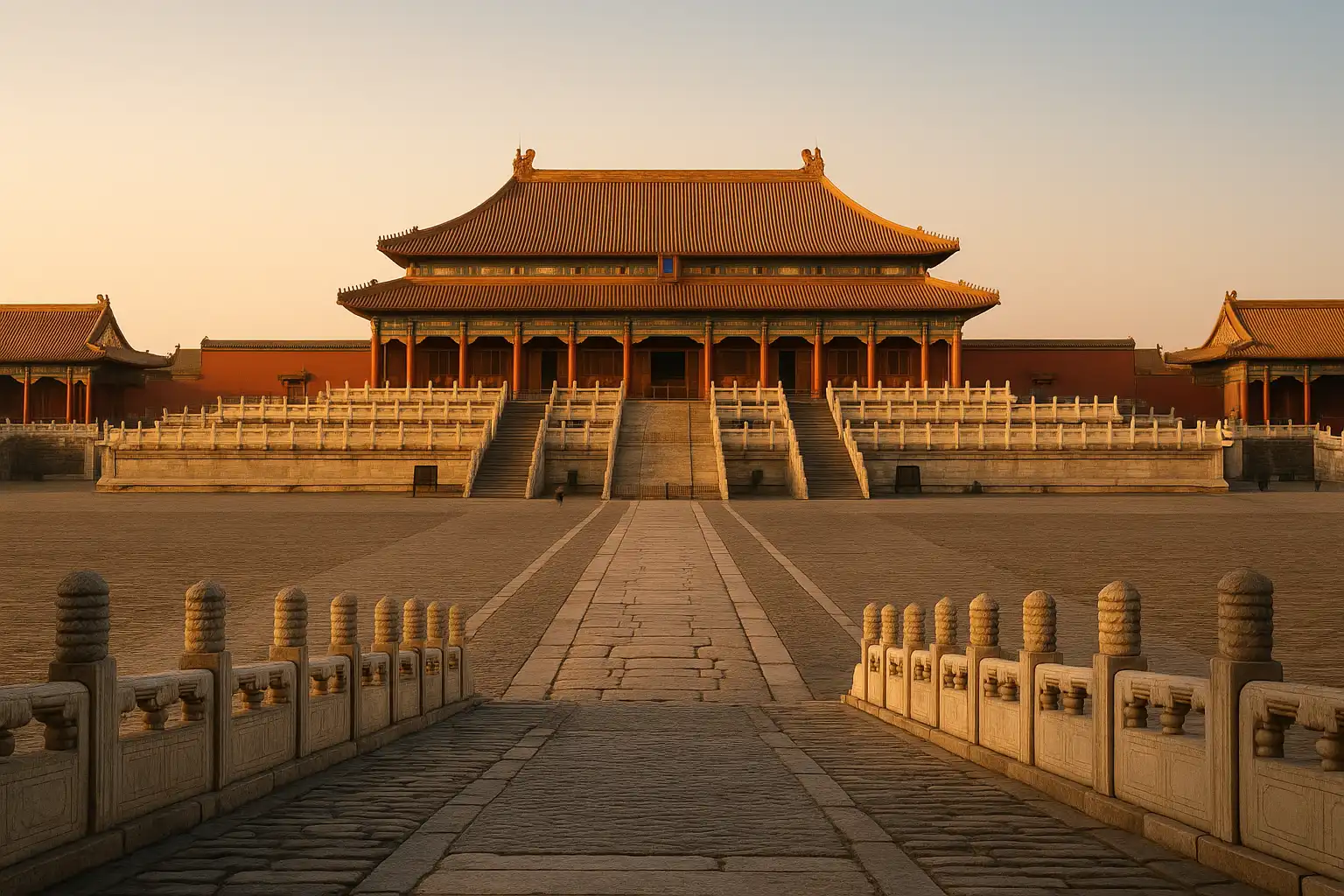
Forbidden City China Travel Guide 2026: Imperial Palace of Beijing
Chinese ImperialExplore the Forbidden City, China's imperial palace for 500 years. Discover the Hall of Supreme Harm...
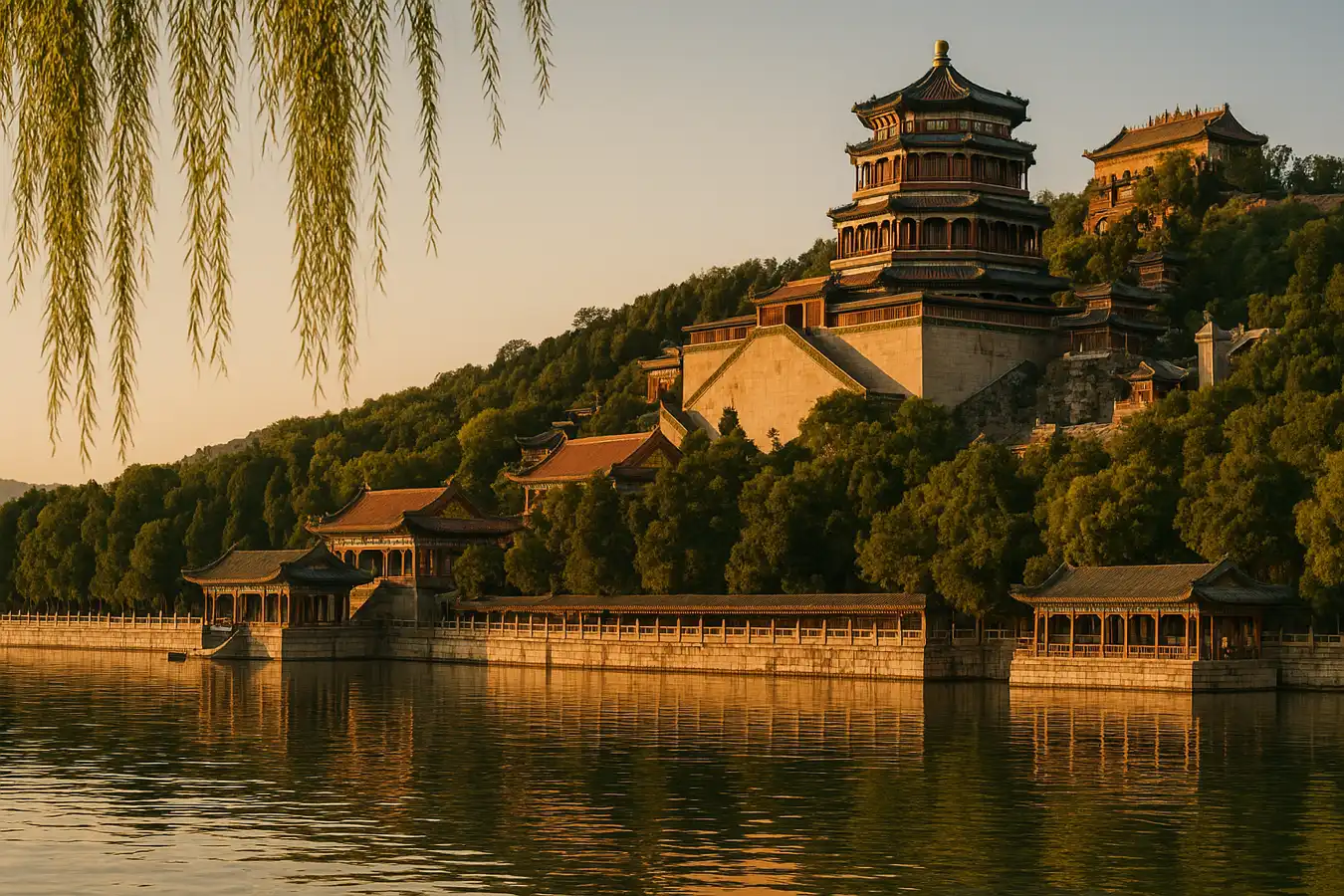
Summer Palace China Travel Guide 2026: Imperial Gardens of Beijing
Chinese ImperialExplore the Summer Palace, China's masterpiece of imperial garden design. Discover Kunming Lake, Lon...
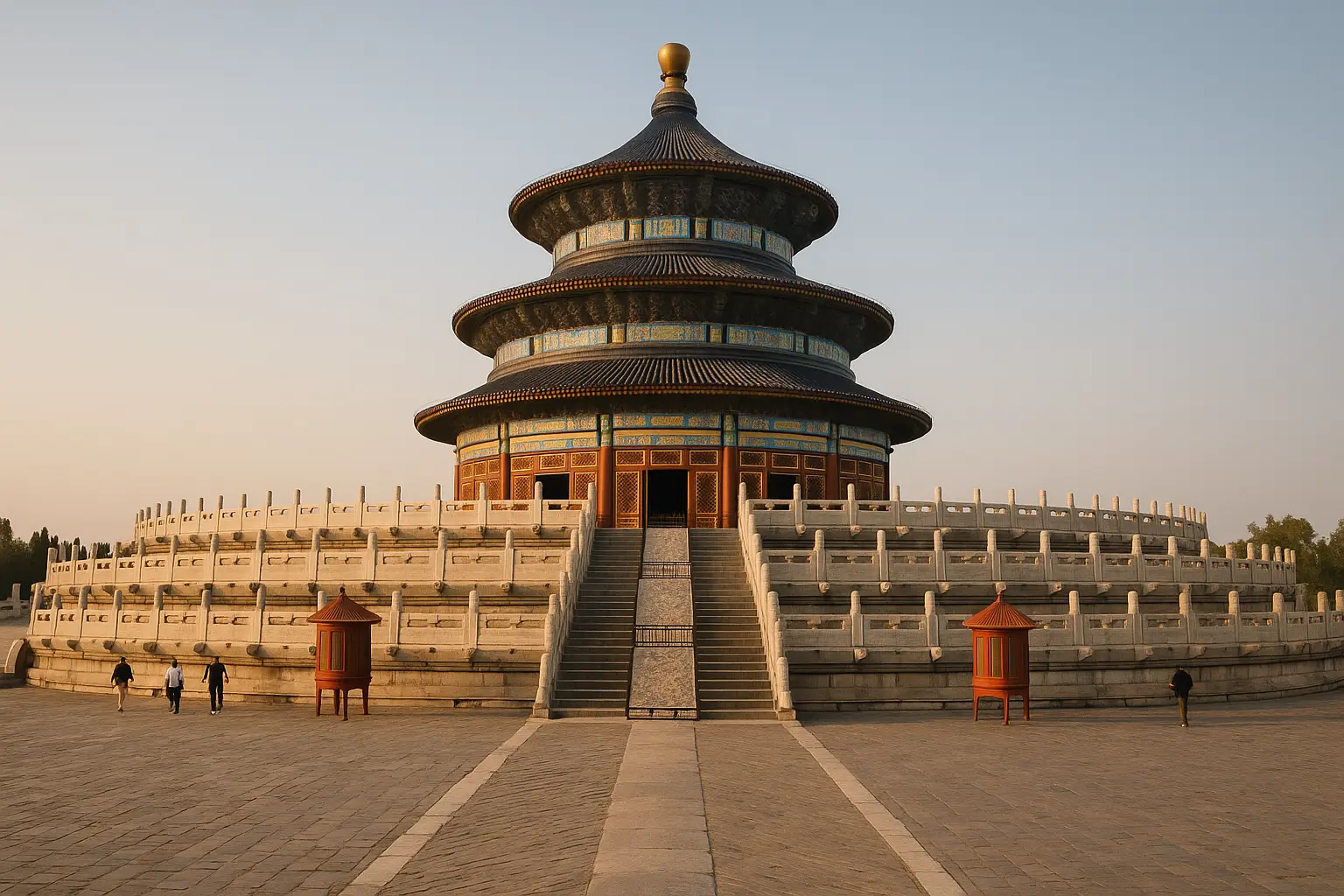
Temple of Heaven China Travel Guide 2026: Where Emperors Prayed
Chinese ImperialVisit the Temple of Heaven where Ming and Qing emperors prayed for good harvests. Explore the Hall o...