Quick Info
Curated Experiences
Alexandria City Tour with Montaza Palace Gardens
Private Alexandria Shore Excursion Including Montaza Palace
Montaza Palace and Alexandria Highlights Guided Tour
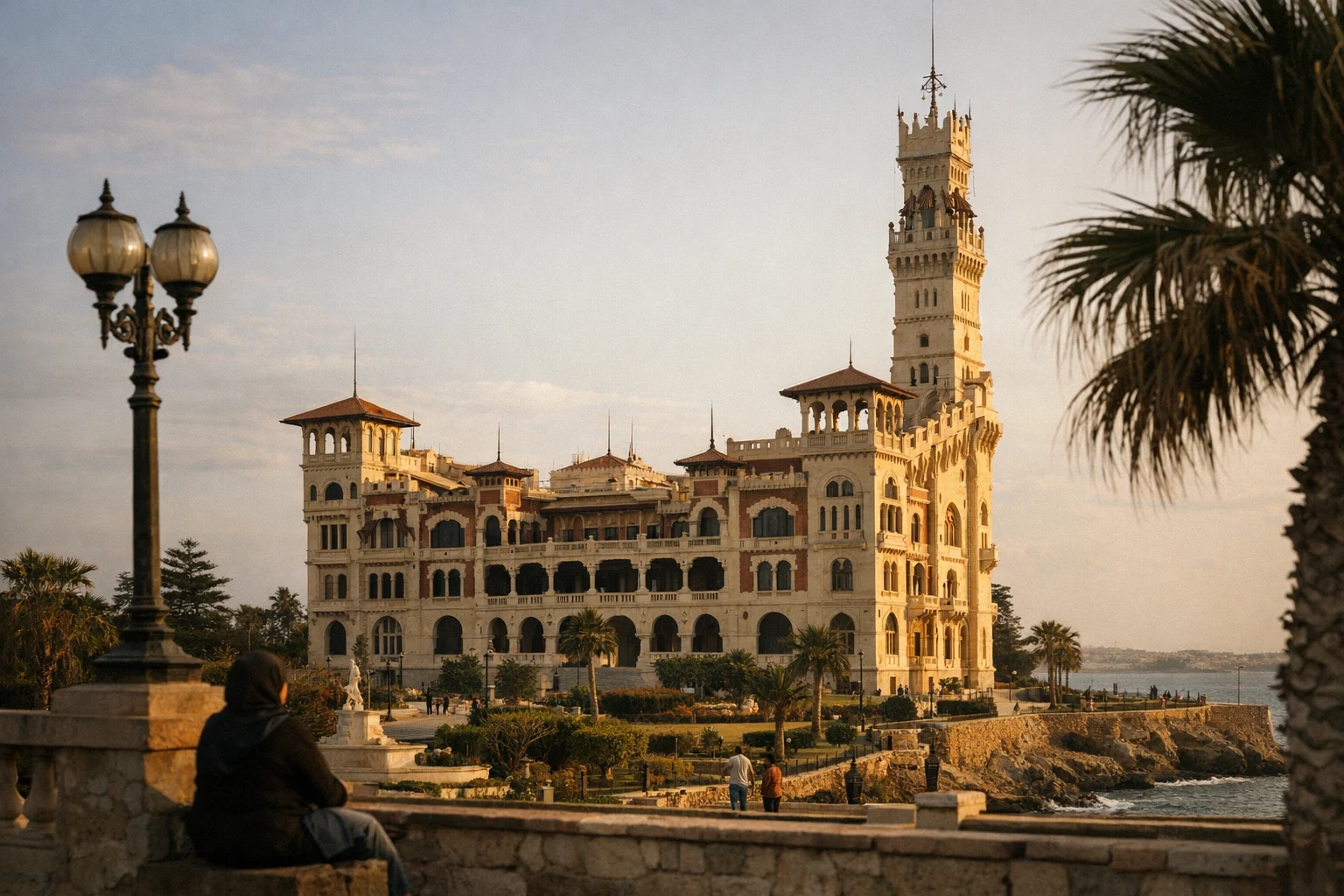
Montaza Palace in Egypt stands on the Mediterranean edge of Alexandria with a mood entirely different from the country’s pharaonic temples and desert tombs. Here the air smells of salt instead of dust, palm-lined grounds open toward the sea, and the architecture belongs not to ancient dynasties but to the final centuries of royal Egypt. The Montaza estate is best understood as a coastal retreat: a landscaped royal domain where gardens, beaches, towers, terraces, and palace buildings were arranged to catch breezes and project elegance rather than overwhelming sacred power. For travelers used to thinking of Egypt through pyramids and ruins, Montaza offers a useful correction. The country’s historical story did not stop in antiquity, and this seaside estate captures one of its most visually distinctive later chapters.
What makes Montaza memorable is the combination of setting and atmosphere. The palace complex rises above the coast in eastern Alexandria, surrounded by broad lawns, mature trees, promenades, and ornamental structures that feel almost Mediterranean-European in mood while remaining rooted in Egypt’s own royal history. The best-known building, with its towers and red-tiled rooflines, looks more like a royal fantasy on the sea than a seat of bureaucratic power. Visitors come partly for that striking silhouette, but they stay for the grounds: sea views, shaded walks, formal gardens, and the lingering sense of a monarchy that wanted beauty, privacy, and distance from the political intensity of Cairo. Montaza is therefore not just a palace stop. It is a landscape of leisure, image-making, and late dynastic memory on one of Egypt’s most storied coastlines.
History
A Royal Retreat in Late 19th-Century Egypt
Montaza Palace began as part of a broader transformation of Egypt during the late 19th century, when the ruling dynasty sought to express modern royal identity through new architecture, landscaped estates, and cosmopolitan taste. Khedive Abbas II is generally associated with the creation of the Montaza complex in the 1890s, choosing a coastal site east of Alexandria where the Mediterranean climate offered relief from summer heat. This choice mattered. Alexandria had long been Egypt’s great port city and Mediterranean gateway, and for the royal family it provided both prestige and relative seasonal comfort. A palace here was not simply a residence. It was a statement about refinement, international orientation, and dynastic lifestyle.
The site was developed as a retreat rather than a primary seat of power. That helps explain its atmosphere even today. Montaza was never meant to feel like a fortress or ceremonial capital. It was a place of escape, display, and cultivated leisure, where gardens, sea breezes, and architecture combined to produce a royal environment at some distance from Cairo’s political pressures. The palace grounds grew into a large estate that blended formal planning with scenic coastal appeal, creating one of the most distinctive modern royal landscapes in Egypt.
Abbas II, Dynastic Style, and Architectural Identity
The development of Montaza reflected the tastes and ambitions of Egypt’s ruling family in an age when architecture was deeply tied to identity. The late Muhammad Ali dynasty operated in a world shaped by Ottoman inheritance, European influence, and Egyptian self-fashioning. Montaza’s built language reflects that mixture. The estate’s structures include elements that feel Ottoman, Florentine, and Mediterranean, yet they were assembled in a specifically Egyptian royal context. This eclecticism was not accidental or confused. It was part of how modern dynasties expressed sophistication and worldliness.
Two structures became particularly associated with the estate: the larger Haramlek Palace and the smaller Salamlek building. Their names and functions reflect domestic and courtly traditions, but their appearance also signals a hybrid modern style. Towers, balconies, tiled roofs, arcades, and ornamental detailing created a palace complex that looked outward to the sea and to a wider Mediterranean world. In this, Montaza differs sharply from older inland palaces or administrative complexes. It was designed to be seen in relation to landscape, climate, and coastal pleasure.
Monarchy, Leisure, and the Final Royal Era
As the 20th century progressed, Montaza remained part of the royal orbit and became associated with the lifestyles of Egypt’s last monarchs, especially King Farouk. By this period, the estate had become more than a seasonal residence. It functioned as a stage for elite life, private retreat, and royal image. Photographs, memoirs, and popular memory all contributed to Montaza’s identity as one of the places where monarchy felt most visibly leisurely and insulated. The gardens, sea-facing buildings, and protected grounds reinforced the idea of a royal world oriented toward elegance and controlled escape.
That said, Montaza’s beauty sits against a more complicated political backdrop. The late monarchy in Egypt was marked by widening tensions, colonial entanglements, class imbalance, and rising nationalist dissatisfaction. Palaces like Montaza could therefore symbolize both charm and distance: refinement for some, privilege for others. This ambiguity is part of the site’s historical meaning. It represents a real architectural achievement and a real social world, but also one whose political foundations were becoming increasingly fragile.
After the Revolution and Into the Present
The 1952 revolution that ended the Egyptian monarchy changed the meaning of Montaza fundamentally. Like many royal properties, it moved from dynastic possession into a different relationship with the state and public memory. Some palace spaces were repurposed, access rules changed over time, and the estate began to function less as a private royal world and more as a public or semi-public historical landscape. The buildings remained, but the story attached to them shifted. Montaza was no longer a living royal retreat in the old sense. It became a monument to a vanished order.
In the decades since, the estate has continued to attract visitors for its gardens, seafront position, and architecture. It occupies an unusual place in Egyptian heritage: not ancient enough to belong to the standard tourist imagination of Egypt, but historically rich enough to reveal another major layer of the country’s past. That is part of why Montaza matters. It connects Alexandria’s coastal identity, modern Egyptian monarchy, and Mediterranean architectural aspiration in one unusually photogenic site. Today, the palace complex survives less as a museum of rooms than as a landscaped memory of royal Egypt on the sea.
Key Features
The most immediately striking feature of Montaza Palace is the architecture of the main palace building itself, especially the Haramlek Palace, whose towers and layered rooflines give it an almost storybook quality. It does not resemble the massive symmetry of European imperial capitals or the court architecture of older Islamic citadels. Instead, it feels deliberately picturesque. The red tiles, elevated massing, balconies, and decorative elements create a silhouette that is best appreciated from a slight distance across the gardens or from coastal viewpoints. This is a palace designed not only to house royalty, but to enchant the eye.
The Salamlek building adds to the estate’s architectural personality. Smaller and in some ways more intimate in impression, it complements the larger palace while reinforcing the estate’s character as a retreat rather than a single monolithic royal block. Together, these structures reveal how Montaza functioned as a composed environment. The buildings matter, but they matter in relation to one another and to the grounds. You do not visit Montaza only to look at facades. You visit to understand how architecture, open space, and coastline were choreographed into a royal experience.
The gardens are arguably the site’s greatest feature for most modern visitors. Broad lawns, mature palms, ornamental trees, flower beds, and sea-facing promenades give Montaza a spaciousness that is rare in dense urban Alexandria. The estate feels designed for walking, pausing, and looking outward. The vegetation softens the palaces’ edges and creates an atmosphere of cultivated calm. Because the Mediterranean is never far away, the light behaves differently here than at inland Egyptian sites. Water, sky, and greenery continuously modify the experience of the stone and plaster structures.
The coastal setting itself is essential. Montaza’s position above the sea makes it one of the most scenic palace sites in Egypt. Rocky shorelines, open horizons, and marine air give the estate an immediacy that many inland palaces lack. This setting is not just attractive; it explains why the site was built here in the first place. The palace and gardens were conceived as a climate-conscious royal refuge, and the coast is the central reason they work so well. Even travelers who are only moderately interested in royal history often find Montaza rewarding because the setting is pleasurable on its own terms.
Another key feature is the estate’s ability to show a less commonly discussed phase of Egyptian history. Montaza offers architecture of monarchy, modernity, and Mediterranean aspiration rather than temple ritual or pharaonic burial. That makes it especially interesting for visitors who want a broader sense of Egypt’s historical texture. It also means the emotional tone of a visit is different. Instead of awe in the face of deep antiquity, Montaza offers something closer to reflective elegance: a landscape of privilege, leisure, and vanished political worlds.
Getting There
Montaza Palace is located in eastern Alexandria, and most visitors reach it easily from central city neighborhoods by taxi, rideshare, or private car. Depending on traffic, the trip from central Alexandria usually takes around 20 to 40 minutes. Taxi fares vary with negotiation and route, but many travelers should expect something in the rough range of 80 to 250 EGP for a one-way trip within the city. App-based rides can be simpler if available, especially for visitors who prefer price transparency. If you are arriving by cruise excursion or private Alexandria tour, Montaza is often included alongside the Bibliotheca Alexandrina, the Catacombs of Kom el Shoqafa, Pompey’s Pillar, or the Qaitbay Citadel.
For travelers coming from Cairo, Alexandria itself is reachable by train, private driver, or intercity bus, and Montaza can then be added as part of a city day tour or overnight stay. Many organized Alexandria excursions from Cairo include a stop at Montaza because it offers a visually appealing contrast to the city’s Greco-Roman and Islamic landmarks. This is especially useful for first-time visitors trying to understand how many layers of history Alexandria contains.
Once you arrive, the main effort is walking the grounds rather than navigating a complex approach. Wear comfortable shoes and allow extra time if you enjoy photography or prefer a slower garden visit. Since the estate is more about atmosphere than interior access, transport planning is the main practical concern rather than timed palace-entry logistics.
When to Visit
Montaza Palace can be visited year-round, but the best seasons are usually spring and autumn, when Alexandria’s Mediterranean climate is at its most pleasant. During these months, the gardens are inviting, sea breezes feel refreshing rather than chilly, and walking the estate becomes one of the site’s real pleasures. Spring in particular can be beautiful, with softer light and more comfortable temperatures for lingering outdoors.
Summer is also popular because Alexandria is a classic warm-weather destination and Montaza’s coastal setting becomes especially attractive in hot months. Compared with inland Egyptian cities, Alexandria remains more manageable, and the sea air helps. That said, summer can also be busier, with more local visitors enjoying the grounds and waterfront. If you want a calmer experience in warm weather, go early in the morning or later in the afternoon.
Winter is perfectly viable for visiting, especially on clear days. The atmosphere becomes quieter, and the coastal light can be striking, though some days may feel windy. Unlike desert sites that are largely improved by winter alone, Montaza works in multiple seasons because its appeal depends as much on gardens and sea views as on avoiding extreme heat. Whenever you go, late afternoon is especially rewarding for photography, when the palace architecture and coastal horizon soften into warmer tones.
| Quick Facts | Details |
|---|---|
| Location | Alexandria Governorate, Egypt |
| Best Known For | Royal seaside palace estate, gardens, and Mediterranean views |
| Main Historical Association | Late Muhammad Ali dynasty and Egyptian monarchy |
| Signature Buildings | Haramlek Palace and Salamlek building |
| Setting | Coastal estate on the Mediterranean in eastern Alexandria |
| Recommended Visit Length | 1.5 to 3 hours |
| Best Nearby Base | Alexandria |
| Best Seasons | Spring and autumn |
| Typical Experience | Garden walks, palace exteriors, sea views, and royal-history context |
| Practical Tip | Go in the late afternoon for the best light and a more relaxed coastal atmosphere |
Frequently Asked Questions
What is Montaza Palace best known for?
Montaza Palace is best known for its royal seaside setting in Alexandria, its extensive gardens, and the distinctive Salamlek and Haramlek palace buildings associated with Egypt’s late monarchy.
Can you go inside Montaza Palace?
Access policies vary, but most visitors primarily explore the Montaza Palace gardens and exterior grounds rather than the full palace interiors.
Is Montaza Palace worth visiting in Alexandria?
Yes, especially if you want a different side of Egyptian history beyond antiquity, with royal architecture, sea views, landscaped grounds, and a more leisurely atmosphere.
How much time should you spend at Montaza Palace?
Most travelers should allow 1.5 to 3 hours to enjoy the gardens, coastal views, and palace exteriors without rushing.
How far is Montaza Palace from central Alexandria?
Montaza Palace is located in eastern Alexandria and is usually around 20 to 40 minutes from the city center, depending on traffic.
When is the best time to visit Montaza Palace?
Spring and autumn are especially pleasant, but Montaza can be visited year-round thanks to Alexandria’s milder Mediterranean climate compared with inland Egypt.
Nearby Ancient Sites
Great Sphinx of Giza Egypt Travel Guide 2026: Guardian of the Pyramids
Ancient EgyptianVisit the Great Sphinx, Egypt's enigmatic limestone guardian. Our guide covers the Sphinx's history,...
Abydos Temple Egypt Guide 2026: Temple of Seti I & King List
New Kingdom-PtolemaicAbydos Temple near Luxor: magnificent Temple of Seti I with war reliefs, ancient king list, and vibr...
Dendera Temple Complex Egypt Guide 2026: Temple of Hathor & Zodiac Ceiling
Ptolemaic-RomanExplore Dendera's magnificent Temple of Hathor near Luxor. Star-mapped zodiac ceiling, Ptolemaic arc...
Karnak Temple Complex Egypt Travel Guide 2026: Egypt's Greatest Temple
Ancient EgyptianExplore Karnak, the world's largest ancient religious complex. Discover the Hypostyle Hall, Sacred L...