Quick Info
Curated Experiences
Mount Huashan Day Trip from Xi'an
Xi'an to Huashan Hiking & Temple Tour
Huashan Night Hiking Experience
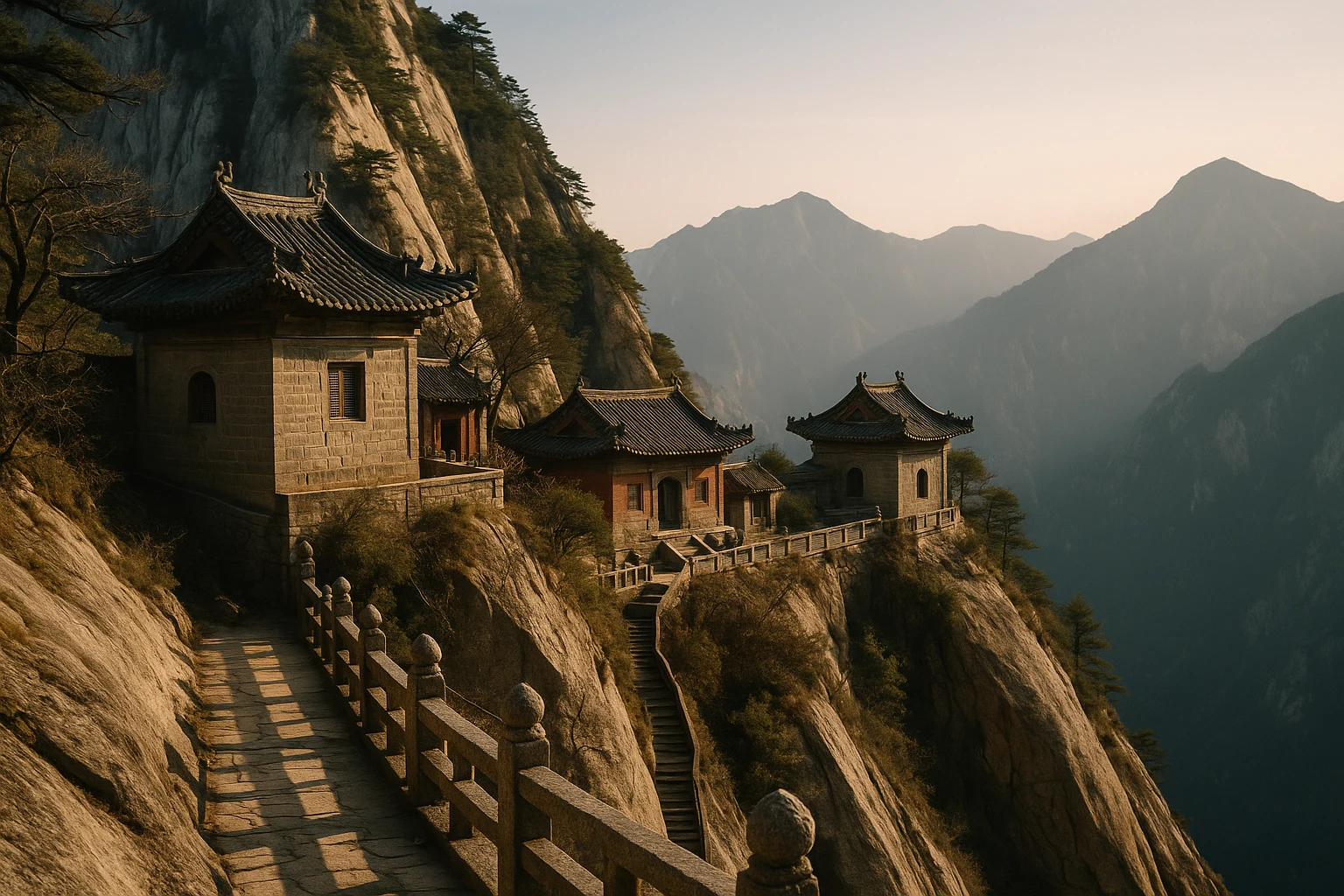
Rising from the Wei River plain of Shaanxi Province in a sudden eruption of bare granite, Mount Huashan has arrested the human imagination for more than two millennia. Five great peaks cluster around a single massif, their near-vertical walls scored by fissures and draped in ancient chains. Daoist hermits were drawn here precisely because of that drama: a mountain so forbidding seemed already consecrated to heaven. Today, scores of temples, shrines, and pavilions perch on ledges that look engineered by myth rather than mortar, making Huashan one of the most visually arresting sacred landscapes anywhere in East Asia. Pilgrims still burn incense at altars that have occupied the same cliff faces since the Han dynasty. Hikers inch across the legendary Plank Walk, hearts hammering, eyes fixed on nothing but chain and sky. Both groups are in dialogue with the same mountain, reading the same vertical text in their own idiom.
A Mountain Sacred Since the Han
Huashan’s spiritual biography begins formally in the second century BCE, when the first Daoist practitioners settled on its flanks and established what became Yuquan Temple at the mountain’s base. The temple’s founding is traditionally attributed to a Han-era hermit named Xie Mengzhi, though the site accumulated the usual layers of legend over subsequent centuries. By the Tang dynasty (618–907 CE), imperial courts recognised Huashan as one of the Five Sacred Mountains of China — Wuyue — assigning it the western cardinal position and the ritual title Xiyue, the Western Sacred Peak. This designation carried concrete consequences: emperors sent envoys to perform state sacrifices, and the imperial treasury helped fund construction of temples and pathways.
The Tang and Song periods saw the most intensive burst of building activity. Jade Spring Monastery, roughly midway up the north route, was expanded into a significant monastic complex where pilgrims could rest before the brutal ascent. During the Song dynasty a separate Quanzhen school of Daoism gained a foothold on the mountain, and the gentle competition between the Zhengyi and Quanzhen sects generated a small flowering of new shrines, each group eager to stake its presence on the peaks. Many of the carved inscriptions that embellish Huashan’s rock faces date from this era — calligraphy cut deep enough to survive eight centuries of frost and rain.
The Ming dynasty (1368–1644) brought bureaucratic organisation to what had been loosely administered sacred space. Officials catalogued the temples, codified their ritual calendars, and oversaw repairs following damage from several earthquakes that rattle the Wei River fault zone. The great gateway arch at the mountain’s foot, Huashan Gate, and the formal stone-paved pilgrim road through the Thousand-Foot Gorge both reached their present form during the Ming and early Qing periods. By the eighteenth century the mountain’s outline — five peaks, a thousand chains, a constellation of tilted rooftops — had become one of the most reproduced images in Chinese painting and woodblock print culture.
The Five Peaks and Their Temples
Huashan’s topography organises the sacred landscape into a clear hierarchy. North Peak (Yunti Feng, Cloud Ladder Peak, 1,614 m) is the first summit reached by the northern cable car and by the main hiking path ascending through the Thousand-Foot Gorge and Hundred-Foot Gorge. Its summit platform holds a cluster of modest shrines including the Zhenwu Palace, dedicated to the Supreme Ruler of the Dark Heaven, a militaristic Daoist deity particularly venerated during the Ming. North Peak functions as a crossroads, the point from which ridge paths diverge toward all remaining summits.
East Peak (Chaoyangfeng, Facing the Sun, 2,082 m) offers the finest sunrise views on the mountain. The Sun and Moon Pavilion on its edge is perhaps the most photographed structure at Huashan: a small stone gazebo silhouetted against the drop, with nothing visible below but cloud and the faint grid of the Wei River valley. Daoist priests maintain a small temple here dedicated to the Jade Emperor.
South Peak (Luoyanfeng, 2,154.9 m) is the highest and in some sense the most daunting. It is the terminus of the Plank Walk in the Sky — a sequence of narrow wooden planks bolted horizontally into a vertical cliff face, traversed by gripping overhead chains and shuffling sideways above a sheer drop of several hundred metres. Though it now serves as a tourist thrill rather than a solitary ascetic ordeal, the route originated as a genuine test undertaken by Daoist practitioners seeking remote meditation caves accessible by no other path. The shrine complex at South Peak includes the Golden Lock Pass, where lovers and pilgrims affix padlocks to iron chains — a custom that has become ubiquitous on sacred Chinese peaks.
West Peak (Lianhuafeng, Lotus Flower Peak, 2,082 m) is named for its profile, which from certain angles resembles an open lotus blossom. Its summit temple, the Cuiyun Palace (Jade Cloud Temple), is dedicated to the Daoist deity Xiao Sheng, and an enormous axe-shaped boulder nearby is explained by legend as the stone split by the hero Chen Xiang to free his mother from divine imprisonment — a tale dramatised in the classic opera Bao Lian Deng. The axe-shaped rock and the nearby stone inscribed with the character for “axe” have made West Peak a favourite for literary pilgrims acquainted with the legend.
Middle Peak (Yunü Feng, Jade Lady Peak, 2,037 m) is the smallest summit and carries the least temple infrastructure, though a shrine to the Jade Lady — a figure of disputed identity in the Daoist canon, sometimes identified as a daughter of the Mountain God — occupies its crest. Tradition holds that the Jade Lady taught an immortal the art of cultivating inner elixir here, and the peak’s forested shoulders feel noticeably quieter than the other four.
The Thousand-Foot Gorge and the Old Pilgrim Road
Before the northern cable car opened in 1996, every visitor arrived the same way: through the long cleft of the Thousand-Foot Gorge, a slot canyon whose walls rise so steeply that sunlight reaches the floor only at midday. The path through the gorge is paved with stone and lined in places with iron handrails, but it remains genuinely demanding — the gradient is relentless and certain sections are cut as steps into near-vertical rock. Descending from the gorge the path threads through the Hundred-Foot Gorge, narrower still and at points requiring pilgrims to press their backs against the stone and edge sideways. This route, collectively called the East Route or the traditional pilgrimage path, is the preferred ascent for those who want to understand Huashan as it was experienced for eighteen centuries before mechanised access.
A secondary route, the West Route, descends more gradually from the col between North and West Peaks through pine forest. Historically this was used for descent, and many hikers still make a loop of it: ascending by the gorge route, traversing the ridge from peak to peak, then returning via the West Route to the cable car. The combination takes a full day and involves an estimated 12–15 kilometres of trail and more than 2,000 steps.
Daoist Life on the Mountain Today
Huashan is not merely a preserved relic. Ordained Daoist priests live permanently in residence at several of the summit temples, maintaining ritual schedules, receiving offerings, and performing ceremonies tied to the lunar calendar. The mountain’s Daoist association is affiliated with the Chinese Daoist Association and maintains an active relationship with the Quanzhen school, whose founder Wang Chongyang established a legendary connection to the mountain in the twelfth century when he is said to have met and exchanged poems with a Huashan hermit. The chess game that supposedly took place in the Chess Pavilion between Wang Chongyang and his interlocutor — with the mountain itself as the wager — is commemorated in reliefs and inscriptions that visitors still pause to examine.
Pilgrimage intensifies around the spring and autumn equinoxes, during the Qingming festival in early April, and during the Ninth Month Double Ninth festival (Chongyang), when climbing to high places is a ritual imperative in Chinese tradition. On these dates the air above the incense burners thickens, temple bells ring the hours, and the ordinary transaction of tourism tips briefly into something more archaic.
Getting There
By high-speed train: Xi’an North Station to Huashan North Station, approximately 40 minutes. Trains run frequently throughout the day. From Huashan North Station, shuttle buses run to the north cable car terminus (Huashan Scenic Area North Gate).
By long-distance bus: Buses from Xi’an’s Textile City East Bus Station reach the Huashan Town (Yuquan Yard) trailhead, which is the starting point for the traditional East Route gorge path. Journey time approximately 2 hours depending on traffic.
By car or private transfer: The mountain lies roughly 120 kilometres east of Xi’an along the G30 expressway. Authorised shuttle buses are required inside the scenic area; private vehicles park at the base.
Cable cars: Two cable cars serve the mountain. The northern cable car connects Huashan North Gate directly to North Peak (roughly 8 minutes). The western cable car connects the West Gate terminus to the col between West and South peaks. Both are subject to closure during high winds.
When to Visit
Spring (April–June) is the classic recommendation: wildflowers on the middle slopes, bearable temperatures for climbing, and clear skies above the often misty winter plain. Autumn (September–October) offers similar conditions with the added spectacle of turning maple leaves on the lower ridge. Summer brings both the greatest crowds and the risk of afternoon thunderstorms; the trails become dangerously slick when wet and lightning exposure on the exposed ridgelines is a genuine hazard. Winter ascents are undertaken by hardy visitors and night-hiking devotees but require traction devices: the stone steps ice over thoroughly.
Sunrise hikes are a deep-rooted tradition. Night hikers ascend from roughly midnight, armed with headlamps, to reach East Peak before dawn. The experience is both strenuous and transcendent in clear weather; in cloud, the sunrise becomes a luminous diffusion rather than a disc, which is in its way equally compelling. Accommodation at the summit — basic but functional guesthouses — means the experience is accessible without requiring a full night’s hiking ability.
Combining Huashan with Nearby Sites
Mount Huashan fits naturally into any itinerary centred on Xi’an, itself one of the densest concentrations of antiquity in China. The Terracotta Army at Lintong — the buried ceramic legions of China’s first emperor Qin Shi Huang — lies roughly 40 kilometres west of the mountain and is an obvious pairing. The Xi’an City Wall, one of the best-preserved medieval city fortifications in the world, and the Shaanxi History Museum, whose collection of Zhou, Qin, and Tang artefacts is among the richest in Chinese archaeology, both reward a day each in the city itself.
Visitors with deeper interests in Daoist sacred geography can extend their journey to the other Sacred Mountains: Taishan in Shandong to the east, Songshan in Henan (where the Shaolin Monastery stands), or Hengshan in Shanxi to the north. Each has its own character, but Huashan’s combination of sheer verticality, well-preserved temple infrastructure, and proximity to a major transport hub makes it the most accessible introduction to this tradition.
Why Mount Huashan Still Matters
In an era when most sacred mountains have been effectively converted into scenic-area theme parks — with entry gates, gift shops, and carefully managed viewpoints — Huashan manages a rarer trick. The mountain genuinely defends itself. Its cliffs are too steep for the usual apparatus of tourist infrastructure to fully colonise. The temples remain functional places of worship with resident clergy. The Plank Walk cannot be made comfortable: it is what it always was, a ledge bolted to a cliff above nothing. This is not wilderness in the Western sense — the stone is worn smooth by millions of feet, the chains are regularly replaced, and there is a cable car — but there is no escaping the mountain’s own terms. Huashan asks something of every visitor, and that demand, whether answered by devotion, athleticism, or simple courage, is the thing that keeps the site alive across the centuries.
Quick Facts
| Detail | Information |
|---|---|
| Location | Huayin City, Shaanxi Province, China |
| Coordinates | 34.4869°N, 110.0851°E |
| Highest Peak | South Peak (Luoyanfeng), 2,154.9 m (7,070 ft) |
| Designation | One of China’s Five Sacred Mountains (Wuyue); Western Sacred Peak |
| Primary Religion | Daoism (Quanzhen and Zhengyi schools) |
| Entry Fee | CNY 180 peak season; cable car ticketed separately |
| Best Access | High-speed train from Xi’an (~40 min) |
| Main Temples | Yuquan Temple, Jade Spring Monastery, Zhenwu Palace, Cuiyun Palace |
| Key Feature | Plank Walk in the Sky (mandatory harness route) |
| UNESCO Status | Not separately listed; part of broader Wuyue cultural heritage |
| Nearest Major City | Xi’an, ~120 km west |
| Recommended Stay | 1–2 days (overnight summit stay for sunrise) |
Explore More
Huashan’s peaks reward those who resist the temptation to check every summit off a list in a single frantic day. The mountain’s silences — in the hours before dawn on East Peak, on the forested path descending the West Route, in the incense smoke of a working temple that has not been converted into a café — are available to any visitor willing to slow down and stay longer. Two thousand years of pilgrimage have established what the mountain offers. The terms have not changed much.
Frequently Asked Questions
How do I get to Mount Huashan from Xi'an?
High-speed trains run from Xi'an North Station to Huashan North Station in about 40 minutes. From there, shuttle buses connect to the mountain's north cable car or the traditional east gate trailhead. The full journey takes roughly 1.5–2 hours.
Is Mount Huashan dangerous?
Certain sections — especially the Plank Walk in the Sky on South Peak — are genuinely exposed and require clipping a harness to a chain railing. The main summit trails are well-maintained and manageable for reasonably fit hikers, but the sheer granite faces are not suited to those with severe vertigo.
What temples are on Mount Huashan?
The mountain hosts more than a dozen Daoist shrines and temples, including Yuquan Temple at the base, Jade Spring Monastery halfway up, and the Five Peak temples crowning each summit — North, South, East, West, and Middle Peaks. The Chess Pavilion and Immortal Palm Cliff are among the most photographed.
Can you visit Mount Huashan overnight?
Yes. Budget guesthouses operate near the East Peak and South Peak, allowing pilgrims and hikers to watch the sunrise from the summits — a beloved tradition. Book well in advance during Golden Week holidays.
Do I need to book tickets in advance?
Online advance booking is strongly recommended during public holidays and summer weekends, when the mountain can reach daily visitor caps. The park's official ticketing platform accepts WeChat Pay and Alipay. International visitors can also purchase through authorised third-party booking agents.
What is the elevation of Mount Huashan?
South Peak (Luoyan, Wild Goose Landing) is the highest point at 2,154.9 metres (7,070 ft). The other four main peaks range from roughly 1,614 m (North Peak) to 2,082 m (East Peak).
Is the Plank Walk safe?
The Plank Walk in the Sky is a narrow series of wooden boards bolted into a cliff face at roughly 2,100 metres. Safety harnesses and clip systems are mandatory and provided on site. It is physically demanding and not recommended for those with heart conditions, vertigo, or limited upper-body strength.