Quick Info
At a glance
Mungo National Park in Australia is a place where deep time seems visible on the surface. In the far west of New South Wales, among dry lake basins, low scrub, and pale dunes shaped by ancient winds, the landscape carries traces of human life stretching back tens of thousands of years. This is not a monumental site in the classical sense: there are no towering temples or stone fortifications. Instead, Mungo’s power comes from exposure, silence, and the way the land itself preserves memory.
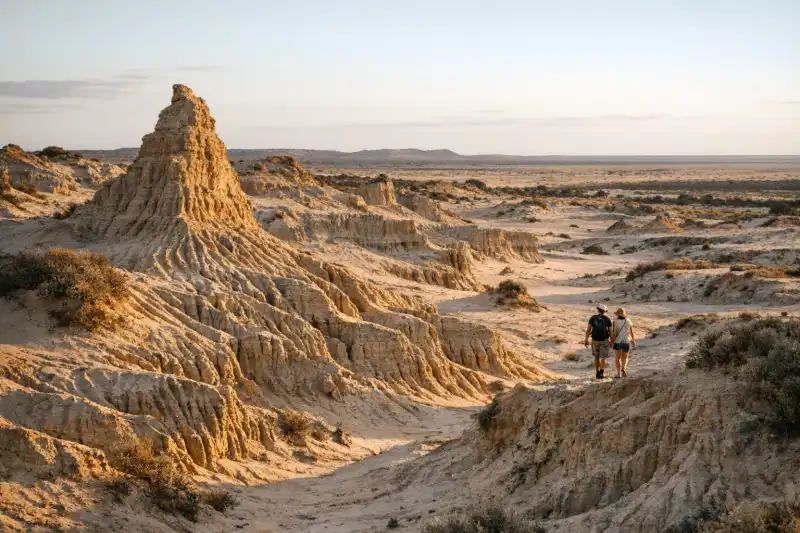
Part of the Willandra Lakes Region World Heritage Area, the park protects one of the most important archaeological and cultural landscapes in Australia. Here, long-dried lakes once attracted abundant animal life and supported generations of Aboriginal people, whose descendants remain deeply connected to country today. The most famous landform, the crescent-shaped lunette known as the Walls of China, rises in chalky ridges and eroded forms above the former shorelines. In these sediments, hearths, footprints, stone tools, and burials have transformed the global understanding of human antiquity on the continent.
For travelers, Mungo National Park offers something rare: the chance to stand inside an environment that feels both starkly beautiful and intellectually profound. Sunrise and sunset reveal bands of cream, rust, and grey across the dunes, while the empty lakebeds suggest a vanished inland world. Visiting is not simply scenic; it is an encounter with an ancient cultural landscape whose significance still unfolds through archaeology, oral tradition, and careful stewardship.
History
Ancient lakes and the first peoples
The story of Mungo National Park begins long before the park itself existed. During the late Pleistocene, the Willandra Lakes system held water in a chain of lakes fed by rivers flowing across what is now arid country. Around these freshwater margins, Aboriginal people lived, traveled, hunted, gathered shellfish, and made use of the rich ecological resources available along the shores. Archaeological evidence from the region indicates human presence at least 40,000 years ago, and likely earlier, placing Mungo among the most important records of early human life in Australia.
As lake levels rose and fell over thousands of years, the shores shifted. Winds built lunettes—crescent-shaped dune formations—on the eastern sides of the lakes. These sediments trapped and preserved traces of activity: fireplaces containing burnt bone and charcoal, discarded stone artifacts, and burials. Unlike many ancient places where evidence lies buried beneath later settlement layers, Mungo’s history is often visible in exposed sediment, though this also makes it fragile and vulnerable to erosion.
For Aboriginal communities connected to the region, Mungo is not merely an archaeological archive. It is country, part of a living cultural world in which ancestral presence and knowledge continue into the present. Scientific dating methods have drawn global attention to the antiquity of the site, but the deeper significance of Mungo rests equally in continuing custodianship by Traditional Owners.
Discovery, excavation, and global importance
In the twentieth century, pastoral activity and scientific interest brought wider attention to the ancient lakebeds. The major turning point came in 1968, when geologist Jim Bowler identified human remains at Lake Mungo, later known as Mungo Lady. Her cremated remains became one of the world’s earliest known examples of ritual cremation, an extraordinary finding that reshaped understanding of early symbolic behavior in Australia and beyond.
A few years later, in 1974, another major discovery was made: the remains known as Mungo Man. These remains, found in the dunes, became central to debates about the antiquity of human occupation in Australia. Dating has been contested over time, but the broader significance remains clear. The discoveries demonstrated that people had lived in this region during a much wetter climatic phase tens of thousands of years ago, and that they practiced complex funerary traditions.
These finds drew archaeologists, geologists, and physical anthropologists from around the world. Excavation at Mungo revealed an intricate picture of changing environments and long-term adaptation. Stone tools, grinding stones, shell middens, hearths, and animal remains all contributed to the reconstruction of prehistoric life around the lakes. The landscape showed that ancient Australians were not temporary wanderers in a hostile desert but highly skilled communities adapting to dynamic environments over immense spans of time.
At the same time, scientific investigation raised serious questions about the ownership of ancestral remains and the authority to interpret the past. Over the late twentieth century, Aboriginal calls for respect, repatriation, and shared management became increasingly central to Mungo’s story.
Protection, World Heritage, and joint management
Recognition of the area’s importance led to formal protection. Mungo National Park was established in 1979, and the wider Willandra Lakes Region was inscribed on the UNESCO World Heritage List in 1981 for both cultural and natural values. This dual recognition reflects how inseparable environment and human history are at Mungo: the dry lakebeds, dunes, and sediments are the very medium through which the deep human past is known.
From the late twentieth century onward, management shifted toward greater inclusion of Traditional Owners. The park today is associated especially with the Barkandji/Paakantyi, Mutthi Mutthi, and Ngiyampaa peoples, whose voices have become essential in interpretation and protection. The return of ancestral remains, including the long campaign concerning Mungo Man, marked an important step in addressing earlier scientific practices that had marginalized Indigenous authority.
Modern conservation at Mungo balances public access, research, and cultural sensitivity. Erosion naturally reveals new traces but also threatens them. Visitors are encouraged to stay on marked routes, and many of the most sensitive areas are accessible only through guided experiences. This approach reflects a broader understanding: Mungo is not a static ruin but a living cultural landscape where heritage must be protected in partnership with those to whom it is most deeply connected.
Key Features
The defining feature of Mungo National Park is the landscape itself. The most famous section, the Walls of China, is a dramatic lunette running along the edge of ancient Lake Mungo. Formed by windblown sediments over millennia, it appears as a series of sculpted ridges and gullies in pale beige, white, pink, and orange tones. In changing light, the formation looks almost unreal, especially at dawn and dusk when shadows sharpen every contour. This is where many of the park’s most significant archaeological finds were made, and where visitors most clearly sense the mixture of beauty and vulnerability that defines Mungo.
Equally striking are the dry lakebeds. Today they stretch wide and flat beneath enormous skies, but they were once living water bodies that sustained fish, birds, shellfish, and game. Walking or driving near these basins requires a degree of imagination: the silence of the present conceals a far richer ancient ecology. Interpretive materials help visitors understand how dramatically the climate and hydrology of inland Australia have changed since the Pleistocene. The emptiness is part of the experience, but so is the realization that this was once a productive and inhabited world.
The Mungo Visitor Centre provides essential context. Exhibits explain the geology of the lunettes, the archaeology of the burials and hearths, and the continuing cultural importance of the region to Aboriginal peoples. For many travelers, this is the best place to begin, since the landscape can seem abstract without background. Learning about the discoveries of Mungo Lady and Mungo Man before heading into the dunes makes the park more legible and far more powerful.
Another key feature is the park’s network of self-drive and walking experiences. The Mungo self-guided drive loop takes visitors through several representative environments, including lunettes, sand plains, former shorelines, and pastoral heritage sites. Along the route, short stops and lookouts reveal how varied the park is beyond its most photographed ridges. There are also traces of more recent history, including historic sheep station buildings that tell the story of European pastoral occupation in the outback. These structures do not overshadow the park’s ancient significance, but they do show another chapter in the changing use of the land.
Guided Aboriginal tours are among the most meaningful ways to experience Mungo. These tours often provide access and interpretation not available through signs alone, connecting archaeological evidence with cultural knowledge and lived relationships to country. Rather than treating the site purely as a prehistoric puzzle, such experiences emphasize continuity, responsibility, and memory. For visitors unfamiliar with Australian Indigenous heritage, this can be one of the most illuminating aspects of the park.
Wildlife and atmosphere also matter here. Though Mungo is best known for archaeology, the park supports kangaroos, emus, wedge-tailed eagles, and a range of arid-zone species. Vegetation is sparse in places but ecologically important, adapted to low rainfall and fragile soils. The vast horizons, clear night skies, and outback quiet are central to the destination’s appeal. Mungo is a place to observe carefully rather than rush through. Its key features are not crowded together; they unfold gradually, with distance and stillness as part of the design.
Getting There
Mungo National Park is remote, and reaching it is part of the experience. The most practical gateway for many visitors is Mildura in Victoria, which has an airport with regular flights from Melbourne, Sydney, and Adelaide. Return airfares vary by season, but domestic fares commonly range from about AUD 180 to AUD 450 when booked in advance. From Mildura, the park is roughly a 1.5- to 2.5-hour drive depending on route and road conditions. Car rental in Mildura often starts around AUD 70 to AUD 120 per day for a standard vehicle, though higher-clearance vehicles may cost more.
Another approach is via regional towns in western New South Wales such as Balranald, from which the park is around 110 kilometers away. If you are self-driving from Sydney, expect a long journey of roughly 9 to 10 hours; from Melbourne, around 6.5 to 7.5 hours is typical. Fuel prices in outback areas are usually higher than in major cities, so budget accordingly.
Road conditions matter more here than in many national parks. Some access roads are unsealed and may become difficult or temporarily closed after rain. A 4WD is not always essential, but checking conditions with New South Wales National Parks before departure is strongly recommended. There is usually a park entry fee per vehicle, generally around AUD 8 to AUD 12, though rates can change.
Accommodation includes camping and lodge-style options near or within the park area, with campsites often costing around AUD 20 to AUD 40 per night and rooms considerably more. Bring water, snacks, and a full tank whenever possible: services are limited, and distances in this region feel much larger than they appear on a map.
When to Visit
The best time to visit Mungo National Park is generally from April to October, when temperatures are milder and exploring outdoors is far more comfortable. During autumn and spring, daytime conditions are often ideal for scenic drives, short walks, and photography. Morning and late afternoon light also brings out the extraordinary colors of the Walls of China, making these seasons especially rewarding for first-time visitors.
Winter, from June to August, can be excellent if you do not mind cold mornings and evenings. Daytime temperatures are usually pleasant for walking, and the lower sun angle can create dramatic contrasts across the dunes and dry lakebeds. Nights, however, can become very cold, especially for campers, so warm clothing is essential.
Summer can be harsh. From December to February, temperatures regularly climb above 35°C and may be significantly higher. The exposed terrain offers little shade, and dehydration becomes a real risk. If you do visit in summer, plan activities for early morning or late afternoon and avoid long walks in the middle of the day.
Rain is less frequent than in coastal Australia, but when it does arrive it can affect roads quickly. A visit after light rain can be visually beautiful, with softened dust and vivid skies, but heavy rain may disrupt access. Always check forecasts and official road reports before setting out. For most travelers, spring and autumn offer the best combination of accessibility, moderate temperatures, and striking landscape conditions.
| Quick Facts | Details |
|---|---|
| Location | Far western New South Wales, Australia |
| World Heritage Context | Part of the Willandra Lakes Region UNESCO World Heritage Area |
| Best Known For | The Walls of China lunette and ancient Aboriginal archaeological sites |
| Cultural Significance | Evidence of some of the earliest known human occupation and burial practices in Australia |
| Famous Discoveries | Mungo Lady and Mungo Man |
| Best Time to Visit | April to October |
| Nearest Major Gateway | Mildura |
| Time Needed | Full day minimum; overnight recommended |
| Access | Best by car; road conditions should be checked in advance |
| Landscape Type | Dry lakebeds, lunettes, dunes, and semi-arid outback plains |
Mungo National Park rewards travelers who arrive with patience and attention. Its significance is not concentrated in a single monument but spread across sediment, horizon, and memory. The dried lakes and sculpted dunes preserve one of the world’s great records of ancient human life, while the continuing involvement of Traditional Owners reminds visitors that this is not a vanished world but a living cultural landscape. To stand at the Walls of China as light moves over the ridges is to sense both fragility and endurance. Few places in Australia offer such a powerful meeting of archaeology, environment, and spiritual depth, and fewer still do so with such haunting visual simplicity.
Guided tours: worth it?
A guide can be genuinely useful at Mungo National Park, especially if you want help with transport, timing, tickets, or understanding a large site without losing half the day to logistics.
Best for
- Travelers who want transport, timing, or entry logistics handled
- Short visits where a planned route saves time
When to go self-guided
Go independently if you already have transport and tickets sorted, enjoy moving at your own pace, and are comfortable checking the latest official rules before you arrive.
What I’d avoid
Skip paid tours that bundle unrelated stops you do not actually want. The best option should either save meaningful planning time or add historical context you would miss on your own.
Mungo National Park Tours
Useful when: you want to compare guided formats before deciding
Willandra Lakes Tours
Useful when: you want to compare guided formats before deciding
Outback New South Wales Tours
Useful when: you want to compare guided formats before deciding
Some tour links are affiliate links, which may earn Ancient Travel a small commission at no extra cost to you. I try to surface options that make practical sense for the site—not just anything bookable.
Frequently Asked Questions
What is Mungo National Park famous for?
Mungo National Park is famous for the ancient dry lakebeds of the Willandra Lakes Region and for the discovery of some of the oldest known human remains in Australia, showing Aboriginal occupation dating back tens of thousands of years.
Where is Mungo National Park located?
Mungo National Park is in far western New South Wales, Australia, within the Willandra Lakes Region World Heritage Area. It lies in remote outback country north-east of Mildura.
Do I need a 4WD to visit Mungo National Park?
A 4WD is helpful in wet conditions and for exploring remote outback roads, but many visitors reach the park in a standard vehicle when roads are dry. Always check road conditions before departure.
Can I see Mungo Lady and Mungo Man remains at the park?
Visitors cannot view the original remains, but the park interprets their significance through guided experiences, cultural information, and exhibits at the visitor centre.
How much time should I spend at Mungo National Park?
A full day is enough for the main highlights, including the Walls of China and the visitor centre, but an overnight stay allows time for sunrise, sunset, and ranger or Aboriginal guide experiences.
Is Mungo National Park a UNESCO World Heritage Site?
Mungo National Park forms part of the Willandra Lakes Region, which is listed as a UNESCO World Heritage Site for both cultural and natural values.