Quick Info
At a glance
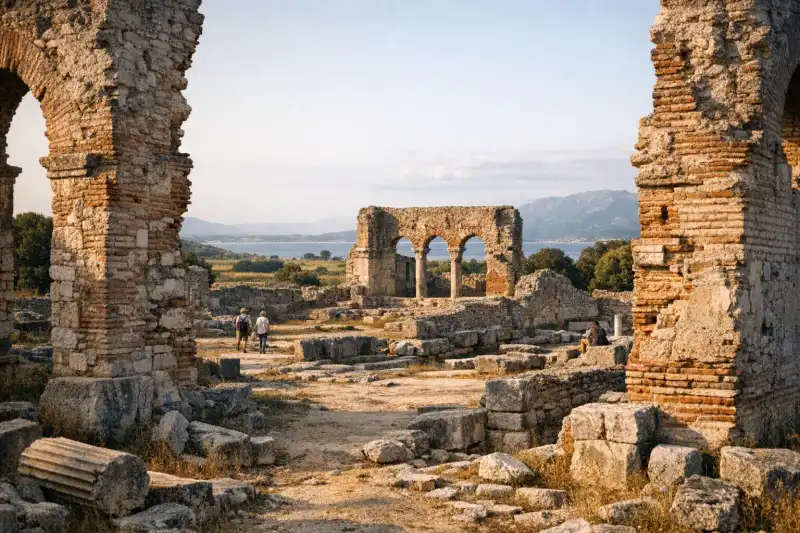
Nikopolis in Greece feels less like a single ruin and more like a whole ancient landscape left open to the sky. Spread across the plains near Preveza, between low hills and the waters of the Ambracian Gulf, this vast archaeological site preserves the memory of imperial ambition on an extraordinary scale. Founded by Octavian after his decisive naval victory at Actium, Nikopolis was conceived not simply as another city but as a monumental declaration that a new political age had begun. Even now, the place has a certain theatrical power. You approach not one isolated temple or a compact acropolis, but traces of walls, roads, public buildings, basilicas, baths, and performance spaces dispersed across a broad rural setting where birdsong, wind, and olive groves soften the edges of empire.
That sense of scale is what makes Nikopolis distinct among ancient sites in Greece. It is Roman in planning and political message, Greek in language and cultural setting, and deeply shaped by the transformations of late antiquity and early Christianity. Visitors can wander through a city founded in triumph, enlarged in confidence, defended in uncertainty, and eventually reduced to fragments by changing trade routes, invasions, and time. The result is a destination that rewards patient exploration. Nikopolis does not reveal itself all at once. Instead, it unfolds gradually, with every ruined wall and surviving arch hinting at the life of a city that once stood among the most important urban centers of western Greece.
History
Foundation after Actium
The story of Nikopolis begins with one of the most famous turning points of the ancient Mediterranean. In 31 BCE, Octavian defeated the forces of Mark Antony and Cleopatra at the Battle of Actium, fought nearby off the western coast of Greece. The victory was not only military; it cleared the way for Octavian’s emergence as Augustus, the first Roman emperor. To commemorate the event, he founded a new city in 29 BCE and named it Nikopolis, meaning “City of Victory.”
This was no modest colonial foundation. Augustus wanted a city worthy of imperial memory, and he built it in a commanding position near the Actian battlefield and the entrance to the Ambracian Gulf. Population was drawn into the new center from surrounding communities, a process common in antiquity when rulers sought to create stronger urban hubs. Nikopolis was planned as a major Roman city with public monuments, formal street organization, and extensive defenses. It also acquired prestige through the Actian Games, athletic and cultural competitions modeled in part on Greek traditions and linked directly to the emperor’s triumph.
Growth under the Roman Empire
During the first centuries of the Roman Empire, Nikopolis flourished. It occupied an important strategic and commercial location along routes connecting the Adriatic, western Greece, and the inland territories of Epirus. Trade, administration, and imperial patronage helped the city prosper. Monumental construction reflected that success. A theater and odeon served performance and civic life, baths expressed Roman urban comfort and sociability, and religious monuments tied the city’s identity to both imperial ideology and local cult practice.
Nikopolis became known not merely as a commemorative settlement but as a functioning urban center with regional importance. Its status was strengthened by links to Rome and by the continuing symbolic value of Actium in imperial propaganda. The city’s architecture and planning showed the blending of Roman civic ideals with a Greek environment where older traditions remained deeply rooted. Inscriptions, building remains, and urban infrastructure suggest a place of wealth, ceremony, and political significance.
Late Antiquity and the Christian city
Like many eastern Roman cities, Nikopolis changed considerably in late antiquity. From the 3rd to the 6th centuries CE, the eastern Mediterranean experienced political instability, administrative reform, religious transformation, and shifting economic patterns. Nikopolis adapted rather than disappearing immediately. It remained important enough to be fortified more compactly in later periods, a sign that urban life persisted but under new pressures.
Christianity transformed the cityscape. Several large basilicas were built, and Nikopolis became a bishopric of considerable standing. These churches, with their mosaics, apses, and architectural sophistication, are among the site’s most striking remains. They testify to a city still wealthy and active enough to support major sacred building projects even as the classical urban world evolved into something different. The survival of these basilicas gives visitors a rare chance to see how a Roman victory city became an important Christian center.
Decline and afterlife
Nikopolis declined gradually rather than vanishing in one dramatic moment. Invasions, earthquakes, changing trade networks, and the broader contraction of some urban centers in the Balkans all played a role. By the medieval period, much of the ancient city had fallen into ruin, though parts of the site remained known and reused. Stones from monumental structures were often carried off for later buildings, as happened across the Mediterranean.
Modern archaeology has restored Nikopolis to historical visibility. Excavations and conservation work have revealed the scale of the city and clarified its unusual character as both a monument to Augustus and a long-lived provincial center. Today, the site stands as one of the most important Roman archaeological landscapes in Greece. It also reminds visitors that ancient cities were not static snapshots. Nikopolis was founded in victory, matured in empire, reinvented itself in Christian late antiquity, and then slowly dissolved into the countryside, leaving behind a wide field of memory.
Key Features
Nikopolis is remarkable above all for its breadth. Many ancient sites are experienced as a single cluster of ruins, but here the visitor moves through a dispersed cityscape where distinct monuments stand at intervals across a large plain. This can feel unusual at first, yet it is exactly what gives the site its power. You are not just looking at buildings; you are reading the scale of an urban experiment founded by Augustus himself.
The city walls are among the most impressive elements. They communicate immediately that Nikopolis was meant to be substantial and secure. In some sections, the fortifications still suggest the perimeter of a major city, while later defensive adaptations hint at changing historical conditions. Walking near these walls helps visitors imagine the transition from high imperial confidence to the more uncertain world of late antiquity.
The odeon is often one of the most evocative monuments for modern travelers. More intimate than a large theater, it brings ancient performance closer to human scale. You can picture recitations, music, civic gatherings, and ceremonial events held within a structured acoustic environment where architecture shaped sound as much as space. Nearby remains of the theater and stadium area point to the role of spectacle and competition in the city’s identity, especially given the prestige of the Actian Games.
Nikopolis also preserves notable bath remains, which illuminate everyday Roman urban life. Baths were never merely places for washing. They were social centers, settings for conversation, exercise, and routine interaction. Even fragmentary walls, chambers, and service areas reveal the engineering confidence of Roman builders and the expectation that a successful city should offer public comfort on an impressive scale.
For many visitors, however, the most memorable structures are the early Christian basilicas. These are essential to understanding Nikopolis as more than an Augustan monument. Their large plans, surviving floor patterns, and liturgical spaces show that the city remained important centuries after its foundation. They also reveal a cultural shift visible across the late Roman world: civic prestige increasingly expressed through Christian architecture rather than pagan temples or imperial cult buildings. The basilicas provide some of the clearest evidence for Nikopolis as a living urban center in late antiquity.
Another important aspect of the visit is the archaeological museum, where sculptures, inscriptions, architectural fragments, and smaller finds provide context for the ruins outside. On the open site, it is easy to be overwhelmed by space and fragmentary remains. In the museum, names, dates, artistic details, and everyday objects help anchor the experience. You can connect broken columns and scattered masonry with the people who built, used, and transformed this city over centuries.
Finally, the landscape itself is a key feature. Nikopolis sits in a setting of fields, low vegetation, and distant water, and this environment shapes the emotional experience of the site. It feels less urbanized than many famous destinations in Greece, which is part of its appeal. There is room here for silence and imagination. The openness helps you understand why Augustus chose this area for a city of commemoration and control, and why later generations continued to value the location. Nikopolis is not just a cluster of ruins to photograph; it is an ancient territory to move through slowly.
Getting There
Nikopolis is easiest to reach from Preveza, the nearest city, located only a few kilometers away. By taxi, the journey usually takes around 10 to 15 minutes and commonly costs about €8 to €15 depending on season, time of day, and exact drop-off point. If you want to visit several sectors of the archaeological zone and the museum, a taxi arranged for return pickup can save time because the site is spread out.
Travelers arriving from Athens can reach the area by long-distance bus to Preveza, generally with fares in the range of €35 to €45 one way, or by renting a car for greater flexibility. Driving from Athens takes roughly five to six hours depending on traffic and route. From Ioannina, another useful regional base, buses and rental cars are also practical; the drive is around 1.5 to 2 hours and gives access to other Epirus destinations.
The nearest airport for many visitors is Aktion National Airport, close to Preveza. From the airport, a taxi to Nikopolis or central Preveza usually costs about €20 to €30. In summer, when flights increase, this can be the most convenient option for international travelers.
Public transport directly to the ruins can be limited, so independent visitors should check local bus schedules in advance if they hope to combine a bus ride with walking. In hot weather, walking long distances between sectors is less pleasant than it looks on a map. A rental car is often the best choice if you want to see the full site comfortably and at your own pace.
When to Visit
Spring and autumn are the best times to visit Nikopolis. From April to early June, the surrounding plain is greener, temperatures are usually mild, and walking between monuments feels far more comfortable than in midsummer. September and October are similarly pleasant, with warm light and fewer seasonal pressures. These shoulder months are ideal for travelers who want time to absorb the site’s scale without rushing from shade to shade.
Summer is still possible, especially for visitors already staying on the coast near Preveza or Lefkada, but it requires planning. Temperatures can be high, and much of Nikopolis is exposed. If you visit in July or August, try to arrive early in the morning or later in the afternoon, carry plenty of water, and wear strong sun protection. The advantage of summer is easier access through seasonal flights and a lively atmosphere in nearby seaside towns, but the archaeological experience itself is more demanding.
Winter has a quieter charm. The site can feel especially atmospheric under softer light, and crowds are minimal. Rain is more likely, and some days may be windy, but for photographers and travelers interested in reflective, uncrowded visits, winter can be rewarding. The key is to verify opening hours in advance, as schedules may vary by season or conservation work.
In any season, allow more time than you first expect. Nikopolis is not a quick stop. Its rewards come from wandering, pausing, and letting the historical layers become clear.
| Quick Facts | Details |
|---|---|
| Location | Near Preveza, Epirus, northwestern Greece |
| Founded | 29 BCE |
| Founder | Octavian, later Emperor Augustus |
| Name Meaning | “City of Victory” |
| Historical Trigger | Victory at the Battle of Actium in 31 BCE |
| Main Periods | Roman Imperial and Late Antique |
| Highlights | City walls, odeon, theater area, baths, basilicas, museum |
| Best Base | Preveza |
| Ideal Visit Length | 2 to 4 hours, or half a day with museum |
| Best Seasons | Spring and autumn |
| Access | Best by car or taxi from Preveza |
| Why It Matters | One of the largest and most significant Roman sites in Greece |
Nikopolis rewards travelers who are willing to trade the instant drama of a single iconic monument for something broader and, in many ways, deeper. It is a city of political memory, Roman planning, Greek geography, and Christian transformation all layered across one wide archaeological landscape. Near the quiet roads and fields of modern Epirus, Augustus’s declaration of victory still survives, not as propaganda alone, but as a place where centuries of human life left visible traces. For visitors interested in how empires imagined themselves, how cities evolved, and how ruins can still hold a sense of scale and purpose, Nikopolis is one of Greece’s most compelling destinations.
Guided tours: worth it?
Self-guided works here, but a guide can add real value if you want the ruins explained as a living place rather than just a sequence of monuments.
Best for
- First-time visitors who want context, not just photos
- Short visits where a planned route saves time
When to go self-guided
Go independently if you prefer setting your own pace, reading as you go, and checking official hours or ticket rules directly before you arrive.
What I’d avoid
Skip paid tours that bundle unrelated stops you do not actually want. The best option should either save meaningful planning time or add historical context you would miss on your own.
Preveza and Nikopolis tours
Useful when: you want to compare guided formats before deciding
Epirus archaeology tours
Useful when: you want to compare guided formats before deciding
Ancient Greece private tours
Useful when: you want flexible timing or a private guide
Some tour links are affiliate links, which may earn Ancient Travel a small commission at no extra cost to you. I try to surface options that make practical sense for the site—not just anything bookable.
Frequently Asked Questions
What is Nikopolis famous for?
Nikopolis is famous as the monumental city founded by Octavian, later Augustus, after his victory at the Battle of Actium in 31 BCE. It preserves Roman walls, a theater, an odeon, baths, stadium remains, and important early Christian basilicas.
Where is Nikopolis located?
Nikopolis is in the Epirus region of northwestern Greece, just north of the modern town of Preveza and close to the Ambracian Gulf.
How much time do you need to visit Nikopolis?
Most visitors should allow at least two to four hours to explore the main archaeological zones and museum. Those with a strong interest in Roman urbanism or early Christian architecture may want half a day.
Is Nikopolis worth visiting from Preveza?
Yes. Nikopolis is one of the most impressive Roman archaeological landscapes in Greece and makes an easy and rewarding excursion from Preveza.
Can you visit Nikopolis without a car?
It is possible to reach Nikopolis by taxi from Preveza, and some travelers also combine local buses with a short taxi ride or walk. A car is still the most convenient option because the ruins are spread over a large area.
What should I wear when visiting Nikopolis?
Wear comfortable walking shoes, a hat, sunscreen, and light layers in warm weather. The site is extensive and exposed, so water and sun protection are especially important.
Nearby Ancient Sites
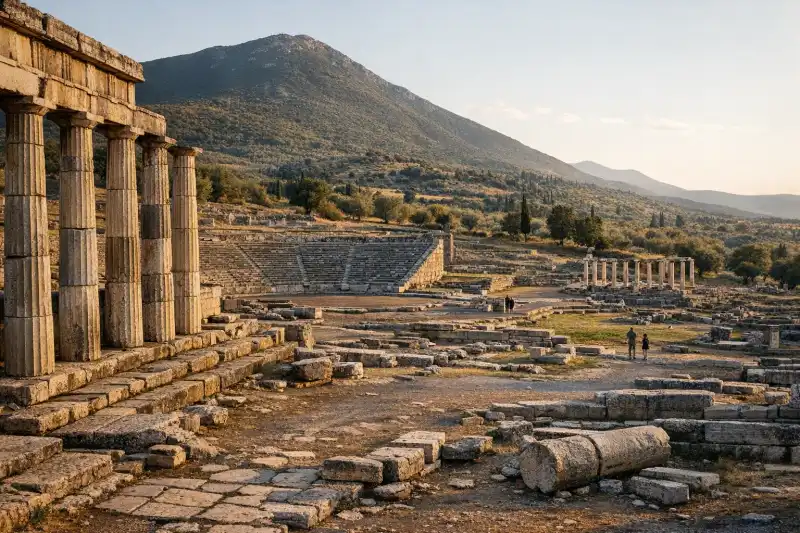
Ancient Messene
Ancient GreekExplore Ancient Messene, a remarkably preserved Greek city with grand stadium, theater, and fortific...
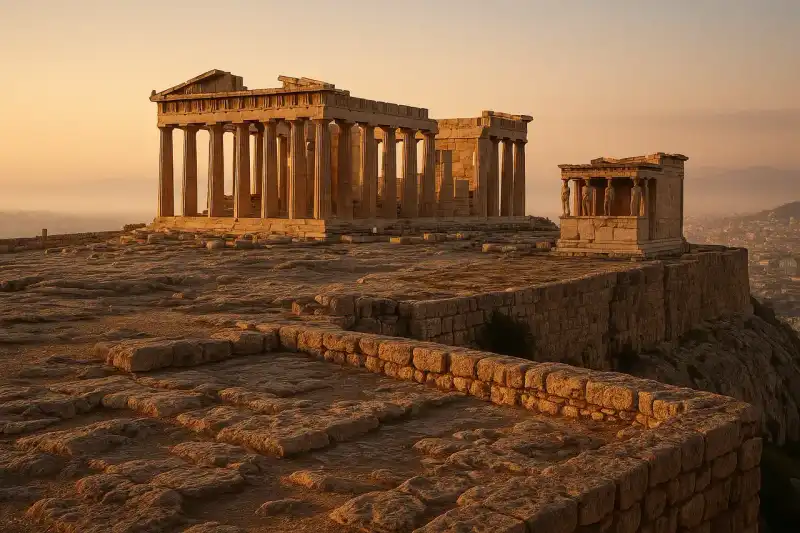
The Complete Acropolis Athens Travel Guide: Temples
Ancient GreecePlan the perfect visit to the Acropolis of Athens with our 2026 guide. Discover the Parthenon, best ...
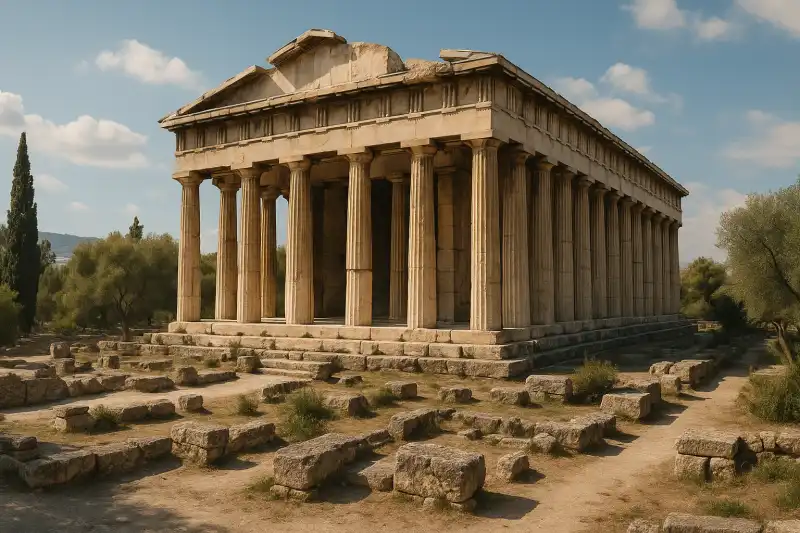
Ancient Agora of Athens Travel Guide 2026: Route, Tickets, and Context
Classical GreekPlan a better Ancient Agora visit with practical timing, monument priorities, and clear historical c...