Quick Info
At a glance
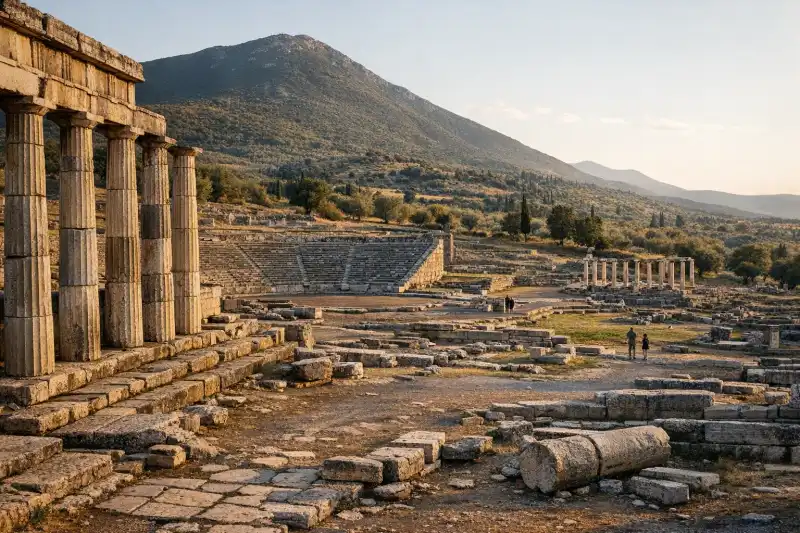
Ancient Messene in Greece is one of those rare archaeological places where the scale of an ancient city still feels legible in the landscape. Rather than a few isolated ruins scattered across a dusty field, visitors find fortifications climbing the hills, broad public spaces, a theater, a stadium, sanctuaries, and long stretches of masonry that make it possible to imagine urban life with unusual clarity. Set in the fertile countryside of Messenia in the southwestern Peloponnese, the site lies in a basin ringed by mountains, and that natural setting adds to the sense of entering a self-contained ancient world.
Unlike better-known Greek landmarks that can feel overwhelmed by crowds, Ancient Messene often rewards travelers with room to pause, look closely, and absorb the details. The light across the valley changes throughout the day, olive groves frame the stones, and the topography explains why this city mattered so much politically and militarily. Its planners took advantage of the terrain while also expressing a civic ambition that still reads clearly more than two millennia later. For visitors interested in Greek history beyond Athens, this is an essential stop: a city built as a symbol of liberation, strengthened as a regional center, and preserved well enough to reveal the rhythms of public, religious, and athletic life in ancient Greece.
History
Foundation after Spartan domination
Ancient Messene owes its existence to one of the great political reversals of Greek history. For centuries, the region of Messenia had lived under Spartan domination. The Messenians had been conquered in archaic times after long and bitter conflicts, and many were reduced to the status of helots, a dependent population whose labor underpinned Spartan power. This background is essential to understanding the emotional and symbolic force behind the city’s foundation.
In 369 BCE, after Sparta’s defeat by Thebes at the Battle of Leuctra, the Theban general Epaminondas moved to reshape the balance of power in the Peloponnese. One of his boldest measures was the liberation of Messenia and the establishment of a fortified capital for the restored Messenians. The new city of Messene was founded at the foot of Mount Ithome, a naturally strong position with deep historical and religious associations. Its creation was not simply an act of urban planning but a declaration of independence and identity. Exiles and descendants of displaced Messenians were invited to return, and the city quickly became the political center of the newly reconstituted Messenian state.
Growth in the Classical and Hellenistic periods
From the start, Messene was designed as a major urban center. Its fortification walls, among the finest in Greece, enclosed a substantial area and connected with the heights of Mount Ithome. The city was laid out with public buildings, sanctuaries, and civic institutions befitting a self-confident polis. The Asklepieion, an important religious and civic complex, emerged as one of the city’s central monumental spaces. The theater, agora, stadium, and gymnasium all reflected the city’s integration into the cultural and political norms of the Greek world.
During the Hellenistic period, Messene continued to prosper. It participated in the shifting alliances and rivalries that characterized post-Classical Greece, including the politics of the Achaean League and tensions with Sparta. Its strategic location in the southwestern Peloponnese made it important, while its fortifications helped secure its independence. Ancient authors mention Messene in the context of regional power struggles, and archaeology confirms that the city maintained a high degree of urban investment. Public monuments were repaired, embellished, and used over long periods, suggesting both continuity and wealth.
Under Roman rule
Like many Greek cities, Messene adjusted rather than disappeared when Roman influence expanded into Greece. After the Roman conquest in the 2nd century BCE, the city remained inhabited and active. Local elites continued to sponsor buildings and civic improvements, while older structures were adapted to changing needs. Roman administration did not erase the city’s Greek character; instead, Messene joined the many urban centers in the eastern Mediterranean where Greek language, education, religion, and civic traditions continued under imperial oversight.
This period likely brought both stability and gradual transformation. Some monuments stayed in use, while others were remodeled. The theater and stadium remained central to public life, and the sanctuaries retained their prestige. As elsewhere in Greece, Roman patronage could coexist with deeply local traditions. The archaeological evidence at Messene reveals this long occupation through layered building phases rather than a simple story of decline.
Late antiquity, abandonment, and rediscovery
Over time, the urban vitality of Messene diminished. Earthquakes, changing trade patterns, shifting population centers, and the wider transformations of late antiquity all contributed to the contraction of many ancient cities in Greece. By the Byzantine era, the classical city had largely faded from prominence, even though the broader region remained inhabited. Stones from ancient buildings were reused, monuments collapsed, and the site gradually merged into the rural landscape.
Systematic interest revived in the modern era, especially through archaeological work in the 19th and 20th centuries. Excavations revealed how remarkably much of the city survived, particularly compared with other Greek sites where later urban occupation obscured the ancient plan. Ongoing research and restoration have made Ancient Messene one of the most intelligible archaeological parks in Greece today. Scholars continue to uncover inscriptions, architectural fragments, and urban details that illuminate not only Messenian history but the wider workings of the ancient Greek city-state.
Key Features
What makes Ancient Messene so striking is not any single monument but the unusual completeness of the ensemble. The city unfolds across a broad area, and its components still relate to one another in ways that let visitors grasp how an ancient polis functioned. Even before entering the heart of the site, the fortification system makes an impression. The walls, towers, and gates demonstrate both technical sophistication and political intent. Built to defend a newly free population, they remain among the site’s most dramatic features. The Arcadian Gate, in particular, is a highlight, with its circular internal court and massive stone construction offering a rare sense of ancient defensive architecture at full scale.
Within the city, the Asklepieion forms one of the most important monumental spaces. Dedicated to Asklepios, the god of healing, this sanctuary also served civic and ceremonial purposes. Its stoas and sculptural settings suggest a place where religion, politics, and public identity overlapped. As at many Greek sanctuaries, the sacred and the social were deeply intertwined. Walking through the area today, visitors can see colonnaded spaces, bases for statues, and the spatial logic of a civic sanctuary that would once have been animated by ritual, dedications, and community gatherings.
The theater is another major draw. Positioned with careful attention to landscape, it reflects the central place of performance and assembly in Greek civic life. Though time has damaged parts of the structure, the surviving seating and architectural elements still convey the monument’s scale. The relationship between built form and surrounding hills is especially compelling here: the theater does not merely occupy the terrain but seems to grow out of it.
Nearby, the stadium and gymnasium complex are among the best-preserved sections of Ancient Messene. Long colonnaded passages, spectator seating, and the track itself make this area unusually evocative. In many ancient sites, athletic spaces require imagination to reconstruct; at Messene, the layout remains legible enough to communicate the physical culture of Greek education and competition. The gymnasium was not only a place for exercise but also for training, sociability, and civic formation. Young male citizens would have spent significant time in such spaces, where athletics, identity, and public life intersected.
Another rewarding aspect of the site is the broader urban setting. Streets, house areas, tombs, and lesser-known structures add texture beyond the famous monuments. There is a sense of moving through a city rather than visiting isolated ruins. The natural environment amplifies this effect. Olive trees, mountain slopes, and open skies soften the stone remains without diminishing their grandeur. In spring, wildflowers and green hillsides make the ruins especially photogenic; in summer, the bright light sharpens every line of masonry.
Visitors should also pay attention to the museum, which helps connect the standing ruins to the people who used them. Sculptures, inscriptions, architectural fragments, and small finds deepen the experience by restoring names, cults, and local histories to the stone landscape outside. Ancient Messene rewards both the casual traveler and the serious enthusiast because it offers two experiences at once: immediate visual drama and a wealth of historical detail for those who linger.
Getting There
Ancient Messene is easiest to reach from Kalamata, the main city in the area. By car, the journey usually takes around 40 to 50 minutes, depending on traffic and your starting point. This is the most convenient option because public transport to the site is limited, and having your own vehicle makes it easier to combine Ancient Messene with other stops in Messenia. Rental cars in Kalamata often start from about €30 to €50 per day outside peak season, with higher rates in summer.
Taxis from Kalamata to Ancient Messene generally cost around €45 to €65 each way, depending on the company, time of day, and whether you arrange a waiting return. For couples or small groups, this can be practical if you prefer not to drive. If you are arriving via Kalamata International Airport, the total transfer time by car is usually under an hour, and airport taxis may charge slightly more.
Bus options can be possible but are less straightforward. Local KTEL services in the Peloponnese sometimes connect Kalamata with nearby villages, but schedules can be infrequent and may require checking locally in advance. If a bus runs toward Mavrommati or nearby communities, expect a fare in the rough range of €3 to €6, followed by a short taxi ride or walk depending on the stop. Because services change seasonally, travelers relying on public transport should confirm timetables before setting out.
Organized tours from Kalamata or wider Peloponnese circuits can also be a good solution, especially for visitors who want commentary and easier logistics. These vary widely in price, but day tours often begin around €70 to €120 per person depending on inclusions.
When to Visit
The best times to visit Ancient Messene are spring and autumn, when the weather is mild and the landscape is at its most attractive. From April to early June, the countryside around the site is usually green, temperatures are comfortable for walking, and the ruins look especially beautiful against flowering fields and clear skies. This is often the ideal season for photography and for exploring the large archaeological area without the fatigue of midsummer heat.
Autumn, especially from late September through October, is another excellent choice. The temperatures are still pleasant, the peak tourist season has eased, and the warm light over the Messenian hills creates a softer atmosphere than in high summer. For travelers who want a quieter experience, this period combines practicality and beauty.
Summer visits are certainly possible, but conditions can be hot, especially from midday into the afternoon. Temperatures in the Peloponnese often rise well above 30°C, and the site has limited shade in some sections. If you visit in June, July, or August, arrive early in the morning or later in the afternoon, bring water, wear a hat, and allow extra time for walking at a slower pace. Winter can also be rewarding for those who prefer solitude, though cooler temperatures and occasional rain may affect comfort and visibility on uneven paths.
Whenever you go, aim for a clear day if possible. Ancient Messene is as much about landscape as architecture, and the surrounding mountains, valley views, and spacious setting are part of what makes the site memorable.
| Quick Facts | Details |
|---|---|
| Location | Messenia, Peloponnese, Greece |
| Nearest major city | Kalamata |
| Founded | 369 BCE |
| Historical significance | Capital of the restored Messenian state after liberation from Sparta |
| Best known for | Fortification walls, Arcadian Gate, theater, Asklepieion, stadium, and gymnasium |
| Recommended visit length | 2 to 4 hours |
| Best seasons | Spring and autumn |
| Terrain | Large archaeological park with uneven stones, dirt paths, and some slopes |
| Best transport option | Rental car or organized tour from Kalamata |
| Travel style | Ideal for history lovers, photographers, and travelers seeking major ruins without heavy crowds |
Ancient Messene is one of the most rewarding archaeological destinations in Greece because it offers both monumentality and coherence. You do not simply look at ruins here; you move through the footprint of a city founded in a moment of political liberation and sustained across centuries of Greek and Roman history. The walls still declare strength, the public buildings still suggest ceremony and civic pride, and the athletic spaces still preserve the energy of communal life. Combined with the calm rural setting of Messenia, this gives the site a powerful atmosphere that lingers long after a visit. For anyone exploring the Peloponnese or seeking a deeper understanding of ancient Greece beyond its most famous landmarks, Ancient Messene deserves a place near the top of the itinerary.
Guided tours: worth it?
Self-guided works here, but a guide can add real value if you want the ruins explained as a living place rather than just a sequence of monuments.
Best for
- First-time visitors who want context, not just photos
- Short visits where a planned route saves time
When to go self-guided
Go independently if you prefer setting your own pace, reading as you go, and checking official hours or ticket rules directly before you arrive.
What I’d avoid
Skip paid tours that bundle unrelated stops you do not actually want. The best option should either save meaningful planning time or add historical context you would miss on your own.
Ancient Messene day tours
Useful when: you want to compare guided formats before deciding
Kalamata to Ancient Messene tours
Useful when: you want to compare guided formats before deciding
Peloponnese archaeology tours
Useful when: you want to compare guided formats before deciding
Some tour links are affiliate links, which may earn Ancient Travel a small commission at no extra cost to you. I try to surface options that make practical sense for the site—not just anything bookable.
Frequently Asked Questions
Where is Ancient Messene located?
Ancient Messene is in the regional unit of Messenia in the southwestern Peloponnese of Greece, near the modern village of Mavrommati and about 30 kilometers from Kalamata.
How much time do you need to visit Ancient Messene?
Most travelers need at least 2 to 4 hours to appreciate the main monuments, though history enthusiasts can easily spend half a day exploring the theater, stadium, agora, sanctuaries, and museum.
Is Ancient Messene worth visiting?
Yes. It is one of Greece's most impressive archaeological sites thanks to its scale, excellent preservation, scenic rural setting, and relatively uncrowded atmosphere compared with more famous classical sites.
Can you visit Ancient Messene from Kalamata?
Yes. Ancient Messene is an easy day trip from Kalamata by rental car, taxi, or organized tour, with the drive usually taking around 40 to 50 minutes.
What are the highlights of Ancient Messene?
Major highlights include the Arcadian Gate, the massive fortification walls, the theater, the Asklepieion, the stadium, the gymnasium, and the beautifully integrated landscape of the surrounding hills.
Is Ancient Messene difficult to walk around?
The site is extensive and includes uneven stones, dirt paths, and some slopes, so sturdy shoes are recommended. Visitors with mobility concerns should allow extra time and plan a shorter route.
Nearby Ancient Sites
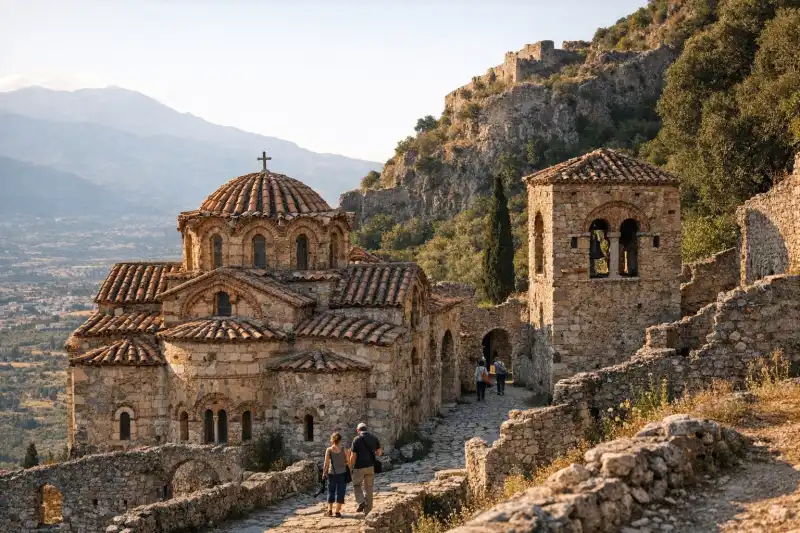
Byzantine Mystras
ByzantineExplore Byzantine Mystras in Greece, a haunting hilltop city of palaces, monasteries, frescoed churc...
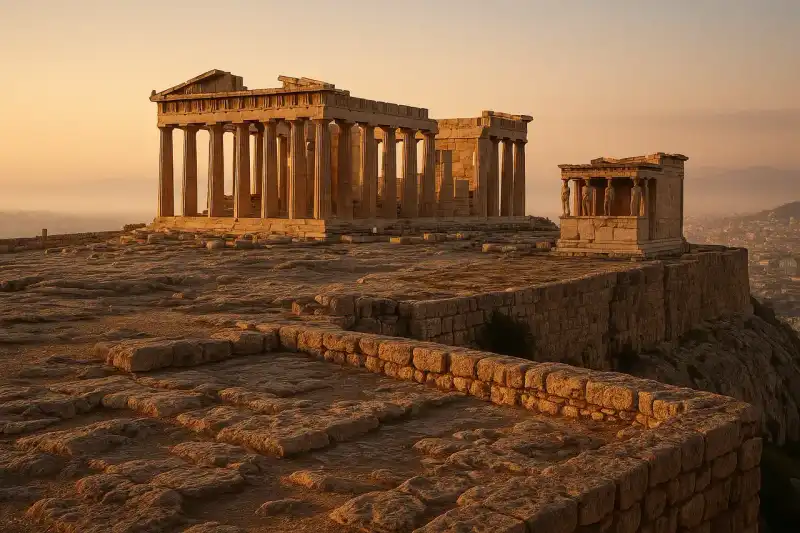
Acropolis Travel Guide 2026: Parthenon, Tickets, and Best Time
Ancient GreecePlan an efficient Acropolis visit with practical ticket timing, key monuments, and museum pairing ti...
The Complete Acropolis Athens Travel Guide: Temples
Ancient GreecePlan the perfect visit to the Acropolis of Athens with our 2026 guide. Discover the Parthenon, best ...