Quick Info
At a glance
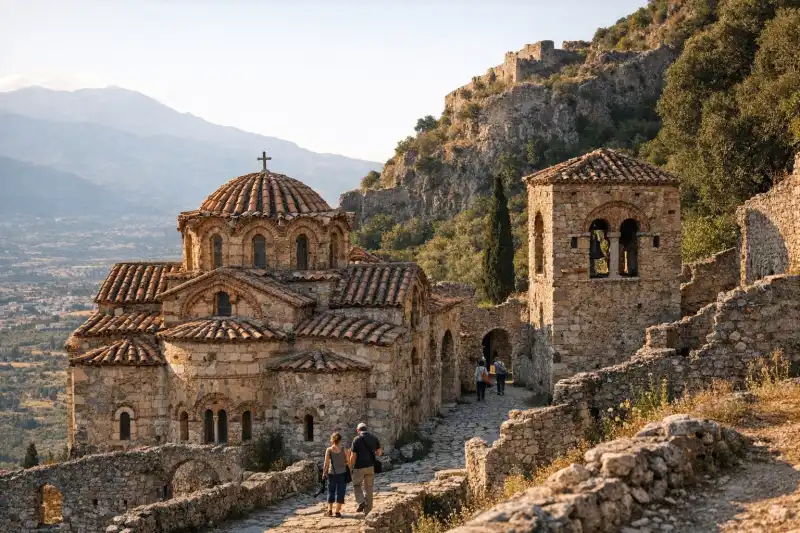
Byzantine Mystras in Greece rises above the plain of Laconia like a stone memory of a vanished empire. Clinging to the slopes of Mount Taygetus near modern Sparta, this abandoned medieval city is not a single monument but an entire historic landscape: a fortress on the summit, palaces and mansions scattered along the hillside, monasteries still alive with devotion, and churches whose frescoes preserve the visual world of the last centuries of Byzantium. Few places in Greece combine architecture, topography, and atmosphere so completely. You do not merely arrive at Mystras; you enter it gradually, climbing through gates, paths, terraces, and ruins that seem to unfold in layers.
What makes Mystras especially powerful is the way its silence sharpens the imagination. Here, governors once ruled the Despotate of the Morea, scholars discussed philosophy in the twilight of Byzantium, monks painted chapels with luminous saints, and nobles walked streets that looked toward both Constantinople and the Peloponnesian countryside. Today, cypress trees, broken walls, vaulted chapels, and broad views over Sparta create a setting that feels both intimate and epic. For travelers interested in Byzantine art, medieval urbanism, or simply one of the most evocative archaeological sites in Greece, Mystras offers an experience that is far more immersive than a museum visit. It is a ruined city that still feels inhabited by history.
History
Frankish foundation and the making of a fortress
Mystras began not as a Byzantine city but as a Frankish stronghold. In 1249, William II of Villehardouin, the Prince of Achaea, built a castle on the steep hill above Sparta to secure his power in the Peloponnese after the Fourth Crusade had fractured the former Byzantine world. The location was strategic: high, defensible, and commanding the fertile Eurotas plain below. From the summit, the new rulers could monitor movement across Laconia and reinforce their authority over the region.
Yet Frankish control proved short-lived. After William II was captured by the Byzantines at the Battle of Pelagonia in 1259, he was forced to surrender several key strongholds, including Mystras, to regain his freedom. This transfer changed the future of the site completely. What had been conceived as a Latin military outpost became one of the most important Byzantine centers in southern Greece.
Byzantine expansion and the rise of an urban center
Once under Byzantine authority, Mystras expanded rapidly. Settlement spread beneath the castle as administrators, soldiers, clergy, and merchants established themselves on the hillside. Fortifications enclosed different sectors of the town, and churches, residences, and public buildings appeared in growing numbers. The city developed into a regional capital, closely tied to imperial efforts to reassert Byzantine influence in the Peloponnese.
By the 14th century, Mystras had become the administrative heart of the Despotate of the Morea, a semi-autonomous Byzantine province usually governed by members of the imperial family. This elevated status brought wealth, prestige, and new construction. The city’s palatial complex took shape, monasteries were endowed, and local elites sponsored richly decorated churches. Mystras also emerged as a cultural center, attracting artists, theologians, and intellectuals.
Its urban form reflected both the constraints and possibilities of the hillside terrain. Rather than the grid of a classical city, Mystras grew organically along steep paths and terraces. The upper and lower sections of the settlement developed around defensive needs, religious foundations, and residential clusters. This gave the city a layered quality that remains visible today.
A final flowering of Byzantine culture
The 14th and 15th centuries marked the high point of Mystras. As Byzantine political power contracted elsewhere, the city became one of the empire’s brightest surviving centers. Churches such as the Peribleptos, Pantanassa, and Hagia Sophia were adorned with sophisticated fresco cycles, while the palace complex was enlarged to suit princely administration and ceremony. Monastic life flourished, but so did secular learning.
Mystras is particularly associated with the philosopher George Gemistos Plethon, one of the most famous thinkers of the late Byzantine world. His presence at Mystras turned the city into a place of intellectual significance, especially in the years leading up to the fall of Constantinople. Plethon’s revival of classical learning and Platonic thought had an influence that reached beyond Greece and contributed to broader currents in Renaissance humanism.
The final Byzantine emperor, Constantine XI Palaiologos, had also served as despot at Mystras before ascending to the throne in Constantinople. This connection gives the site a poignant place in the closing chapter of Byzantine history. In many ways, Mystras represents the last strong provincial flowering of an empire nearing its end.
Ottoman rule, decline, and abandonment
After Constantinople fell in 1453, Mystras survived for a time as an important regional center. In 1460 it passed into Ottoman hands, though control shifted briefly during later conflicts, including Venetian occupation. Despite political change, the city remained inhabited for centuries. However, its fortunes gradually declined. Trade routes changed, regional power structures evolved, and the medieval hilltop settlement became less practical than newer communities on the plain.
The final blow came in the modern era. During the Greek War of Independence and the unstable decades around it, Mystras suffered damage and depopulation. Eventually, the nearby settlement of modern Sparta, founded in the 19th century, drew away inhabitants and administrative focus. The old city was largely abandoned, leaving its churches, monasteries, and houses to weather into ruins.
Today, Mystras is recognized as a UNESCO World Heritage Site and one of the most important surviving Byzantine urban ensembles anywhere. Its significance lies not only in individual monuments but in the remarkable preservation of an entire medieval cityscape, still draped across the mountain as if waiting for its former life to resume.
Key Features
The defining feature of Byzantine Mystras is its completeness as a historic environment. Many famous sites preserve a temple, a church, or a palace. Mystras preserves a city. As you move through it, the relationship between fortress, aristocratic residence, monastic enclosure, parish church, and domestic quarter becomes vividly clear. The steep terrain is not a backdrop but an active part of the experience, shaping every line of sight and every route.
At the very top sits the Frankish castle, the earliest major structure on the site. Its military function is obvious from the first glance. Built to dominate the surrounding plain, it offers broad views over Laconia and toward the Taygetus range. The ascent is demanding, but the reward is one of the finest panoramas in the Peloponnese. From here, the logic of Mystras becomes visible: summit fortress, protected urban slopes, and agricultural plain below.
Below the castle lies the palace complex, among the most striking secular remains from the Byzantine period in Greece. This ensemble is not a single neatly preserved building but a series of structures constructed and remodeled over time. Even in ruin, it suggests ceremony and administration on a significant scale. Arcades, halls, and façades hint at the courtly life once concentrated here. Because many Byzantine sites preserve mainly sacred architecture, the palaces of Mystras are especially valuable for understanding the political and residential dimension of the era.
The churches are, for many visitors, the emotional center of the site. The Cathedral of Saint Demetrios, often called the Metropolis, combines substantial architecture with important frescoes and historical prestige. Tradition holds that Constantine XI was crowned here as despot before becoming the final Byzantine emperor. The building carries the weight of both local devotion and imperial memory.
The Monastery of the Pantanassa remains active, creating a rare continuity between medieval foundation and present-day religious life. Its architecture is elegant, combining decorative brickwork, refined proportions, and a still-inhabited sacred atmosphere. Nearby, the Monastery of the Peribleptos is one of the visual highlights of Mystras. Built dramatically into the hillside, it feels half natural and half architectural, as if the mountain itself had opened to house a chapel. Inside, its frescoes are among the finest examples of late Byzantine painting, with expressive faces, fluid drapery, and vivid narrative scenes.
Hagia Sophia, though more restrained in setting than some of the other churches, is another important monument, connected to the elite life of the city. Its compact grandeur reflects the patronage networks and artistic ambitions of late Byzantium. Across the site, what stands out is the consistency of quality: even comparatively modest churches and chapels reveal careful design and significant painted decoration.
Beyond the major monuments, Mystras rewards attention to smaller details. Stone houses cling to terraces. Arches frame sudden views over olive groves and the plain. Cisterns, stairways, fragments of walls, and garden plots suggest daily routines rather than only official history. The city is not frozen in one idealized moment; its buildings show adaptation, repair, and long use. This gives it a lived-in complexity.
Nature intensifies the sense of time. Cypress and pine trees punctuate the ruins, while the changing light across the hillside transforms the masonry from pale gold to gray and rose. In spring, wildflowers soften the paths. In summer, heat and cicada sound lend the site an almost hypnotic stillness. Late in the day, when many visitors have left, Mystras can feel astonishingly remote.
For photographers, art historians, and travelers simply drawn to atmospheric places, the site has unusual depth. You can focus on military architecture, Byzantine wall painting, monastic life, urban planning, or landscape. Very few destinations support so many different ways of seeing. That richness is the essence of Mystras: a place where imperial politics, religious art, scholarship, and mountain topography remain inseparable.
Getting There
Byzantine Mystras is easiest to reach via Sparta, the nearest major town, located about 6 kilometers away. If you are driving, the route is straightforward and well signed from Sparta, with the journey typically taking 10 to 15 minutes. Rental cars are the most flexible option for travelers exploring the Peloponnese, especially if you want to combine Mystras with other historic sites. Parking is usually available near the main entrances, though spaces can be tighter in peak season.
From Athens, driving to Mystras generally takes around 3 to 3.5 hours, depending on traffic and rest stops. Expect tolls and fuel costs in addition to rental fees. If you prefer public transport, intercity KTEL buses run from Athens to Sparta. A one-way ticket is often in the range of €20 to €25, though fares can change. From Sparta, you can take a local taxi to Mystras for roughly €10 to €15 each way, depending on the exact drop-off point and season.
Some travelers join organized day trips from Athens, particularly if they do not want to manage a long drive. These tours can be convenient but may limit time at the site, which is best explored at a relaxed pace. If you are staying in the Peloponnese, private transfers from Nafplio, Kalamata, or other regional bases are also possible, though prices vary widely.
Mystras has more than one access point, and many experienced visitors enter from the upper gate and exit from the lower gate, or the reverse, to avoid retracing steep sections. Ask locally which approach best fits your stamina and transport arrangement.
When to Visit
The best times to visit Byzantine Mystras are spring and autumn, when the weather is milder and walking the hillside is far more comfortable. From April to early June, the landscape is especially beautiful, with green slopes, wildflowers, and clearer air over the Laconian plain. Temperatures are usually pleasant enough for a long visit, and morning light can be excellent for photography. September through November is similarly rewarding, with warm but less oppressive days and fewer crowds than high summer.
Summer brings long opening hours and bright skies, but it can also be intensely hot. Because Mystras involves sustained walking uphill over exposed ground, midday heat can make the experience tiring, especially in July and August. If you must visit in summer, arrive as early as possible, carry plenty of water, wear a hat, and allow extra time for rest. Good footwear is essential in every season, as the paths are uneven and often stony.
Winter is quieter and can be atmospheric, particularly on crisp days when the mountain setting feels especially dramatic. However, weather can be unpredictable, with rain making paths slippery and cloud obscuring views. Some travelers enjoy winter precisely because the ruins feel more solitary, but it is wise to check current opening arrangements before setting out.
If your priority is fresco viewing and comfortable exploration, aim for a weekday morning in late spring or early autumn. If your priority is mood and photography, the softer light of early or late day is hard to beat. In every season, give yourself more time than you expect. Mystras is not a site to rush.
| Quick Facts | Details |
|---|---|
| Location | Near Sparta, Laconia, Peloponnese, Greece |
| Main period | 13th-15th century CE |
| Founded | 1249 CE as a Frankish fortress |
| Later importance | Capital of the Byzantine Despotate of the Morea |
| UNESCO status | World Heritage Site |
| Best for | Byzantine art, medieval ruins, hilltop views, photography |
| Time needed | 3-5 hours |
| Terrain | Steep, uneven, with many steps |
| Nearest city | Sparta |
| Best seasons | Spring and autumn |
A visit to Byzantine Mystras is less about checking off monuments than about entering a complete world. Its churches are beautiful, its palaces compelling, and its fortress dramatic, but the real power of the site lies in their relationship to one another across the mountain slope. Here, the final centuries of Byzantium become tangible not through isolated objects but through streets, elevations, and surviving spaces of worship, government, and domestic life. Few places in Greece feel so layered, and fewer still reward slow exploration so completely. If you are willing to climb, pause, and look carefully, Mystras offers one of the most memorable historical experiences in the country.
Guided tours: worth it?
Self-guided works here, but a guide can add real value if you want the ruins explained as a living place rather than just a sequence of monuments.
Best for
- First-time visitors who want context, not just photos
- Short visits where a planned route saves time
When to go self-guided
Go independently if you prefer setting your own pace, reading as you go, and checking official hours or ticket rules directly before you arrive.
What I’d avoid
Skip paid tours that bundle unrelated stops you do not actually want. The best option should either save meaningful planning time or add historical context you would miss on your own.
Mystras and Sparta tours
Useful when: you want to compare guided formats before deciding
Peloponnese historical tours from Athens
Useful when: transport or pickup logistics matter
Byzantine Mystras private day trips
Useful when: you want flexible timing or a private guide
Some tour links are affiliate links, which may earn Ancient Travel a small commission at no extra cost to you. I try to surface options that make practical sense for the site—not just anything bookable.
Frequently Asked Questions
What is Byzantine Mystras?
Byzantine Mystras is a fortified medieval city near Sparta in southern Greece, famous for its palaces, monasteries, churches, and important late Byzantine art.
How long do you need to visit Mystras?
Most visitors need at least 3 to 4 hours to explore the upper and lower town, but a full half-day is better if you want time for museums, viewpoints, and major churches.
Is Mystras difficult to walk?
Yes, parts of Mystras can be demanding. The site is spread across a steep hillside with uneven stone paths, steps, and significant elevation changes, so sturdy shoes are essential.
Can you visit Mystras as a day trip from Athens?
Yes, Mystras can be visited as a long day trip from Athens, though many travelers prefer to stay overnight in Sparta or the surrounding area to explore at a slower pace.
Why is Mystras important?
Mystras was one of the most significant centers of the late Byzantine world and the capital of the Despotate of the Morea, preserving major examples of Byzantine architecture, frescoes, and urban planning.
Do you need separate tickets for different parts of Mystras?
Ticketing policies can change, but visitors generally buy one site ticket that covers the main archaeological zone, including key monuments and museums within Mystras.
Nearby Ancient Sites
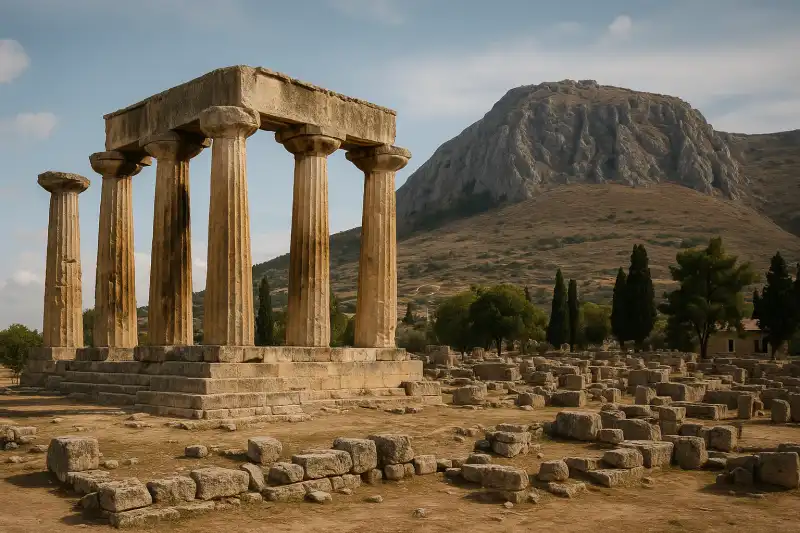
Ancient Corinth Travel Guide 2026: Ruins, Museum, and Visit Strategy
Classical GreekPlan a focused Ancient Corinth visit with practical timing, monument priorities, and route context f...
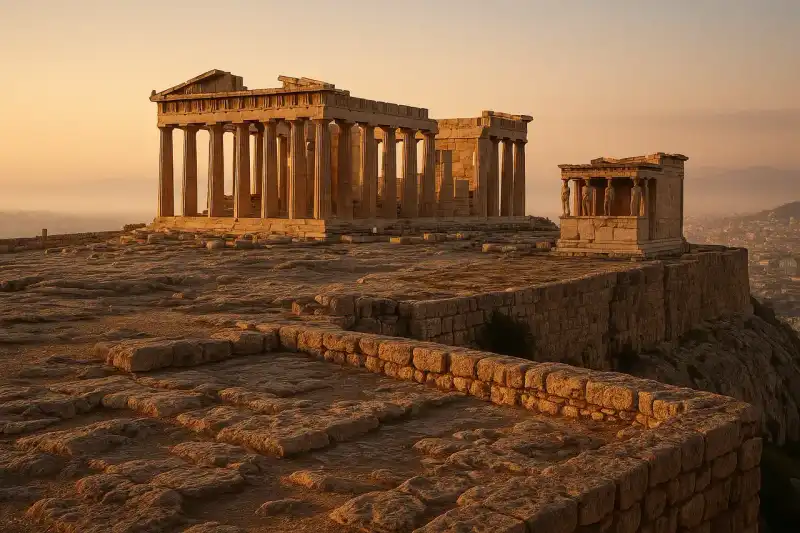
Acropolis Travel Guide 2026: Parthenon, Tickets, and Best Time
Ancient GreecePlan an efficient Acropolis visit with practical ticket timing, key monuments, and museum pairing ti...
The Complete Acropolis Athens Travel Guide: Temples
Ancient GreecePlan the perfect visit to the Acropolis of Athens with our 2026 guide. Discover the Parthenon, best ...