Quick Info
At a glance
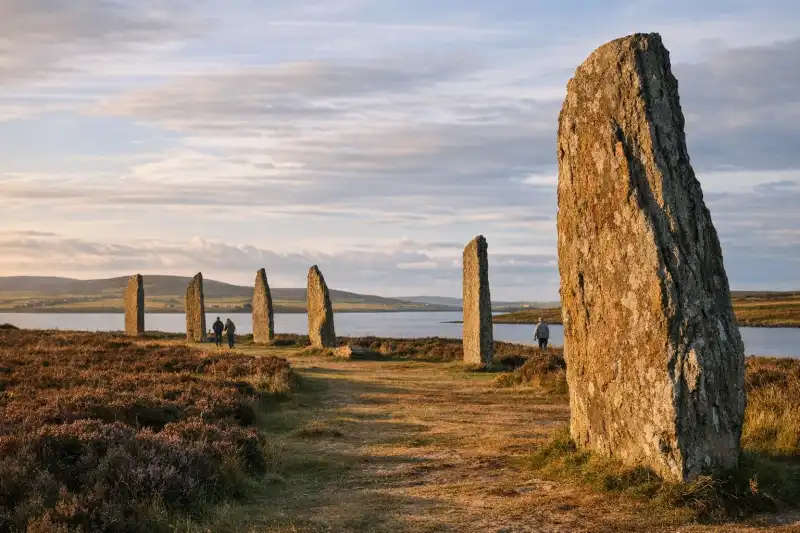
Orkney Ring of Brodgar in the United Kingdom is one of those places that feels larger than any single monument. The famous stone circle rises from a narrow strip of land between the Loch of Harray and the Loch of Stenness, under a wide northern sky that can shift from silver cloud to piercing blue in minutes. Even before you reach the stones, the setting announces that this is no ordinary prehistoric site. Water, wind, open moorland, and the low rolling horizon combine to make the landscape feel ceremonial in its own right, as though the people who built the circle chose not only a precise location but an entire stage for ritual, gathering, and memory.
Standing here, you are in the heart of one of Europe’s richest concentrations of Neolithic archaeology. The Ring of Brodgar is part of the UNESCO-listed Heart of Neolithic Orkney, a remarkable cluster that also includes the Stones of Stenness, Maeshowe, and Skara Brae. Yet Brodgar has a personality all its own. It is grand without being heavy, austere without being barren. The surviving monoliths form an immense ring that still suggests movement, processions, and social drama, even though many stones are missing and the original ceremonies remain unknown. Visitors often arrive expecting a simple stone circle and leave with a stronger impression of landscape, scale, and mystery. It is a site that rewards slow walking, changing light, and a willingness to imagine deep time.
History
Neolithic beginnings
The Ring of Brodgar was built during the Late Neolithic, most likely around 2600 to 2400 BCE, at a time when Orkney was one of the most innovative and connected cultural landscapes in prehistoric Britain. Farming communities had already been established in the islands for centuries, constructing substantial stone houses, chambered tombs, and ceremonial monuments. By the time Brodgar was laid out, the people of Orkney were not isolated villagers improvising with local materials; they were builders working within a mature cultural tradition that had developed distinctive architectural and ceremonial forms.
What makes the Ring of Brodgar particularly striking is its scale. The monument was designed as both a stone circle and a henge, with a vast ditch cut into the rock around it. Unlike later assumptions that a “henge” must involve a mound and bank of dramatic size, the importance here lies in the enclosed sacred space and the effort required to create it. Excavating a great circular ditch with stone tools and antler or bone implements would have demanded serious labor and coordination. That effort suggests the monument was socially important, perhaps serving as a gathering place for dispersed communities, a ceremonial arena, or a place where alliances, identities, and beliefs were reaffirmed.
A ceremonial landscape takes shape
Brodgar did not stand alone. It emerged within a wider ritual complex on the Ness of Brodgar, a narrow isthmus between the lochs where excavations have revealed substantial ceremonial buildings and evidence of large-scale feasting and activity. Nearby stand the earlier Stones of Stenness and the great chambered tomb of Maeshowe. Rather than thinking of Brodgar as an isolated circle, it is more accurate to see it as one element in an interconnected sacred landscape.
Archaeologists continue to debate exactly how the monuments related to one another. Some interpret the area as a ceremonial route, with water and land passages linking tombs, standing stones, and meeting places. Others emphasize social performance, with the site used during seasonal gatherings or rites that marked cosmological beliefs, ancestral connections, or transitions in communal life. The spacing of the stones, the monumental ditch, and the commanding visual placement all indicate that this was a carefully planned project. The builders understood how people would approach, see, and experience the ring.
Though no single explanation has won universal agreement, the consensus is clear that the Ring of Brodgar was a place of high significance. It belonged to a period when monument building in Orkney was not only technically accomplished but deeply symbolic, embedding social memory into stone and earth.
Later prehistoric and historic survival
As the Neolithic world changed, the original rituals associated with Brodgar faded from use or transformed beyond recognition. Yet the monument remained visible, and that visibility mattered. Across later prehistory and into the historic era, standing stones often accumulated new stories, local traditions, and folk interpretations. People who no longer knew the original purpose still treated such places as meaningful landmarks.
In Orkney, as elsewhere in Britain, old monuments were sometimes woven into oral tradition. Antiquarians later recorded stories of giants, supernatural beings, or petrified figures attached to ancient stones. While these tales do not explain Neolithic intent, they do show that the ring was never simply forgotten. The stones persisted as a notable feature of the landscape, a place that inspired curiosity, caution, and local lore.
The monument also survived because of the durability of its materials and the relative openness of its setting. Not all the original stones remain standing today, and centuries of weathering and occasional damage have altered the site. Even so, enough survives to preserve the outline, scale, and emotional power of the original design.
Antiquarian interest and modern protection
From the 18th and 19th centuries onward, antiquarians and early archaeologists took increasing interest in Orkney’s prehistoric monuments. Measurements, sketches, and descriptions of the Ring of Brodgar helped establish it as one of the great stone circles of Britain. These early records are valuable because they captured the condition of the monument before modern conservation methods and before some later losses or changes.
In the 20th century, archaeological study placed Brodgar more firmly within the broader context of Neolithic Orkney. As research expanded across the islands, scholars began to appreciate just how exceptional the concentration of monuments was. This eventually contributed to international recognition through the inscription of the Heart of Neolithic Orkney as a UNESCO World Heritage Site in 1999.
Today the Ring of Brodgar is protected not only as a singular monument but as part of an entire archaeological landscape. Conservation is an ongoing concern because foot traffic, erosion, and weather can all affect such fragile sites. Managed access, marked paths, and visitor guidance are not inconveniences but part of ensuring that the monument survives. Modern visitors, in that sense, become part of the site’s long history: each generation inherits the stones and decides how carefully they will be passed on.
Key Features
The first feature that defines the Ring of Brodgar is sheer size. With a diameter of roughly 104 meters, it is among the largest stone circles in Britain. The scale is not immediately obvious in photographs, which often flatten the monument into a line of isolated stones. In person, the broad circumference changes everything. As you walk around the ring, distances open up between stones, and the monument feels less like a compact arrangement and more like an architectural boundary enclosing an immense ceremonial space. The surviving stones, slender and weathered, stand like punctuation marks around an invisible center.
Equally important is the surrounding henge ditch. Though less visually dramatic than the stones themselves, it is one of the most impressive aspects of the site once you understand the labor involved. Cut into bedrock, the ditch forms a monumental circular enclosure that speaks to planning, manpower, and communal effort. It transforms Brodgar from a mere collection of standing stones into a built environment, one in which the approach, threshold, and interior all mattered. The two causeways that provide access into the enclosed area reinforce the sense that entry was controlled and significant.
The individual monoliths are another of the ring’s great attractions. Around 27 stones survive today out of what may originally have been about 60. Their varied heights and profiles create a subtly changing rhythm around the circle. Some stones taper elegantly, others appear more rugged or fractured, and no two seem exactly alike. This irregularity gives the monument a human quality despite its scale. It also means that light and shadow constantly alter the appearance of the ring. Early morning and late evening can be especially beautiful, when low sun emphasizes texture and makes the stones seem to glow against the sky.
Yet perhaps the site’s most powerful feature is its setting within the broader Brodgar-Stenness landscape. The circle lies between two lochs, and water is never far from view. This creates a sense of separation from ordinary ground, as if the monument occupies a liminal zone between worlds. On calm days the lochs can seem reflective and tranquil; in wind they add movement and sound to the experience. The changing weather of Orkney is not incidental to the site but central to it. Fast clouds, sudden rain, and bursts of sunlight can turn a visit into something almost theatrical.
The surrounding archaeology deepens that impression. From Brodgar, you are close to the Stones of Stenness, the Maeshowe chambered cairn, and the excavated complex at the Ness of Brodgar. Even when these places are not all visible in one glance, they shape how the ring is understood. This is a monument embedded in a network of places rather than a lone survivor in empty countryside. The cumulative effect is extraordinary: standing at Brodgar feels like standing in the ceremonial heart of Neolithic Orkney.
There is also the less tangible feature of ambiguity. The Ring of Brodgar has never yielded a simple explanation, and that uncertainty is part of its appeal. It may have been a ritual gathering place, a ceremonial boundary, an arena for social performance, or all of these at different times. Unlike later monuments with inscriptions or written records, Brodgar asks the visitor to read meaning from form, scale, and setting. Far from being frustrating, this often heightens the encounter. The monument remains open to interpretation while still carrying immense historical weight.
For many travelers, the emotional impact comes from the balance of monumentality and exposure. The stones are unmistakably man-made, but they stand in a landscape that still feels raw and elemental. There are no towering walls, no roofs, and no obvious narrative panels carved into the site itself. Instead, there is space, weather, and stone. The result is a prehistoric place that feels alive not because it has been reconstructed, but because the essential relationship between monument and landscape still endures.
Getting There
The Ring of Brodgar is on Mainland Orkney, about 10 miles (16 km) west of Kirkwall, the islands’ main town. Most visitors first reach Orkney by ferry or plane. Flights from mainland Scotland to Kirkwall can be the fastest option, with fares often starting around £80 to £180 one way depending on season and booking time. Ferries operated from ports such as Scrabster to Stromness or Aberdeen to Kirkwall can be more scenic and useful if you are bringing a car; foot passenger fares commonly start around £20 to £40, while vehicle fares are higher.
Once in Orkney, driving is the simplest way to reach the monument. Car rental in Kirkwall or at the airport is widely used by travelers exploring the UNESCO sites, and daily rates often begin around £40 to £70 in shoulder season. The roads are straightforward, and the journey from Kirkwall usually takes 20 to 25 minutes. Parking arrangements can vary, so check current visitor information and use designated areas only.
Public buses do serve parts of Mainland Orkney, but schedules can be limited compared with urban destinations. A single fare is usually inexpensive, often in the range of a few pounds, though timing may not align perfectly with sightseeing plans. Taxis from Kirkwall are convenient for those not driving; expect roughly £20 to £35 each way depending on time of day and exact pickup point.
Cycling is another rewarding option in good weather, especially for travelers comfortable with wind and narrow roads. However you arrive, bring waterproof layers and sturdy footwear. Orkney’s distances are manageable, but conditions can change quickly, and a comfortable visit depends as much on preparation as on transport.
When to Visit
Late spring through early autumn is the easiest and most popular time to visit the Ring of Brodgar. From May to September, Orkney benefits from long daylight hours, greener landscapes, and generally milder conditions for walking and driving. June and July can be especially appealing because the light lingers late into the evening, giving photographers and slower travelers more time to experience the site under shifting skies. Accommodation prices are usually highest in this period, so booking ahead is wise.
Spring, particularly May, offers a good balance between accessibility and relative calm. The landscape feels fresh, birdlife is active, and visitor numbers are often lower than in high summer. Early autumn can also be excellent, with softer light and fewer crowds, though rain and wind become more frequent as the season advances.
Winter visits have a stark beauty of their own. The site can feel even more dramatic under low cloud, mist, or pale northern light. However, this season is best for flexible travelers who are comfortable with difficult weather and reduced transport options. Strong winds, icy patches, and ferry or flight disruptions are more likely, and short daylight hours limit how much else you can combine into a single day.
Whenever you go, the best time of day is often early or late rather than midday. Lower light gives the stones more texture, and the site can feel quieter and more contemplative. Because weather is so changeable in Orkney, there is no guaranteed “perfect” forecast. Instead, dress in layers, carry waterproofs, and think of dramatic skies as part of the experience rather than a problem to solve.
| Quick Facts | Details |
|---|---|
| Location | Mainland Orkney, Scotland, United Kingdom |
| Monument Type | Neolithic stone circle and henge |
| Date | c. 2600–2400 BCE |
| UNESCO Status | Part of the Heart of Neolithic Orkney |
| Nearby Hub | Kirkwall |
| Approximate Diameter | 104 meters |
| Surviving Stones | About 27 |
| Original Number of Stones | Possibly around 60 |
| Best Visit Length | 30 minutes to 1.5 hours at the site itself |
| Combined Itinerary | Often paired with Stones of Stenness, Maeshowe, and Skara Brae |
The Ring of Brodgar is not a site that overwhelms with ornament or explanatory certainty. Its power lies in older things: scale, placement, labor, and the endurance of stone in an exposed northern landscape. It remains one of the finest places in the United Kingdom to encounter the ceremonial imagination of the Neolithic world. Seen in passing, it is impressive. Seen slowly, with time to walk, look outward to the lochs, and notice how the circle changes under the sky, it becomes unforgettable.
Guided tours: worth it?
Most travelers can visit Orkney Ring of Brodgar independently. Compare a tour only if you want a tighter history-focused visit, easier logistics, or a guide who can answer questions on the spot.
Best for
- Short visits where a planned route saves time
When to go self-guided
Go independently if you prefer setting your own pace, reading as you go, and checking official hours or ticket rules directly before you arrive.
What I’d avoid
Skip paid tours that bundle unrelated stops you do not actually want. The best option should either save meaningful planning time or add historical context you would miss on your own.
Orkney Ring of Brodgar tours
Useful when: you want to compare guided formats before deciding
Orkney Neolithic sites tours
Useful when: you want to compare guided formats before deciding
Mainland Orkney archaeology tours
Useful when: you want to compare guided formats before deciding
Some tour links are affiliate links, which may earn Ancient Travel a small commission at no extra cost to you. I try to surface options that make practical sense for the site—not just anything bookable.
Frequently Asked Questions
What is the Ring of Brodgar?
The Ring of Brodgar is a large Neolithic stone circle and henge monument on Mainland Orkney in Scotland, part of the Heart of Neolithic Orkney UNESCO World Heritage Site.
Is there an entrance fee to visit the Ring of Brodgar?
No, the site is generally free to visit. Access conditions can change because of conservation work or weather, so check current guidance before traveling.
How long should I allow for a visit?
Most visitors spend 30 minutes to 1.5 hours at the circle itself, though many allow half a day to combine it with nearby sites such as the Stones of Stenness and Skara Brae.
Can you walk among the stones?
Access routes and paths may vary to protect the archaeology and surrounding landscape. Visitors should stay on marked paths, follow onsite signs, and respect any temporary closures.
When was the Ring of Brodgar built?
Archaeologists generally date the monument to the late Neolithic, likely between about 2600 and 2400 BCE, though exact phases of construction remain a topic of research.
What is the best time of year to visit?
Late spring through early autumn usually offers the longest daylight and easiest travel conditions, while winter can be atmospheric but windier, wetter, and more challenging for transport.
Nearby Ancient Sites
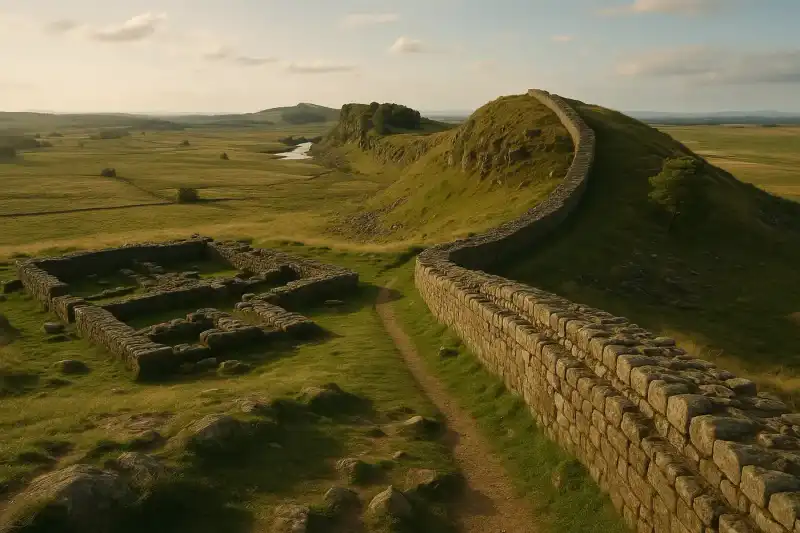
Hadrian's Wall Travel Guide 2026: Best Sections, Roman History, and Practical Planning
Roman BritainPlan a UK frontier-heritage day at Hadrian's Wall with clear section priorities, practical one-day r...
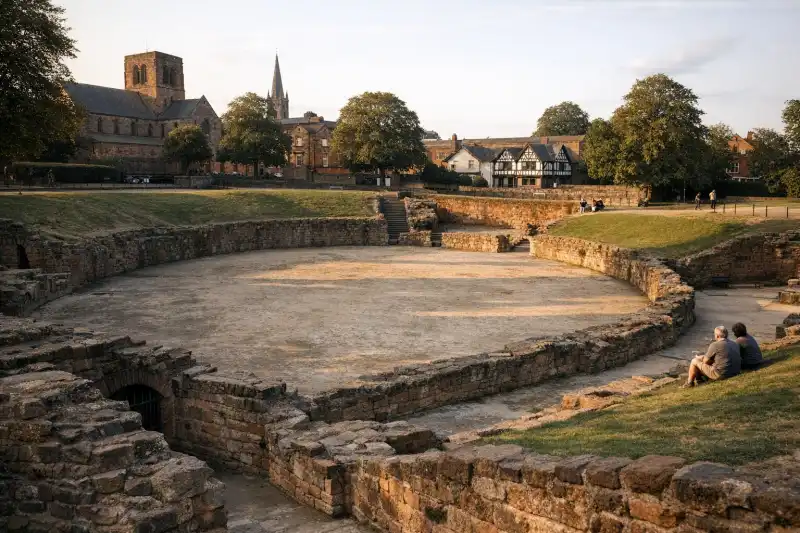
Chester Roman Amphitheater
Explore Chester Roman Amphitheater in the United Kingdom, the largest known Roman amphitheater in Br...
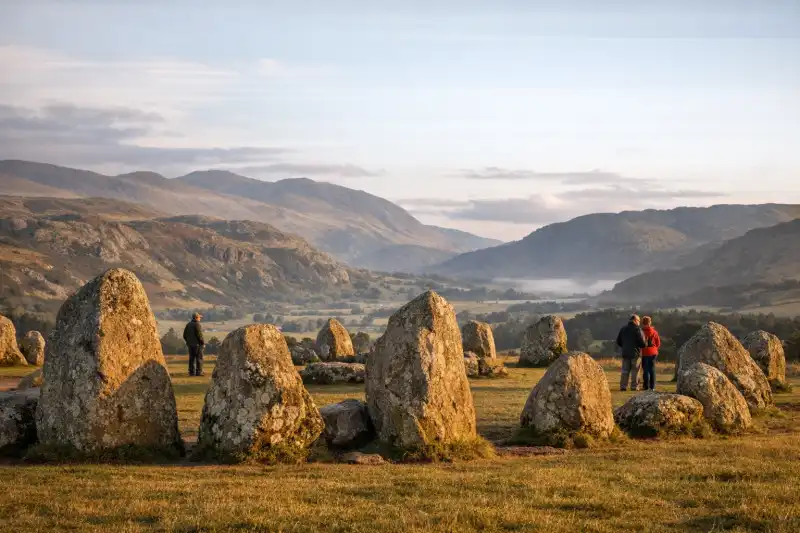
Castlerigg Stone Circle
Neolithic BritainAncient stone circle near Keswick in the United Kingdom, famed for dramatic mountain views and one o...