Quick Info
Curated Experiences
Osaka Castle & Highlights Tour
Osaka Historical Walking Tour
Kansai Castles Day Trip
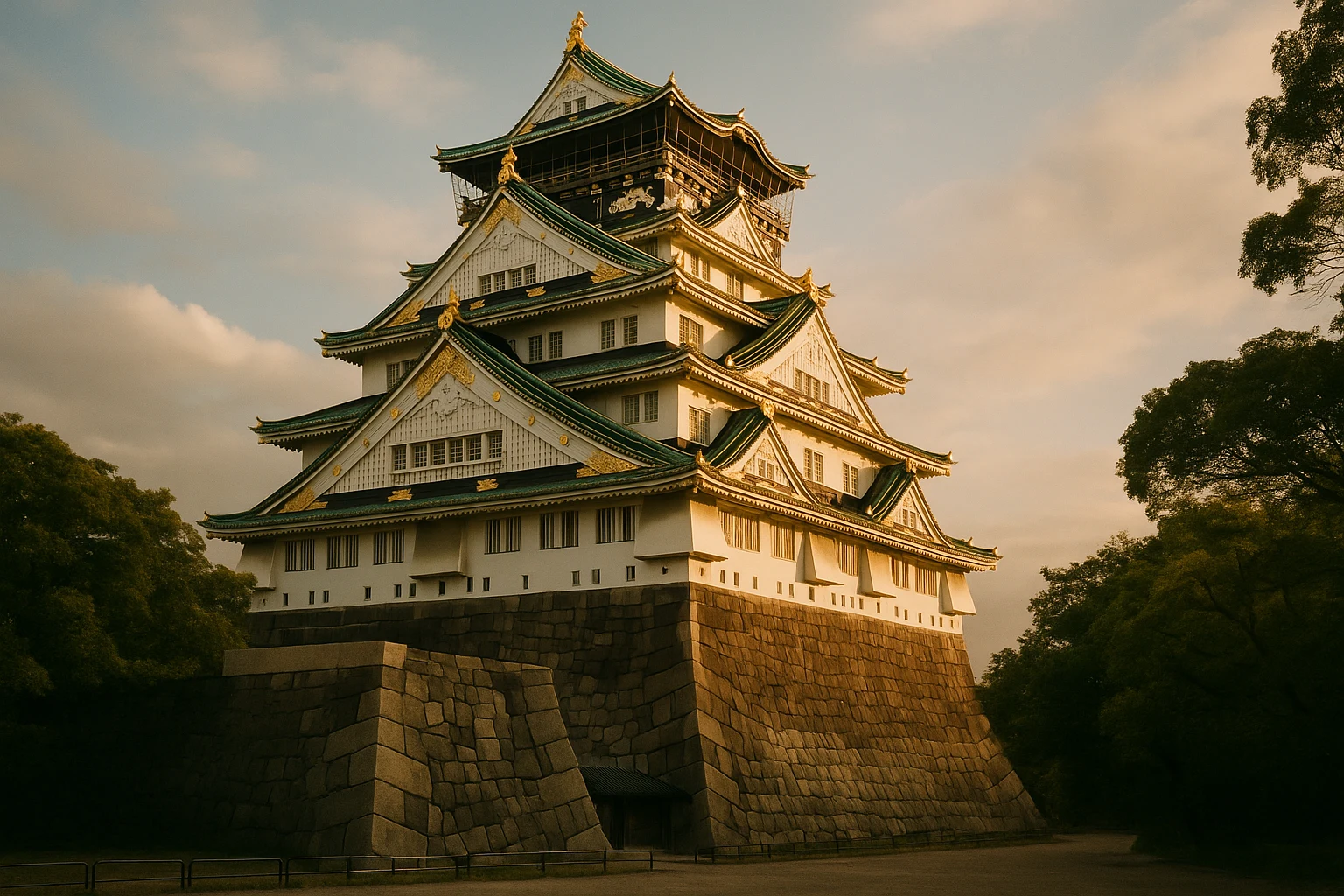
Few skylines in Japan carry the weight of history as unmistakably as Osaka’s. Rising above a sea of cherry trees, ringed by massive granite moats, and capped with gleaming gold-leaf ornaments, Osaka Castle announces itself from kilometers away. This is not just a tourist attraction—it is the geographical and symbolic heart of a city that was once the commercial capital of Japan, and the stage upon which the country’s feudal age reached its dramatic climax.
Toyotomi Hideyoshi chose this hilltop deliberately. When he began construction in 1583, he wanted a fortress that would project absolute dominance over the Kinki plain, dwarfing every rival stronghold and broadcasting to anyone approaching from any direction that a new political order had arrived. He largely succeeded. Osaka Castle became the largest castle complex in Japan at the time, and Hideyoshi used it as his base to complete the unification of the country’s warring domains—a task no ruler had managed in over a century of bloody civil conflict.
Standing at the base of the inner citadel’s stone walls today, feeling the sheer weight of individually fitted granite blocks stacked fifteen meters above your head without mortar or metal, it remains an almost incomprehensible feat of human organization. Workers quarried stone from Shōdoshima Island in the Seto Inland Sea, loaded blocks weighing up to 130 tons onto barges, and floated them to Osaka before somehow maneuvering them into place. The largest single stone visible in the walls, known as Tako-ishi, or octopus stone, measures about 36 square meters in surface area—one of the largest castle stones anywhere in Japan.
History of Osaka Castle
The site Hideyoshi selected had not been empty. He razed the fortified temple complex of Ishiyama Honganji, which had withstood a ten-year siege by the warlord Oda Nobunaga before finally surrendering in 1580. Hideyoshi inherited the site from Nobunaga, who died before he could build upon it, and he set about constructing something unprecedented in scale and ambition.
Construction began in 1583 with tens of thousands of laborers conscripted from across Japan’s domains. The castle was completed in 1585 and immediately impressed foreign and domestic observers. Portuguese Jesuit missionary Gaspar Coelho, who visited in 1586, described a building of extraordinary beauty, its upper stories lacquered in black with gold and silver metalwork glinting in the sunlight. Hideyoshi reportedly received guests in rooms lined with gold leaf—a spectacle of wealth designed to awe potential rivals into submission.
Hideyoshi died in 1598, leaving behind a five-year-old heir, Toyotomi Hideyori, and a Japan that had not yet been fully subdued. The council of regents he appointed to protect his son quickly fractured. At the Battle of Sekigahara in 1600, Tokugawa Ieyasu defeated the coalition loyal to the Toyotomi clan and established the Tokugawa shogunate that would govern Japan for the next 267 years. Osaka Castle held out as the last major Toyotomi stronghold.
The Siege of Osaka came in two phases. In the winter of 1614, Tokugawa forces flooded the outer moats and pressured Hideyori into a peace agreement that saw the defensive walls of the outer citadel filled in, stripping the castle of its main protection. When Hideyori realized the trap and attempted to restore the fortifications, Tokugawa launched the summer campaign of 1615. The castle fell, Hideyori died inside its burning walls, and the Toyotomi line was extinguished. Osaka Castle passed into Tokugawa control.
The Tokugawa shogunate rebuilt the castle between 1620 and 1629, constructing a new main tower on a higher stone base to surpass the original in grandeur. This second castle lasted until 1665, when the tower was struck by lightning and destroyed by fire. For nearly two centuries, the site had no main tower—only its stone walls and water defenses remained.
The current tower dates to 1931, built through a public fundraising campaign during Japan’s nationalistic Showa era. Though constructed of reinforced concrete rather than traditional wood and plaster, it closely follows the design of the Tokugawa-era tower and sits on the original Toyotomi-era stone foundations. A major renovation in 1997 installed modern elevators and transformed the interior into the sophisticated museum visitors find today.
During the Second World War, the Osaka Army Arsenal, which occupied much of the castle grounds, became a target for American air raids. The arsenal was destroyed in 1945, but the main tower itself survived. After the war, the surrounding park was opened to the public, gradually evolving into the beloved green space it is today.
What to See at Osaka Castle
The Main Tower
The eight-story main tower is the centerpiece of any visit. Visitors enter on the ground floor where rotating special exhibitions often showcase artifacts recovered from archaeological excavations of the original castle site, including pottery, weapons, and gold ornaments. Permanent galleries on successive floors trace the life of Toyotomi Hideyoshi in remarkable detail—from his birth to a peasant farmer’s family in 1537, through his improbable rise as a sandal-bearer in Nobunaga’s service, to his command of the most powerful military force in Japanese history.
Particularly striking are the life-sized dioramas recreating key moments: Hideyoshi presenting a freshly captured banner to Nobunaga, commanders bent over war maps in the dim glow of oil lamps, artisans hammering the golden tea room that Hideyoshi carried on campaign as a symbol of his boundless wealth. The displays are bilingual in Japanese and English throughout.
The seventh floor holds a small cinema showing a short documentary about the castle’s history. The eighth floor opens onto an outdoor observation deck that wraps around all four sides of the tower. On a clear day, the views extend across Osaka Bay to the southwest, toward the Ikoma Mountains to the east, and straight down over the inner citadel’s stone walls, moat, and the carpet of trees beyond.
The Stone Walls and Moats
The castle’s defensive engineering deserves as much attention as its tower. Osaka Castle is surrounded by two concentric rings of stone walls and moats—the inner enclosure protecting the main tower, and the outer enclosure enclosing a broader complex. The outer moat alone stretches for several kilometers in circumference.
The stone walls were constructed using a technique called nozurazumi and nendanzumi, which stacked irregular stones without mortar, relying on weight, precise fitting, and natural friction. Despite centuries of earthquakes, the walls stand virtually intact in many sections, a testament to the skill of Azuchi-Momoyama era engineers. Walking along the outer wall’s edge and looking down into the still, dark water of the moat, it is not difficult to understand why the castle proved so difficult to capture by conventional assault.
Nishinomaru Garden
The western section of the park, Nishinomaru Garden, sits on a slightly elevated plateau within the outer castle enclosure. Its 600 cherry trees make it one of Osaka’s most coveted blossom-viewing venues each spring, when the park stays open in the evenings and lanterns illuminate the blossoms against the night sky. During autumn, the garden’s ginkgo and maple trees turn brilliant shades of yellow and crimson. A small tea house on the grounds serves matcha and seasonal sweets.
The Museum of History Connection
While not part of the castle complex itself, the Osaka Museum of History stands immediately adjacent to the park’s northern edge and makes an excellent companion visit. The museum’s upper floors offer some of the best external views of the main tower, looking across the park from a modern vantage point that emphasizes just how dramatically the castle dominates its surroundings.
Getting to Osaka Castle
Osaka Castle is well-served by public transit from every direction.
By Subway: The most direct option from central Osaka is the Chuo Line or Tanimachi Line to Tanimachi 4-chome Station, a six-minute walk from the castle’s main gate. From Osaka (Umeda) Station, take the Midosuji Line south to Shinsaibashi and transfer to the Chuo Line eastbound.
By JR: The JR Osaka Loop Line stops at Morinomiya Station and Osaka Business Park Station, both on the castle’s eastern side. From Shin-Osaka (shinkansen terminus), the journey takes about 15 minutes via the Midosuji Line and a subway transfer.
On Foot from Namba: The castle is roughly 2.5 kilometers from the Dotonbori entertainment district, a pleasant 30-minute walk following the Higashi-Yokobori River north through Osaka’s older eastern neighborhoods.
By Bicycle: Osaka has an excellent cycle-share network (Docomo Bike Share). Stations ring the castle park, and the flat, well-marked cycling paths approaching from the river to the west are a particularly enjoyable approach.
When to Visit
Cherry Blossom Season (late March–early April) is peak time, when the park transforms into one of Japan’s most celebrated hanami (blossom viewing) destinations. Crowds are large but the atmosphere is festive, and evening illumination events make for a dramatically different experience after dark.
Autumn (mid-October–late November) offers cooler temperatures and vivid foliage colors with meaningfully thinner crowds than spring. The combination of red maple canopies and the castle’s gold ornaments in autumn light is exceptional.
Summer (June–August) brings Osaka’s brutal humidity and heat. The castle itself remains comfortable thanks to air conditioning, but exploring the park grounds in July or August demands early morning starts and steady hydration.
Winter (December–February) is the quietest season. Occasional snowfall creates dramatic scenes, especially with snow settled on the castle’s curved roof tiers, and you will often have the outer park nearly to yourself.
Combining Osaka Castle with Nearby Sites
Osaka Castle fits naturally into a broader Kansai itinerary that takes advantage of the region’s extraordinary concentration of historical sites within easy train access of one another.
Nara (45 minutes by express train) makes an effortless day trip companion. Todai-ji Temple’s Great Buddha Hall is among the most overwhelming wooden structures on earth, and Nara’s famous free-roaming deer have made the surrounding park a cultural experience unto itself.
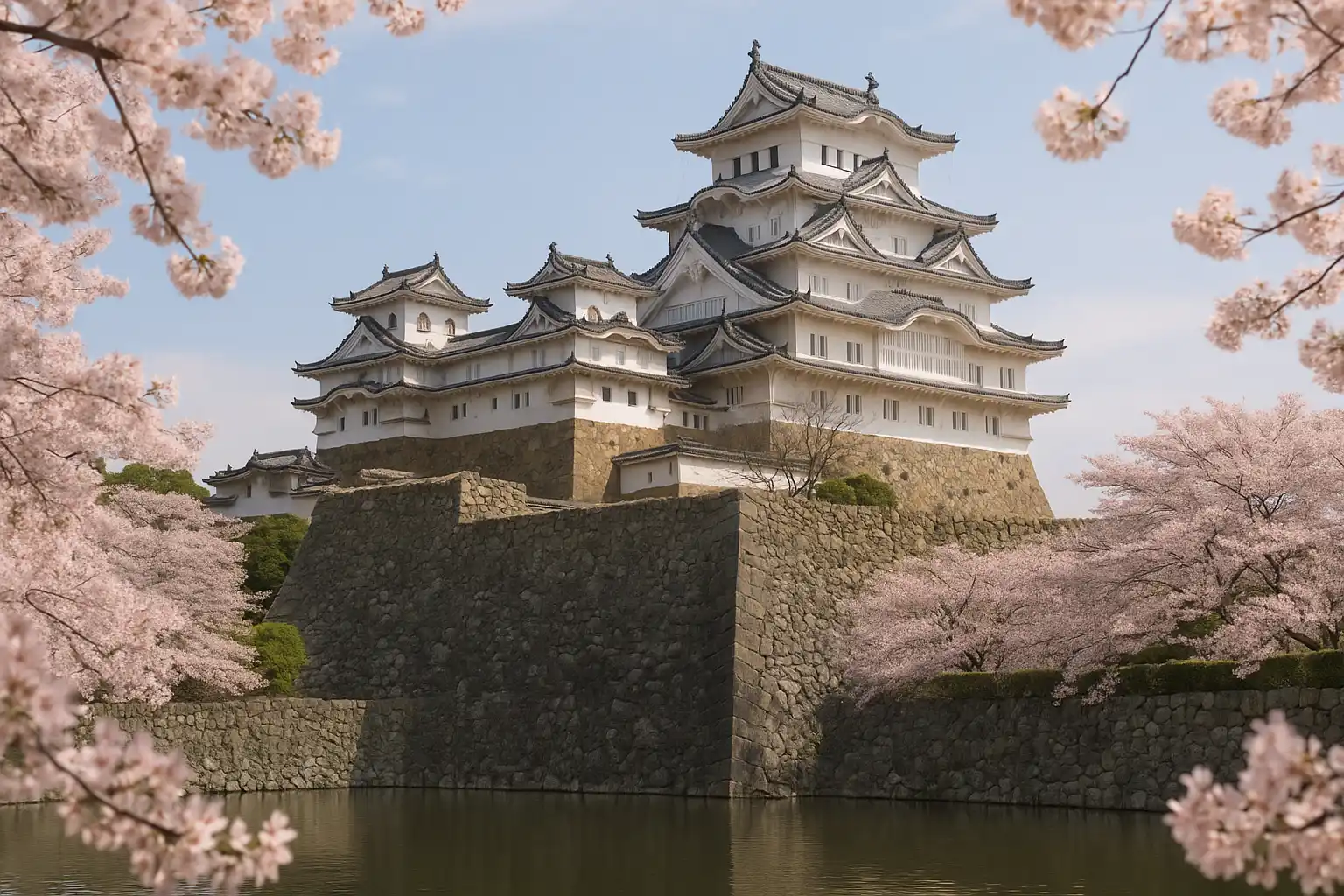
Himeji Castle (60 minutes on the Shinkansen or express train) is often paired with Osaka because it represents the other great pole of Japanese castle architecture—where Osaka Castle is a powerful, moated urban fortress rebuilt in the modern era, Himeji is a complete original feudal complex of astonishing preservation, gleaming white and endlessly photographed. Visiting both in the same trip produces a genuinely illuminating contrast.
Kyoto (15 minutes on the Shinkansen, 30–40 minutes by express train) is the obvious counterpart to an Osaka stay. Fushimi Inari Shrine, the Nishiki Market, and the Gion district are all easy day-trip targets, and Kyoto’s historical density rewards multiple days.
Within Osaka itself, the street-food culture of Dotonbori, the art and harbor life of the Tempozan waterfront, and the renovated Shinsekai neighborhood all offer depth to a city that most visitors reduce to a transit stop between Kyoto and Hiroshima.
Why Osaka Castle Still Matters
Osaka Castle is not simply a picturesque ruin preserved for tourists. It sits at the center of one of the most consequential transitions in Japanese history—the moment when decades of civil war gave way to the enforced peace of the Tokugawa shogunate. Hideyoshi’s decision to build here, and the Tokugawa family’s decision to conquer and then rebuild here, reflect how completely this hilltop was understood by Japan’s rulers to be the symbolic heart of national power.
The castle’s repeated destruction and reconstruction also mirrors something essential about Japan’s relationship with historical memory. Unlike European stone keeps that crumble slowly over centuries, Japanese wooden architecture has always been understood as temporary—rebuilt on the same sacred ground, to the same design, as an act of cultural continuity rather than physical preservation. The 1931 concrete tower is honestly described as a modern reconstruction, yet it carries the same footprint, faces the same cardinal directions, and looks out over the same moats as Hideyoshi’s original. That coherence across four centuries of burning, sieges, lightning strikes, and firebombing is its own kind of survival.
For the traveler arriving from outside Japan, Osaka Castle offers something rare: a place where the gap between the living city and its deepest history narrows almost to nothing. Salarymen eat lunch on the stone steps of a sixteenth-century citadel. Schoolchildren feed the park’s koi in the shadow of walls that once sheltered the ruler of all Japan. The shinkansen rumbles across a viaduct visible from the observation deck, and the whole panorama—ancient, modern, and deeply, unmistakably Osaka—seems to make perfect sense.
Quick Facts
| Detail | Information |
|---|---|
| Location | Chuo Ward, Osaka City, Osaka Prefecture, Japan |
| Built | 1583 (Toyotomi); 1620–1629 (Tokugawa reconstruction); 1931 (current tower) |
| Builder | Toyotomi Hideyoshi (original); Tokugawa Shogunate (second); City of Osaka (1931) |
| Period | Azuchi-Momoyama to Edo Period |
| Tower Height | 58 meters (including stone base) |
| Park Area | 106 hectares |
| Opening Hours | 9:00 AM – 5:00 PM daily (last entry 4:30 PM); park open 24 hours |
| Admission | ¥600 adults; free for children under 15; park grounds free |
| Nearest Station | Tanimachi 4-chome (Osaka Metro), 6-minute walk |
| UNESCO Status | National Historic Site of Japan |
| Best Season | Cherry blossom (late March–April) or autumn foliage (November) |
| Average Visit | 2–3 hours (half day with park and garden) |
Explore More
Frequently Asked Questions
How old is Osaka Castle?
The original Osaka Castle was completed in 1585 by Toyotomi Hideyoshi, making the site over 440 years old. The current main tower is a 1931 reinforced concrete reconstruction built on the original foundations, with the interior renovated as a museum in 1997.
Is Osaka Castle worth visiting?
Yes, Osaka Castle is one of Japan's most rewarding historical landmarks. Beyond its dramatic exterior, the eight-story museum inside tells the story of Japan's feudal unification, and the surrounding park is one of Osaka's premier cherry blossom viewing spots.
How long does it take to visit Osaka Castle?
Allow two to three hours for a complete visit, including the park grounds, the main tower museum, and the view from the observation deck on the eighth floor. If you plan to relax in Nishinomaru Garden or join a tour, budget half a day.
When is the best time to visit Osaka Castle?
Late March to early April brings spectacular cherry blossoms across the 106-hectare park, making it the most popular season. Autumn foliage in November is equally beautiful and less crowded. Avoid mid-summer if possible, as Osaka's heat and humidity are intense.
Is there an admission fee for Osaka Castle?
The park grounds are free to enter at all times. Admission to the main tower museum costs ¥600 for adults and is free for children under 15. The Nishinomaru Garden charges a separate small entry fee, typically ¥200, during cherry blossom season.
How do I get to Osaka Castle by train?
Take the Osaka Loop Line to Morinomiya or Tanimachi 4-chome Station on the Tanimachi or Chuo subway lines, both of which are a short walk from the castle park. From Osaka Station, the journey takes about 15 minutes.
Can you go inside Osaka Castle?
Yes, the main tower is open to visitors and functions as an eight-story museum covering the life of Toyotomi Hideyoshi and the castle's history. The top floor offers a 360-degree observation deck with views over modern Osaka.