Quick Info
Curated Experiences
Pachacamac Ruins and Museum Half-Day Tour from Lima
Private Pachacamac Archaeological Tour with Coastal Viewpoints
Lima Archaeology Full Day: Huaca Pucllana and Pachacamac
Here is the 240-word introduction for Pachacamac:
Perched on a desert ridge where the Lurín Valley meets the Pacific coast 31 kilometers south of Lima, Pachacamac stands as one of the most continuously inhabited sacred sites in the Americas. For more than a millennium, pilgrims traveled from across the Andean world to consult the oracle housed within its painted adobe temples — a deity so powerful that the Inca, rather than destroy the sanctuary after conquest, built their own temple alongside it and integrated it into the empire’s ceremonial calendar.
The sanctuary’s layered biography is what distinguishes it from better-known highland sites. Successive civilizations — the Lima culture, the highland-influenced Wari, the local Ychsma administrators, and finally the Inca — each added compounds and reworked older structures, leaving a compressed architectural record of coastal religious life that spans roughly 1,300 years. The on-site Pachacamac Museum organizes this complexity before visitors set foot on the ridge, making it among the most intelligently presented archaeological experiences in Peru.
For Lima-based travelers, Pachacamac offers something the city’s urban huacas cannot: space. The sanctuary spreads across 465 hectares of desert ridge, with open processional roads, panoramic Pacific views, and a quieter pace than the capital’s traffic-encircled pyramids. A focused half-day visit covers the museum, the Inca Sun Temple, and the Painted Temple sector comfortably. This guide provides the historical context, site orientation, and transport logistics needed to make that visit count.
Word count: ~237
History: The Oracle Sanctuary of the Central Coast
Pachacamac’s story spans more than a millennium of overlapping civilizations, each drawn to the same desert ridge above the Lurín River valley by the authority of an ancient oracle whose reputation reached across the Andes.
The Lima Culture and the First Oracle (c. 200–600 CE)
The earliest monumental construction at Pachacamac belongs to the Lima culture, the coastal people who raised the Old Temple—a massive adobe platform that anchored the sanctuary’s ritual identity for centuries. The Lima were master irrigators and traders, and they established Pachacamac as a pilgrimage destination whose oracle deity, associated with earthquakes and creation, drew supplicants from across the central Peruvian coast. The site’s name derives from Pacha Kamaq, a Quechua phrase meaning “he who animates the world,” though the oracle almost certainly predates Quechua speakers by many generations.
Wari Influence and Regional Prestige (c. 600–1000 CE)
During the Middle Horizon, the highland Wari empire expanded its political and religious reach across much of Peru. At Pachacamac, Wari influence is visible in architectural modifications and in the presence of new ceramic styles, though the site was never simply absorbed. Instead, Pachacamac appears to have negotiated its own status—its oracle carried enough prestige that even expansionist powers found accommodation more useful than conquest. The sanctuary grew in regional importance precisely because of this independence, cementing a reputation that would outlast the Wari collapse.
The Ychsma and the Maturing Pilgrimage Center (c. 1000–1440 CE)
Following the Wari withdrawal, local Ychsma lords assumed administrative control and oversaw Pachacamac’s most intensive building phase. The Ychsma constructed new temple compounds, expanded the pilgrimage road network, and organized the ceremonial infrastructure that received visitors arriving by sea and by land from distant valleys. Burials from this period reveal the extraordinary social range of pilgrims—commoners and elites alike sought audience with the oracle in exchange for offerings deposited in the sacred precincts.
Inca Integration and the Sanctuary’s Final Chapter (c. 1440–1533 CE)
The Inca incorporated Pachacamac in the mid-fifteenth century under Pachacutec, wisely choosing negotiation over destruction. They constructed the Temple of the Sun on the ridge’s highest point and introduced solar worship alongside the existing oracle cult, creating a layered theological landscape. The sanctuary continued to function as a major pilgrimage destination under Inca administration, its oracle consulted even by Inca rulers on matters of state. When Francisco Pizarro’s lieutenant Hernando Pizarro arrived in 1533 searching for treasure, he found the oracle chamber largely evacuated—the priests had hidden or dispersed the idol before Spanish hands could reach it.
The Key Monuments: What to See at Pachacamac
Pachacamac rewards careful exploration across its interconnected temple compounds, administrative sectors, and residential quarters. The sanctuary sprawls across a desert ridge approximately 600 hectares in extent, so prioritizing the principal structures helps visitors build a coherent picture of the site’s layered occupation.
The Temple of the Sun
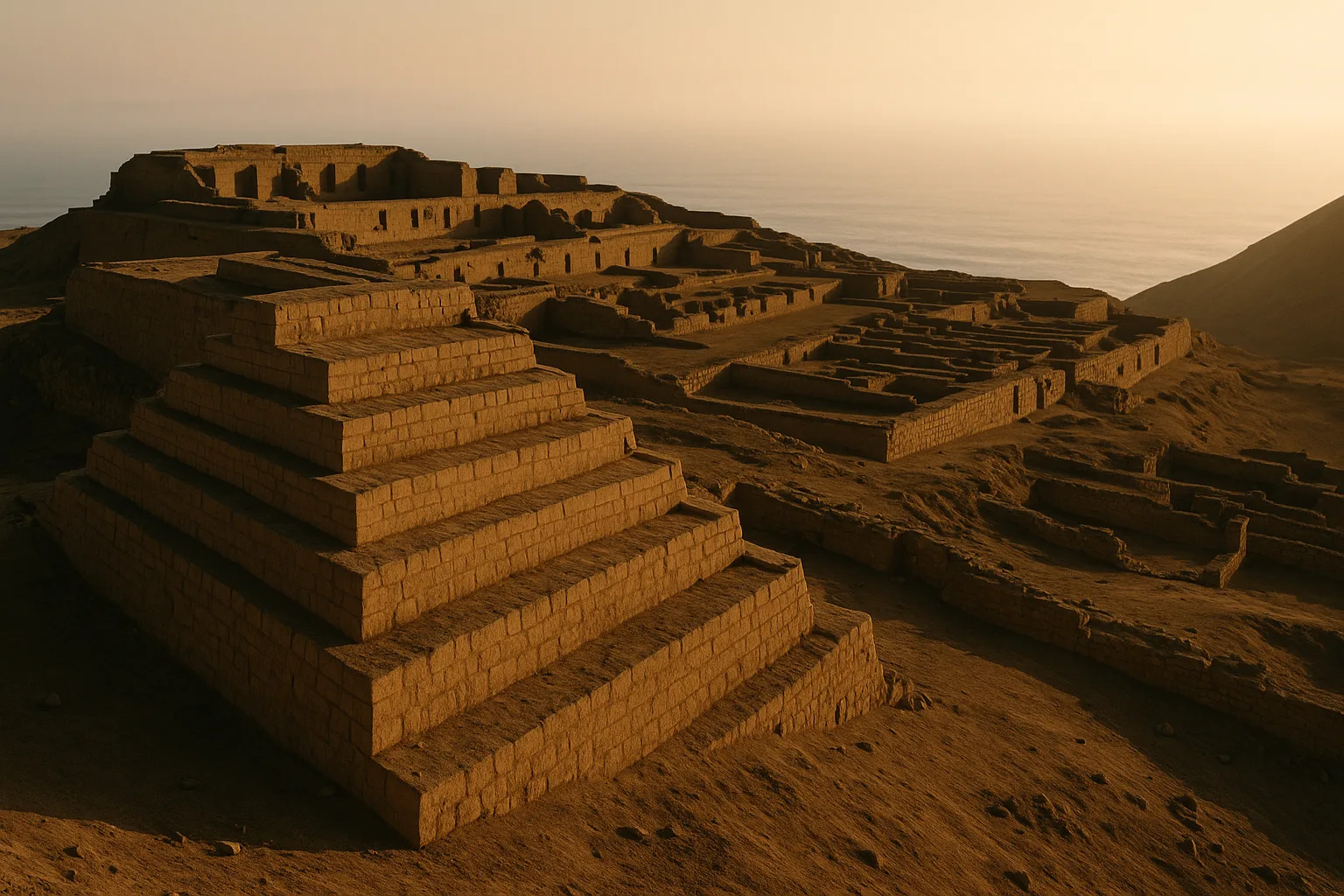
The Inca-period Temple of the Sun dominates the highest point of the ridge and represents the most dramatic single structure at Pachacamac. Constructed after the Inca incorporated the sanctuary around 1470 CE, the temple’s stepped platform rises in broad adobe and stone terraces oriented toward the Pacific. From its upper level, the full spatial logic of the sanctuary becomes clear: pilgrimage roads arriving from the north and south, subsidiary plazas funneling devotees toward the oracle precinct below, and the coastal plain stretching toward Lima. The Inca deliberately positioned their solar temple above the existing Ychsma sacred core, asserting imperial theology over an already ancient and revered center.
The Painted Temple (Temple of Pachacamac)
Below the Sun Temple sits the older Painted Temple, the original house of the oracle deity for whom the entire sanctuary is named. Dating to the Early Intermediate Period and expanded through Wari and Ychsma phases, this multi-story adobe structure once bore vivid polychrome murals depicting marine life, serpents, and geometric registers. Fragments of painted plaster have been documented across its facades. The oracle housed here was among the most consulted in the Andean world, attracting pilgrims from Ecuador to northern Chile across more than a millennium of continuous veneration.
The Mamacona (House of the Chosen Women)
To the north of the oracle temples lies the Mamacona compound, an enclosed precinct associated with the Inca institution of the acllawasi — the residence of consecrated women selected for religious and administrative service. The compound’s well-preserved adobe walls and interior rooms convey the organizational scale the Inca imposed on Pachacamac after absorption. Archaeological investigations have recovered textile tools, storage vessels, and botanical remains that document the compound’s productive and ritual functions alongside its residential role.
The Pilgrimage Roads and Plaza Mayor
Connecting the temple sectors is a network of wide processional roads and the central Plaza Mayor, a large open ceremonial space that once accommodated substantial gatherings of pilgrims. The roads arriving from north and south were engineered with adobe walls defining their margins, funneling movement and controlling access to the sacred core in a manner mirrored at Inca sites across the Andes. Walking sections of these roads helps visitors understand Pachacamac not as a static ruin but as a destination infrastructure — a place designed to receive, direct, and process thousands of people in acts of collective devotion.
The Site Museum (Museo de Sitio Julio C. Tello)
The on-site museum, named for the pioneering Peruvian archaeologist who excavated here in the early twentieth century, provides essential context before or after walking the compounds. Its galleries display the reconstructed wooden idol of Pachacamac — a carved post believed to represent the oracle deity itself — alongside ceramics, textiles, metalwork, and osteological material spanning the site’s full occupation sequence. The idol display alone justifies the museum visit; few comparable pre-Hispanic cult objects survive with such direct documentary association to a specific sanctuary and deity.
Getting There: Transportation and Access from Lima/Miraflores
Pachacamac sits roughly 31 kilometers south of Miraflores along the Panamericana Sur, making it one of the most accessible major archaeological sites in Peru despite its distance from Lima’s tourist center.
Taxi or Rideshare The most straightforward option is a taxi or app-based rideshare (InDriver, Cabify, or Uber). From Miraflores, expect 45–75 minutes depending on traffic and fares typically ranging from S/45–70 (approximately USD 12–19). Peak-hour departures before 8 AM or after 4 PM can push travel time significantly longer. Negotiate a round-trip fare with waiting time if you prefer a fixed arrangement; drivers usually accept S/90–120 (USD 24–32) for a half-day with two to three hours on-site.
Combi (Public Bus) Budget travelers can take Línea 1 combis marked “Lurín” from Avenida Angamos or the Metropolitano feeder routes toward Chorrillos, then connect to a southbound Lurín-bound combi on the Panamericana Sur. The combined fare runs approximately S/3–5 (under USD 2), but journey time often exceeds 90 minutes and requires navigating two transfers with luggage.
Organized Tour Half-day tours from Miraflores typically depart around 8–9 AM, include round-trip transport and a guided walkthrough, and run USD 35–55 per person through reputable agencies. This option suits first-time visitors or those combining Pachacamac with Huaca Pucllana in a single day.
Driving Self-drivers follow Panamericana Sur south to Km 31.5, where signage directs toward the sanctuary entrance. Parking is free at the site.
Practical Information
Admission: Entry to the Pachacamac Archaeological Sanctuary costs approximately S/15 (around US$4) for adults, with reduced rates for students and children. The ticket covers all open temple sectors and the on-site museum.
Opening Hours: The sanctuary is open Tuesday through Sunday, 9:00 AM to 5:00 PM (last entry around 4:00 PM). The site is closed on Mondays. Arrive before noon to allow adequate time for both the museum and the main temple circuits.
Museum: The Pachacamac Site Museum is a modern facility housing ceramics, textiles, and the remarkable carved wooden idol of Pachacamac recovered from the sanctuary. Plan 45–60 minutes here before walking the site.
Walking Distances: The sanctuary covers roughly 465 hectares. The core visitor circuit from the museum entrance to the Temple of the Sun and back is approximately 3–4 kilometers over uneven desert terrain with moderate inclines.
What to Bring:
- Sunscreen and a wide-brimmed hat (minimal shade on site)
- At least 1.5 liters of water per person
- Comfortable closed-toe shoes with grip
- A light jacket for coastal fog, especially in winter months (June–September)
- Cash in soles for the entrance fee
When to Visit: Seasonal Considerations
December to March: Hot and Hazy Summer
Lima’s summer brings warmer temperatures and higher humidity along the coast. Pachacamac sits on an exposed desert ridge, and midday heat can be intense. If visiting during these months, arrive early—by 9 a.m.—and carry extra water. The upside is clearer skies than the rest of the year.
April to June: Shoulder Season Comfort
These transitional months offer the most comfortable walking conditions at Pachacamac. Temperatures moderate, crowds thin after the Easter holiday surge, and the coastal garúa fog has not yet settled in. This window is arguably the best balance of manageable weather and manageable visitor numbers.
July to September: Peak Tourism, Overcast Skies
Lima’s winter coincides with peak international tourism. The persistent garúa—low coastal cloud and drizzle—keeps temperatures cool but reduces visibility across the sanctuary’s desert panoramas. Expect larger tour groups and slightly longer queues at the on-site museum. Layering is essential; mornings feel cold despite the latitude.
October to November: Late Dry Season Value
October and November see thinning fog and fewer visitors compared to the July–September peak. Temperatures remain mild, panoramic views along the Pacific ridge begin to open up again, and afternoon light on the adobe temple platforms is particularly photogenic. This is an underrated window for independent travelers seeking space and good conditions simultaneously.
How to Combine Pachacamac with Nearby Sites
Pachacamac sits at the southern edge of Lima’s metropolitan sprawl, which makes it genuinely easy to weave into a broader archaeology itinerary without long travel days or logistical headaches.
Pachacamac and Huaca Pucllana — the natural Lima pairing. The most efficient combination is a single day that opens at Huaca Pucllana in Miraflores — a compact Lima culture pyramid rising improbably from the mid-city grid — and then drives south to Pachacamac for the afternoon. Alternatively, reverse the order: reach Pachacamac early, when it is coolest, and save Huaca Pucllana for late afternoon when its on-site restaurant makes a civilized ending. The two sites together trace coastal Andean urbanism across nearly a millennium without leaving the Lima region.
Adding Caral for a deeper chronological arc. If you have a second day and want to push the timeline dramatically further back, Caral in the Supe Valley lies roughly four hours north of Lima. Dating to around 3000 BCE, it predates Pachacamac by more than two millennia, making the contrast almost disorienting in scale. Most visitors base in Lima and do Caral as an early-start day trip, then treat Pachacamac as a separate half-day excursion.
Connecting to highland Inca sites. Pachacamac was absorbed into the Inca empire in the mid-fifteenth century, and following that thread inland leads naturally toward Cusco and its monumental works. Sacsayhuaman above Cusco represents the highland counterpart to Pachacamac’s coastal authority — both were sacred precincts with pan-Andean pilgrimage significance, and visiting them in sequence makes the geographic and political scale of the Inca state genuinely legible.
For most visitors, the Pachacamac–Huaca Pucllana pairing is the practical choice. Caral and Sacsayhuaman reward those with the time to pursue the wider story.
Quick Facts
| Field | Details |
|---|---|
| Civilization | Lima, Wari influence, Ychsma administration, later Inca integration |
| Period | c. 200-1532 CE |
| Established | c. 200 CE as major coastal oracle sanctuary |
| Typical Visit Time | 2.5-4 hours |
| Best Combined With | Huaca Pucllana and Lima historic districts |
| Landscape | Desert ridge sanctuary overlooking the Pacific littoral |
Explore More Ancient Sites in Peru
After Pachacamac, compare urban coastal archaeology at Huaca Pucllana and then widen the chronology with a longer trip to Caral, one of the oldest urban centers in the Americas. For contrast with imperial highland stonework, continue to Sacsayhuaman and the Sacred Valley.
Frequently Asked Questions
How much time should I spend at Pachacamac?
Most visitors need 2.5 to 4 hours to cover the museum and principal temple sectors at a comfortable pace. The sanctuary is extensive, so rushing tends to reduce understanding and enjoyment.
Can you visit Pachacamac without a guide?
Yes, independent visits are possible and signage has improved. However, the site's layered Lima, Wari, Ychsma, and Inca chronology is much easier to understand with a knowledgeable guide.
Is Pachacamac worth it if I only have one day in Lima?
If you are archaeology-focused, yes. A half-day at Pachacamac paired with central Lima or Miraflores gives one of the strongest pre-Hispanic context days possible in the capital region.
What is the best time of day to visit Pachacamac?
Morning generally offers cooler walking conditions and cleaner visibility before coastal haze intensifies. Late afternoon can be beautiful for desert light but often warmer on exposed sections.
How do I get to Pachacamac from Miraflores?
By taxi or rideshare, travel time is usually 45-75 minutes depending on traffic, with fares varying by demand. Organized tours are convenient if you prefer fixed timing and interpretive support.
Nearby Ancient Sites
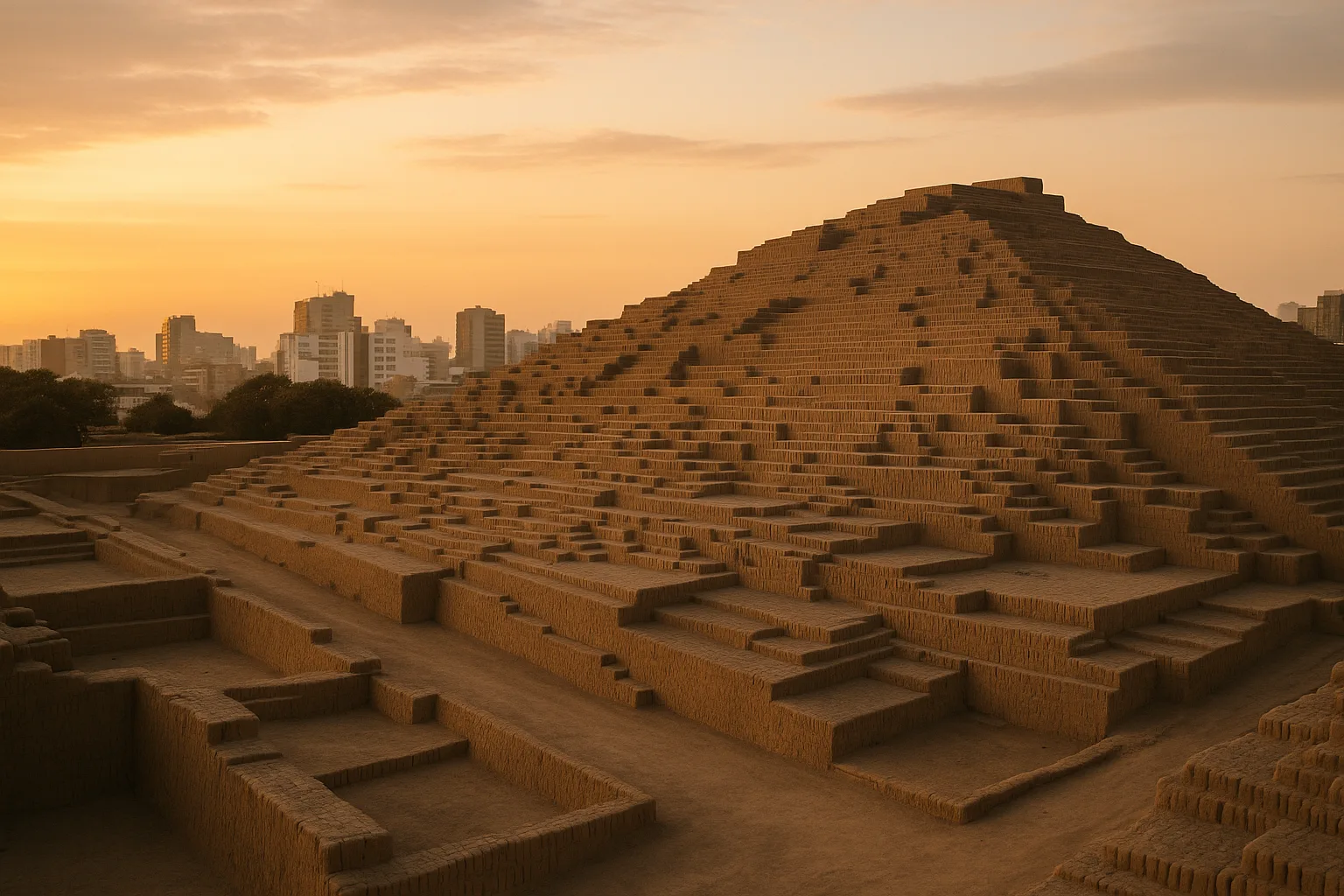
Huaca Pucllana Peru Guide 2026: Lima Adobe Pyramid & Lima Culture
Lima-Ychsma-IncaExplore Huaca Pucllana in Lima: pre-Inca adobe pyramid architecture, museum circuit, practical entry...
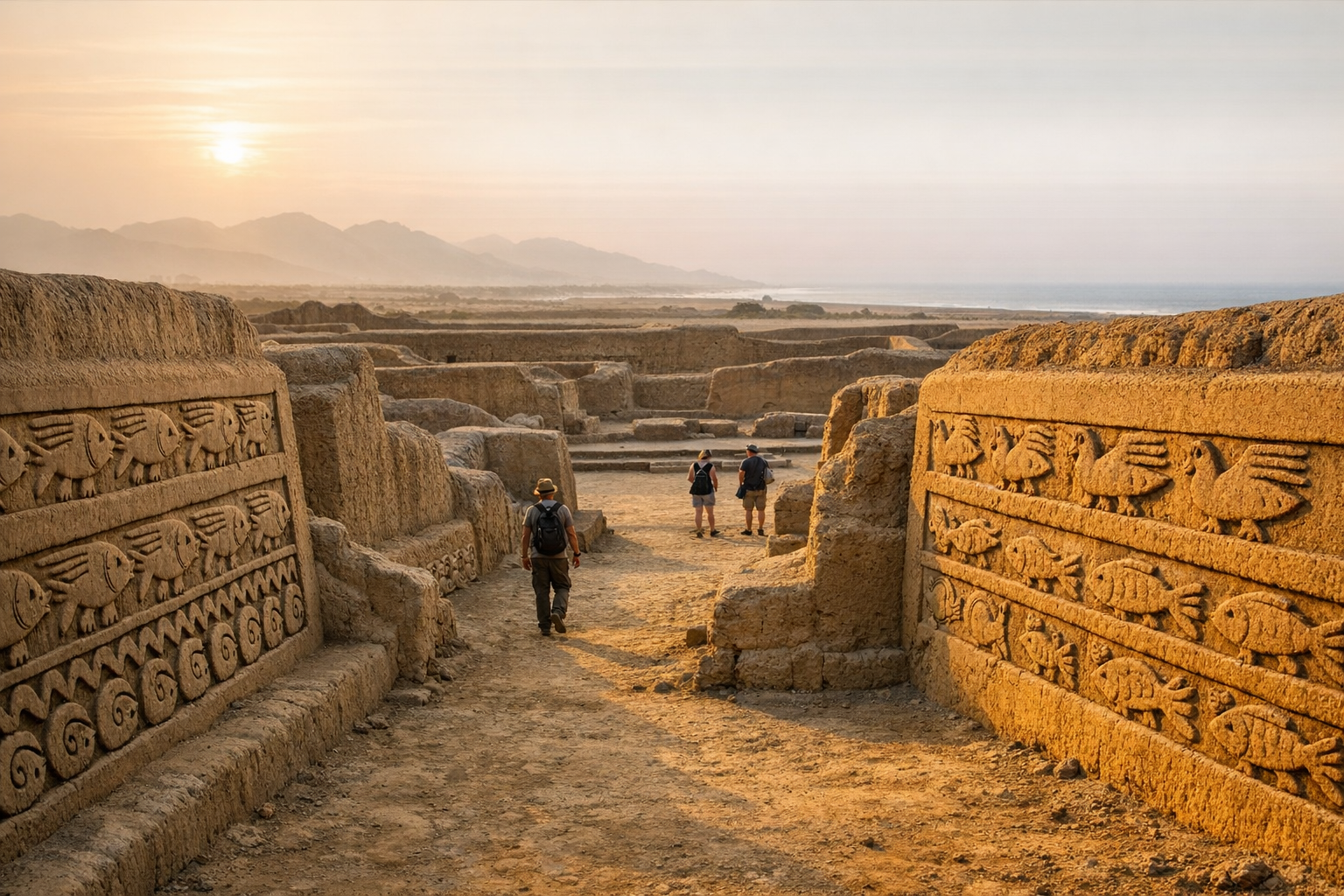
Chan Chan Peru Guide 2026: Chimu Capital & Adobe Citadels
ChimuExplore Chan Chan near Trujillo — the largest pre-Columbian city in the Americas. Discover the Chimu...