Quick Info
Curated Experiences
Rhodes Old Town Walking Tour with Palace Entry
Full-Day Rhodes City and Medieval Town Tour
Rhodes Island Private Day Tour
Why the Palace of the Grand Master Belongs on Your Greece Itinerary
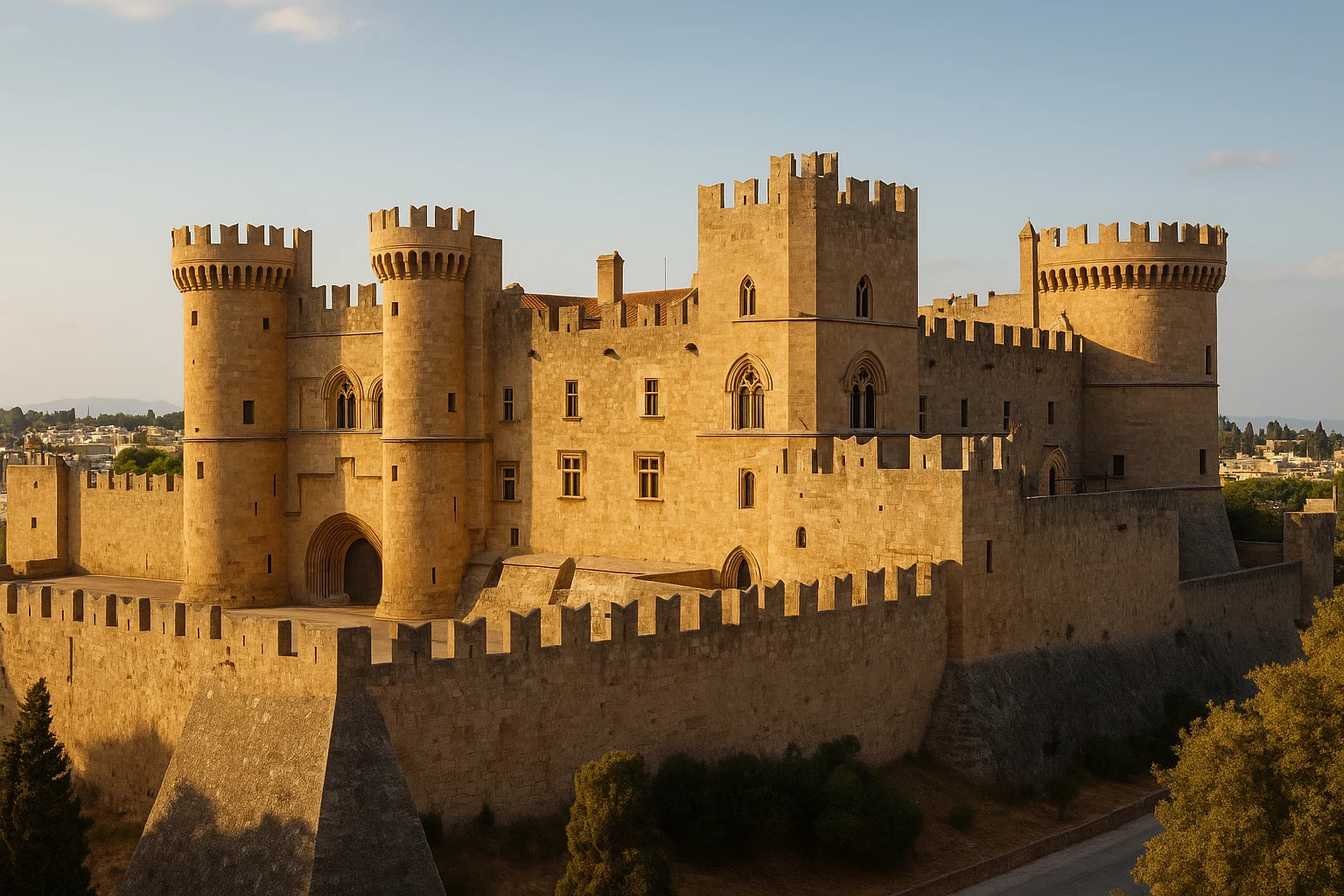
Few buildings in the Mediterranean manage to be simultaneously a functioning medieval fortress, a baroque Mussolini-era restoration, and a genuine repository of late-antique art — all in the same address. The Palace of the Grand Master of the Knights of Rhodes sits at the crown of Rhodes Old Town, its muscular twin towers visible from the harbor and its mosaic floors so unexpected that first-time visitors invariably stop mid-stride to stare downward.
Rhodes Old Town is a UNESCO World Heritage Site, and the palace is its architectural anchor. Unlike many “medieval” sites that survive only as ruins, this one gives you rooms you can walk through, courtyards you can linger in, and a narrative stretching from Byzantine governors to crusader knights to Italian colonial administrators. If you visit only one thing in Rhodes, this is it.
Historical Context
The site has been fortified since ancient times, but the palace as it stands today is primarily a creation of the Knights Hospitaller, the military-religious order that controlled Rhodes from 1309 to 1522. After driving the Byzantine governors from the island, the Knights rebuilt an existing Byzantine citadel into a purpose-built administrative and defensive center, completing the core structure in the early fourteenth century.
The Grand Master — the elected head of the Order — resided here, receiving ambassadors, directing the defense of the Latin East, and managing what was, effectively, a sovereign crusader state in the eastern Aegean. The Order was extraordinarily wealthy, drawing income from hospitals, estates, and the sea trade it both protected and taxed. That wealth shows in the building: massive ashlar walls, vaulted chambers, and a scale of construction that was unusual for an island outpost.
The Ottoman siege of 1522 ended the Knights’ tenure. Sultan Suleiman the Magnificent captured Rhodes after a months-long campaign, and the Knights evacuated to Malta, where they eventually became the Knights of Malta. The Ottoman administration converted parts of the palace into a prison and later a barracks. By the nineteenth century the structure had deteriorated significantly, and a catastrophic accidental explosion of stored gunpowder in 1856 caused severe damage to the adjoining area.
When Italy took possession of the Dodecanese islands after the Italo-Turkish War of 1912, the new colonial administration undertook a wholesale restoration. The work, completed under the direction of Italian architects between 1937 and 1940, was politically motivated — Mussolini intended to use the palace as a summer residence and symbol of Italian Mediterranean prestige — and scholars have criticized liberties taken with historical accuracy. Nevertheless, the result is a largely coherent medieval interior, enriched by an extraordinary collection of Roman and Early Christian mosaic floors salvaged from the island of Kos and installed throughout the upper rooms.
What to See Inside
The Entrance Gate and Towers The main facade is the most photographed element: two round towers flanking a pointed-arch gate, battlemented and solid, built to absorb siege artillery. Pass through the gate into the cobblestoned courtyard, where the scale of the structure becomes apparent. Headless marble statues on pedestals give the space a slightly surreal, theatrical quality — a mix of genuine ancient sculpture and Italian-era additions.
The Mosaic Floors The single most remarkable feature of the interior is the series of ancient mosaic floors, transferred from archaeological excavations on Kos and laid into the upper-floor rooms during the Italian restoration. These are not replicas. They are original late-Roman and Early Christian works, some dating to the third and fourth centuries CE, depicting marine scenes, mythological figures, and geometric patterns of startling sophistication. Walking across them feels transgressive; they are simply too beautiful to be floor coverings.
The Exhibition Halls The ground floor houses two permanent exhibitions. The first covers the medieval city of Rhodes — urban planning, daily life, military organization — with a useful model of the Old Town walls. The second presents ancient Rhodes from the Neolithic period through the Hellenistic and Roman eras, with pottery, coins, funerary stelae, and bronze objects. Both exhibitions are well-labeled in Greek and English and offer context that makes the rest of the Old Town more legible.
The Knights’ Courtyard The inner courtyard is surrounded by vaulted arcades. In summer, concerts and open-air events are occasionally staged here. Even without programming, it is a fine place to pause — the proportions are generous, the stonework is carefully maintained, and the tower visible above the arcade gives a clear sense of how formidable this structure was designed to be.
Practical Tips for Visitors
Getting There The palace is at the top of the Street of the Knights (Odos Ippoton), the best-preserved medieval street in Europe and itself worth a slow walk. Enter Rhodes Old Town through the D’Amboise Gate (the northernmost gate, closest to the new town) and walk straight — the palace gate is visible within minutes. From the main harbor (Mandraki), walk into the Old Town and follow signs; the walk takes about 10 minutes.
Tickets and Timing Buy tickets at the gate. A combined ticket with the nearby Archaeological Museum of Rhodes offers better value if you plan to visit both (recommended — the museum houses the famous Aphrodite of Rhodes). Arrive when the palace opens (8:00 AM in summer) to beat tour groups, which arrive in force from about 10:00 AM onward. Midday in July and August is stifling; early morning or late afternoon visits are considerably more comfortable.
Guided vs. Self-Guided The palace is navigable without a guide, particularly with the free floor plan provided at the entrance. However, a licensed local guide hired through the Old Town gate or a reputable tour operator will substantially deepen the experience, particularly regarding the Italian restoration controversies and the provenance of the mosaic floors.
Accessibility The ground floor and courtyard are accessible for mobility-impaired visitors. Upper floors involve stairs and uneven historic paving. Confirm current accessibility provisions at the ticket desk.
Combining with Nearby Sites
Rhodes Old Town is dense with layered history and can absorb a full day without repetition.
Street of the Knights (Odos Ippoton): The 200-meter cobbled street running from the palace gate to the Hospital of the Knights is one of the most intact medieval streetscapes anywhere. The inns (auberges) of the various linguistic divisions of the Order line each side.
Archaeological Museum of Rhodes: Housed in the restored Hospital of the Knights at the foot of the Street of the Knights, the museum displays the Aphrodite of Rhodes — a first-century BCE marble of unusual quality — alongside Mycenaean and Geometric finds. Allow an additional 90 minutes.
Walls and Moat Walk: Rhodes Old Town’s circuit of walls is approximately 4 kilometers long. A guided walk along the ramparts (departing Tuesday and Saturday from the palace gate, subject to season) offers rooftop views of the Old Town and the sea beyond.
Lindos and the Acropolis of Lindos: 50 kilometers south, Lindos combines a classical acropolis perched on a 116-meter sea cliff with a Knights-era castle and a whitewashed village that is photogenic to the point of self-parody. Full-day excursions run daily from Rhodes town.
When to Visit
April to early June and September to October are the optimal windows: comfortable temperatures (18–26°C), manageable crowds, and full opening hours. July and August bring extreme heat and dense cruise tourism; the Old Town fills by mid-morning and the palace queues grow long. November to March sees reduced hours and some facility closures, but the Old Town is serene, accommodation prices drop substantially, and the light on the limestone walls is extraordinary.
Rhodes receives direct flights from most major European hubs throughout the summer season, with fewer connections in winter. The island is also a major cruise port; if you are arriving on a cruise ship, the palace is within easy walking distance of both the commercial harbor (Kolona) and the cruise terminal.
Why This Place Matters
The Palace of the Grand Master is not a ruin you have to mentally reconstruct, nor a sanitized theme-park approximation of the past. It is a building that has been continuously significant — militarily, administratively, symbolically — for seven centuries, passing through Byzantine, crusader, Ottoman, and Italian hands, each layer leaving legible traces. The mosaic floors from Kos are a reminder that medieval builders, like their ancient predecessors, were unsentimentally practical about repurposing beauty. The restoration debates are a reminder that the past is always partly a projection of whoever holds power in the present.
Walking from the harbor through the Amboise Gate, up the Street of the Knights, and into the palace courtyard is one of the great short journeys in Greek travel. It takes fifteen minutes and crosses fifteen hundred years.
Frequently Asked Questions
Is the Palace of the Grand Master worth visiting?
Yes — it is one of the finest surviving examples of medieval Gothic architecture in Greece and the centerpiece of Rhodes Old Town, a UNESCO World Heritage Site. The interior rooms and mosaic floors are genuinely impressive.
How long do you need at the Palace of the Grand Master?
Budget 1.5 to 2 hours for a thorough visit, including the ground-floor exhibition halls and upper rooms with the famous Roman and Early Christian mosaic floors.
What are the opening hours for the Palace of the Grand Master?
The palace is generally open Tuesday to Sunday, 8:00 AM to 8:00 PM in summer (April to October) and 8:00 AM to 3:00 PM in winter. It is closed on Mondays. Always confirm current hours before visiting.
How much does entry to the Palace of the Grand Master cost?
Entry typically costs around €6–€8 for adults, with reduced rates for EU students and free entry for children under 18. A combined ticket with the nearby Archaeological Museum is available.
Can you climb the towers of the Palace of the Grand Master?
Access to the towers is limited, but you can walk the interior courtyard and tour the upper-floor rooms. The exterior battlements and the Street of the Knights leading to the gate are freely walkable.
Where is the Palace of the Grand Master located?
It stands at the northern end of Rhodes Old Town, at the top of the Street of the Knights (Ippoton), about 10 minutes on foot from the commercial harbor and easily reached from any point in the walled city.