Quick Info
Curated Experiences
Pamukkale and Hierapolis Day Trip from Istanbul
Pamukkale and Hierapolis Tour from Kusadasi
Pamukkale Hot Springs and Hierapolis Private Tour
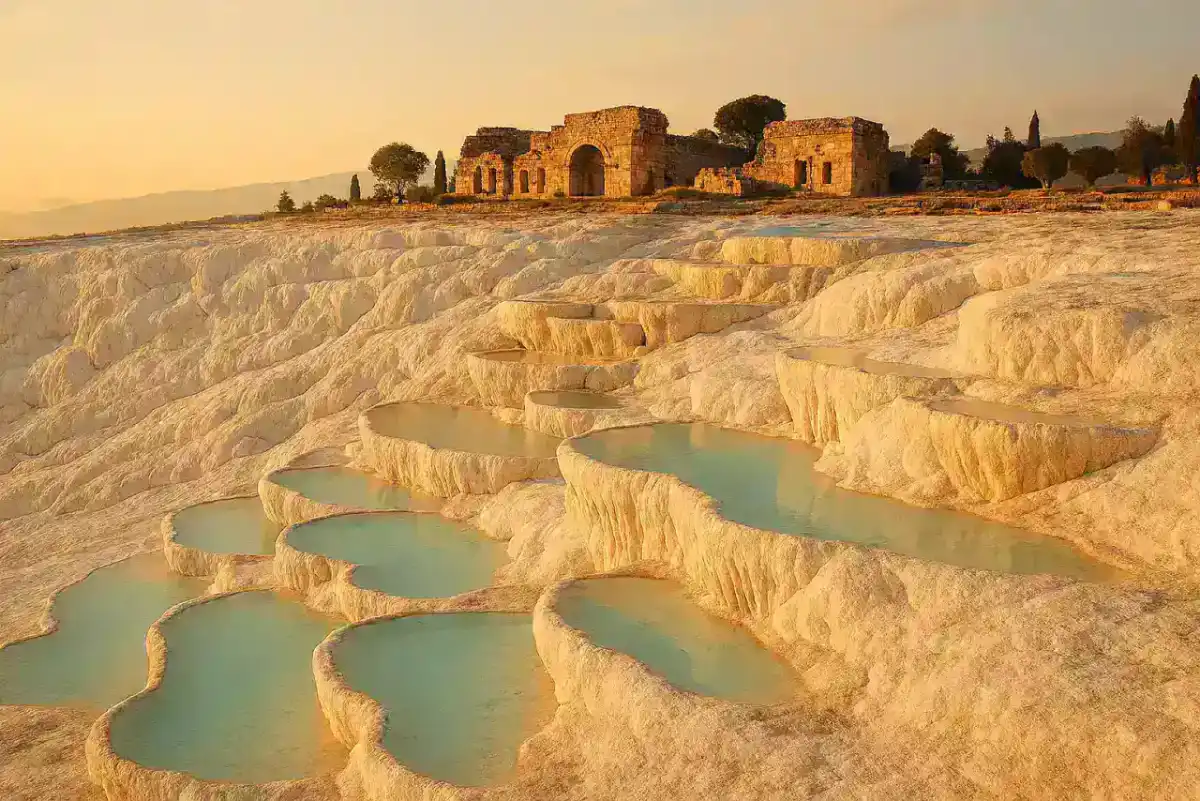
You see it before you understand it. From the road below, the hillside appears to be covered in snow — a brilliant white cascade pouring down the slope, impossibly bright against the brown and green of the Anatolian landscape. Then you get closer and the snow resolves into something stranger: terraced pools of warm turquoise water, their rims built up over millennia by mineral deposits into a frozen waterfall of white travertine that has no parallel anywhere on earth. This is Pamukkale — Cotton Castle in Turkish — and it looks like a landscape from another planet.
Walk barefoot onto the terraces and the warm water flows over your feet, 95°F (35°C) year-round, faintly fizzy with dissolved minerals. The white surface beneath your soles is smooth and slightly textured, like walking on warm porcelain. Above you, at the plateau’s edge, the ruins of Hierapolis spread across the hilltop: a Roman theater seating 15,000, a necropolis stretching two kilometers along the ancient road, a thermal pool where you can swim among fallen marble columns in water that has not cooled in two thousand years. Below you, the Menderes River valley extends to the horizon. Few places anywhere combine geological spectacle and archaeological depth so completely, and fewer still remain as genuinely astonishing as their reputation promises.
Pamukkale demands a full day. Rushed day-trippers who photograph the terraces and leave miss Hierapolis entirely, which is like visiting the Acropolis and skipping the Parthenon. The terraces are the spectacle; Hierapolis is the substance. Together, they create one of the most complete and varied site experiences in Turkey.
Historical Context
The thermal springs at Pamukkale have been active for roughly fourteen thousand years, far longer than any human settlement in the area. The geology is straightforward: thermal water heated by volcanic activity deep in the Anatolian crust rises through limestone, dissolving calcium carbonate along the way. When the water reaches the surface and cools in contact with air, carbon dioxide escapes and the calcium carbonate precipitates out, depositing — infinitely slowly — the white travertine that has been building up the terraces one microscopic layer at a time. The stepped pools form where water pauses before spilling onward, each rim growing a little higher with each passing century.
The Attalid dynasty of Pergamon recognized the springs’ sacred and therapeutic potential and founded Hierapolis — “Holy City” — around 190 BCE. The name acknowledged what local populations had likely understood for centuries: a place where hot water rises from the earth, where vapors emerge from rock fissures, where the boundary between the surface world and the underworld seems permeable. When Rome absorbed the Attalid kingdom in 133 BCE, Hierapolis began its period of greatest prosperity.
Under Roman patronage, the city expanded dramatically into one of the ancient world’s premier healing destinations. Wealthy citizens from across the empire traveled here to bathe in waters believed to cure ailments from rheumatism to skin disease. The population may have reached 100,000 at its peak. Massive bath complexes, a monumental colonnaded street, temples to Apollo and other healing deities, and the full infrastructure of a prosperous Roman city spread across the plateau. The Stoic philosopher Epictetus, whose writings on freedom and self-mastery influenced Marcus Aurelius and remain widely read today, was born here into slavery around 50 CE.
Hierapolis also became an important early Christian center. The Apostle Philip was martyred here in the late first century CE, and the 5th-century Martyrium built in his honor is one of the most architecturally distinctive early Christian monuments in Turkey. The city continued through the Byzantine period, declining gradually as trade routes shifted and earthquakes damaged its infrastructure. By the 14th century, Hierapolis was abandoned.
The travertine terraces suffered serious degradation in the mid-20th century, when unrestricted tourism, hotel construction directly on the plateau, and the channeling of spring water into commercial swimming pools turned large sections gray and brown. A major restoration program begun in the 1990s demolished the offending hotels, redirected thermal water, prohibited shoes and chemicals on the terraces, and closed the most damaged sections. The restoration has been largely successful: the brilliant white has returned to most areas, making Pamukkale a rare conservation success story. UNESCO inscribed the site in 1988.
What to See
The Travertine Terraces
The white terraces are Pamukkale’s defining feature and the reason most visitors come. You must walk barefoot — shoes are prohibited to protect the fragile surface — and the sensation is unlike anything else: warm mineral water flowing over smooth white stone, shallow pools reflecting the sky, the entire hillside glowing in the sun. The main terrace path runs from the lower entrance (south gate) upward toward the Hierapolis plateau, climbing roughly 160 meters over about 600 meters of distance. The lower terraces, where water flows most actively, offer the most dramatic pool formations and the most vivid turquoise color. Higher sections are drier but provide sweeping views over the Menderes Valley.
The terraces are a living geological process. Water is rotated between different sections to allow mineral buildup and recovery, so the specific pools that are wet and photogenic change over time. What remains constant is the overall effect: a cascade of white and blue against brown hillsides that defies photographic reproduction — every picture you have seen undersells the reality.
Practical tip: walk the terraces in late afternoon for the best light and smallest crowds. Sunset turns the white surface pink and gold. Bring a waterproof phone pouch — the combination of water and slippery surfaces makes dropped electronics a common casualty.
The Theater of Hierapolis
The 2nd-century Roman theater is the architectural crown of Hierapolis and one of the best-preserved Roman theaters in Turkey. Seating roughly 15,000 spectators in steep limestone tiers, it was substantially rebuilt under the Severan emperors in the early 3rd century CE. Most of the cavea (seating area) is intact, and significant portions of the elaborately decorated stage building still stand. Carved marble reliefs on the scaenae frons depict mythological scenes — the labors of Dionysus, Apollo’s pursuit of Daphne, episodes from the Trojan cycle — with a craftsmanship that reflects Hierapolis’s wealth during its imperial peak.
The theater’s most striking quality is its view. From the upper rows, you look out over the white terraces cascading below and the Anatolian plain extending to distant mountains. In late afternoon, with the sun dropping toward the west and the terraces turning gold beneath you, this is among the most spectacular vantage points at any ancient site in Turkey.
Practical tip: climb to the upper rows for the full panoramic effect. The climb is steep but the payoff is substantial. Allow 30 to 45 minutes for the theater.
The Antique Pool (Cleopatra’s Pool)
The pool marketed as “Cleopatra’s Pool” — Cleopatra almost certainly never visited Hierapolis — is more accurately called the Antique Pool, and it deserves the visit despite the misleading name. This outdoor thermal pool, fed by the same springs that built the terraces, contains the collapsed architectural elements of a Roman bath complex: columns, capitals, marble drums, and carved fragments litter the pool floor at depths of one to three meters, all visible through the warm, slightly carbonated water. The temperature holds constant at 96°F (36°C) regardless of season. Swimming slowly among submerged Roman ruins while mineral water fizzes gently against your skin is an experience genuinely unlike any other.
Entry requires a separate ticket beyond the general site admission (approximately 130 TL / $5 USD). Changing rooms, lockers, and basic facilities are available. Bring your own towel and a waterproof bag for valuables. The pool floor is uneven due to the fallen masonry — some sections are slippery, and awareness of depth is important.
Practical tip: visit the Antique Pool in the early afternoon, between the morning terraces and the late-afternoon theater climb. The water is most refreshing after walking and before the final push into Hierapolis proper.
The Necropolis
The necropolis stretching for roughly two kilometers along the road north of Hierapolis is one of the largest and best-preserved ancient cemeteries in the Mediterranean world. Over a thousand tombs of wildly varying types, sizes, and periods line both sides of the ancient road: simple stone sarcophagi beside elaborate two-story family mausoleums, Hellenistic tumuli next to Roman columnar monuments. Inscriptions in Greek record names, professions, family relationships, and occasionally warnings to grave robbers so specific and colorful they read like miniature novels.
Walking through the necropolis slowly, pausing to examine individual monuments, builds a more intimate sense of Hierapolis’s human texture than any of its public buildings. These were real people — merchants, physicians, freedmen, priestesses — and their tombs reveal the cosmopolitan diversity of a city that drew visitors from across the empire.
Practical tip: the necropolis extends far beyond the main tourist path. Walk at least fifteen to twenty minutes along the road to reach the larger and more elaborate tombs that most visitors never see.
The Ploutonion (Gate to Hell)
Near the Temple of Apollo, a cave entrance emits concentrated carbon dioxide from a geological vent — the gas pooling invisibly at ground level where it suffocates anything that enters. Ancient observers recognized this phenomenon as an entrance to the underworld. The priests of Cybele staged demonstrations by driving animals into the cave and watching them die, a spectacle witnessed and recorded by the geographer Strabo in the 1st century BCE. The vent still functions: small animals are occasionally found dead nearby. The Ploutonion is one of the rare places where a specific mythological tradition connects directly to a demonstrable, observable natural phenomenon — a junction of geology and religious imagination that few other sites replicate.
Practical tip: the Ploutonion is fenced and cannot be entered. The viewing area is small. A five to ten minute stop is sufficient, but the site’s significance merits attention from anyone interested in how ancient religion explained natural phenomena.
The Hierapolis Archaeological Museum
Housed in the former Roman bath building near the southern entrance, the museum displays sculpture, sarcophagi, inscriptions, and small finds excavated from Hierapolis and the surrounding region. The Roman bath architecture provides a dramatic setting, with marble sculptures displayed in the original vaulted chambers. The collection is strong on portrait sculpture and decorative architectural elements. Allow forty-five minutes.
Practical tip: the museum is air-conditioned and provides welcome relief on hot days. Visit after the terraces and before heading to the theater and necropolis.
Timing and Seasons
The best months to visit Pamukkale are April through June and September through October. Spring temperatures run 68-86°F (20-30°C), the Menderes Valley is in bloom, and the thermal water is refreshing rather than superfluous. Autumn matches spring’s advantages with slightly fewer crowds.
Summer (July and August) is hot — 95-104°F (35-40°C) — and very crowded. The white terraces reflect intense UV radiation, compounding the heat. If visiting in summer, arrive at the 6:30 a.m. opening and plan to finish the terraces by mid-morning. The Antique Pool and museum provide midday relief, with the theater and necropolis reserved for late afternoon.
Winter (November through March) is genuinely underrated. Cool air temperatures of 45-55°F (7-13°C) make the 96°F (36°C) thermal water feel luxurious. Snow occasionally dusts the white terraces for extraordinary photography. Crowds drop to a fraction of summer numbers, and accommodation prices fall significantly. The pools remain open year-round.
The single best time of day for the terraces is late afternoon into sunset. The low sun turns the white surface pink, gold, and amber, the crowds thin, and the temperature drops to a comfortable walking level. For photography, sunset from the terraces looking west over the valley is the money shot.
Tickets, Logistics, and Getting There
General admission to Pamukkale and Hierapolis is approximately 200 Turkish lira (around $7 USD). The Antique Pool requires a separate ticket of approximately 130 TL ($5 USD). The Hierapolis Archaeological Museum charges an additional 50 TL ($2 USD). The Museum Pass Turkey (2,500 TL / $90 USD, valid 15 days) covers general admission and the museum but not the Antique Pool. The site opens at 6:30 a.m. year-round and closes at sunset (roughly 8:30 p.m. in summer, 5:30 p.m. in winter).
Pamukkale lies 20 kilometers north of Denizli, roughly a 30-minute drive. From Denizli, minibuses run to Pamukkale town every 15 to 20 minutes during daylight hours (approximately 15 TL). Taxis from Denizli cost 200-300 TL. The site has entrances at both the south (town) and north gates; the south entrance provides direct access to the terraces and the barefoot walk up.
From Istanbul, the most practical approach is a one-hour flight to Denizli Cardak Airport, followed by a one-hour shuttle or taxi to Pamukkale. Total journey time runs four to five hours door to door, making an overnight stay strongly recommended. From Kusadasi or Selcuk (the Ephesus base), the drive is roughly 190 kilometers and three hours. Organized day tours from those locations run $70-100 per person.
Overnight buses from Istanbul reach Denizli in ten to twelve hours — economical but exhausting. Driving is practical via well-maintained highways, and a rental car gives maximum flexibility for combining Pamukkale with Ephesus, Aphrodisias (a superb Roman city 90 minutes east), or Pergamon.
Accommodation in Pamukkale village ranges from simple guesthouses ($20-40 per night) to mid-range hotels ($60-100), many with their own thermal pools. Staying overnight allows dawn and sunset visits to the terraces — both far superior to the midday experience that package tours deliver.
Practical Tips
- Shoes are prohibited on the travertine terraces. Wear slip-on footwear for easy removal and carry a bag for your shoes during the barefoot walk.
- Bring a swimsuit for the Antique Pool and for wading on the lower terraces.
- SPF 50+ sunscreen is essential. The white surface reflects intense UV radiation, and burns can be severe even on overcast days.
- Bring at least one liter of water per person. The site has cafes, but prices are elevated.
- A waterproof phone pouch protects your devices during terrace wading and pool swimming. Dropped phones are the most common visitor mishap.
- Bring your own towel for the Antique Pool. Rentals are available but limited.
- The Antique Pool floor is uneven with submerged masonry. Wear water shoes if you have them, and watch depth changes.
- Allow at least thirty minutes of transition time between the terraces and Hierapolis. The shift from geological spectacle to archaeological ruin benefits from a mental pause.
Suggested Itinerary
Arrive at the south entrance at 6:30 a.m. (or as early as possible). Walk barefoot up the travertine terraces, spending time in the lower pools where water flows most actively (60-90 minutes). Reach the plateau and visit the Antique Pool for a swim among the submerged columns (45-60 minutes). Dry off and visit the Hierapolis Archaeological Museum in the former Roman baths (45 minutes). Walk to the theater, climbing to the upper rows for the panoramic view (30-45 minutes). Continue north to the necropolis, walking at least 15 minutes along the ancient road to reach the larger monuments (30-45 minutes). If time allows, visit the Ploutonion near the Temple of Apollo (10 minutes). Return to the terrace area for late-afternoon light and sunset photography (30-45 minutes). Total time: 6 to 8 hours.
For travelers with two days, split the visit: terraces and Antique Pool on day one (afternoon into sunset), Hierapolis ruins on day two (morning). This is the most relaxed and thorough approach.
Nearby Sites
Ephesus is the natural pairing. Located roughly 190 kilometers west (about 3 hours by car), Ephesus delivers the monumental Roman city experience that Hierapolis complements but does not replicate. The Library of Celsus, the Great Theater, and the marble-paved streets make Ephesus the visual counterpart to Pamukkale’s geological and archaeological combination. Many travelers base in Selcuk or Kusadasi and visit both sites over two to three days.
Pergamon lies roughly 300 kilometers northwest (about 4 hours by car) and adds the Hellenistic royal capital dimension to a western Turkey itinerary. Its mountaintop acropolis, vertiginous theater, and Asclepion healing center extend the themes of ambition and medicine that Hierapolis introduces.
Aphrodisias, just 90 minutes east of Pamukkale by car, is one of Turkey’s most underrated archaeological sites. A superbly preserved Roman stadium (seating 30,000), an elaborate temple of Aphrodite, and a world-class sculpture school make Aphrodisias a strong half-day addition for travelers with their own transport.
Laodicea, one of the Seven Churches of Revelation, lies only 10 kilometers from Pamukkale and is visible from the terraces. Its ongoing excavations have revealed colonnaded streets, churches, and civic buildings. The site is uncrowded and free to enter.
Final Take
Pamukkale does something that very few places manage: it astonishes you twice. First with the terraces — the warm water, the impossible white, the sensation of walking barefoot across a geological process that has been running for fourteen thousand years. Then with Hierapolis — the theater’s view over the cascade, the necropolis that humanizes the abstract grandeur, the Antique Pool where you swim among ruins in water that Roman senators once bathed in. Neither half is complete without the other. Give Pamukkale a full day, stay overnight if you can, and time your visit for the golden hour when the terraces turn amber and the valley darkens below. It is one of the few places in Turkey that exceeds its reputation, and its reputation is extraordinary.
Discover More Ancient Wonders
- Ephesus — the magnificent Roman city with the Library of Celsus
- Pergamon — acropolis city with the steepest theater in the ancient world
- Troy — the legendary city of Homer’s Iliad
- Explore more with our Turkey Ancient Sites Guide
- Plan your visit with our beginner’s guide to archaeological sites
Quick Facts
| Attribute | Details |
|---|---|
| Location | Denizli Province, Turkey |
| Country | Turkey |
| Region | Denizli |
| Civilization | Roman-Greco |
| Historical Period | c. 190 BCE–14th century CE |
| Established | c. 190 BCE |
| UNESCO Status | World Heritage Site (1988) |
| Coordinates | 37.9134, 29.1187 |
Frequently Asked Questions
Can you swim in the pools at Pamukkale?
Yes, but only in designated areas. The main travertine terraces no longer allow bathing to protect the fragile formations. However, Cleopatra's Pool (Ancient Pool) and the lower travertine sections permit swimming. Bring your swimsuit and a waterproof bag for valuables.
How do I get to Pamukkale from Istanbul?
Fly from Istanbul to Denizli Çardak Airport (1 hour), then take a shuttle or taxi (1 hour) to Pamukkale. Alternatively, overnight buses from Istanbul take 10-12 hours. Many visitors combine Pamukkale with Ephesus by flying to Izmir instead.
How much time do I need at Pamukkale and Hierapolis?
Plan a full day (6-8 hours) to fully experience both sites. This allows 2-3 hours for the travertine terraces and Cleopatra Pool, plus 2-3 hours exploring Hierapolis ruins, theater, and museum. Sunsets at the white terraces are spectacular—time your visit accordingly.
What should I wear to Pamukkale?
Bring a swimsuit for the pools, but you must walk barefoot on the travertine terraces (shoes prohibited to protect the surface). Wear slip-on shoes for easy removal, bring a waterproof bag for valuables, and pack sunscreen—the white terraces reflect intense sunlight.
Is Pamukkale worth visiting in winter?
Absolutely. Winter visits (November-March) offer several advantages: fewer crowds, lower accommodation prices, and the 35°C thermal water feels incredible against cooler air. The white terraces against snow-capped mountains create stunning photography. Pools remain open year-round.
What is Hierapolis and why is it significant?
Hierapolis was an ancient Greco-Roman spa city founded in 190 BCE around Pamukkale's thermal springs. It became a major healing center, attracting visitors from across the Roman Empire. Highlights include a well-preserved theater, extensive necropolis (cemetery), ancient baths, and the martyrium of St. Philip. The site is a UNESCO World Heritage treasure.
Nearby Ancient Sites
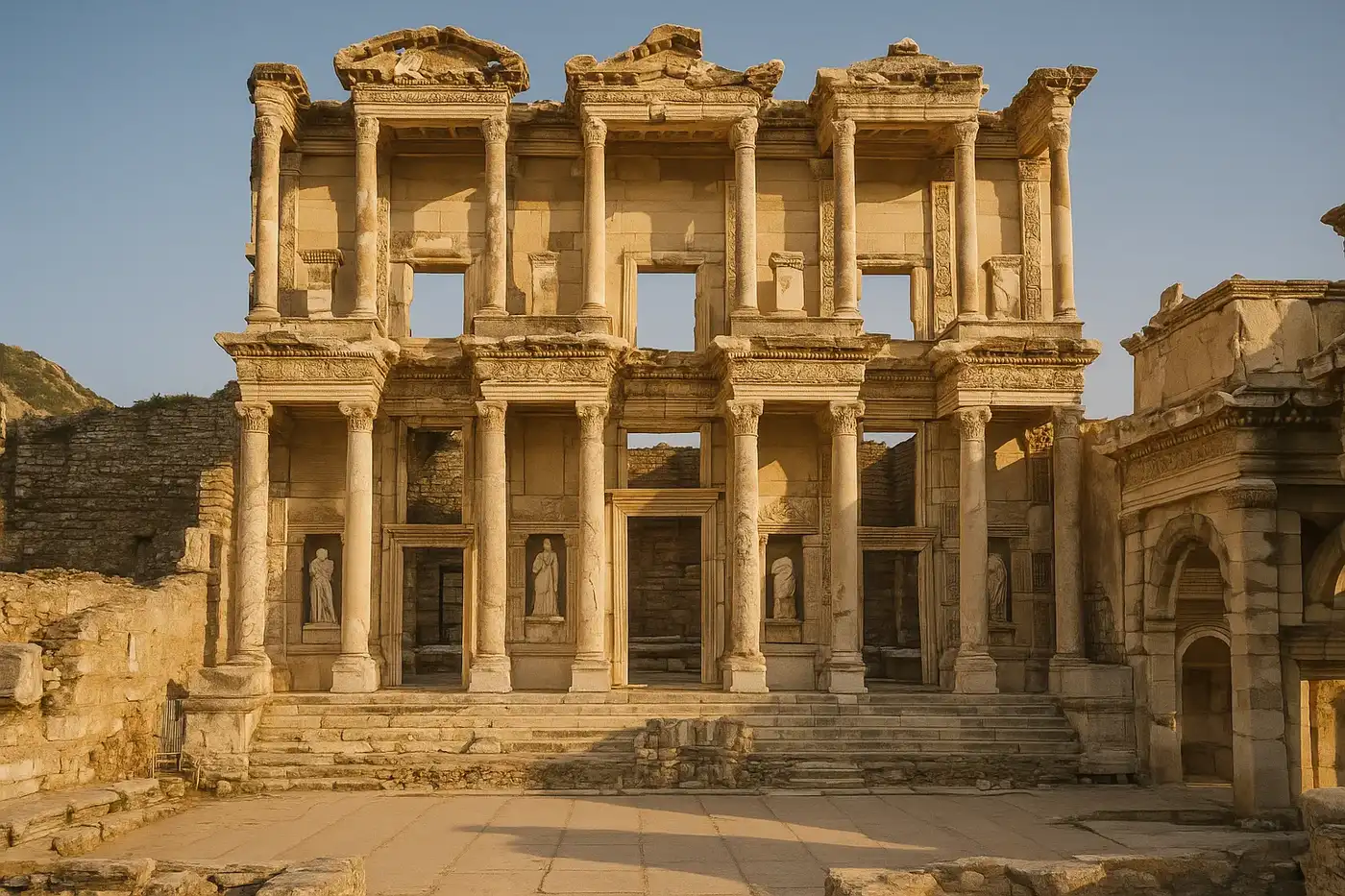
Ephesus Turkey Travel Guide: Library of Celsus & Terrace Houses
Greco-RomanDiscover Ephesus, the best-preserved ancient city in the Mediterranean. Our complete guide covers th...
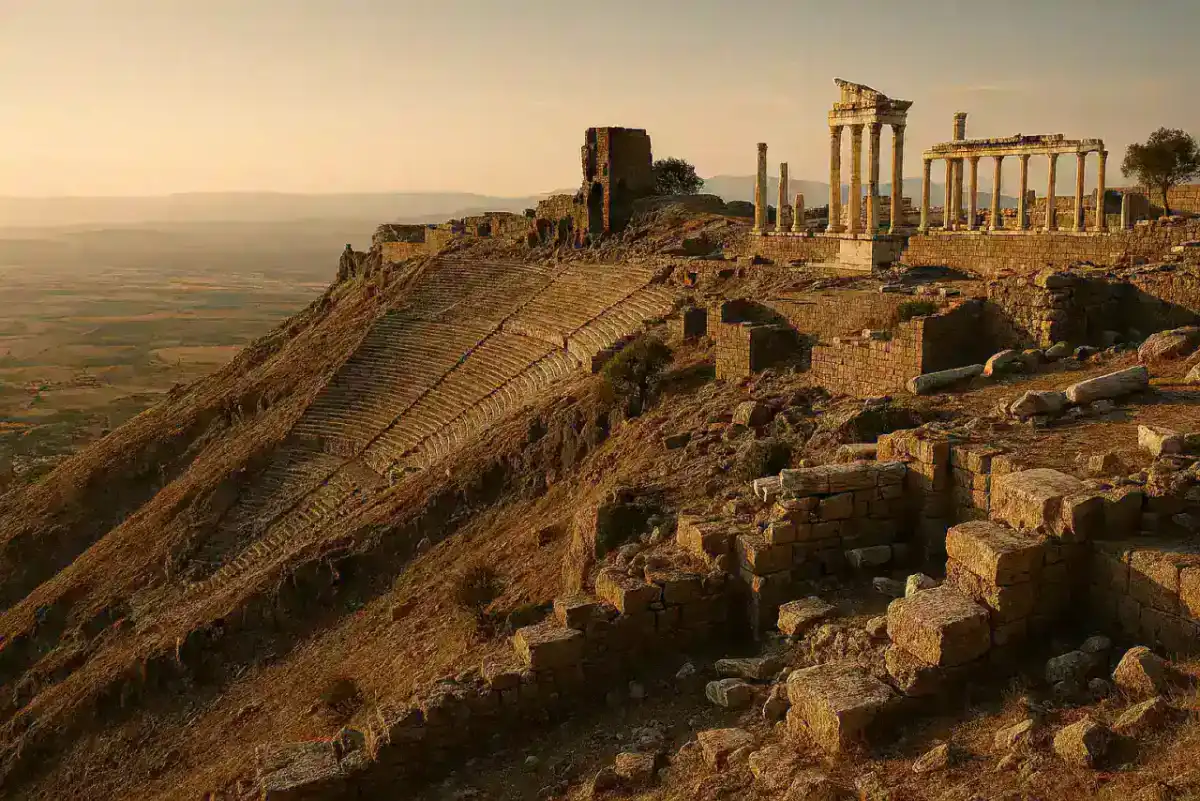
Pergamon Turkey Travel Guide: Ancient Acropolis & Library
Explore Pergamon, one of Turkey's greatest ancient cities. A hilltop acropolis with temples, theater...
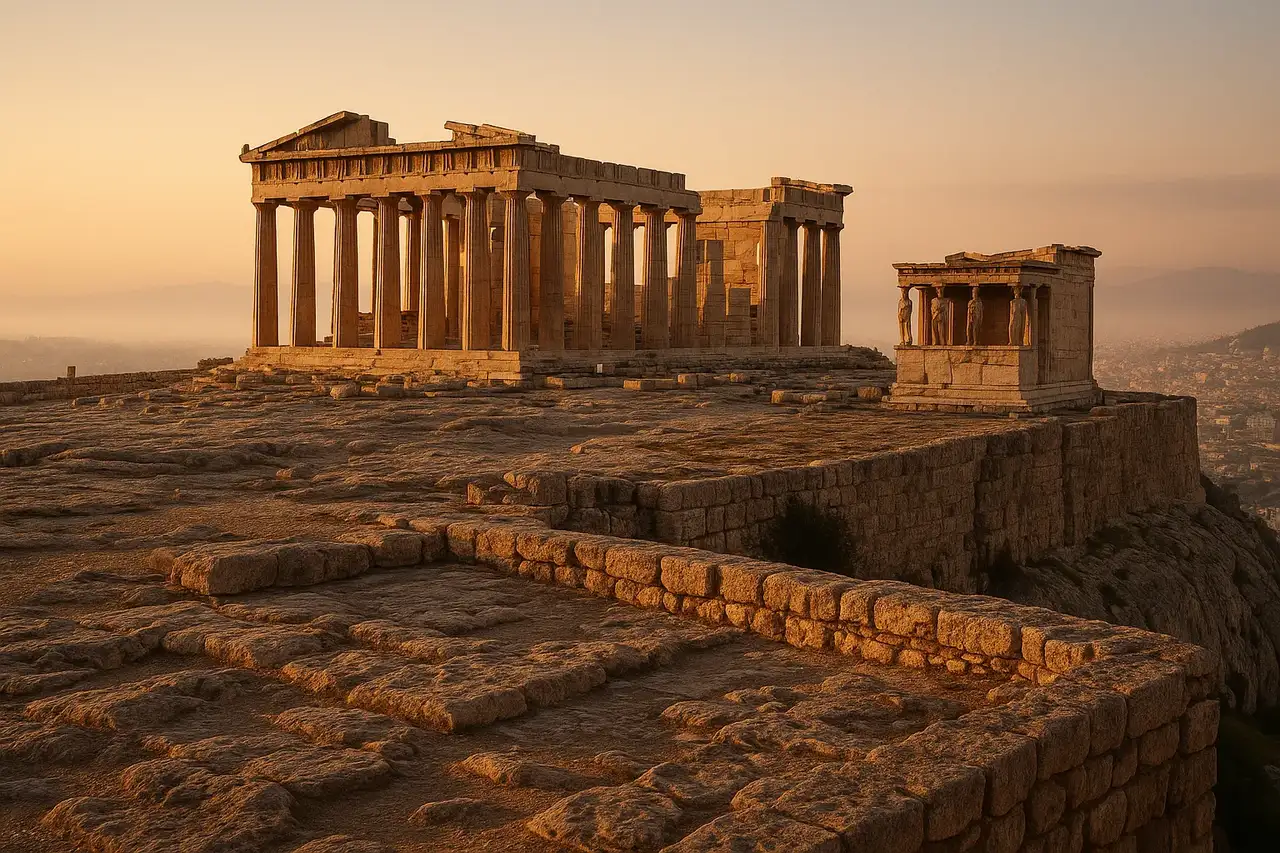
The Complete Acropolis Athens Travel Guide: Temples
Ancient GreecePlan the perfect visit to the Acropolis of Athens with our 2026 guide. Discover the Parthenon, best ...