Quick Info
At a glance
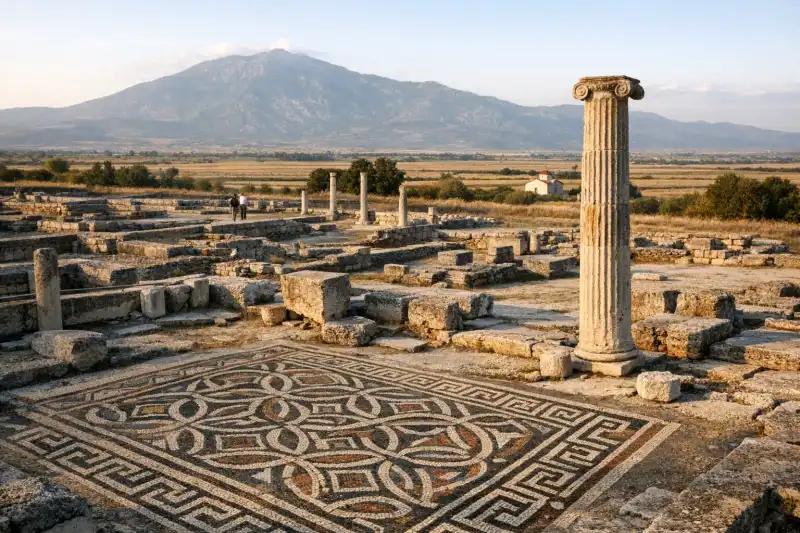
Pella, Greece, lies quietly in the plains of Central Macedonia, but its historical resonance is anything but modest. Once the glittering capital of the Macedonian kingdom, this was the political and cultural center from which rulers shaped the destiny of the Greek world and beyond. Today, the site does not overwhelm with towering monuments in the manner of Athens or Delphi. Instead, Pella reveals itself gradually: through broad archaeological expanses, through the geometry of ancient streets, through courtyards and workshops, and above all through the remarkable mosaics that still convey the sophistication of the city’s wealthy inhabitants.
To walk through Pella is to enter a place where empire once felt practical and immediate rather than purely ceremonial. This was a living city with markets, homes, sanctuaries, drainage systems, storerooms, and formal avenues. Here, the ambitions of Macedon were rooted in everyday urban order. For travelers interested in Alexander the Great, Philip II, and the rise of Macedonian power, Pella offers something invaluable: context. It shows not only where rulers came from, but the kind of prosperous, carefully organized world that produced them. The nearby museum deepens that impression, displaying artifacts that connect the archaeological remains to daily life, trade, religion, and aristocratic taste. Pella rewards visitors who enjoy history in layers, where fragments of walls and floors become legible evidence of a city that once stood at the center of Mediterranean events.
History
Origins and the Rise of the Macedonian Capital
Although the wider region had been inhabited long before the city’s political prominence, Pella emerged as a major urban center during the Classical period. It is generally understood to have replaced Aigai as the principal seat of Macedonian royal power, likely in the late 5th or early 4th century BCE. Its location offered practical advantages. In antiquity, Pella stood closer to navigable waters and benefited from access to fertile agricultural land across the Macedonian plain. This combination of inland productivity and maritime connectivity made it ideal for administration, trade, and military logistics.
The move of the capital to Pella was not merely symbolic. It reflected Macedonia’s transformation from a kingdom on the fringes of the southern Greek world into a more centralized and outward-looking power. Royal authority became increasingly tied to an urban environment that could support diplomacy, storage, craft production, and elite display. By the time of Philip II, Pella had become the heart of an increasingly disciplined and expansionist state.
Philip II and the Consolidation of Macedonian Power
In the 4th century BCE, Philip II reshaped Macedonia and in many ways reshaped the ancient world. Reigning from 359 to 336 BCE, he transformed a vulnerable kingdom into the dominant military force in Greece. Pella served as the center of that project. From here, Philip reorganized the army, developed diplomatic alliances, and extended Macedonian influence across the Greek mainland.
The city during Philip’s reign would have been filled with political movement: envoys arriving and departing, troops assembling, craftsmen supplying royal needs, and aristocratic households participating in court life. Pella’s prosperity was tied directly to this new concentration of power. Wealth from conquest and tribute likely flowed through its markets and into its elite residences. Urban planning and grand architecture reflected a kingdom that wished to present itself as orderly, cultured, and capable of leadership.
Pella also became associated with the cultural tensions of Macedonia’s rise. Southern Greeks sometimes viewed Macedonians as outsiders or semi-barbaric, yet the city demonstrates clear participation in the broader Hellenic world. Its art, urban planning, and luxury goods reveal a court and aristocracy fully engaged with Greek styles and ideas, even as they developed a distinctive Macedonian identity.
Alexander the Great and the Hellenistic Moment
Pella’s fame is inseparable from Alexander III, known to history as Alexander the Great, who was born in 356 BCE and was traditionally associated with the city. Though his conquests would carry Macedonian power across Egypt, Persia, and into Central Asia, the environment of his youth was shaped by Pella’s courtly and strategic culture. Here he would have grown up amid military preparation, royal ceremony, and intellectual ambition.
After Alexander inherited the throne in 336 BCE, Pella remained an important center, though the focus of political energy increasingly stretched far beyond Greece. The city benefited from the prestige of being the homeland of the conqueror who transformed the eastern Mediterranean and Near East. In the Hellenistic age, Pella continued as a significant Macedonian city, marked by wealth, monumental building, and urban refinement.
Archaeological evidence from this era reveals houses of striking scale and decoration. The famous pebble mosaics belong largely to this period and indicate that local elites embraced elaborate visual culture. Pella was not only a royal capital but also a thriving civic space in which private luxury and public order coexisted.
Roman Conquest and Decline
The fortunes of Pella changed dramatically with Rome’s expansion into the Greek world. After the Roman defeat of Macedon in the 2nd century BCE, the kingdom was dismantled and reorganized. Pella remained inhabited and retained some regional importance, but it no longer stood at the center of a sovereign imperial power. Political prestige shifted elsewhere, and the city entered a long phase of reduced prominence.
Natural factors may also have contributed to decline. Changes in waterways, silting, and environmental transformation likely altered the landscape that had once made Pella so well positioned. Ancient authors and archaeological interpretation suggest that the relationship between the city and the sea or navigable marshland changed over time, affecting trade and connectivity.
By the Byzantine era, the ancient city had largely faded from major importance. Its remains were gradually buried, repurposed, or forgotten beneath the plain. Modern excavations in the 20th century brought Pella back into historical focus, revealing one of the most important archaeological windows into ancient Macedonia. What survives today is therefore both a remnant of antiquity and a modern rediscovery of the world that produced Philip and Alexander.
Key Features
Pella’s most striking quality is its urban clarity. Unlike many ancient sites where isolated temples dominate the visitor’s memory, Pella preserves the shape of a living city. Its orthogonal street plan is one of the clearest indicators of deliberate design. Wide roads, organized blocks, and sophisticated water management systems show that this was a carefully planned capital. Even in ruin, the layout communicates administration, confidence, and civic purpose. You do not simply see a monument here; you see the framework of urban life.
Among the site’s most celebrated features are the domestic buildings, especially the large houses with interior courtyards and richly decorated floors. The pebble mosaics found in these residences are extraordinary for both artistry and subject matter. Created from naturally colored pebbles rather than later cut tesserae, they depict mythological scenes, animals, hunting imagery, and divine figures with subtle shading and impressive movement. The House of Dionysus is particularly famous for its depiction of the god riding a panther, while other houses preserve scenes of hunts and heroic combat. These floors reveal the tastes of wealthy Macedonians and suggest a society eager to express status through visual sophistication.
The agora of Pella is another essential feature. It was one of the largest commercial and civic complexes in the Greek world, serving as a center for trade, administration, and social interaction. Although what remains is largely foundational and architectural in outline, the scale of the complex still impresses. One can imagine merchants, officials, artisans, and visitors moving through colonnaded spaces where economic and political life intertwined. Pella was not simply a royal court; it was also a functioning city whose prosperity depended on exchange and organization.
The palace complex, set on higher ground near the city, adds another dimension to the visit. Though less visually complete than some palace sites elsewhere, its extent hints at the ceremonial and administrative world of the Macedonian monarchy. The palace was not a single compact structure but a broad complex arranged around courtyards and terraces. It would have embodied the authority of rulers who were at once kings, military leaders, and hosts to nobles and foreign envoys. Even in fragmentary form, the elevated setting helps visitors understand the relationship between royal power and the urban plain below.
No visit to Pella is complete without the Archaeological Museum of Pella, which gives texture and meaning to the excavated remains. The museum is modern, well organized, and indispensable for interpreting the site. Here, the mosaics can be appreciated up close, alongside pottery, metalwork, figurines, inscriptions, tools, and objects from sanctuaries and houses. The displays reconstruct aspects of domestic life, religious practice, commerce, and burial customs. For many visitors, the museum is where Pella becomes fully legible. The stones outside provide scale and setting; the museum provides faces, objects, and stories.
What makes Pella especially memorable is the balance between political history and human detail. It is certainly a site of kings and empire, but it is equally a place of homes, drains, workshops, and decorated floors. That combination allows travelers to imagine ancient Macedonia not as an abstraction but as a lived environment, full of practical ingenuity and artistic ambition.
Getting There
Pella is easiest to reach from Thessaloniki, the largest city in northern Greece and the main gateway for most international visitors. By car, the drive usually takes around 45 minutes to 1 hour, depending on traffic and your exact starting point. A rental car is the most convenient option if you want flexibility, especially if you plan to combine Pella with Vergina or other sites in Central Macedonia. Expect fuel and toll-related costs to be modest for a day trip, while car rental rates commonly start from around €35 to €60 per day depending on season and vehicle type.
Public transport is possible but requires a little more planning. Intercity buses from Thessaloniki toward Giannitsa or nearby areas can connect you to the region, though schedules may vary by season and day of the week. Bus fares are generally inexpensive, often in the range of €6 to €10 one way, but you may still need a short taxi ride from a bus stop to the archaeological entrance. A local taxi connection can add roughly €10 to €20 depending on distance.
Organized day tours from Thessaloniki are a popular alternative and often the simplest for travelers without a car. These tours commonly include transport, a guide, and sometimes a combined visit with Vergina. Prices often begin around €50 to €90 per person, depending on group size, inclusions, and duration.
If you are arriving by air, Thessaloniki Airport is the nearest major airport. From there, renting a car or spending a night in Thessaloniki before heading to Pella is the most practical plan. Once on site, parking is usually straightforward, and the museum and archaeological area are close enough to visit together comfortably.
When to Visit
Spring and autumn are the best times to visit Pella. From April to early June, the Macedonian plain is greener, temperatures are mild, and walking among the ruins is much more comfortable than in midsummer. Autumn, especially September through October, offers similarly pleasant conditions, with warm light that suits both photography and longer visits. These shoulder seasons strike the best balance between agreeable weather and manageable visitor numbers.
Summer is certainly possible, but the heat can be intense, particularly in the open archaeological areas where shade is limited. If you visit between late June and August, aim to arrive early in the morning. Bring water, sunscreen, and a hat, and consider beginning with the outdoor site before moving into the cooler museum spaces. Midday can feel tiring, especially for families or older travelers.
Winter offers a quieter experience and can be rewarding for travelers focused on history rather than atmosphere. The site is often peaceful, and the museum remains a major highlight regardless of season. However, weather can be gray, windy, or wet, and the open landscape may seem less inviting than in spring. Check opening hours in advance, since seasonal schedules may differ.
For those interested in combining multiple Macedonian sites in one trip, spring is especially appealing because road conditions are easy, daylight is generous, and nearby destinations such as Thessaloniki and Vergina are also enjoyable at that time of year. Weekdays are generally calmer than weekends, and arriving earlier in the day helps avoid both tour groups and the strongest sun. If your main interest is photography, morning and late afternoon tend to give the ruins and landscape a softer, more atmospheric light.
| Quick Facts | Details |
|---|---|
| Location | Near the modern village of Pella, Central Macedonia, Greece |
| Ancient Role | Capital of the Macedonian kingdom |
| Best Known For | Association with Philip II and Alexander the Great, pebble mosaics, urban planning |
| Nearest Major City | Thessaloniki |
| Ideal Visit Length | 2 to 4 hours |
| Best Time to Visit | Spring and autumn |
| Main Highlights | Archaeological site, agora, elite houses, palace area, Archaeological Museum of Pella |
| Travel Style | Easy half-day or full-day trip from Thessaloniki |
| Historical Period | Classical and Hellenistic |
| Why Visit | To understand the urban and cultural world of ancient Macedonia |
Guided tours: worth it?
Self-guided works here, but a guide can add real value if you want the ruins explained as a living place rather than just a sequence of monuments.
Best for
- First-time visitors who want context, not just photos
- Short visits where a planned route saves time
When to go self-guided
Go independently if you prefer setting your own pace, reading as you go, and checking official hours or ticket rules directly before you arrive.
What I’d avoid
Skip paid tours that bundle unrelated stops you do not actually want. The best option should either save meaningful planning time or add historical context you would miss on your own.
Pella and Vergina Tours
Useful when: you want to compare guided formats before deciding
Day Trips from Thessaloniki to Pella
Useful when: transport or pickup logistics matter
Ancient Macedonia Archaeology Tours
Useful when: you want to compare guided formats before deciding
Some tour links are affiliate links, which may earn Ancient Travel a small commission at no extra cost to you. I try to surface options that make practical sense for the site—not just anything bookable.
Frequently Asked Questions
What is Pella famous for?
Pella is best known as the ancient capital of the Macedonian kingdom and as the birthplace traditionally associated with Alexander the Great. It is also famous for its finely preserved pebble mosaics, large palace complex, and well-planned urban grid.
Where is Pella located in Greece?
Pella is located in the region of Central Macedonia in northern Greece, not far from Thessaloniki. The archaeological site lies near the modern village of Pella and is often visited on day trips from the city.
How much time do you need to visit Pella?
Most visitors should allow two to four hours to see both the archaeological site and the museum. If you are especially interested in ancient Macedonian history, plan for a half day.
Is there a museum at Pella?
Yes, the Archaeological Museum of Pella stands near the excavated remains and is an essential part of the visit. It displays mosaics, pottery, inscriptions, domestic objects, and finds that help explain daily life in the ancient city.
Can you visit Pella from Thessaloniki in one day?
Yes, Pella is an easy day trip from Thessaloniki by car, organized tour, or a combination of bus and taxi. Many travelers pair it with Vergina for a full-day excursion focused on ancient Macedonia.
What are the highlights of the site?
The main highlights include the House of Dionysus and other elite residences with pebble mosaics, the city’s broad streets and drainage system, the agora, and the nearby museum with some of the most important artifacts from the excavations.
Nearby Ancient Sites
Acropolis Travel Guide 2026: Parthenon, Tickets, and Best Time
Ancient GreecePlan an efficient Acropolis visit with practical ticket timing, key monuments, and museum pairing ti...
The Complete Acropolis Athens Travel Guide: Temples
Ancient GreecePlan the perfect visit to the Acropolis of Athens with our 2026 guide. Discover the Parthenon, best ...
Ancient Agora of Athens Travel Guide 2026: Route, Tickets, and Context
Classical GreekPlan a better Ancient Agora visit with practical timing, monument priorities, and clear historical c...