Quick Info
Quick Facts
- Location: Hilltop acropolis near Bergama, western Turkey (Ionia region)
- Best for: Ancient history enthusiasts, dramatic city planning, architectural ambition
- When to visit: April-May, September-October
- Entry fee: Around 300 Turkish Lira
- Crowds: Moderate - popular destination but not overwhelming
- What to see: Acropolis, Greek theater, temples, library foundations, altar of Zeus
The City That Challenged Alexandria
You climb switchback paths toward the acropolis of Pergamon, ascending from the valley floor toward a hilltop citadel that demonstrates how ancients thought about city design and power. Unlike coastal cities that spread naturally along harbors, Pergamon was engineered—built vertically, concentrating power and prestige on a defensible height.
Pergamon was never the largest city of the Mediterranean world, but during the Hellenistic period it was arguably the most ambitious. The Attalid dynasty, who ruled Pergamon for more than two centuries, invested vast resources in transforming this hillside into a center of learning, culture, and military power that competed directly with Alexandria, Athens, and Antioch.
The signature achievement was the Library of Pergamon—a collection of scrolls that, by the 2nd century BCE, numbered approximately 200,000—second only to Alexandria’s. The library represented an investment in knowledge, in intellectual prestige, in the idea that a city’s worth could be measured not just by military might but by cultural achievement.
The Acropolis and Temples
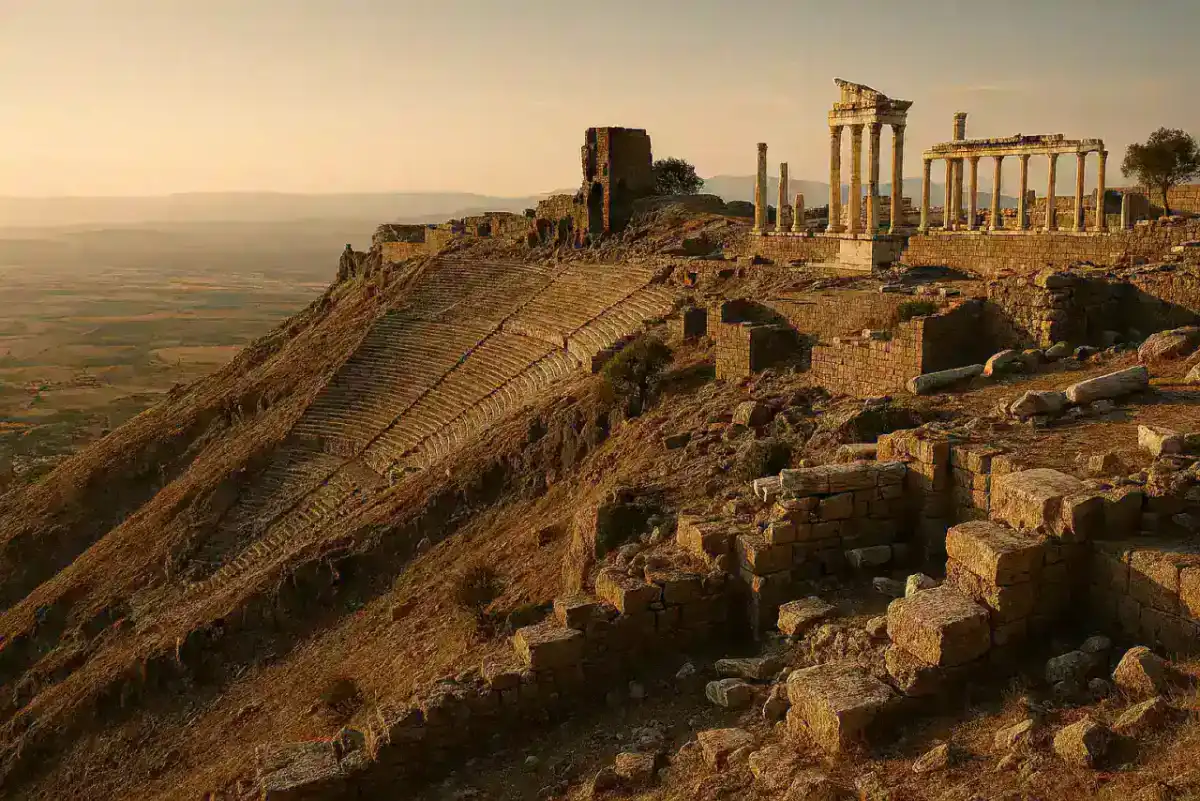
The acropolis crowns the hilltop, a dense arrangement of temples, government buildings, and defensive structures. The Temple of Athena Polias (protector of the city) anchored the sacred zone. The Temple of Trajan honored the Roman emperor during the later Pergamene period. These structures, built with the finest marble and architectural precision, announced the city’s wealth and political significance.
The Altar of Zeus, one of the most famous monuments of the ancient world, stood on the acropolis. Its sculptural reliefs—depicting the battle between gods and giants—were among the greatest achievements of Hellenistic art. These reliefs are now in the Berlin Museum, but you can still trace the platform and foundations where this monumental altar commanded the acropolis.
The Theater—Built for Drama and Politics
Descending the acropolis, you encounter the theater—one of the steepest and most dramatically positioned theaters of the ancient world. Built into the hillside with a capacity of nearly 10,000, the theater wasn’t simply an entertainment venue. It was where the assembly gathered for political decision-making, where dramatic festivals happened, where civic identity was performed.
The steep seating means that standing on the stage, you’re surrounded by citizens rising steeply upward—a physical arrangement that emphasized your vulnerability and their power. The acoustics are exceptional. A whisper from the stage carries to the back rows, allowing the city’s leadership to address thousands in an era before amplification.
The Library and Intellectual Prestige
Though the actual library building is largely gone, its foundations are visible on the acropolis. The library represented something revolutionary: the idea that a provincial city could rival the intellectual centers of the Mediterranean. Scholars were recruited. Manuscripts were copied. The Pergamene parchment (pergament—the word is named after the city) was developed here as a substitute for papyrus, which Egypt controlled and rationed.
The library was not a quiet archive. It was a political statement: we are wealthy enough to collect knowledge; we are sophisticated enough to preserve it; we are important enough to attract the Mediterranean’s greatest minds.
Lower City and Civic Infrastructure
Descending from the acropolis, you enter the lower city—a remarkable example of Hellenistic urban planning. Streets are organized by function: markets, shops, temples, housing. The agora (marketplace) sits at the city’s center, surrounded by covered porticos protecting merchants and shoppers.
A gymnasium complex provided physical training for youth. Public baths offered bathing facilities. The sanitation and infrastructure reveal a city that invested in public well-being—pipes bringing water from distant sources, drainage systems managing waste, streets planned for foot and cart traffic.
The Asklepieion—A Healing Sanctuary
Descending further into the lower city, you find the Asklepieion, a sanctuary dedicated to Asklepios (god of healing). This was an ancient healing center—part hospital, part shrine, part therapeutic retreat. Patients came seeking cure through a combination of medical practice, ritual, and the placebo effect of sacred space.
The Asklepieion was famous throughout the Mediterranean. People traveled to Pergamon specifically to access this healing sanctuary. The complex includes treatment chambers, sleeping quarters, and a small theater. The water from the sanctuary’s spring was believed to have therapeutic properties—whether true or not, the belief itself was therapeutic.
Pergamon Under Rome
When Rome incorporated Pergamon into its empire, the city remained important. The transition was relatively peaceful—the last Attalid king bequeathed Pergamon to Rome in his will, avoiding conquest or destruction. Roman emperors respected Pergamon’s cultural significance and invested in new temples and public works honoring themselves.
The Temple of Trajan sits prominently on the acropolis—Roman in architecture but Hellenistic in its urban context. This blend of Hellenistic planning with Roman imperial monuments characterizes Pergamon’s later period.
Visiting Pergamon
Access: Pergamon is near the town of Bergama, easily reached by bus or car. Most visitors come as day trips from Izmir or Ayvalık.
Best time: April-May or September-October. Summers are hot; winters bring rain.
Duration: A full day to explore both acropolis and lower city (Asklepieion). Many visitors focus on the acropolis (2-3 hours) and skip the lower city.
Museum: The Bergama Museum holds sculptures, artifacts, and inscriptions from the site. It complements your understanding of the ruins considerably.
Crowds: Moderate, especially in mornings. Afternoons can be busy with tour groups.
Guides: Hiring a guide enriches understanding of the political and cultural context.
Accessibility: The acropolis has steep paths and many stairs. A cable car assists ascent for some visitors.
Connecting to Pergamon’s Rivals
Pergamon should be understood in context of its competitors. Ephesus was the wealthy port city. Alexandria (in Egypt) was the intellectual capital. Antioch (in Syria) was the great eastern city. Pergamon was smaller, more isolated—but it succeeded through cultural investment and intellectual prestige. Visiting these sites together reveals the diversity of Mediterranean city strategies.
The Achievement of Pergamon
Pergamon teaches that greatness in the ancient world could be achieved through investment in culture, not just military power or trade. The Attalid kings understood that intellectual prestige—embodied in a library, in artistic achievement, in architectural ambition—could project power as effectively as legions.
The city declined when the basis for that power shifted. Trade routes changed. Rome consolidated power. The library was partially transferred to Egypt. But the acropolis remains—testament to a civilization’s ambition to create something lasting through cultural investment.
Standing on Pergamon’s acropolis, looking toward the distant Aegean, you understand why ancients considered this city worthy of rivalry with the Mediterranean’s greatest powers.