Quick Info
Curated Experiences
Phaistos & Heraklion Archaeological Museum Day Tour
South Crete: Phaistos, Matala & Gortyna from Heraklion
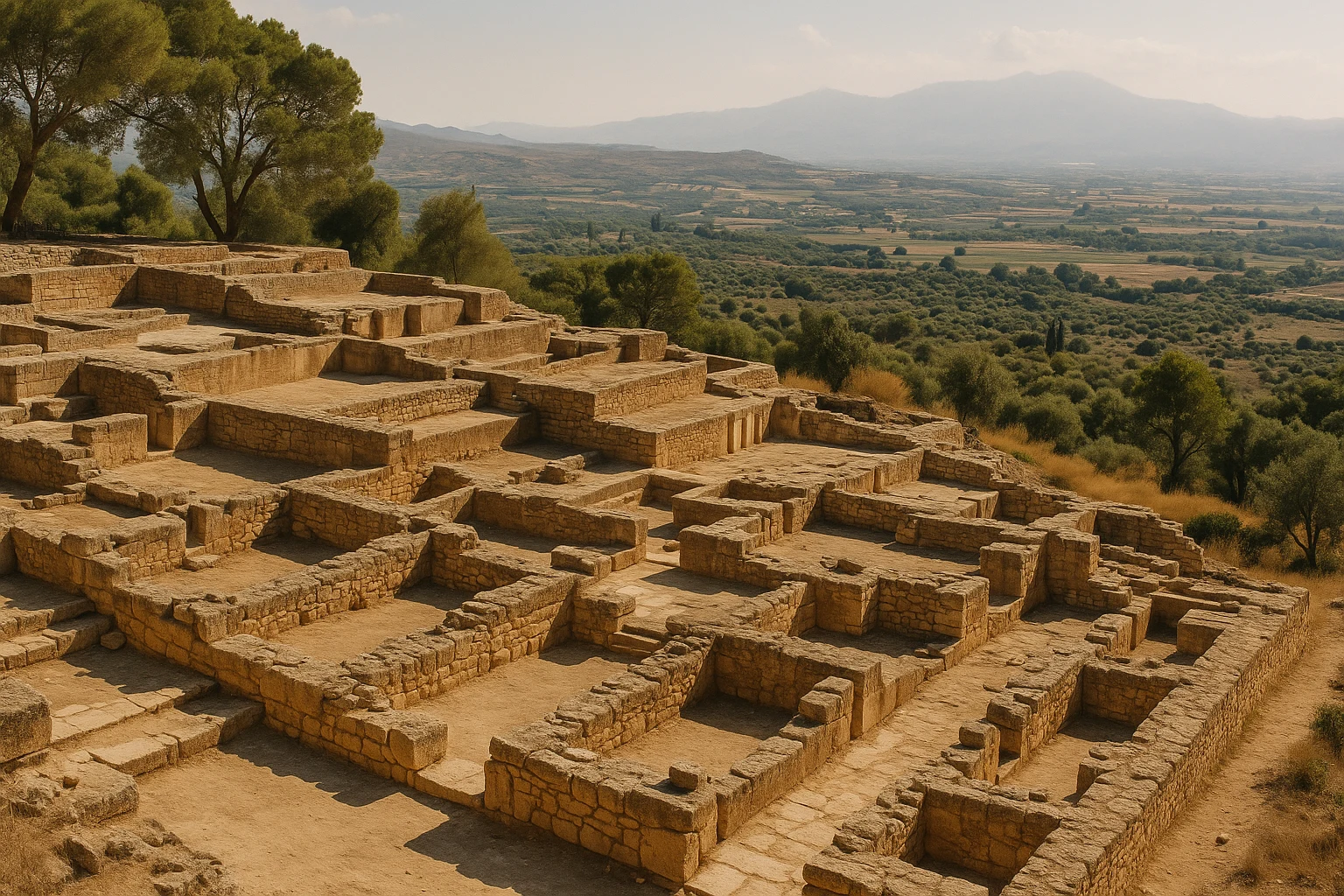
Perched on a low ridge above the sweeping Messara Plain, Phaistos commands one of the most spectacular archaeological panoramas in the Mediterranean. To the north, the White Mountains disappear into cloud. To the south, the plain fades toward the Libyan Sea. And below your feet, the fitted limestone blocks of a Minoan palace — the second greatest on Crete — spread across the hillside in orderly ruin. Phaistos does not compete with Knossos for crowds or reconstructed frescoes. What it offers is something rarer: Minoan architecture in its raw, excavated state, set inside a landscape that has changed remarkably little in three thousand years.
Why Phaistos Deserves a Day
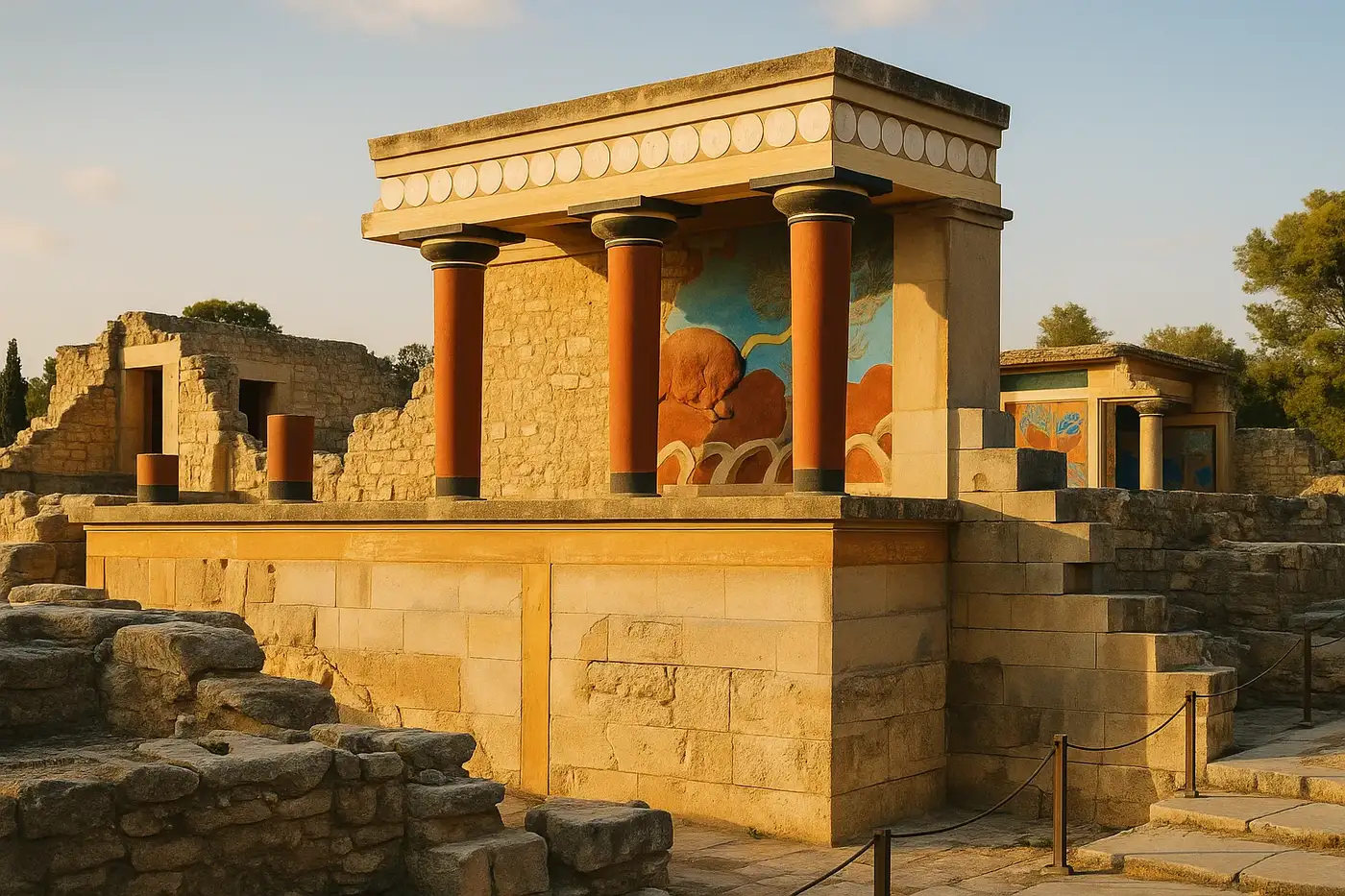
Phaistos is often reduced to a footnote after Knossos in Crete itineraries, which is a mistake. The site is substantially larger and more complex than most visitors expect. The central court alone measures roughly 50 by 22 metres. Grand staircases, storage magazines, and royal apartments spread across multiple terraces, and the views from the upper propylon stop conversation mid-sentence. For travellers who want Minoan Crete without the crowds and concrete reconstructions of Knossos, Phaistos is the destination.
It is also the findspot of one of the ancient world’s most debated objects. In 1908, the Italian archaeologist Luigi Pernier excavated a basement storeroom and pulled out a fired clay disc about the size of a side plate, both faces spiralling with 45 distinct stamped symbols arranged in 241 groups. The Phaistos Disc remains the only known example of its script. No Rosetta Stone has emerged to crack it. The disc sits in a case in the Heraklion Archaeological Museum, and scholars still argue — sometimes heatedly — about whether it represents a language, a prayer, a game, or something else entirely.
Historical Context
Settlement on the Phaistos ridge stretches back to the Neolithic period, around 4000 BCE. By the Early Bronze Age, a substantial community occupied the hill. Around 2000–1900 BCE, the Minoans constructed the first palace — a complex of storage rooms, workshops, and ceremonial courts that mirrored developments at Knossos and Malia. This First Palace was destroyed, probably by earthquake, around 1700 BCE.
The Minoans rebuilt immediately and grandly. The New Palace of Phaistos that visitors walk through today dates to roughly 1700–1450 BCE and represents Minoan architecture at its most confident. Rooms were fitted with gypsum ashlar masonry, light wells, and plumbing. The palace controlled the agricultural wealth of the Messara Plain — the most productive farming valley in Crete — and likely served as the administrative and religious centre for southern Crete.
Around 1450 BCE, Phaistos was destroyed along with most other Minoan palaces, in an event archaeologists still debate. Mycenaean Greeks subsequently occupied Crete. The site continued to function as a town through the Classical and Hellenistic periods — a Greek city-state called Phaistos competed and occasionally warred with its neighbour Gortyna — but the palace itself was never rebuilt or reoccupied in its Minoan form. Roman-era Gortyna eventually eclipsed Phaistos entirely, and the hill returned to farmland. Italian excavations began in 1900, the same year Arthur Evans started work at Knossos.
What to See
The Grand Staircase and West Court. The principal entrance climbs through a theatral area — tiered steps that may have functioned for public assemblies or ritual viewing — before arriving at the Upper Court. The geometry is confident and imposing. Stand at the top and look back over the Messara: this was almost certainly deliberate stagecraft by Minoan architects.
The Central Court. The heart of any Minoan palace. At Phaistos the court is exceptionally well preserved, with the original paving stones still in place across much of the surface. The long axis of the court aligns roughly north-south, consistent with other Minoan palaces — a pattern whose significance is still being worked out.
The Royal Apartments. To the north of the central court, a suite of rooms fitted with lustral basins, light wells, and polythyron (pier-and-door) partitions that allowed fine control of light and air flow. The technique is sophisticated: folding wooden doors could open a room to full ventilation or seal it into near-darkness. This is domestic architecture operating at a level not seen again in Greece for another thousand years.
The Storage Magazines. Along the west wing, a row of long narrow rooms once held giant pithoi (storage jars) filled with olive oil, grain, and wine — the palace economy made tangible. Several pithoi remain in situ.
Room 25: The Disc Room. A small basement storeroom in the northwest area of the palace. A sign marks the spot where Pernier found the disc in 1908, alongside a Linear A tablet and a fire-blackened deposit. The room itself is modest, which somehow makes the find more extraordinary.
The Protopalatial Ruins. North of the New Palace, the remains of the earlier First Palace are visible — older, rougher masonry at a slightly different orientation. The stratigraphy of two construction phases sitting side by side is one of the most legible architectural sequences in Minoan archaeology.
Practical Tips
Getting there. From Heraklion, KTEL buses depart from Bus Station B (near the ferry port) roughly every two hours; the journey takes about 90 minutes and costs around €7 one-way. By car, take the E75 motorway west and then turn south through the Messara Valley — about 65 km, allow an hour. Parking at the site is free and usually uncrowded except in high summer.
Opening hours and tickets. The site is open daily year-round, typically 8:00–20:00 in summer and 8:00–15:00 in winter (hours vary; check the Greek Ministry of Culture website before visiting). Entry is €8 standard, €4 reduced. No combined ticket with Knossos is currently available, but a combined ticket with nearby Agia Triada is sometimes offered at the gate.
On-site. There is a café at the entrance, restrooms, a gift shop, and a shaded car park. The palace ruins themselves are largely exposed. Bring a hat and at least a litre of water per person in summer — temperatures on the ridge can exceed 38°C in July and August. Sturdy footwear is advisable: the stone surfaces are uneven.
Photography. Excellent throughout. The best light for the grand staircase and central court is morning. The view north toward the White Mountains is best in spring when snow still caps the peaks.
When to Visit
April through early June is ideal: the Messara Plain is green, wildflowers grow between the ruins, and temperatures are comfortable. September and October offer warm weather with significantly thinner crowds than August. Avoid midday in July and August — the heat on the exposed ridge is intense and the light is flat for photography. Winter visits are possible and atmospheric, though the site closes early.
Combining Phaistos with Nearby Sites
Agia Triada lies just 3 km west along a signposted road and is an easy 15-minute walk or a short drive. This smaller Minoan villa complex yielded some of the finest Minoan art ever found, including the Harvester Vase and the Boxer Rhyton, both now in Heraklion. A combined morning at Phaistos and afternoon at Agia Triada makes an excellent full-day itinerary.
Gortyna is 17 km northeast and warrants a stop for the monumental Law Code inscription — the most extensive surviving Greek legal text, carved onto the walls of an odeion and dating to around 450 BCE. The site also has substantial Roman ruins including a basilica and governor’s praetorium.
Matala, the famous beach village with its sea caves carved into the cliffs, is 22 km southwest. After a morning at Phaistos it makes a logical lunch stop and afternoon swim.
Why Phaistos Still Matters
Phaistos complicates easy narratives about Minoan civilisation. At Knossos, Evans’s extensive reconstructions — however well-intentioned — have made it difficult to separate the Minoan from the Edwardian. Phaistos, excavated more carefully by Italian archaeologists who largely resisted reconstruction, shows the actual scale and quality of Bronze Age Aegean architecture without interpretive overlay. The stones are where the Minoans left them. That restraint is now understood to be a gift.
The Phaistos Disc adds an intellectual dimension that few archaeological sites can match. Standing in the room where it was found and knowing that the symbols pressed into that clay remain unread after more than a century of effort is a genuinely humbling experience. Whatever it says, someone took the trouble to say it carefully, in a script they evidently expected others to understand. That expectation turned out to be misplaced, and the silence has lasted three and a half thousand years.
| Quick Facts | |
|---|---|
| Location | Near Timbaki, Heraklion regional unit, Crete |
| Coordinates | 35.0497° N, 24.8130° E |
| Civilization | Minoan |
| Active period | c. 2000–1450 BCE |
| Site area | Approx. 8,000 sq metres (palace complex) |
| Entry fee | €8 standard / €4 reduced |
| Opening hours | Summer 8:00–20:00 / Winter 8:00–15:00 (verify before visiting) |
| Nearest city | Heraklion (65 km) |
| Managed by | Greek Ministry of Culture |
Frequently Asked Questions
What is the Phaistos Disc and where can I see it?
The Phaistos Disc is a fired clay disc about 16 cm in diameter, covered on both sides with a spiral sequence of stamped symbols. Discovered in 1908 in a basement room of the palace, it dates to around 1700 BCE. Its script has never been definitively deciphered. The disc is displayed at the Heraklion Archaeological Museum, not at the site itself.
How does Phaistos compare to Knossos?
Phaistos was the second most powerful Minoan palatial centre. While Knossos has been extensively reconstructed, Phaistos remains largely unrestored — you see raw excavated stonework, which many archaeologists and travellers find more authentic. The setting above the Messara Plain is arguably more dramatic than Knossos.
Is Phaistos worth visiting without a guide?
The site is enjoyable without a guide, but context matters. Bring a good map or download the free site plan at the entrance. Signage is adequate but sparse. A guided tour or audio guide helps you understand the palace layout and the significance of the Disc discovery room.
How do I get to Phaistos from Heraklion?
KTEL buses run from Heraklion Bus Station B (near the port) to Phaistos roughly every two hours; the journey takes about 1.5–2 hours and costs around €7 each way. By car it is about 65 km via the E75 motorway and then south through the Messara Valley — allow 1 hour. Taxis and rental cars are also popular options.
How long does a visit to Phaistos take?
Most visitors spend 1.5 to 2 hours exploring the palace. Add 30 minutes if you plan to linger at the overlook terraces. Combining with nearby Agia Triada (3 km away) makes for a full half-day excursion.
Are there facilities at the Phaistos site?
Yes. There is a small café and snack bar at the entrance, restrooms, a gift shop, and a shaded parking area. The site itself has limited shade, so a hat and water are essential in summer.