Quick Info
At a glance
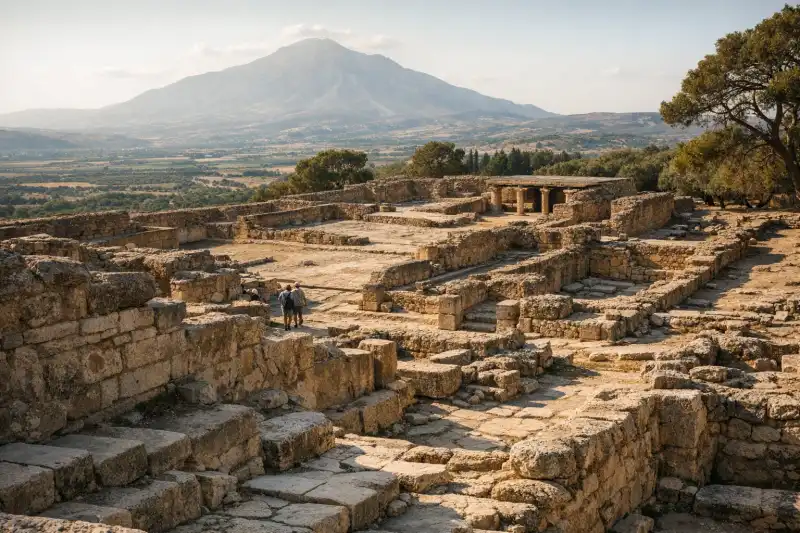
Phaistos Palace in Greece rises above the fertile Mesara Plain of southern Crete, where broad farmland, distant mountains, and sea light combine to create one of the island’s most atmospheric archaeological settings. Unlike sites that impress through sheer monumentality alone, Phaistos has a quieter power. The ruins spread across a natural terrace, and as you walk through the remains of courts, stairways, magazines, and ceremonial spaces, the landscape is never far from view. That openness matters. It helps visitors understand why this was once one of the great centers of Minoan Crete: a palace not hidden in a valley, but positioned to oversee routes, fields, and communities tied to the prosperity of the Bronze Age island.
For many travelers, Phaistos offers an experience that feels more reflective than crowded. It lacks the heavy reconstruction seen at some other famous Minoan sites, so its stones speak in a more understated voice. Yet its significance is immense. This was one of the principal palatial centers of the Minoan world, a place of administration, storage, ritual, and elite display. It was also linked to the wider cultural network of prehistoric Crete, connecting villages, agricultural estates, and coastal contacts across the Mediterranean. To visit today is to encounter both grandeur and mystery: a palace complex whose plan can still be traced with clarity, and a civilization whose writing, religion, and political structures remain only partly understood.
History
Early settlement and the rise of a palace center
The hill of Phaistos was occupied long before the surviving palace ruins took shape. Archaeological evidence points to habitation in the Neolithic period, showing that people recognized the strategic and agricultural value of this position very early. By the Early Bronze Age, Crete was developing increasingly complex communities, and the Mesara Plain became one of the island’s key productive regions. Phaistos emerged within this setting as a local power center, benefiting from fertile land, trade connections, and access to routes running between the interior and the southern coast.
Around 1900 BCE, during the period scholars often call the Protopalatial or First Palace era, the first major palace complex at Phaistos was constructed. This was part of a broader transformation in Minoan society, when large palatial centers appeared at sites such as Knossos, Malia, and Phaistos. These were not merely royal residences in the later classical sense. They served administrative, economic, religious, and ceremonial functions, gathering produce, overseeing craft production, and organizing political authority. At Phaistos, the palace became the dominant monumental expression of that system in southern Crete.
Destruction, rebuilding, and Minoan florescence
Like other Minoan palaces, the first major complex at Phaistos did not last unchanged. Sometime around 1700 BCE, a widespread destruction horizon affected many Cretan palatial sites, possibly due to earthquakes, though the exact causes remain debated. At Phaistos, the palace was heavily damaged and then rebuilt on an even more ambitious scale. Much of what visitors see today belongs to this Neopalatial or Second Palace phase, generally dated from around 1700 to 1450 BCE.
This rebuilt palace reflected the confidence and sophistication of high Minoan culture. Architectural planning became more elaborate, with a grand central court, formal approaches, storage rooms, staircases, light wells, and carefully arranged circulation routes. The site’s position gave it commanding views, and its design suggests an impressive combination of ceremonial theater and practical administration. The palace likely coordinated agricultural surplus from the Mesara region and may have held authority over nearby settlements, villas, and sanctuaries.
Phaistos also belonged to a literate administrative culture. Clay tablets and sealings found in Minoan contexts across Crete reveal systems of record-keeping, though the scripts used in earlier periods, especially Linear A, remain undeciphered. The famous Phaistos Disc, discovered in 1908 in a structure associated with the site, added another layer of mystery. Stamped with spiraling symbols unlike any other known text from the Bronze Age Aegean, it remains one of archaeology’s most puzzling objects. Whether it was ritual, administrative, literary, or something else entirely is still uncertain.
Final destruction and the post-palatial period
By around 1450 BCE, Phaistos, like many Minoan centers, experienced another major destruction. This turning point affected much of Crete and coincided with the rising influence of Mycenaean Greeks from mainland Greece. After this event, Phaistos did not regain its earlier role as a leading palace center. Administrative dominance in parts of the island appears to have shifted elsewhere, and the old Minoan palatial system entered its final phase.
The site was not simply abandoned overnight, however. Activity continued in the surrounding region, and nearby Agia Triada became especially important in later Bronze Age contexts. In the broader pattern of Cretan history, this reflects a transition rather than a complete rupture. Political organization changed, cultural traditions evolved, and Mycenaean elements became more visible in material culture and administration.
In the centuries that followed, the palace itself fell into ruin, while memory of the place persisted in changing forms. Hellenistic and later populations knew the area, but the Bronze Age complex gradually disappeared beneath collapse and soil. It was only with modern archaeology, particularly Italian excavations beginning in the early 20th century under Federico Halbherr and Luigi Pernier, that Phaistos re-emerged as one of the key sites for understanding Minoan civilization. Their work exposed the palace plan, clarified the chronology of occupation, and transformed Phaistos from a buried relic into a central chapter of Aegean prehistory.
Key Features
Phaistos is most striking for the way architecture and landscape work together. The palace sits on a sloping terrace overlooking the Mesara Plain, and that elevated setting immediately shapes the experience of the site. Even before you begin tracing walls and thresholds, the topography explains why this was an elite center. It could command views across a productive agricultural basin while maintaining links toward the coast and inland routes. That sense of supervision and connectivity would have been fundamental to its economic power.
The central court is the defining element of the palace. Large, open, and carefully oriented, it served as the heart of the complex. Like the courts of other Minoan palaces, it probably hosted ceremonies, public gatherings, processions, and performances of authority. Standing there now, visitors can still feel the intentional scale of the space. It creates a pause in the architecture, a place around which all other functions seem to revolve. The court’s openness also enhances the site’s distinctive atmosphere, because the surrounding countryside remains visible and alive beyond the ancient stonework.
One of the most memorable architectural features is the western court and the monumental approach leading toward the palace. This area includes broad paved surfaces and stepped zones that suggest formal movement into the complex. Minoan architecture often emphasized processional access, and at Phaistos the approach seems designed not only for convenience but for effect. Visitors entering important areas would have experienced a sequence of widening and narrowing spaces, changes in elevation, and carefully framed views. Such planning indicates that the palace was built to communicate power through movement as much as through walls.
The storage areas, often called magazines, reveal another side of palace life. These long, narrow rooms once held large pithoi, or storage jars, used for olive oil, grain, wine, and other goods. Their presence is a reminder that Phaistos was an economic engine. The palace gathered and managed resources from the surrounding countryside, and storage was central to its authority. These were not incidental back rooms; they were part of the system that sustained elite households, redistribution, feasting, and probably taxation or tribute in kind.
Stairways, corridors, and multi-level architectural remains point to the sophistication of Minoan building techniques. Although upper stories have largely vanished, enough survives to show that the palace was vertically complex. This matters because Minoan palaces were not simple ground-level compounds. They were dynamic structures with changing light, layered access, and controlled circulation. At Phaistos, the surviving remains make it easier than at some sites to imagine the rhythm of movement between formal and functional zones.
Another compelling aspect is what Phaistos does not have. Unlike Knossos, where major restorations and reconstructions have shaped the visitor experience, Phaistos remains comparatively restrained. The ruins are clearer in some ways because they have not been heavily remade. You see original stonework, foundations, and excavated spaces in a form that feels closer to the archaeological record. For some travelers, this creates a more authentic encounter, even if it demands more imagination. It rewards slow walking and close attention rather than quick visual consumption.
The surrounding area deepens the site’s importance. Nearby Agia Triada, another major Minoan center, suggests that Phaistos belonged to a dense regional network rather than standing alone. The palace should be understood as part of a wider landscape of farms, roads, shrines, workshops, and harbors. Even the famous Phaistos Disc, though not on display at the site itself, contributes to the palace’s aura. It symbolizes how much is still unknown about the people who lived, worked, worshipped, and governed here.
In the end, Phaistos is defined less by one single monument than by balance: ceremonial grandeur paired with economic purpose, open courts paired with enclosed storage, and local rootedness paired with island-wide significance. It remains one of the best places in Greece to grasp the complexity of Minoan civilization without losing sight of the land that sustained it.
Getting There
Phaistos Palace is in southern Crete, roughly 60 to 65 kilometers from Heraklion depending on your route. The easiest way to visit is by rental car, which allows flexibility and is especially helpful if you plan to combine the site with Agia Triada, Matala, or villages in the Mesara region. Driving from Heraklion usually takes about 1 hour 15 minutes to 1 hour 30 minutes. Expect fuel and rental costs to vary by season, but a compact car often starts around €30 to €50 per day outside peak summer and can rise significantly in high season.
Public transport is possible but less direct. From Heraklion, buses operated through the regional KTEL network run toward Moires, the main town near the site. A one-way fare is typically in the range of €6 to €9, depending on service and route. From Moires, you may need a local taxi for the final stretch to Phaistos, usually costing around €10 to €20 depending on time of day and exact pickup point. Schedules can be limited, so it is wise to check current timetables in advance and avoid assuming easy same-day return connections.
Organized day tours are another practical option, especially for travelers without a car. These commonly depart from Heraklion or resort towns and may include Phaistos together with Matala or other south Crete highlights. Prices often begin around €45 to €90 per person depending on transport, group size, and whether entrance fees or guide services are included. If you value context, a guided trip can be worthwhile, since the ruins are more meaningful when interpreted on site.
When to Visit
The best times to visit Phaistos Palace are spring and autumn, when Crete offers mild temperatures, clearer light, and fewer crowds. From April to early June, the Mesara Plain is often green, wildflowers may still be visible, and daytime conditions are comfortable for walking around an exposed archaeological site. September through October is similarly appealing, with warm weather but less intense heat than midsummer. These shoulder seasons are ideal if you want to linger, photograph the ruins, and enjoy the views without rushing for shade.
Summer, especially July and August, brings strong sun and high temperatures that can make Phaistos feel demanding by late morning. The site has limited shelter, so if you visit in peak season it is best to arrive as early as possible, wear a hat, carry plenty of water, and plan on a slower pace. The advantage of summer is long daylight, predictable road conditions, and easy pairing with beach stops nearby, but the archaeological experience itself is usually more pleasant outside the hottest months.
Winter can still be rewarding for travelers who prefer solitude. Crete remains milder than much of Europe, and a clear winter day can give Phaistos a beautiful, contemplative atmosphere. However, opening hours may be shorter, weather can be variable, and transport options are not always as convenient. Whatever the season, morning or late afternoon light often brings out the texture of the stone and the scale of the landscape. Phaistos is a site where weather and season genuinely shape the mood, so choose according to whether you value comfort, quiet, or maximum touring flexibility.
| Quick Facts | Details |
|---|---|
| Location | Southern Crete, Greece |
| Region | Crete |
| Nearest town | Moires |
| Civilization | Minoan |
| Main period | Bronze Age |
| First major palace | c. 1900 BCE |
| Rebuilt palace phase | After c. 1700 BCE |
| Famous associated find | Phaistos Disc |
| Best visit length | 1.5-2.5 hours |
| Best seasons | Spring and autumn |
| Closest major city | Heraklion |
| Ideal transport | Rental car or organized tour |
Phaistos Palace rewards travelers who want more than a checklist stop. It is not simply an archaeological ruin but a landscape of memory, administration, ceremony, and mystery. Here, the Minoan world feels tangible without being overexplained. The stones remain low, the lines of the palace are still legible, and the surrounding plain continues to anchor the site in the practical realities of food production, movement, and power. That combination is rare. Many ancient sites preserve architecture; fewer preserve a full sense of why architecture was placed where it was.
For visitors to Crete, Phaistos offers an essential counterpart to better-known palaces. It is grand but not overwhelming, significant but often peaceful, and intellectually rich without requiring specialist knowledge to appreciate. If you arrive with some patience and imagination, the ruins begin to resolve into a living center of Bronze Age society: officials recording goods, workers carrying storage jars, ritual processions crossing open courts, and communities beyond the palace depending on the rhythms set here. In that way, Phaistos remains one of Greece’s most rewarding ancient destinations, a place where history, archaeology, and landscape still speak together.
Guided tours: worth it?
Self-guided works here, but a guide can add real value if you want the ruins explained as a living place rather than just a sequence of monuments.
Best for
- First-time visitors who want context, not just photos
- Short visits where a planned route saves time
When to go self-guided
Go independently if you prefer setting your own pace, reading as you go, and checking official hours or ticket rules directly before you arrive.
What I’d avoid
Skip paid tours that bundle unrelated stops you do not actually want. The best option should either save meaningful planning time or add historical context you would miss on your own.
Crete Archaeological Sites Tours
Useful when: you want to compare guided formats before deciding
Heraklion to Phaistos Palace Day Tours
Useful when: you want to compare guided formats before deciding
South Crete and Phaistos Palace Excursions
Useful when: you want to compare guided formats before deciding
Some tour links are affiliate links, which may earn Ancient Travel a small commission at no extra cost to you. I try to surface options that make practical sense for the site—not just anything bookable.
Frequently Asked Questions
Where is Phaistos Palace located?
Phaistos Palace is in southern Crete, Greece, above the Mesara Plain near the village of Agia Triada and not far from Matala and Heraklion.
Is Phaistos Palace worth visiting?
Yes. It is one of Crete's most important Minoan sites, known for its grand central court, open views, and quieter atmosphere compared with Knossos.
How much time do you need at Phaistos Palace?
Most visitors spend 1.5 to 2.5 hours exploring the ruins, reading interpretive signs, and enjoying the surrounding landscape.
Can you visit Phaistos Palace without a guide?
Yes. The site can be visited independently, but a guide or good background reading helps make the palace layout and Minoan history easier to understand.
What is Phaistos Palace famous for?
Phaistos Palace is famous for being a major Minoan palace center and for the discovery nearby of the mysterious Phaistos Disc, one of Bronze Age archaeology's most debated artifacts.
How do you get to Phaistos Palace from Heraklion?
The easiest way is by rental car or organized tour from Heraklion. Public transport is possible via buses toward the Mesara region, often with a transfer.
Nearby Ancient Sites
Akrotiri
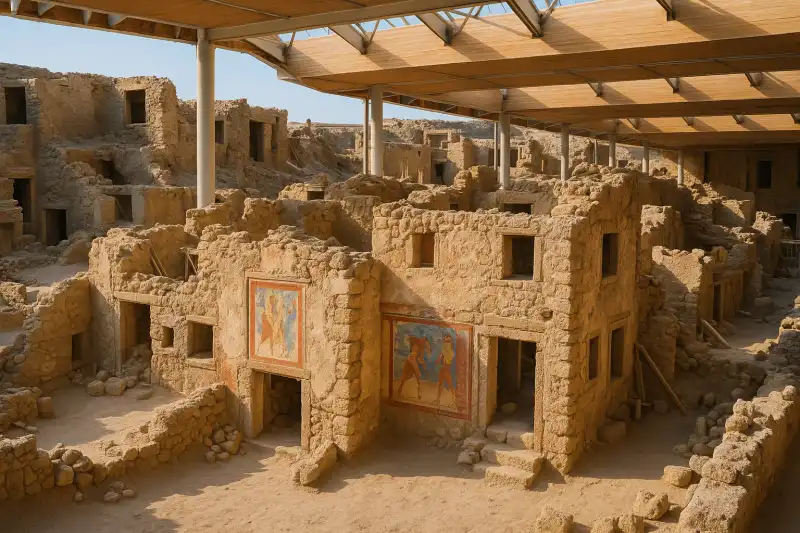
Minoan / CycladicExplore Akrotiri, the Bronze Age Minoan city buried under volcanic ash on Santorini around 1613 BCE ...
Ancient Akrotiri (Santorini)
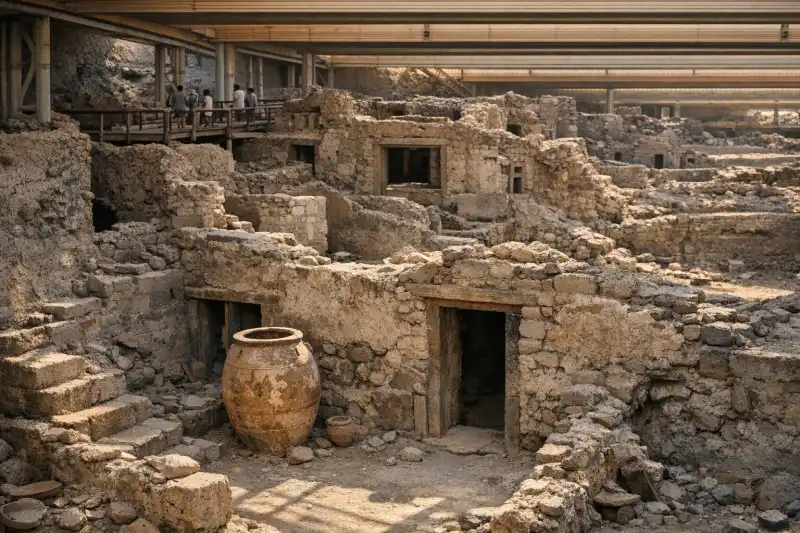
Explore Ancient Akrotiri, the breathtaking Bronze Age settlement preserved in volcanic ash on Santor...
Acropolis Travel Guide 2026: Parthenon, Tickets, and Best Time
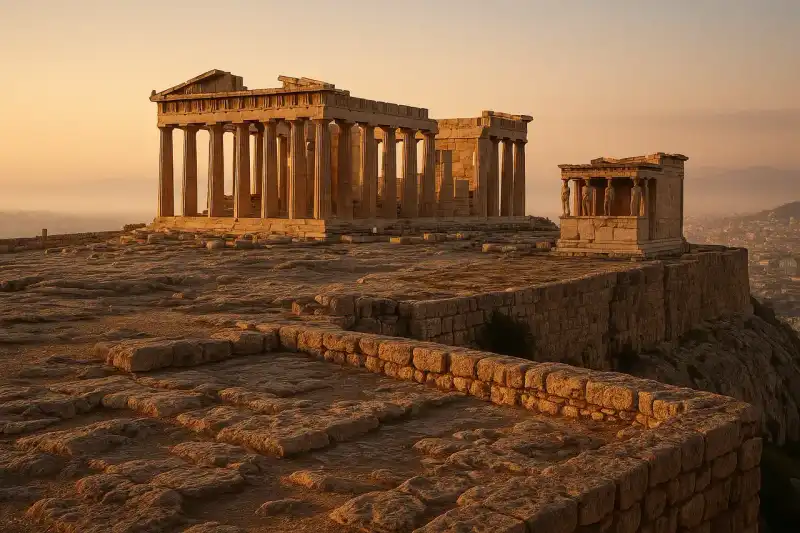
Ancient GreecePlan an efficient Acropolis visit with practical ticket timing, key monuments, and museum pairing ti...