Quick Info
At a glance
Piazza Navona is one of Rome’s most photographed places, which is exactly why it benefits from a little discipline. It is not an excavated stadium awaiting you beneath museum lighting. It is a current public piazza, full of pedestrians, residents, churches, cafés, traffic at its edges, and the usual Roman ability to make several centuries happen at once. Its distinctive elongated shape preserves the footprint of the Stadium of Domitian, the late first-century CE venue that once stood here. The ancient structure explains the plan. The fountains, church, palaces, and daily public life explain the square you actually visit.
History: a Roman sporting venue becomes a city square
Emperor Domitian built Rome’s stadium in the Campus Martius in the late first century CE. Unlike the Colosseum, which was an amphitheater for spectacles such as gladiatorial combat, a stadium was designed for athletic competition. Its long sides and curved ends established the form still visible in Piazza Navona’s outline.
After antiquity, the structure was gradually incorporated into the surrounding city. Roman buildings are unusually good at refusing to vanish cleanly: walls become foundations, seating lines become property boundaries, and former public architecture directs later streets. Piazza Navona’s shape is therefore archaeological evidence even when you are standing above ground with a gelato and several hundred other people.
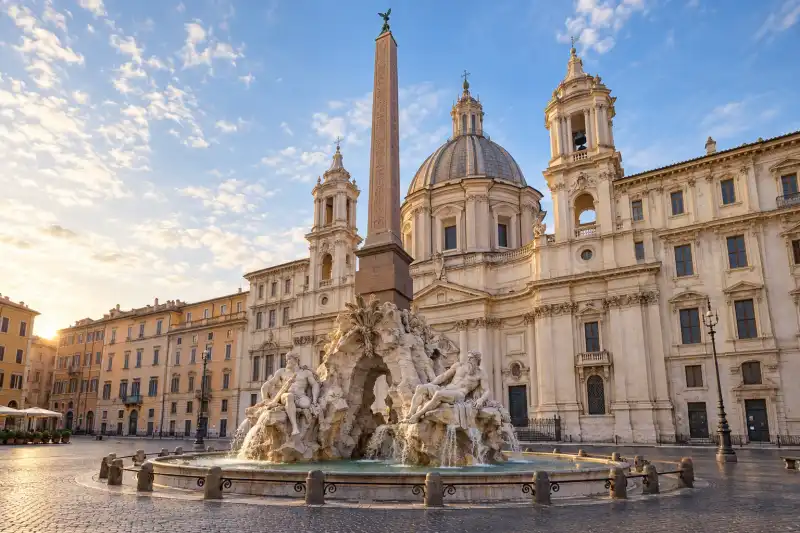
The square acquired much of its present character in the Baroque period. The central Fountain of the Four Rivers, designed by Gian Lorenzo Bernini, and the church of Sant’Agnese in Agone create the dramatic visual axis most visitors know. This later phase is not decoration pasted on top of Rome’s ancient past. It is part of the site’s history, showing how papal Rome used inherited urban forms to stage religious and civic power.
Reading the square
The stadium plan
Start by walking the full length of the piazza rather than stopping only at the central fountain. The curve at each end and the unusually narrow, elongated enclosure make the ancient stadium’s geometry legible. This is the most useful first lesson: archaeology can survive as urban form, not only as freestanding ruins.
Fountain of the Four Rivers and the obelisk
At the center, Bernini’s fountain uses personifications of major rivers to create a theatrical composition around the obelisk. The monument belongs to the seventeenth-century transformation of the square and rewards close looking, but it should not erase the stadium story. Step back far enough to see the fountain as one chapter in a much older plan.
Sant’Agnese in Agone
The church’s relationship to the square is central to the Baroque ensemble. Its name retains the memory of the ancient arena setting. Check current church access arrangements and dress expectations before entering, especially during services. A church is not a backdrop with a roof.
Ancient remains below street level
Below and around the piazza, portions of the ancient Stadium of Domitian survive. Do not assume that every visible masonry fragment is open, or that an online listing still reflects current access. Use official Rome archaeology and cultural-heritage information to confirm what can be visited on your date.
Practical approach
Piazza Navona is open public space, so the best practical advice is timing rather than ticketing. Arrive in the early morning to understand the shape without a wall of bodies in the way. Return after dark if you want to see the Baroque façades under evening light, while keeping normal city awareness. The stone surface can be slick in rain, and the center gets crowded in peak travel periods.
Do not build an itinerary around invented “stadium entry” times or a generic tour timetable. Instead, pair the piazza with nearby sites that clarify its context. The Pantheon is a short walk away and shows another way Roman public architecture was absorbed into later city life. The Colosseum makes the stadium-versus-amphitheater distinction visible at monumental scale. For a separate day outside the center, Ostia Antica offers a more extensive archaeological cityscape.
Why Piazza Navona matters
Piazza Navona is a compact lesson in Rome’s continuity. The ancient stadium is not preserved as a sealed object. Its memory survives through shape, elevation, and the durable logic of the urban block. The Baroque monuments then demonstrate how later patrons used that inherited framework to make a new public stage. Seeing both layers prevents two lazy mistakes: calling the square “ancient” as though nothing changed, or calling it “Baroque” as though Rome’s earlier city had disappeared.
A better walk through the layers
Approach from a side street if possible. Entering through a narrow lane makes the piazza’s sudden width feel more deliberate, and it lets you notice how the surrounding buildings form an enclosure. Walk one long side first, then cross near the center and return along the other. You are tracing the old stadium rather than merely orbiting a fountain.
Use the modern monuments as chronological markers. The street plan recalls Rome under Domitian. The church and fountains express papal Rome’s seventeenth-century ambitions. The vendors, public benches, residents, visitors, and policing needs belong to the current city. No layer cancels another. The square works because all three occupy the same space without being compressed into one fake “Roman times” story.
If you visit any below-grade archaeology, read the current rules before entering and allow time for the physical separation between the square and the remains. Underground archaeological spaces can have limited access, stairs, temperature differences, and changing conservation arrangements. A claim that you can always “go under Piazza Navona” is exactly the sort of sentence that survives online long after it stops helping anyone.
Photography and public-space etiquette
The best photos are often made from the edge, where the oval plan and the relationship of church, fountain, and façades can fit together. Do not climb barriers, block church entrances, stand in the road for a symmetrical shot, or mistake somebody’s restaurant table for part of the public viewing platform. Early light is good because it makes room for observation, not because it turns a living square into a private film set.
For deeper Roman context, pair the visit with an ancient building whose original form is more exposed, then come back to Piazza Navona with a clearer eye. The piazza becomes more satisfying once you understand that urban archaeology often survives in plan and use rather than as a complete, detached monument.
Building a responsible Rome itinerary
Piazza Navona is free to enter because it is part of the city, not because it is without historical significance. That distinction helps with planning. You can use it as a connective stop between formal ticketed sites, but do not treat it as disposable filler. A short, attentive walk can be more useful than an hour spent waiting for a generic tour group to assemble.
If you need restrooms, seating, food, or water, use ordinary courtesy toward local businesses and public facilities. Avoid purchasing from anyone who presents an aggressive sales pitch as “official access.” For ticketed archaeological areas in Rome, use the relevant official site or recognized museum channels. Piazza Navona itself needs no invented ticket, skip-the-line scheme, or urgency theater.
The piazza is also a reminder that a historical place can be alive enough to frustrate the clean composition in your head. Deliveries happen. Children run through the square. Church services begin. Rain makes the pavement shine and everybody scrambles under awnings. None of this diminishes the ancient and Baroque context. It proves that Rome did not stop after the guidebook’s favorite century.
The square as evidence
The most durable archaeological lesson here is simple: cities reuse valuable ground. Piazza Navona’s oval enclosure was not preserved because later Rome froze it in amber. It persisted because the ancient construction and its footprint shaped what could be built afterward. That is urban continuity at work.
Carry that thought to other Roman walks. A street alignment, a curve in a block, or a church foundation may retain information even when the ancient structure is no longer visually complete. Piazza Navona makes that idea easy to see.
Quick Facts
| Attribute | Details |
|---|---|
| Location | Rome, Lazio, Italy |
| Present-day form | Active public piazza |
| Ancient layer | Site and outline of the Stadium of Domitian |
| Main historical distinction | Stadium for athletics, not an amphitheater like the Colosseum |
| Major later monuments | Fountain of the Four Rivers and Sant’Agnese in Agone |
| Best visit rhythm | Early morning walk, then current official archaeology access if desired |
Piazza Navona works best when you stop expecting one clean era. The reward is realizing that the shape under your feet, the church in front of you, and the square’s current life are all part of the same long Roman argument.
Frequently Asked Questions
Is Piazza Navona an excavated Roman stadium?
No. Piazza Navona is a functioning public square. Its long oval plan follows the ancient Stadium of Domitian below and around it, but the piazza itself is a later urban space.
What was the Stadium of Domitian used for?
It was built for athletic contests. It should not be confused with the Colosseum, which was an amphitheater designed for different spectacles.
What are the main monuments in Piazza Navona?
The square's principal Baroque landmarks include Bernini's Fountain of the Four Rivers, the central obelisk, Sant'Agnese in Agone, and the fountains at either end.
When is the best time to see the square?
Early morning is usually the easiest time to understand the space before the busiest pedestrian hours. It is public space, so there is no general piazza admission timetable.
Where can I see the ancient stadium remains?
Seek current information from the archaeological site and Rome's official cultural-heritage sources. Access arrangements for below-grade remains can change.
Nearby Ancient Sites
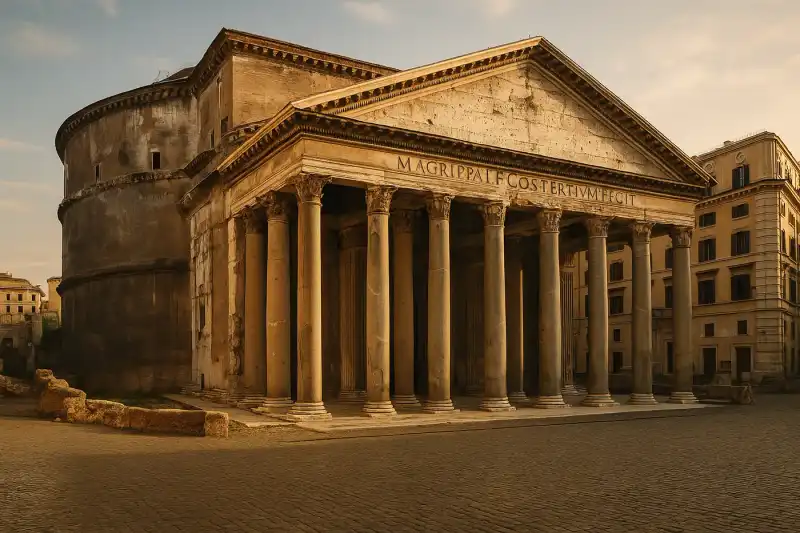
Pantheon Rome: Ultimate Guide to Rome's Best-Preserved Ancient Temple
Roman EmpireMaster your Pantheon visit with history, dome engineering secrets, visiting tips, skip-the-line opti...
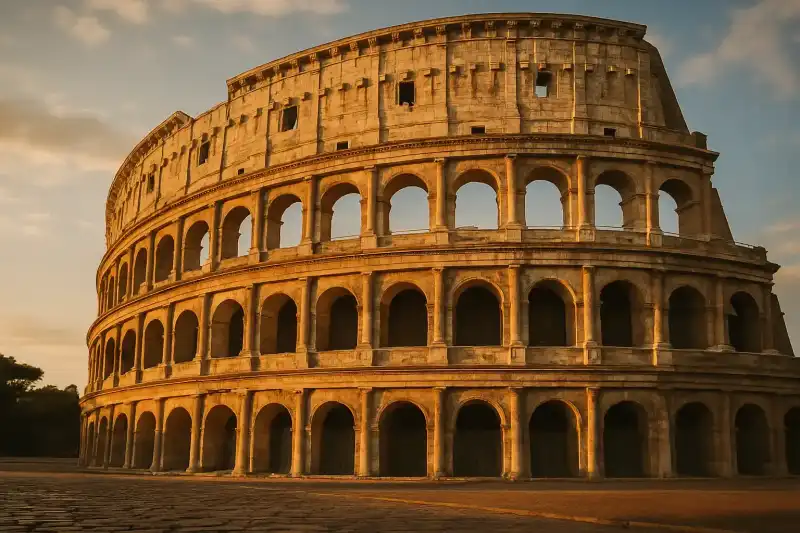
Colosseum Rome: Complete 2026 Guide to Arena Floor, Tickets, and Timing
Roman EmpirePlan the perfect Colosseum visit with timed-entry strategy, Arena Floor and underground access tips,...
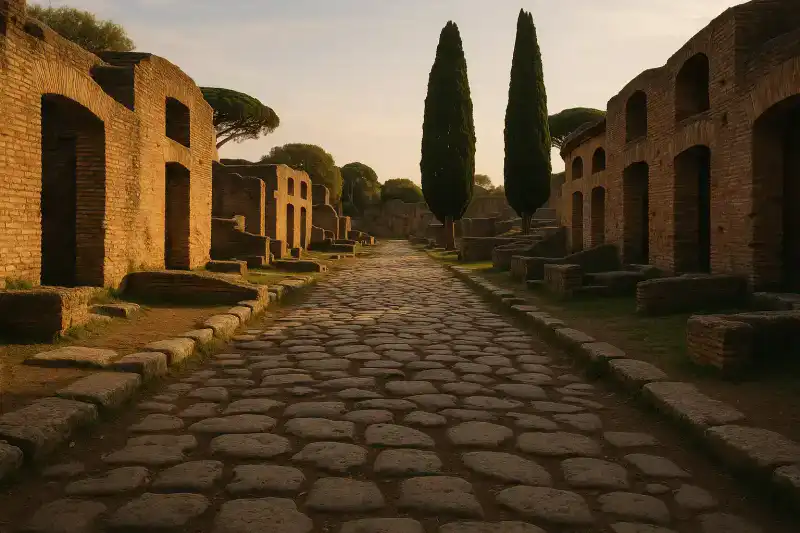
Ostia Antica Italy Travel Guide 2026: Rome's Ancient Port City
Roman EmpireExplore Ostia Antica, the best-preserved ancient Roman city after Pompeii. Walk intact streets, see ...
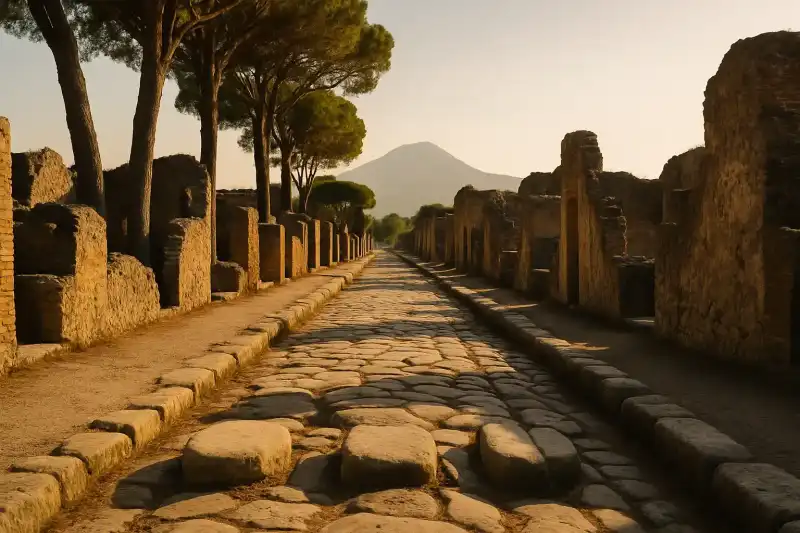
Pompeii Italy Travel Guide: Frozen in Time, Complete 2026
Roman EmpireWalk the streets of ancient Pompeii with our complete guide. Discover the best routes, must-see hous...