Quick Info
At a glance
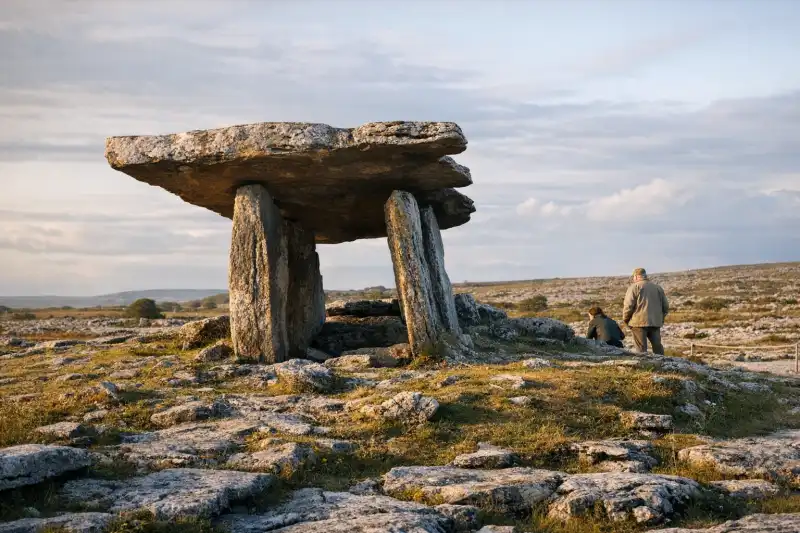
Poulnabrone Dolmen in Ireland stands with startling simplicity against the pale stone of the Burren, a prehistoric monument that seems both fragile and eternal. Set in County Clare’s vast limestone landscape, this Neolithic tomb is one of the country’s most recognizable ancient sites: two upright portal stones supporting a broad capstone, all rising from a terrain that looks almost lunar in changing light. The monument is not large by the standards of Europe’s grandest megalithic complexes, yet it has an unusual power. Visitors often arrive expecting a quick roadside stop and leave with a deeper sense of how old, exposed, and mysterious this corner of western Ireland can feel.
The setting matters as much as the structure itself. Around the dolmen, the Burren stretches in gray slabs, fractured into natural pavements and crevices where wildflowers appear in season. The openness of the land gives Poulnabrone a lonely dignity, as though the tomb were carefully placed to command both horizon and sky. Even when other travelers are present, there is usually a hush here, broken by wind, birdsong, or the distant movement of cars on narrow rural roads. That combination of accessibility and atmosphere makes it memorable. Poulnabrone Dolmen offers more than a photo opportunity: it is an encounter with the deep past of Ireland, with a funerary monument built over five millennia ago and still standing in one of the island’s most distinctive landscapes.
History
Early Neolithic origins
Poulnabrone Dolmen was built during the Neolithic period, generally dated to around 3200-2900 BCE, when farming communities had become established in Ireland. Its Irish name, Poll na Brón, is often translated as the “hole of sorrows,” a fitting title for a funerary monument, though place-name meanings can be layered and debated. What is clear is that this was constructed as a portal tomb, a type of megalithic burial structure associated with some of the earliest monumental architecture in Ireland.
The people who raised it were not casual builders. Erecting the dolmen required planning, labor, and a clear sense of ritual purpose. Massive stones had to be selected, transported, and positioned without metal tools or wheeled vehicles. The chamber created beneath the capstone was not simply a shelter but a ceremonial and burial space, likely used by a local community over time. In the Neolithic world, tombs like this may have been places where memory, ancestry, status, and belief came together. They linked the living to the dead and, in a broader sense, tied human society to the landscape.
Burial use and community meaning
Excavations at Poulnabrone showed that the tomb was indeed used for burial. Human remains discovered there belonged to a number of individuals, including adults and children, indicating that this was not a single interment but a collective burial place. Archaeologists also found grave goods and associated materials, including pottery and personal items, which help place the site within a wider pattern of Neolithic ritual practice in Ireland.
The evidence suggests a complicated funerary process rather than a one-time event. Bodies may have been placed in the chamber after excarnation or partial decomposition elsewhere, a practice known from other prehistoric sites. This would fit with a ritual system in which the tomb acted as a final place of gathering for the dead. The individuals buried here likely represented a segment of the local population rather than everyone in the surrounding area. Tombs often reflect social distinction as much as communal identity, so Poulnabrone may have been reserved for a particular lineage, group, or those of special standing.
Its location in the Burren is significant. Today the area feels exposed and rocky, but prehistoric communities lived, farmed, and moved through this landscape with intimate familiarity. The dolmen would have been visible across open ground and may have served as a marker of territory, memory, and ancestral claim. The monument’s dramatic shape suggests that visibility itself mattered.
Later prehistory to the modern era
Long after its builders were gone, Poulnabrone remained in the landscape as an ancient presence. During the Bronze Age and Iron Age it was already thousands of years old. Like many prehistoric monuments in Ireland, it likely became wrapped in local stories, superstitions, and folk memory, even if its original purpose was no longer understood. Such monuments often survived precisely because they were regarded with awe or caution.
In more recent centuries, antiquarians and scholars took interest in the tomb as part of Ireland’s prehistoric heritage. Its stark silhouette made it one of the most illustrated and photographed megalithic monuments in the country. Yet for a long time, understanding of the site remained based mostly on visual observation and comparison with similar tombs.
Archaeological excavation and conservation
A major turning point came in the 1980s, when a crack in the capstone raised concerns about structural stability. Before conservation work was undertaken, archaeologists carried out excavations that revealed much of what is now known about the site’s use. The remains of around 30-plus individuals were identified, along with artifacts that included a polished stone axe, bone objects, quartz crystals, and pottery fragments. These finds reinforced the dolmen’s importance as one of Ireland’s key Neolithic burial monuments.
Conservation helped secure the structure while preserving its character. Today Poulnabrone Dolmen is protected as a national monument and is managed as one of the Burren’s most significant archaeological attractions. It continues to be studied not only as an isolated tomb but also as part of a wider prehistoric landscape rich in field systems, enclosures, and other traces of early settlement. In that sense, the dolmen is both a famous landmark and a gateway into a much larger story about the first farming societies of western Ireland.
Key Features
What makes Poulnabrone Dolmen so compelling is its combination of elegant form and austere setting. Unlike more sprawling prehistoric sites, it can be understood at a glance, but that first impression only deepens the longer you look. The monument consists primarily of two tall portal stones and a slanting capstone balanced above a burial chamber. The capstone appears almost improbably poised, broad and heavy yet somehow graceful. Its angles create a profile that is instantly recognizable and often used as a visual shorthand for ancient Ireland.
The tomb’s proportions are part of its appeal. It is substantial without being monumental in the overwhelming sense. Standing before it, visitors can appreciate the human challenge of construction: the lifting, aligning, and stabilizing of great slabs of stone using Neolithic methods. The chamber beneath is narrow and relatively small, reminding you that this was not meant for public gathering in the modern sense but for ritual action focused on the dead. The architecture is direct and purposeful. Every stone has a role, and there is little ornamental distraction.
The surrounding Burren landscape is equally important to the experience. The dolmen rises from karst limestone pavement, a terrain shaped by erosion into blocks and fissures. This rocky environment can seem barren at first, but it is ecologically rich and visually subtle, with seasonal flowers and a constantly shifting palette of gray, silver, green, and gold. In sunlight the stone glows pale; under cloud it turns almost metallic. The monument does not dominate the landscape so much as emerge naturally from it, as if architecture and geology belong to the same ancient story.
Another defining feature is visibility. Poulnabrone sits in an open area where the sky feels enormous and weather is always part of the scene. Wind, passing cloud, and changing light alter the monument’s mood from minute to minute. Photographers are drawn to dawn and late afternoon, when the low sun throws shadows across the limestone and emphasizes the contours of the capstone. Even on overcast days, the site has a striking presence. The simplicity of the form means it reads powerfully in all conditions.
Archaeological significance also adds depth to what visitors see. The tomb is not just a beautiful shape but a place where excavations uncovered direct evidence of burial practice. Knowing that human remains and grave goods were found here changes the experience. The chamber ceases to be abstract architecture and becomes a place of memory, ceremony, and mortality. It reminds visitors that these stones once framed acts of grief, reverence, and perhaps community identity.
Accessibility is another key feature. Many ancient monuments are difficult to reach or require long walks, but Poulnabrone is relatively easy to visit from a roadside parking area. That convenience broadens its appeal and makes it a common stop on Burren itineraries. Despite this, the site usually retains an elemental feeling because the wider landscape is so open and the monument itself so exposed. You can arrive quickly, but the sense of time here remains deep.
Finally, the dolmen’s importance lies in how it represents an entire class of prehistoric monument. Portal tombs are found in several parts of Ireland and beyond, but Poulnabrone is among the clearest and most photogenic examples. For many travelers, it becomes an introduction to megalithic Ireland as a whole. In one small structure, the site captures themes of engineering, ritual, burial, landscape, and endurance. That concentration of meaning is rare, and it explains why this isolated tomb has become one of Ireland’s most iconic ancient places.
Getting There
Poulnabrone Dolmen is located in the Burren, County Clare, roughly 8 km south of Ballyvaughan and about 9 km northwest of Kilnaboy. The simplest way to reach it is by car. From Galway, the drive takes about 1 hour 15 minutes depending on traffic, usually via the N67 and local roads through or near Ballyvaughan. From Ennis, expect around 50 minutes to 1 hour. Drivers should allow extra time for narrow rural roads and scenic stops. Car rental prices in western Ireland commonly start at about €35-€70 per day, depending on season and vehicle type, while fuel costs vary but should be factored in for touring the Burren.
There is a small parking area near the monument, and from there it is only a short walk to the viewing area. Comfortable shoes are advisable because the ground can be uneven, especially after rain. There are no major on-site facilities, so bring water and plan restroom stops in nearby villages.
Public transport directly to the dolmen is limited. The nearest useful transport hubs are Galway and Ennis, both of which are connected by bus and rail networks. If you rely on buses, you may be able to reach Ballyvaughan or nearby Burren points, but completing the journey to Poulnabrone without a taxi or tour can be difficult. Local taxi fares from Ballyvaughan may range roughly from €15-€30 one way depending on distance and availability.
Guided day tours are often the most practical car-free option. Tours from Galway or Dublin that combine the Burren, Cliffs of Moher, and nearby heritage sites typically cost around €40-€90 per person, depending on duration and inclusions. For many visitors, a tour offers the easiest way to see Poulnabrone in context rather than as an isolated stop.
When to Visit
Poulnabrone Dolmen can be visited year-round, but the experience changes noticeably with season, weather, and time of day. Late spring through early autumn is the most popular period, and for good reason. From May to September, days are longer, the Burren’s wildflowers may be in bloom, and road conditions are generally easier for travelers unfamiliar with rural Ireland. Temperatures are usually mild rather than hot, often ranging from about 12°C to 20°C, making walking and sightseeing comfortable. Summer brings the best chance of combining the dolmen with a full day exploring County Clare.
Spring is especially rewarding if you appreciate landscape and botany. The Burren is famous for unusual plant life, and the contrast between delicate flowers and bare limestone gives the region a special character. Light can also be beautiful at this time of year, with crisp mornings and fewer crowds than in high summer.
Autumn offers quieter roads and a reflective atmosphere that suits the monument well. September and early October can still be pleasant, though wind and rain become more likely. Winter visits are entirely possible and can be memorable, especially when dramatic skies sweep across the open terrain, but conditions may be wet, cold, and slippery underfoot. If visiting then, wear waterproof layers and sturdy shoes.
Time of day matters as much as season. Early morning and late afternoon generally provide the most evocative light and fewer visitors. Midday can be busier with tour groups, especially in summer. Because the site is exposed, check the forecast before setting out. A clear day reveals the Burren at its most expansive, but even mist and cloud can add a haunting quality that feels appropriate to such an ancient burial place.
| Quick Facts | Details |
|---|---|
| Location | The Burren, County Clare, Ireland |
| Monument Type | Neolithic portal tomb (dolmen) |
| Date | c. 3200-2900 BCE |
| Primary Material | Limestone |
| Cultural Context | Early farming communities of Neolithic Ireland |
| Best Base | Ballyvaughan or Galway |
| Typical Visit Time | 20-45 minutes |
| Entry Fee | Free |
| Best Combined Excursions | Burren, Cliffs of Moher, Ballyvaughan |
| Why It Matters | One of Ireland’s best-known and best-preserved megalithic tombs |
Guided tours: worth it?
Most travelers can visit Poulnabrone Dolmen independently. Compare a tour only if you want a tighter history-focused visit, easier logistics, or a guide who can answer questions on the spot.
Best for
- Short visits where a planned route saves time
When to go self-guided
Go independently if you prefer setting your own pace, reading as you go, and checking official hours or ticket rules directly before you arrive.
What I’d avoid
Skip paid tours that bundle unrelated stops you do not actually want. The best option should either save meaningful planning time or add historical context you would miss on your own.
Burren and Cliffs of Moher Day Tours
Useful when: you want to compare guided formats before deciding
County Clare Archaeology Tours
Useful when: you want to compare guided formats before deciding
Galway to Burren and Poulnabrone Dolmen Tours
Useful when: you want to compare guided formats before deciding
Some tour links are affiliate links, which may earn Ancient Travel a small commission at no extra cost to you. I try to surface options that make practical sense for the site—not just anything bookable.
Frequently Asked Questions
What is Poulnabrone Dolmen?
Poulnabrone Dolmen is a Neolithic portal tomb in the Burren of County Clare, Ireland, built more than 5,000 years ago.
Is there an entrance fee to visit Poulnabrone Dolmen?
No, the site is generally free to visit and is accessible from a small roadside parking area.
How long do you need at Poulnabrone Dolmen?
Most visitors spend 20 to 45 minutes at the monument, though archaeology and landscape enthusiasts may stay longer to explore the surrounding Burren.
Can you visit Poulnabrone Dolmen without a car?
It is possible but difficult using public transport alone, as the dolmen is in a rural area; most visitors arrive by car or as part of a guided tour from Galway, Ennis, or Dublin.
Why is Poulnabrone Dolmen important?
It is one of Ireland’s best-known megalithic tombs and provides important evidence for burial practices, ritual life, and society in Neolithic western Ireland.
Is Poulnabrone Dolmen suitable for children?
Yes, families can visit easily, but children should be supervised because of uneven limestone ground and exposure to weather.
Nearby Ancient Sites
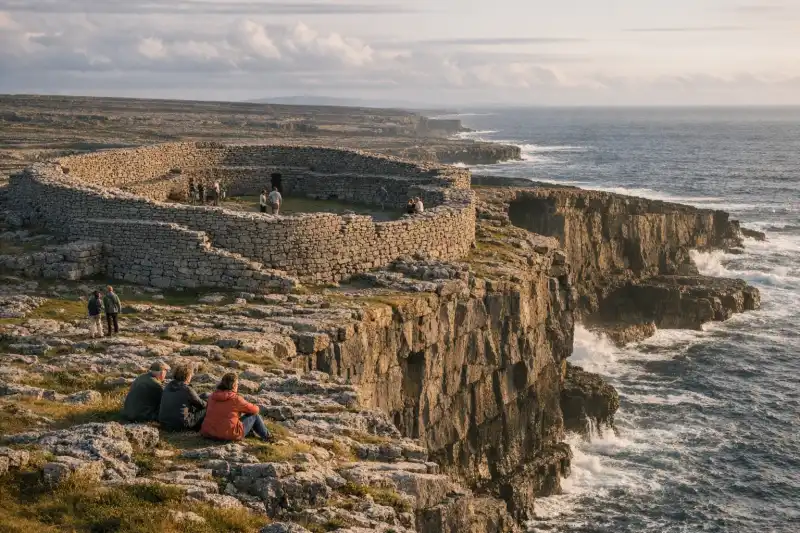
Aran Islands Stone Forts
Prehistoric and early medieval IrishExplore the dramatic prehistoric stone forts of Ireland’s Aran Islands, where Atlantic cliffs and an...
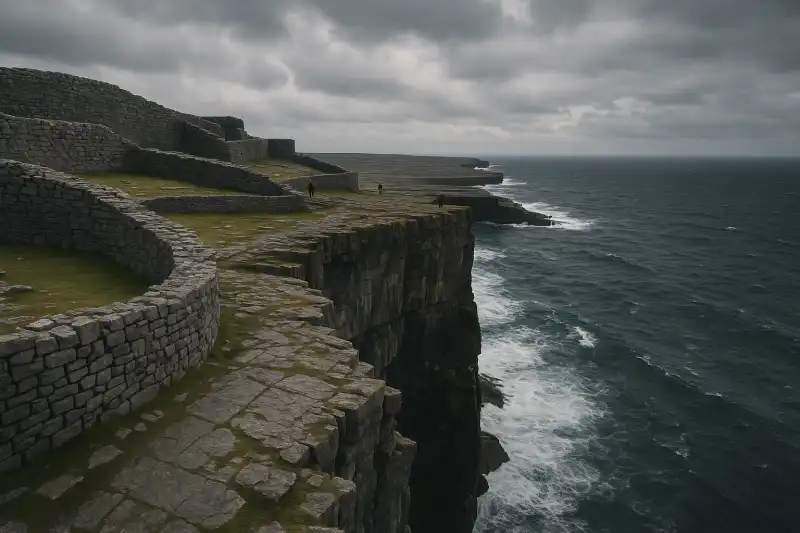
Dún Aonghasa Travel Guide 2026: Aran Islands Cliff Fort History, Highlights, and Visit Planning
Iron Age Atlantic communitiesPlan a first visit to Dún Aonghasa on Inis Mór with practical ferry timing, cliff-fort context, and ...
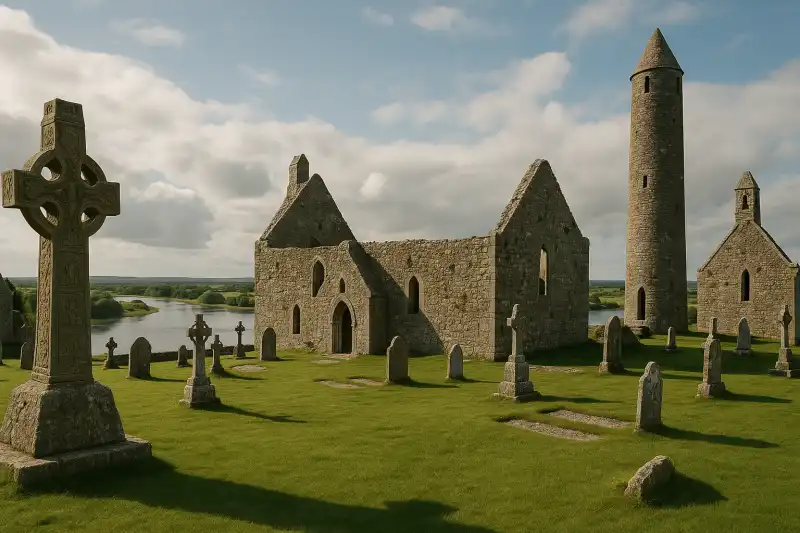
Clonmacnoise Travel Guide 2026: Monastic Ruins, High Crosses, and River Shannon Context
Early Medieval IrelandPlan a first visit to Clonmacnoise with practical timing, monastic-site context, and clear route adv...