Quick Info
Curated Experiences
Prambanan Temple Sunset Tour from Yogyakarta
Borobudur and Prambanan Full Day Tour
Private Yogyakarta Heritage Tour to Prambanan
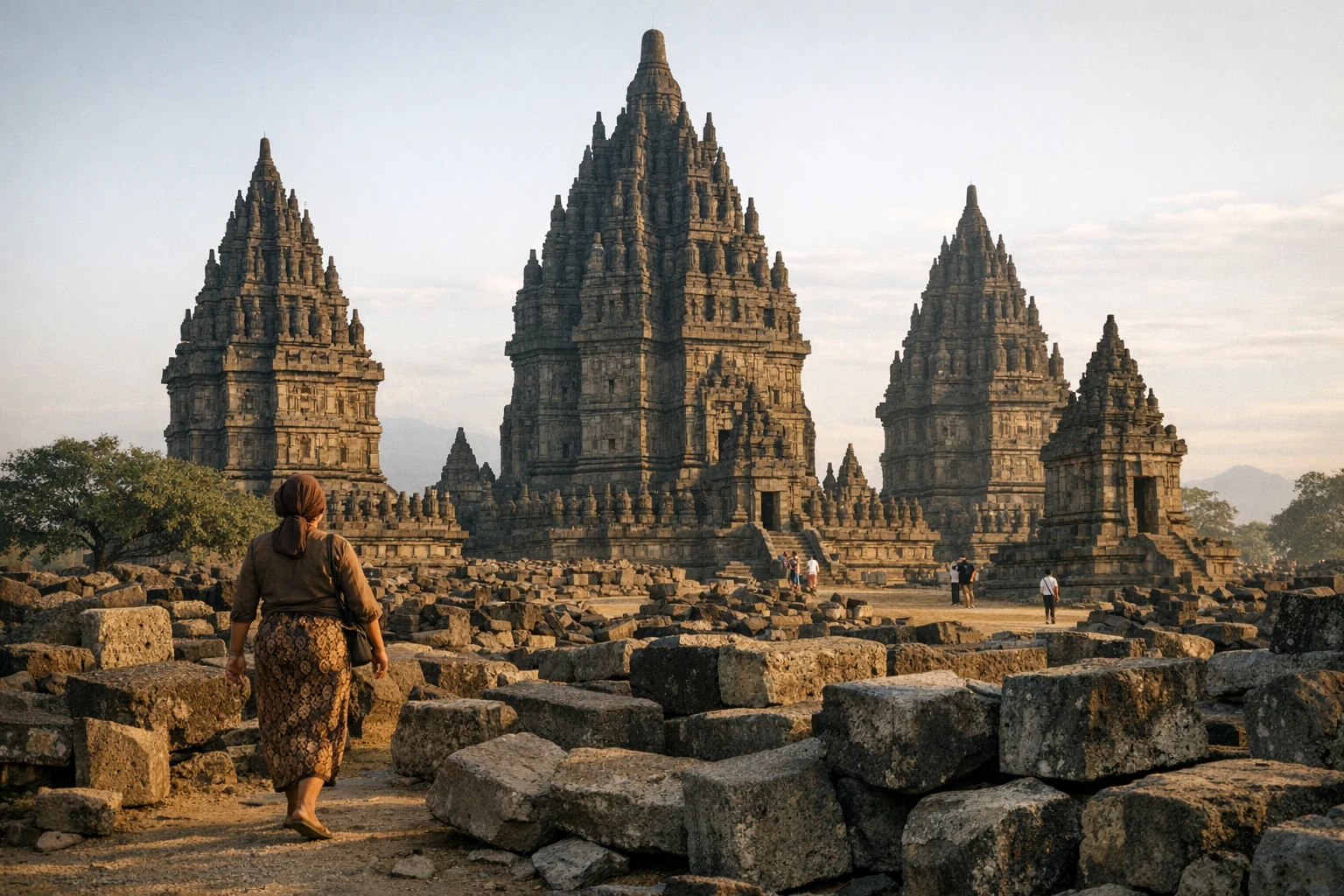
Prambanan in Indonesia rises from the plains near Yogyakarta like a city of stone flames, its sharply vertical temples turning volcanic rock into one of Southeast Asia’s most elegant religious skylines. Even travelers who have seen photographs are often surprised by the sheer delicacy of the silhouette. The main towers do not sprawl; they soar. Their profiles are dense with carved moldings, niches, and rhythmic projections that pull the eye upward until the whole complex feels lighter than stone should allow. In the tropical heat of central Java, with fields, villages, and distant volcanic landscapes around it, Prambanan can feel almost improbable: a vast medieval Hindu complex that somehow manages to be both monumental and exquisitely refined.
What makes the site especially compelling is the balance between grandeur and detail. From a distance, Prambanan is about height, symmetry, and power. Up close, it becomes a world of narratives and sacred structure. Reliefs tell episodes from the Ramayana, guardian figures line stairways, subsidiary shrines organize cosmic hierarchy, and the central temples dedicated to Shiva, Vishnu, and Brahma reveal a carefully ordered vision of divine kingship and religious devotion. Prambanan is often visited alongside Borobudur, and the pairing is famous for good reason, but the comparison can obscure what is special here. Borobudur unfolds as a Buddhist mandala-mountain; Prambanan rises as a dramatic Hindu temple city, more angular, more vertical, and more openly theatrical. To walk through it is to encounter one of the great achievements of early Indonesian architecture, shaped by royal ambition, religious imagination, and a landscape still marked by volcanic force.
History
The Central Javanese Kingdoms and the Rise of Temple Culture
Prambanan emerged during one of the most creative periods in early Javanese history, when central Java was home to powerful kingdoms whose rulers patronized both Buddhist and Hindu monuments on a monumental scale. The 8th and 9th centuries saw the flourishing of dynasties commonly associated with the Sailendra and Sanjaya traditions, though the exact political relationships between them remain complex and debated. What is clear is that central Java became a major center of sacred building, producing some of the most remarkable temple complexes in all of Southeast Asia.
This was not a minor provincial art scene. The region was plugged into maritime trade, Indian religious ideas, and local political consolidation. Sanskrit concepts of kingship, cosmology, and divine legitimacy entered into dialogue with indigenous Javanese traditions, producing a distinctive religious culture rather than a simple imitation of India. Temple architecture was one of the clearest ways rulers expressed power. By sponsoring vast religious monuments, kings linked themselves to cosmic order, sacred geography, and enduring prestige.
Construction in the 9th Century
Prambanan is generally dated to the 9th century CE and is often associated with the Sanjaya line and rulers such as Rakai Pikatan and his successors. The complex is also known as Candi Lara Jonggrang, a name tied to later legend. It was conceived as a major Hindu state temple, with the central group dedicated to the Trimurti: Shiva, Vishnu, and Brahma. Shiva occupies the dominant position, and the great Shiva temple remains the complex’s focal point, reflecting the central role of Shaivism in the courtly religious culture that sponsored the monument.
The scale and organization of Prambanan suggest not only royal wealth but also a highly developed conception of sacred planning. The central compound was surrounded by concentric zones of shrines and enclosure walls, creating an ordered sacred city rather than a lone monumental temple. This arrangement reflects cosmological ideas in which temple space mirrored divine structure. Architecture here was not only a vessel for worship. It was itself a model of the universe, ordered by hierarchy, orientation, and symbolic relationship.
Decline, Abandonment, and Survival in Ruin
Prambanan did not remain the unchallenged center of political and religious life forever. Shifts in power from central to eastern Java, volcanic activity, and broader historical changes contributed to the decline of the region’s great temple landscapes. By the 10th century, central Java had lost some of its earlier political centrality, and Prambanan gradually fell out of active monumental use. Earthquakes also likely played a role in damaging the site over time, weakening structures and contributing to partial collapse.
As centuries passed, the temples entered a long period of ruin. Vegetation, fallen stone, and local legend took over where formal ritual had receded. Yet Prambanan was never entirely erased from memory. Like many great ruins, it persisted in local stories and in the visible authority of its surviving towers. The later legend of Lara Jonggrang, which links the complex to a transformed princess and a near-impossible challenge of building a thousand temples in one night, reflects the way monumental ruins are absorbed into cultural imagination. Even in decline, Prambanan remained alive in narrative.
Rediscovery, Restoration, and UNESCO Recognition
European colonial-era scholars, surveyors, and antiquarians brought Prambanan into wider international awareness, especially from the 18th and 19th centuries onward. Formal study and clearance eventually revealed the complexity of the site, but early intervention was uneven, and restoration took time. The scale of collapse and the dispersal of stones made reconstruction a massive challenge. Over the 20th century, however, increasingly systematic archaeological work and conservation transformed how Prambanan could be experienced. The central temples were painstakingly restored, allowing their architectural logic to re-emerge with remarkable power.
The site suffered another major setback in 2006, when an earthquake damaged parts of the complex and again raised questions of preservation and structural resilience. Yet Prambanan endured, and conservation efforts continued. Its inclusion as a UNESCO World Heritage Site recognized both its artistic significance and its place within the broader story of medieval Southeast Asian civilization. Today, visitors encounter a monument that is both ancient and visibly shaped by modern restoration. That is not a weakness. It is part of Prambanan’s story: a sacred city repeatedly damaged, reassembled, and re-understood across more than a thousand years.
Key Features
The central feature of Prambanan is the soaring cluster of main temples in the inner compound, especially the Shiva temple, which dominates the ensemble with extraordinary confidence. Rising to nearly 50 meters, it is one of the tallest and most graceful Hindu temples in Southeast Asia. Its verticality defines the entire site. Rather than spreading into a broad horizontal complex, Prambanan concentrates power upward. The tower’s many receding levels, ornamental moldings, and niches create a sense of movement toward the sky, while the stairways and sculptural programs draw visitors physically and visually into the monument’s sacred order.
The companion temples of Vishnu and Brahma complete the Trimurti grouping and help establish the complex’s architectural balance. Together they create a carefully orchestrated center, reinforced by the smaller shrines dedicated to the vahana, or divine mounts, associated with the major gods. This arrangement matters because it reveals that Prambanan is not merely a collection of impressive buildings. It is an integrated cosmological statement. Hierarchy, alignment, and repetition turn the compound into a map of sacred relationships, one that visitors can still feel even without specialist knowledge.
One of Prambanan’s greatest pleasures is the relief carving. The narrative panels, especially those illustrating the Ramayana on the balustrades of the Shiva and Brahma temples, are among the most rewarding examples of temple storytelling in the region. They are not just decorative friezes. They form a moving literary and devotional experience in stone, guiding the visitor through episodes of exile, battle, loyalty, and cosmic struggle. Following these reliefs transforms the site from an abstract architectural masterpiece into a lived narrative environment. It reminds visitors that temples were designed to be read, walked, and interpreted through movement.
The sculpture program inside the temples deepens this experience. The Shiva temple, for example, houses significant images including Shiva Mahadeva and associated deities such as Durga, Agastya, and Ganesha in subsidiary chambers. The famous Durga image has long been linked by local tradition to the Lara Jonggrang legend, giving the site a rare fusion of formal iconography and later folklore. These interior spaces are especially striking because they contrast with the bright exterior light of Java. Inside, the mood becomes cooler, darker, and more concentrated, shifting attention from skyline to sacred presence.
The wider site also includes smaller temples and scattered remains that help reveal the original scale of the compound. While the central restored group attracts most attention, the outer zones and associated structures matter because they show that Prambanan was once part of a much larger temple city. Nearby temples such as Sewu, Lumbung, and Bubrah, often explored in the same broader archaeological landscape, reinforce the sense that this was an intensely sacred region rather than a solitary monument. Even if a visitor focuses mainly on the main compound, the surrounding plain and adjacent ruins help preserve that larger mental picture.
Getting There
Prambanan is located about 17 kilometers northeast of central Yogyakarta, making it one of the easiest major archaeological sites in Indonesia to visit independently or as part of a guided tour. The simplest options are taxi, rideshare, private driver, or organized tour. A one-way ride from central Yogyakarta typically costs around IDR 80,000 to 180,000 depending on traffic, pickup point, and vehicle type, though app-based fares can sometimes be lower. Many travelers choose a private driver for half a day or a full day if combining Prambanan with Borobudur or other Yogyakarta area sites.
Public transport is also possible. Local bus services and Trans Jogja connections can get budget travelers close to the complex at a much lower fare, though the journey is slower and less convenient than a direct car. For most visitors, especially those short on time, private transport is worth the difference. Guided tours are especially common because Prambanan is often paired with sunset visits, Ramayana performances, or multi-site temple itineraries.
If you are flying into Yogyakarta, the site is also reachable from the airport area without much difficulty. Once on site, expect some walking in open sun, so carry water, wear comfortable shoes, and allow extra time if you want to explore museums or the surrounding temple landscape. Prambanan is straightforward logistically, which is one reason it works so well as either a standalone visit or part of a broader heritage circuit.
When to Visit
The best time to visit Prambanan is usually during the dry season, roughly from May to October, when skies are clearer and walking conditions are easier. Central Java can be hot and humid year-round, but dry-season mornings and late afternoons are especially pleasant compared with the wetter months. These hours also offer the best light for appreciating the temple silhouettes, which are at their most dramatic when the stone catches low sun rather than flat midday brightness.
Early morning is an excellent time to go if your priority is architecture and relative calm. The complex feels more spacious, temperatures are lower, and the vertical lines of the temples stand out sharply in softer light. Late afternoon is another favorite, especially for photography and for travelers hoping to stay into sunset or pair the visit with an evening Ramayana ballet performance in the broader Prambanan area. Midday can be punishingly hot, and the exposed grounds provide limited relief from the sun.
The wet season, generally from November to April, does not make Prambanan impossible, but it does introduce more humidity, occasional heavy rain, and grayer skies. On the other hand, the surrounding landscape can appear greener and atmospheric after showers. If traveling then, build flexibility into your schedule and bring protection for both sun and rain. For most travelers, though, the sweet spot is dry-season morning or late afternoon, when the temples look their sharpest and the site is easiest to enjoy slowly.
| Quick Facts | Details |
|---|---|
| Location | Near Yogyakarta, Special Region of Yogyakarta, Indonesia |
| Best Known For | Towering Hindu temples dedicated to Shiva, Vishnu, and Brahma |
| UNESCO Status | World Heritage Site |
| Main Building Period | 9th century CE |
| Cultural Tradition | Medieval Javanese Hinduism |
| Signature Monument | Shiva temple |
| Key Artistic Highlight | Ramayana relief carvings |
| Recommended Visit Length | 2 to 4 hours, half day ideal |
| Best Season | May to October |
| Practical Tip | Visit early or late in the day for better light, cooler temperatures, and a stronger sense of the temple skyline |
Frequently Asked Questions
What is Prambanan best known for?
Prambanan is best known for its tall, sharply profiled Hindu temple towers dedicated to Shiva, Vishnu, and Brahma, as well as its detailed Ramayana reliefs.
Where is Prambanan located?
Prambanan is located near Yogyakarta in central Java, Indonesia, close to the border between the Special Region of Yogyakarta and Central Java.
How much time should you spend at Prambanan?
Most visitors should allow at least 2 to 4 hours, though a half day is better if you want to explore the main compound, nearby smaller temples, and museum areas.
Can you visit Borobudur and Prambanan in one day?
Yes, many travelers combine them in a long day trip from Yogyakarta, though each site rewards more time if your schedule allows.
When is the best time to visit Prambanan?
The dry season from roughly May to October is usually best, with clearer skies and more comfortable walking conditions, especially in the morning or late afternoon.
Is Prambanan still an active religious site?
Yes. While it functions mainly as a major heritage monument, Prambanan also retains religious significance and is still associated with Hindu ritual and ceremony.
Nearby Ancient Sites
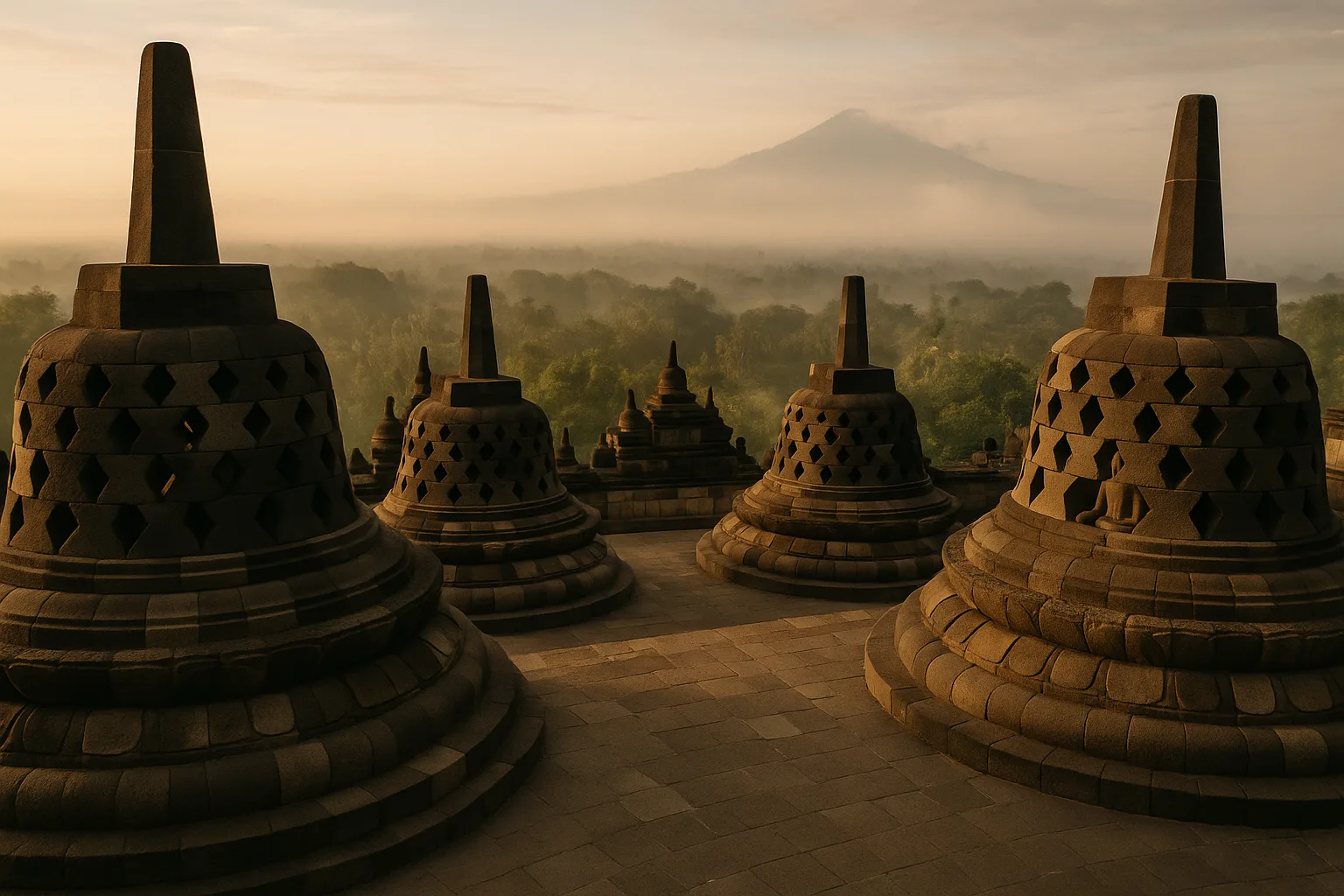
Borobudur Temple, Indonesia: The Sacred Mountain of a
Sailendra Dynasty (Buddhist)Discover Borobudur, the world's largest Buddhist temple and Indonesia's most visited attraction. Com...
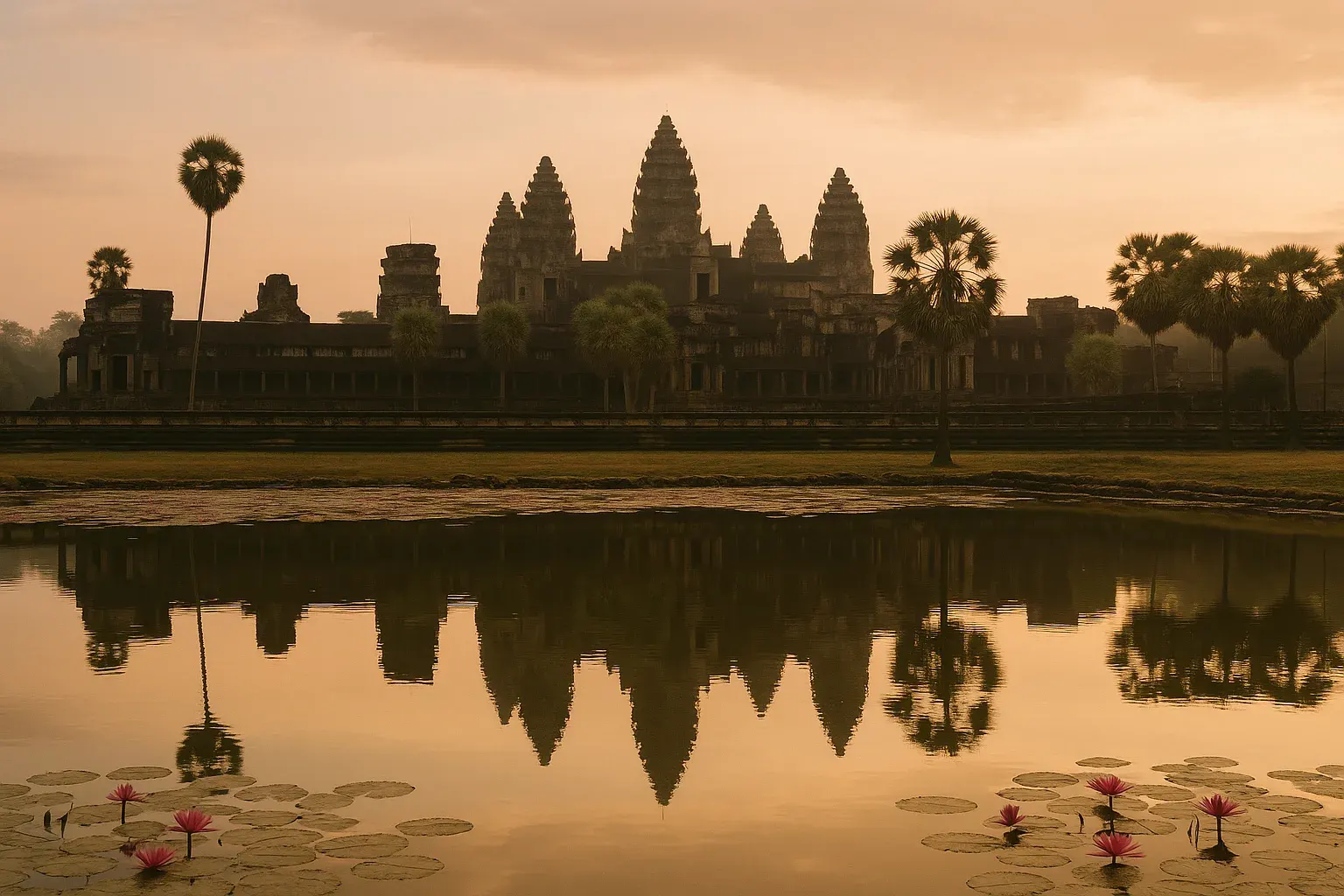
Angkor Wat Travel Guide 2026: Everything You Need to Know
KhmerAngkor Wat, the world's largest religious monument, spans over 400 acres in the heart of Cambodia. T...
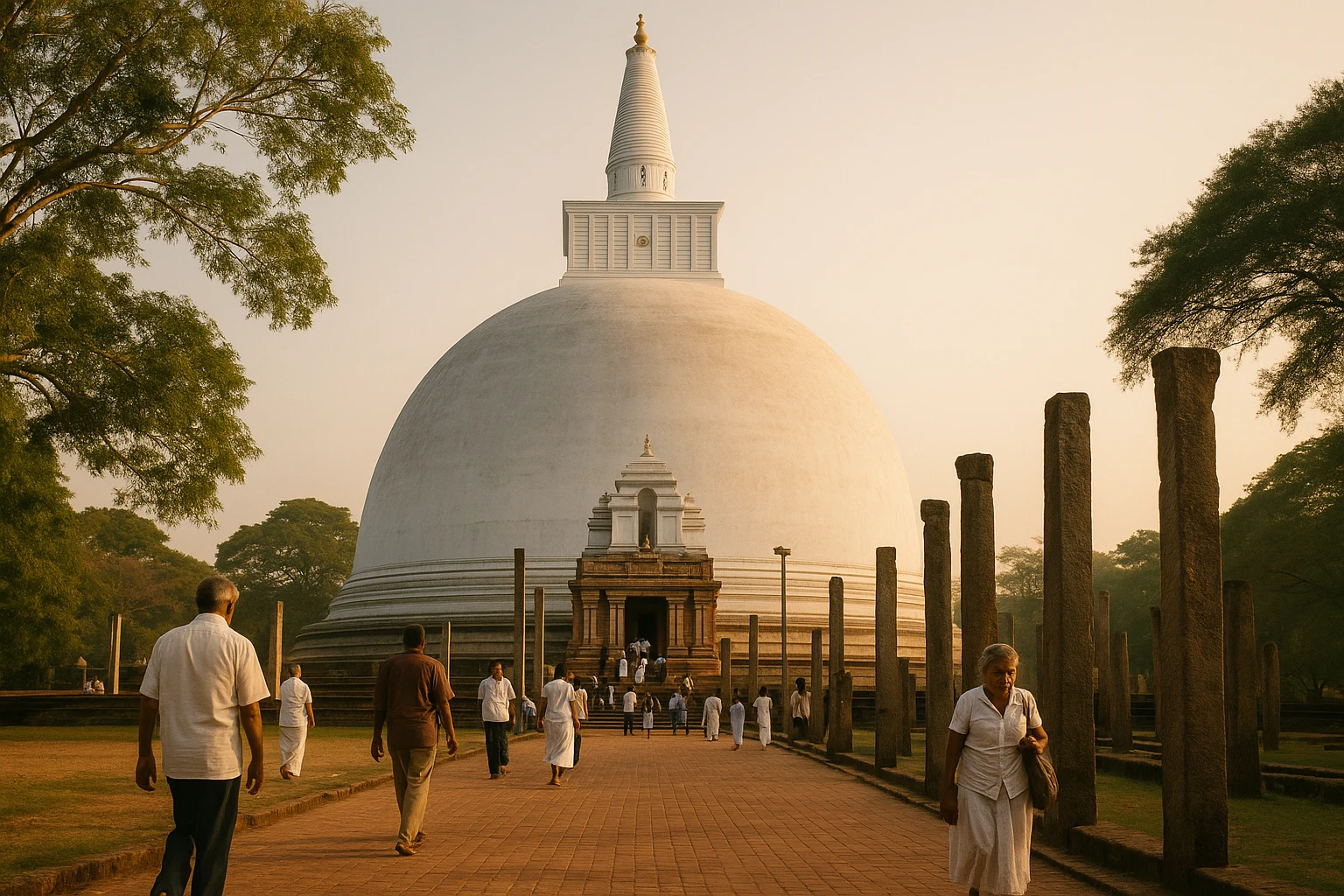
Anuradhapura
SinhaleseSacred ancient capital of Sri Lanka, Anuradhapura preserves towering Buddhist stupas, the world's ol...