Quick Info
At a glance
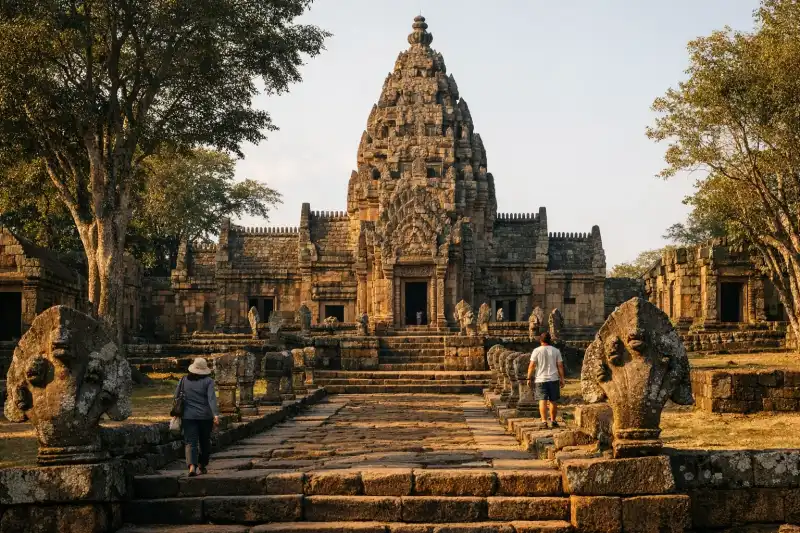
Prasat Hin Khao Phnom Rung in Thailand rises above the plains of Buriram on the rim of an extinct volcano, where a long ceremonial approach leads visitors toward one of mainland Southeast Asia’s most striking Khmer sanctuaries. Even before the first tower appears in full, the setting does much of the work: wind over open countryside, dark volcanic stone underfoot, and a gradual ascent that turns a simple visit into something closer to a ritual arrival. The temple is often called simply Phnom Rung, but its formal name carries the sense of a mountain sanctuary, and that is exactly how it feels.
Unlike ruins that reveal themselves all at once, Phnom Rung is built for anticipation. Travelers pass stairways, a processional causeway, and symbolic bridges before reaching the heart of the complex. This sequence matters. The site was designed not only as architecture, but as a sacred journey shaped by Hindu cosmology. Dedicated to Shiva and influenced by the mountain symbolism central to Khmer religious thought, the temple uses elevation, axis, and ornament to create a powerful sense of ascent toward the divine.
Today, Prasat Hin Khao Phnom Rung is one of Thailand’s most admired ancient monuments. It offers the scale and sculptural refinement associated with the Khmer world, yet it also feels distinctly local, rooted in the volcanic landscape and cultural history of northeastern Thailand. For travelers interested in archaeology, religion, architecture, or simply memorable places, it is among the country’s essential historic sites.
History
Early sacred landscape
Long before the main sandstone sanctuary was constructed, the hill of Phnom Rung already possessed spiritual significance. Built atop the crater rim of an extinct volcano, the location naturally suggested sacred elevation. In Khmer religious geography, mountains were not incidental features; they echoed Mount Meru, the cosmic mountain at the center of the universe in Hindu belief. Choosing this site therefore connected local topography to a broader imperial religious language.
Archaeological evidence indicates that the hill may have held earlier shrines before the grander structures visible today took shape. These initial foundations probably date to the 10th century, when Khmer influence was well established across parts of what is now northeastern Thailand. At that time, the region lay within the cultural orbit of the Khmer Empire, whose political and religious networks extended far beyond present-day Cambodia.
The earliest structures at Phnom Rung were likely modest compared with the later complex. Yet they established the site’s role as a mountain temple dedicated to Shiva, one of the principal gods of Hindu worship in the Khmer realm. Lingas, sanctuaries, and ritual axes would have marked it as a place where political authority and divine legitimacy were closely linked.
Expansion under the Khmer Empire
Most of the monument seen today belongs to the 11th and 12th centuries, when Phnom Rung underwent major development. This was the period in which Khmer architecture reached a mature and highly sophisticated form, and the temple’s design reflects that confidence. Builders created an extended ceremonial route leading uphill to the main sanctuary, integrating stairways, naga bridges, courtyards, galleries, and towers into a carefully orchestrated approach.
Phnom Rung was not simply a rural shrine. Inscriptions connect the site with elite patronage, including lineages tied to the Khmer court. Such support mattered enormously. Temples functioned as religious centers, places of land management, and symbols of status. A sanctuary on a commanding height could proclaim both piety and power, especially in frontier regions of the empire.
The art and ornamentation of Phnom Rung show clear stylistic links with major Khmer developments elsewhere. Carved lintels, pediments, and colonettes display themes from Hindu mythology, while the overall composition follows the temple-mountain concept central to Khmer sacred architecture. Yet the site also has its own identity, shaped by local stone, terrain, and the unusual drama of its volcanic setting.
Later transformations and religious change
As political and religious patterns shifted across mainland Southeast Asia, temples like Phnom Rung changed as well. The Khmer world gradually moved from strong royal Hindu patronage toward forms of Buddhism, and many sanctuaries either adapted to new use or declined in importance. Phnom Rung appears to have remained known and respected, but its role as an active center of high-status Shaivite worship diminished over time.
This does not mean the monument was abandoned overnight. Ancient sites in the region often passed through long periods of layered use, memory, and local reverence. Elements could be repurposed, rituals altered, and meaning reinterpreted. Like many Khmer monuments beyond the imperial core, Phnom Rung survived partly because it remained embedded in the surrounding cultural landscape rather than being erased from it.
Weathering, vegetation, and the collapse of certain architectural elements inevitably affected the temple over the centuries. Sandstone carvings suffered erosion, and fallen blocks changed how later generations experienced the site. Even so, enough remained to preserve the monument’s essential grandeur.
Rediscovery, restoration, and modern identity
In the modern era, Phnom Rung emerged as one of Thailand’s most important archaeological monuments. Conservation work in the 20th century, particularly systematic restoration, helped stabilize the complex and reassemble major structural components. These efforts were significant not only technically but culturally: they transformed the ruins from a little-known regional monument into a nationally recognized historic treasure.
The site also entered public awareness through debates over displaced Khmer art, especially the famous lintel depicting Vishnu reclining on Ananta, which was eventually returned to Thailand after spending time abroad. That episode highlighted both the artistic importance of Phnom Rung and the growing attention paid to heritage ownership and preservation.
Today the temple is protected as part of Phanom Rung Historical Park and is celebrated for both scholarship and tourism. It is especially famous for its solar alignment, when the rising sun is seen through a sequence of doorways on specific dates. This phenomenon has reinforced the temple’s image as a place where architecture, astronomy, ritual, and landscape come together with unusual precision.
Key Features
The most memorable aspect of Prasat Hin Khao Phnom Rung is the way it stages arrival. Visitors do not merely walk into a ruin; they ascend toward it in a sequence that feels both physical and symbolic. The grand stairway rises from the lower approach through shady trees and open views, preparing the eye for the higher terraces ahead. This climb is one reason the site leaves such a strong impression. By the time the sanctuary appears, it already feels earned.
At the top, the processional causeway is among the monument’s defining features. Long and straight, edged with marker stones and framed by the surrounding landscape, it creates a ceremonial axis that directs attention toward the temple core. The causeway is interrupted by bridges flanked with naga forms, those serpent beings so common in Khmer architecture. These are not decorative afterthoughts. In Khmer cosmology, bridges often represent passage between realms, reinforcing the sense that Phnom Rung was conceived as sacred movement through an ordered universe.
The sanctuary itself is a masterpiece of sandstone construction. Its towers, door frames, lintels, and pediments show the confidence of mature Khmer workmanship, with a level of carving that rewards slow looking. Floral motifs, celestial beings, and mythological scenes animate the surfaces, while the stone changes character throughout the day as light shifts across it. Early morning and late afternoon are especially beautiful, when warm tones deepen the carvings and emphasize the temple’s relief.
One of the most discussed artistic elements is the iconography drawn from Hindu mythology. Shiva was the primary deity associated with Phnom Rung, but the temple’s sculptural program includes a broader mythic world. Lintels and pediments depict gods, demons, and cosmic imagery that would have been legible within the religious culture of the Khmer court. For modern visitors, even without specialist knowledge, the carvings communicate movement, drama, and sacred hierarchy.
The site’s layout also reflects a clear concern with sacred geometry and orientation. Multiple doorways align along the temple’s main axis, producing the celebrated sunrise phenomenon on certain days each year. Whether travelers come specifically for this event or not, the alignment reveals how closely architecture and celestial observation could be intertwined. It turns the sanctuary from a static monument into a structure that interacts with time itself.
Another strength of Phnom Rung is the balance between monumentality and detail. From a distance, the temple reads as a commanding mass above the plains. Up close, it becomes intimate: weathered corners, fine carving on false doors, worn thresholds, and stone surfaces polished by centuries of touch and climate. This combination keeps the site engaging for different kinds of visitors. Photographers appreciate the vistas and axial lines; historians focus on inscriptional and stylistic clues; casual travelers simply feel the atmosphere.
The extinct volcanic setting should also be understood as a key feature rather than just background. The elevation provides broad views over the countryside, reinforcing the temple’s association with sacred height. It also distinguishes Phnom Rung from flatter Khmer sites. Standing within the complex, one senses that the builders deliberately used the terrain to heighten the experience of ascent and separation from ordinary space.
Finally, the restoration work deserves attention. Some travelers assume reconstruction lessens authenticity, but at Phnom Rung the careful reassembly of architectural components has helped recover the site’s intended spatial drama. Instead of a field of fallen stones, visitors can move through gateways, courts, and sanctuaries in a way that makes the original design legible again. The monument feels coherent without losing the weathered dignity that reminds you of its age.
Getting There
Prasat Hin Khao Phnom Rung is in Buriram Province in northeastern Thailand, with Nang Rong serving as the most practical base for many visitors. The easiest route from Bangkok is to fly or take a train or long-distance bus to Buriram, then continue by road. Flights from Bangkok to Buriram are often the fastest option, with promotional fares sometimes starting around 1,000 to 2,500 THB one way. From Buriram town or airport, a taxi or private transfer to Phnom Rung typically costs about 1,200 to 2,000 THB depending on negotiation, waiting time, and whether you combine the trip with other sites.
For budget travelers, buses from Bangkok to Buriram or Nang Rong are common and usually cost about 250 to 500 THB, depending on class and operator. Trains to Buriram can also be economical, often ranging from roughly 100 THB in basic classes to 700 THB or more for sleeper options. From Nang Rong, local transport is less regular, so many travelers hire a songthaew, tuk-tuk, motorbike taxi, or private car. Expect roughly 300 to 800 THB for a simple return arrangement from Nang Rong, though prices vary.
Self-driving is a very good option if you want flexibility. Roads in the area are generally manageable, and car rental from Buriram or a larger city makes it easy to pair Phnom Rung with Muang Tam or countryside stops. Parking is available near the historical park entrance.
Once at the site, allow some walking time. The monument is best appreciated at a measured pace, and the uphill sequence is part of the experience. Bring water, sun protection, and cash for entrance fees and local transport.
When to Visit
The most comfortable time to visit Prasat Hin Khao Phnom Rung is generally during Thailand’s cooler dry season, from about November to February. During these months, temperatures are usually more manageable, skies are often clear, and walking the exposed approach feels far easier than in the hotter part of the year. This is the best season for travelers who want a relaxed architectural visit without intense midday heat.
March to May is the hottest period, and the stone surfaces and open walkways can become very warm by late morning. Still, this season has one major attraction: the famous sunrise alignment, usually observed in early April when the sun appears through the temple’s aligned doorways. If you come for this event, expect larger crowds and arrive very early. The spectacle is memorable, but it is also more ceremonial and social than a quiet ruin visit.
The rainy season, usually from June to October, brings greener landscapes and fewer visitors. Showers can be heavy, but they often come in bursts rather than all day. If you do not mind occasional rain, this can be an atmospheric time to visit. Clouds soften the light for photography, the surrounding countryside looks lush, and the temple can feel less crowded. Wet surfaces, however, can make some stone areas slippery.
Whatever the season, the best time of day is early morning or late afternoon. Early visits offer cooler air and softer light, while late afternoon can be beautiful for warm tones on the sandstone. Midday is workable but less comfortable. If you want both good weather and reasonable visitor numbers, aim for a weekday morning between November and February.
| Quick Facts | Details |
|---|---|
| Site Name | Prasat Hin Khao Phnom Rung |
| Also Known As | Phnom Rung, Phanom Rung Historical Park |
| Location | Buriram Province, Thailand |
| Nearest Base | Nang Rong |
| Civilization | Khmer Empire |
| Main Period | 10th-13th centuries CE |
| Primary Religion | Hinduism, especially Shaivism |
| Setting | Extinct volcanic rim |
| Signature Feature | Ceremonial causeway and aligned sanctuary doorways |
| Best Visit Length | 2-4 hours |
| Best Time of Day | Early morning or late afternoon |
| Best Season | November to February |
| Famous Event | Sunrise alignment in early April and early September |
Guided tours: worth it?
Self-guided works here, but a guide can add real value if you want the ruins explained as a living place rather than just a sequence of monuments.
Best for
- First-time visitors who want context, not just photos
- Short visits where a planned route saves time
When to go self-guided
Go independently if you prefer setting your own pace, reading as you go, and checking official hours or ticket rules directly before you arrive.
What I’d avoid
Skip paid tours that bundle unrelated stops you do not actually want. The best option should either save meaningful planning time or add historical context you would miss on your own.
Phanom Rung Historical Park day tours
Useful when: you want to compare guided formats before deciding
Buriram cultural and temple tours
Useful when: you want to compare guided formats before deciding
Northeast Thailand heritage tours
Useful when: you want to compare guided formats before deciding
Some tour links are affiliate links, which may earn Ancient Travel a small commission at no extra cost to you. I try to surface options that make practical sense for the site—not just anything bookable.
Frequently Asked Questions
What is Prasat Hin Khao Phnom Rung?
Prasat Hin Khao Phnom Rung is a major Khmer temple complex in Buriram Province, Thailand, built on the rim of an extinct volcano and dedicated primarily to Shiva.
How much time do you need to visit Phnom Rung?
Most visitors spend 2 to 4 hours exploring the processional walkway, bridges, courtyards, and central sanctuary, though history enthusiasts may stay longer.
Is Phnom Rung suitable for independent travelers?
Yes. The site is straightforward to visit independently by rental car, taxi, or local transport from Buriram or Nang Rong, with clear paths and on-site ticketing.
When is the best time to see the famous sunrise alignment?
The alignment is usually observed on a few days in early April and early September, when the rising sun shines through the temple's doorways.
Are there entrance fees at Phnom Rung?
Yes, there is usually an entrance fee for foreign visitors and a lower rate for Thai nationals, with combo tickets sometimes available for nearby Khmer sites.
Can you combine Phnom Rung with other nearby attractions?
Yes. Many travelers pair it with Muang Tam, local villages, and other cultural stops in Buriram Province for a full-day itinerary.
Nearby Ancient Sites
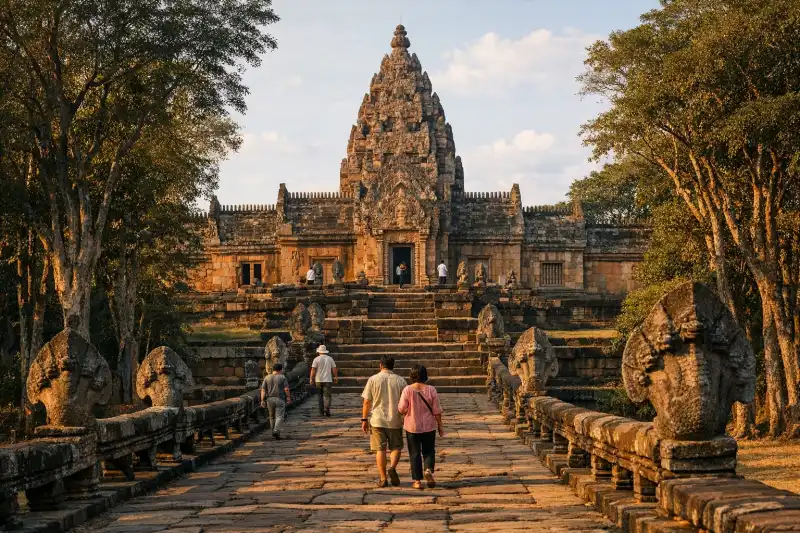
Phanom Rung
Khmer EmpireA dramatic Khmer hilltop temple in Thailand, Phanom Rung is famed for its sandstone carvings and sun...
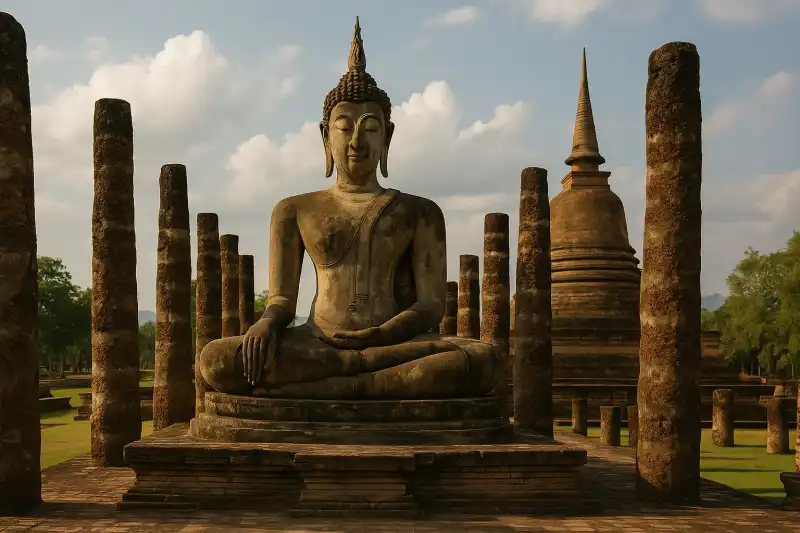
Sukhothai Historical Park Travel Guide 2026: Thailand’s First Capital Without the Crowds
Sukhothai KingdomPlan a smarter Sukhothai Historical Park visit with route tips, key ruins, and practical timing for ...
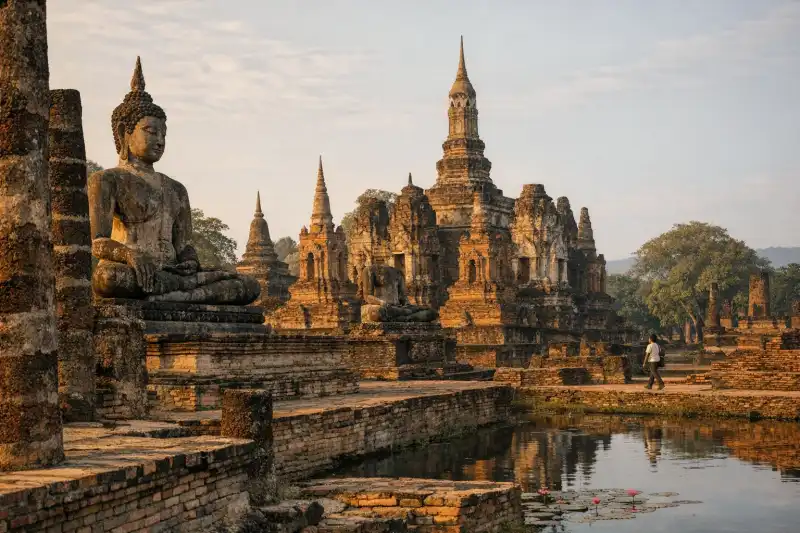
Wat Mahathat (Sukhothai)
Wat Mahathat in Sukhothai, Thailand, is a stunning World Heritage temple complex and the spiritual h...