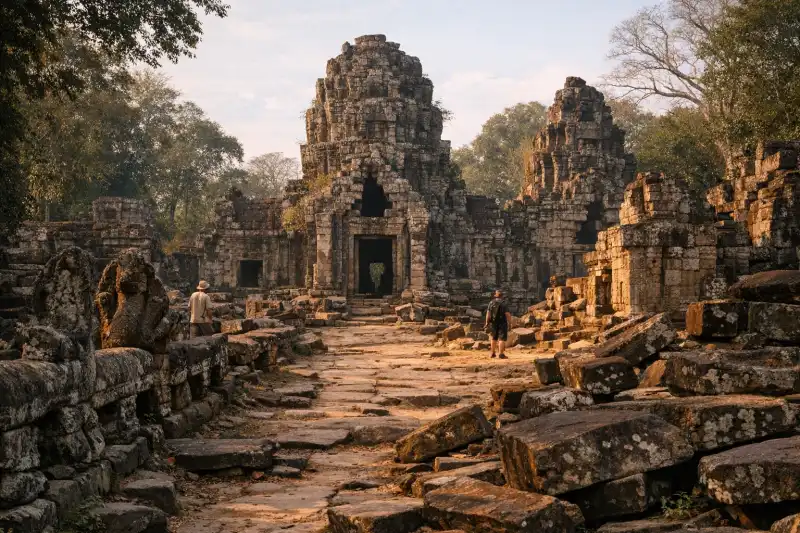
Quick Info
At a glance
Prasat Preah Khan (Kampong Svay) in Cambodia is one of mainland Southeast Asia’s most compelling yet least visited temple landscapes, a place where monumental Khmer design meets silence, distance, and forest. Far from the concentrated circuits of Angkor, this enormous complex sits in a rural setting that still feels genuinely remote, and that remoteness is part of its power. Travelers who make the journey do not usually come for polished visitor infrastructure or tightly staged sightseeing. They come for scale, mystery, and the sensation of encountering a major imperial site that remains outside the mainstream.
The first impression is often one of unexpected vastness. Causeways, gateways, moats, and enclosures stretch across a landscape that suggests the ambitions of kings who thought on a grand geographic scale. The site is frequently overshadowed by the temples near Siem Reap, yet scholars and adventurous visitors have long recognized that Preah Khan of Kampong Svay was no provincial footnote. It was a substantial religious and political center within the Khmer world, linked to roads, reservoirs, and power networks that once tied together the empire’s distant regions. Today, lichen-covered stone, broken towers, and water-filled moats create an atmosphere at once majestic and introspective. To visit is to see Khmer architecture outside the bustle of famous landmarks and to appreciate how deeply monumental building transformed the Cambodian landscape.
History
Early foundations and regional importance
The origins of Prasat Preah Khan (Kampong Svay) remain complex, and like many large Khmer sites, its development likely unfolded over multiple reigns rather than in a single burst of construction. Archaeological evidence suggests that the area gained importance before the complex reached its final monumental form. Its location in the eastern hinterland of Angkor placed it in a strategic zone: far enough from the imperial center to function as a regional hub, yet closely connected to the broader Khmer road and administrative network.
Some scholars propose that early phases may date to the 11th century, possibly with foundations linked to expanding royal control over the region. During this period, Khmer rulers strengthened routes, ritual sites, and hydraulic systems across the empire. A large temple complex here would have served not only spiritual functions but also administrative and symbolic ones, projecting royal authority into the countryside. Even in fragmentary form, the surviving layout indicates careful planning and substantial resources.
Expansion in the great age of Khmer temple building
The site appears to have flourished most strongly in the 12th century, during the high point of monumental Khmer architecture. This was the era in which large temple cities, elaborate reliefs, and vast enclosures became hallmarks of imperial ambition. Prasat Preah Khan (Kampong Svay) shares some of this architectural language while maintaining a distinct identity. Its spatial scale, extensive moats, and formal processional routes all point to a site of considerable status.
One long-standing scholarly discussion connects parts of the complex to the reign of Suryavarman I or later rulers, while some features have also been associated with the broad building momentum that culminated under Jayavarman VII. As with several Khmer monuments, construction and modification likely continued across dynastic transitions. Temples were not static creations; they were often expanded, rededicated, or adapted as royal priorities changed and new religious currents emerged.
The site’s architecture reflects the layered religious world of the Khmer Empire, where Hindu and Buddhist traditions could overlap, replace one another, or coexist over time. Evidence from Preah Khan (Kampong Svay) suggests that the complex participated in this wider pattern of evolving sacred use. Its monumental central sanctuary and ceremonial approach indicate that it functioned as a major ritual center, not an isolated local shrine.
Political role and imperial connectivity
Beyond its religious importance, Prasat Preah Khan (Kampong Svay) seems to have played a meaningful role in imperial geography. Khmer power depended on more than temples alone: roads, rest houses, reservoirs, and regional centers helped maintain cohesion across a wide territory. The site’s size and layout imply that it was embedded in that system. It may have served as a nodal point linking Angkor with eastern and northern territories, while also anchoring elite control over nearby populations and resources.
The complex is often noted for its enormous outer enclosure, one of the largest in the Khmer world. Such scale hints at more than ceremonial grandeur. It suggests labor mobilization, political organization, and sustained investment. In this sense, Prasat Preah Khan (Kampong Svay) offers a valuable counterpoint to the common image of Khmer civilization as centered only on Angkor. It reminds visitors that imperial culture spread through a constellation of major sites, some of them now little known outside specialist circles.
Decline, abandonment, and rediscovery
Like many Khmer centers, the temple eventually declined as political patterns shifted and the old imperial framework weakened. Changes in trade, religion, regional conflict, and royal residence all contributed to the reduced prominence of inland temple complexes. Over time, forest growth, weathering, and neglect transformed the site. Stone blocks shifted, wooden structural elements disappeared, and decorative carving suffered from exposure and vegetation.
In the colonial and post-colonial eras, explorers, archaeologists, and conservation teams documented the site and brought wider attention to its significance. Yet its remoteness meant that it never became a conventional tourist destination on the scale of Angkor. That relative isolation has preserved much of its atmosphere. Even now, Prasat Preah Khan (Kampong Svay) feels less like a curated monument and more like an archaeological landscape still in conversation with jungle, water, and time.
Key Features
What first distinguishes Prasat Preah Khan (Kampong Svay) is sheer extent. This is not a single tower or compact temple cluster but a broad ceremonial landscape enclosed by water and walls. The outer moat and enclosure define an immense sacred precinct, giving visitors a sense of entering not simply a shrine but a planned temple city. The scale is one of the site’s greatest surprises, especially for those who arrive expecting a modest ruin in the forest. Instead, the layout unfolds in stages, revealing avenues, embankments, and successive zones of religious architecture.
The approach to the complex is especially memorable. Khmer temple design often emphasized processional movement, and here that sense of directed passage remains powerful. Crossing causeways and moving through gateways, visitors experience the architecture as a sequence of thresholds. The gopuras, or entrance pavilions, frame the transition from surrounding countryside into sacred space. Even where damage is extensive, the geometry of the design still works: one feels drawn inward toward the ceremonial heart of the complex.
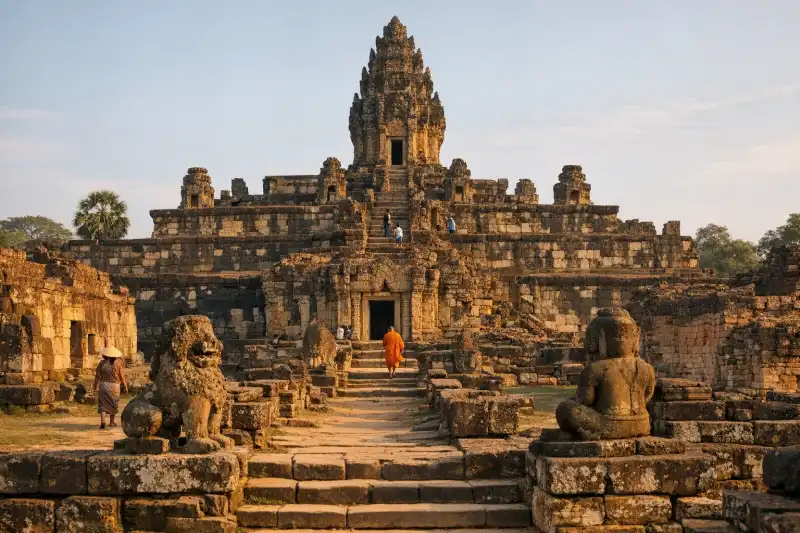
The central sanctuary area preserves some of the site’s most evocative architecture. Towers and galleries, though partly ruined, display the characteristic Khmer concern with axial planning, enclosure, and symbolic elevation. Sandstone details survive in places, and laterite construction appears throughout the broader complex. The contrast between refined carved stone and more rugged structural mass gives the monument a layered texture. Broken lintels, weathered door frames, and partially collapsed walls are not merely remnants; they show how Khmer builders combined decorative sophistication with large-scale engineering.
Water is another defining feature. Moats and reservoirs were central to Khmer sacred and political landscapes, serving ritual, symbolic, and practical purposes. At Prasat Preah Khan (Kampong Svay), the presence of water broadens the visual field and reinforces the monument’s formal order. In the dry season, these features help reveal the site’s geometric planning. In the wet season, reflections and lush vegetation create a different atmosphere, one more immersive and almost dreamlike. The relationship between stone and water is one reason the complex feels so grand despite its ruinous condition.
Unlike some better-known Cambodian temples that are crowded with tour groups from sunrise onward, this site often offers long stretches of near solitude. That transforms the experience of its architecture. Without the pressure of crowds, visitors can notice the rhythm of laterite blocks, the subtle alignment of gateways, and the way forest edges soften monumental lines. Birdsong, wind, and the occasional creak of trees become part of the visit. The monument is impressive in formal terms, but its emotional impact comes equally from quietness.
Prasat Preah Khan (Kampong Svay) also rewards visitors who think beyond individual structures. The true feature of the site is its landscape planning: the integration of enclosure, road, water, and sanctuary into a single vision of ordered sacred territory. This was architecture as political expression, where movement through space mirrored hierarchy and cosmology. Even in damaged form, the arrangement remains legible enough to communicate ambition on an imperial scale.
There are details that suggest shifts in religious use over time, a pattern familiar across Khmer monuments. Elements associated with both Hindu and Buddhist traditions can be considered within the broader context of Khmer state religion and later adaptation. The result is not a single frozen moment in belief but a site shaped by centuries of ritual reinterpretation. For visitors, that historical layering adds depth. The complex is not only large; it is intellectually rich, reflecting the changing priorities of kings, priests, and local communities.
Finally, the site’s relative lack of restoration compared with Angkor gives it a distinct aesthetic. Some travelers prefer heavily conserved monuments where every passage is obvious. Others will find greater meaning here, where ruin remains visible and the archaeology feels less mediated. Prasat Preah Khan (Kampong Svay) stands at that compelling edge between monument and wilderness, where architectural order survives but never fully overpowers the landscape around it.
Getting There
Reaching Prasat Preah Khan (Kampong Svay) takes planning, and that is one reason visitor numbers remain low. The most common base is Siem Reap, though Kampong Thom can also serve as a starting point depending on your route. From Siem Reap, private car hire for a full-day or very long day trip generally ranges from about $90 to $160 depending on vehicle type, fuel costs, and road conditions. If you are traveling in the wet season or want to explore with more flexibility, a 4x4 may cost more but is often worth it.
From Kampong Thom, transport can be somewhat cheaper because the site is closer, though road quality varies and local arrangements are less standardized. Expect private transport in the rough range of $60 to $120 depending on season and negotiation. Motorbike trips are possible for experienced riders, but this is not an ideal destination for casual self-drive visitors, especially after rain. Mud, ruts, and limited signage can make the final approach difficult.
There is no simple, frequent public bus directly to the temple complex itself. A budget traveler could combine intercity buses to Kampong Thom or nearby towns with a hired moto or local car, but this usually saves less money than expected once all connections are added. Intercity buses from Phnom Penh or Siem Reap to Kampong Thom often cost around $8 to $15, but the onward transport to the site is the real logistical challenge.
Hiring a local guide is strongly recommended. Guides can help with route finding, access conditions, and interpretation once you arrive. Bring cash, drinking water, snacks, and a charged phone with offline maps. Facilities near the site are limited, and mobile coverage may be inconsistent.
When to Visit
The best time to visit Prasat Preah Khan (Kampong Svay) is usually during Cambodia’s dry season, roughly from November to February, when roads are more reliable and temperatures are comparatively manageable. These months offer the easiest access and the most comfortable conditions for walking through a large exposed complex. Mornings are especially pleasant, with softer light and less heat, and they help visitors appreciate the geometry of moats, gateways, and causeways before midday glare flattens the stone.
March to May can still be rewarding, but the heat intensifies. Temperatures often become exhausting by late morning, and because the site is expansive, there is more walking and less shelter than some visitors expect. If traveling during this period, start early, carry plenty of water, and plan a slower pace. The benefit is that roads are generally dry and passable, though dust may be heavier.
The wet season, from roughly June to October, transforms the landscape. Forest growth is lush, moats may be fuller, and the monument can look extraordinarily atmospheric. For photographers and travelers drawn to dramatic greenery, this can be a beautiful time to go. The trade-off is access. Roads can become muddy, slippery, and sometimes difficult without a capable vehicle. Travel times may increase, and there is a greater chance of needing local advice on conditions.
If your priorities are ease and comfort, choose the cool dry season. If your priorities are mood, reflections, and greener scenery, the wet season can be unforgettable—provided you accept the logistical uncertainty.
| Quick Facts | Details |
|---|---|
| Location | Preah Vihear Province, Cambodia |
| Alternative name | Preah Khan of Kampong Svay |
| Civilization | Khmer Empire |
| Main period | 11th-13th centuries CE |
| Best known for | Massive enclosure, remote setting, monumental Khmer planning |
| Best base | Siem Reap or Kampong Thom |
| Recommended visit length | Half day minimum, full day ideal |
| Access difficulty | Moderate to challenging, especially in wet season |
| Best season | November to February |
| Visitor atmosphere | Quiet, uncrowded, and remote |
Prasat Preah Khan (Kampong Svay) is the kind of destination that changes how travelers think about Cambodia’s ancient past. It shows that the Khmer world was not limited to the famous silhouettes of Angkor, but extended across a broader ceremonial and political landscape filled with major centers now hidden in plain sight. The journey requires more effort than a standard temple excursion, yet that effort is precisely what gives the visit meaning. Here, monumental architecture is experienced without the filter of heavy tourism. You notice distances, embankments, water, and silence. You begin to understand the temple not only as a building, but as a territory shaped by power, devotion, and design.
For visitors willing to leave the standard route, this site offers one of Cambodia’s richest archaeological experiences. It is grand without being polished, significant without being crowded, and remote without being inaccessible. In a country celebrated for its ancient monuments, Prasat Preah Khan (Kampong Svay) remains one of the most rewarding places to encounter Khmer ambition on its largest and most contemplative scale.
Guided tours: worth it?
A guide can be genuinely useful at Prasat Preah Khan (Kampong Svay), especially if you want help with transport, timing, tickets, or understanding a large site without losing half the day to logistics.
Best for
- First-time visitors who want context, not just photos
- Travelers who want transport, timing, or entry logistics handled
- Trips where tickets, circuits, or timed entry can shape the day
- Short visits where a planned route saves time
When to go self-guided
Go independently if you already have transport and tickets sorted, enjoy moving at your own pace, and are comfortable checking the latest official rules before you arrive.
What I’d avoid
Skip paid tours that bundle unrelated stops you do not actually want. The best option should either save meaningful planning time or add historical context you would miss on your own.
Preah Khan Kampong Svay Tours
Useful when: you want to compare guided formats before deciding
Siem Reap to Remote Khmer Temples
Useful when: you want to compare guided formats before deciding
Preah Vihear Province Temple Tours
Useful when: you want to compare guided formats before deciding
Some tour links are affiliate links, which may earn Ancient Travel a small commission at no extra cost to you. I try to surface options that make practical sense for the site—not just anything bookable.
Frequently Asked Questions
Where is Prasat Preah Khan (Kampong Svay)?
Prasat Preah Khan (Kampong Svay) lies in Preah Vihear Province in northern Cambodia, east of Siem Reap and far from the main Angkor temple zone.
Is Prasat Preah Khan (Kampong Svay) the same as Preah Khan in Angkor?
No. This is a different and much more remote temple complex, often called Preah Khan of Kampong Svay to distinguish it from the better-known Preah Khan at Angkor.
How much time should I allow for a visit?
Most travelers should allow at least half a day on site, with a full day being better if you want time for the outer enclosure, central sanctuary, and surrounding features.
Do I need a guide or 4x4 vehicle?
A local guide is strongly recommended, and in the wet season a 4x4 or capable driver can be essential because access roads may become muddy and difficult.
What should I bring when visiting?
Bring water, sun protection, insect repellent, sturdy shoes, cash for transport and local arrangements, and offline maps because facilities are limited.
Is the site crowded?
Usually no. Compared with Angkor, Prasat Preah Khan (Kampong Svay) receives far fewer visitors, so the atmosphere is often quiet and isolated.
Nearby Ancient Sites
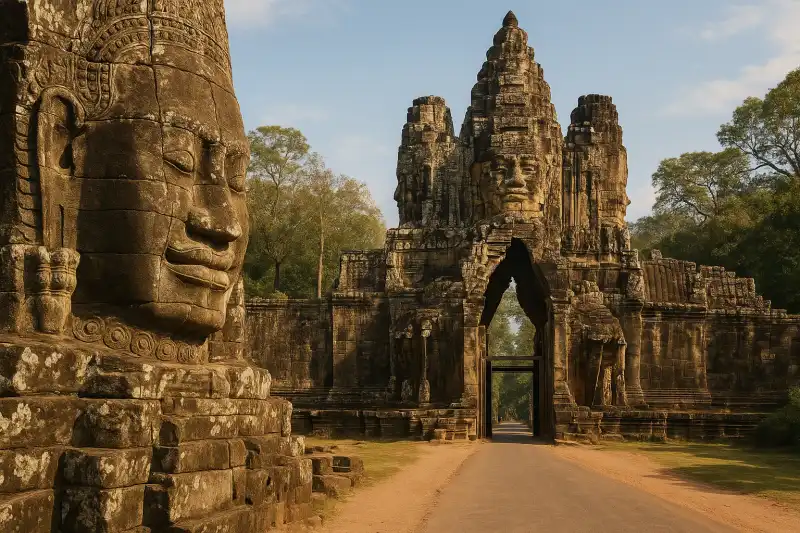
Angkor Thom Travel Guide 2026: Bayon Faces, Gates, and the Khmer Royal City
KhmerAngkor Thom was the last great capital of the Khmer Empire. This guide covers how to visit Bayon, th...
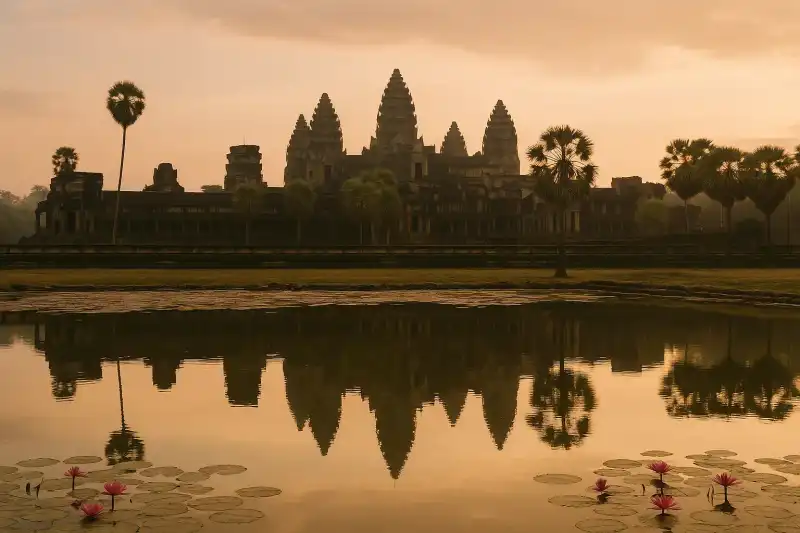
Angkor Wat Travel Guide 2026: Everything You Need to Know
KhmerAngkor Wat, the world's largest religious monument, spans over 400 acres in the heart of Cambodia. T...
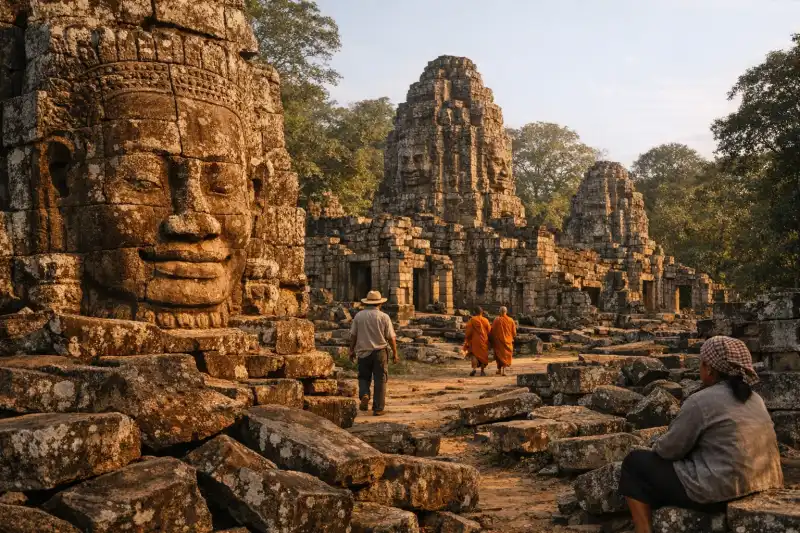
Banteay Chhmar
Khmer EmpireRemote Khmer temple complex in northwestern Cambodia known for monumental walls, serene towers, and ...
Bakong
Bakong is Cambodia's first major sandstone temple mountain, a stunning Khmer monument at the heart o...