Quick Info
At a glance
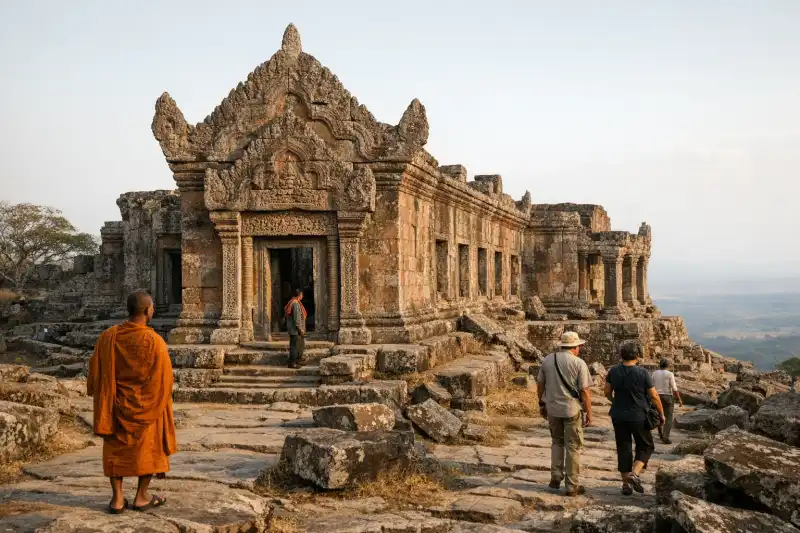
Prasat Preah Vihear Chendaeng in Cambodia feels less like a monument staged for crowds and more like a discovery made in the quiet margins of the Khmer world. In northern Cambodia, where forest, red-earth roads, and scattered villages shape the rhythm of travel, sites like this preserve a different side of the country’s temple heritage: intimate rather than monumental, atmospheric rather than polished, and deeply tied to the landscape around them. For travelers willing to go beyond the most famous circuits, Prasat Preah Vihear Chendaeng offers the kind of encounter that lingers long after the trip ends.
The site belongs to the wider sacred geography of Preah Vihear Province, an area where the influence of the Angkorian state once extended through roads, shrines, reservoirs, and administrative outposts. Today, many temples in this region survive in fragmentary form, with weathered sandstone, laterite blocks, and partial sanctuaries standing among trees and open ground. That condition is part of the appeal. You do not come here expecting the immense galleries of Angkor Wat or the sculptural richness of Banteay Srei. Instead, you come for a quieter experience of Khmer architecture and for the sense of being close to the bones of history.
A visit to Prasat Preah Vihear Chendaeng is as much about journey as destination. Rural roads, local settlements, changing weather, and the isolation of the northern plains all shape the experience. The reward is a temple space that invites careful looking: the way stone fits into stone, the traces of ritual planning, the endurance of sacred architecture, and the feeling that Cambodia’s ancient past was never confined to its most famous icons.
History
Early Khmer expansion and sacred landscapes
Prasat Preah Vihear Chendaeng likely emerged during the Angkorian period, when the Khmer Empire consolidated power across much of mainland Southeast Asia and developed a vast network of religious architecture. While the exact date of the site is not always clearly established in publicly available records, temples in this region generally belong to the centuries between the 10th and 12th centuries, when Khmer builders were extending both royal authority and sacred geography into provincial zones.
Temples like this were rarely isolated in purpose. They often functioned as markers of political control, devotional centers, and components of a broader infrastructure that linked provincial communities to the royal heartland. The Khmer state invested heavily in temple construction because shrines embodied cosmological order. A sanctuary, however modest, was not simply a building. It represented the meeting point of power, religion, and territory. In the countryside, these sites anchored local worship while also affirming that the landscape belonged within an imperial world shaped by kings, priests, and carefully structured ritual.
In northern Cambodia, topography mattered. Elevated ground, forest clearings, and routes connecting settlements could all influence the siting of a temple. Even when the structure itself was relatively small, its placement carried meaning. It may have served a village community, a local elite, or a regional cult associated with Hindu deities and, later in some cases, Buddhist practice.
The Angkorian period and temple building
During the height of the Khmer Empire, temple construction followed established architectural principles while still allowing for local variation. Prasat Preah Vihear Chendaeng would have been part of that tradition. Builders commonly used laterite for structural cores and enclosures, with sandstone reserved for doorframes, decorative carvings, lintels, and more refined architectural elements. This combination balanced durability, availability, and prestige.
Many Khmer temples were first dedicated to Hindu deities such as Shiva or Vishnu, and their sanctuaries housed sacred images or lingas. Orientation, enclosure walls, causeways, and gateways all reflected a symbolic vocabulary rooted in Indian religious ideas adapted to Khmer court culture. Although major state temples drew the greatest artistic investment, smaller provincial shrines often mirrored the same cosmological logic on a reduced scale. The result was a landscape of related monuments that varied in scale but shared core ideas.
What makes provincial sites historically valuable is that they reveal how Angkorian power functioned beyond the capital. Grand monuments show imperial ambition; smaller temples show imperial reach. Prasat Preah Vihear Chendaeng helps illustrate that the Khmer world was not a single ceremonial center surrounded by emptiness. It was a connected system of local and regional places, each participating in the political and religious order of its time.
Religious change and long continuity
Like many ancient Cambodian temples, Prasat Preah Vihear Chendaeng may have experienced changing religious use over the centuries. In the later Angkorian era and especially after the political center shifted southward, Theravada Buddhism spread more widely across Cambodia. Existing Hindu shrines were often reused, adapted, or reinterpreted rather than simply abandoned overnight. Sacred places tend to outlive the dynasties that built them.
This long continuity is one of the most important themes in Cambodian temple history. A sanctuary may begin as a royal or elite Hindu foundation, then become a local place of Buddhist devotion, then remain a landmark in community memory even after regular ritual use declines. Over time, stones collapse, vegetation advances, and inscriptions or carvings weather away, but the place itself often retains significance. Rural communities continue to name it, visit it, and incorporate it into local identity.
The survival of a site like Prasat Preah Vihear Chendaeng, even in partial form, reflects that continuity. It is not merely an archaeological object frozen in the 11th or 12th century. It is also part of a living cultural landscape where memory, local geography, and ancient architecture remain intertwined.
Rediscovery, preservation, and modern travel
In the modern era, many remote Khmer sites became more visible through archaeological surveys, regional mapping, and the growth of cultural tourism in Cambodia. Yet visibility has been uneven. Famous temples near Siem Reap entered international travel circuits early, while smaller or more remote sites remained relatively little visited. That relative obscurity has preserved some of their quiet atmosphere, but it also means conservation may be less extensive.
Prasat Preah Vihear Chendaeng today stands in that middle ground between historical monument and lightly interpreted ruin. Visitors may encounter minimal signage, partial structural remains, and a setting where context must be read from the stones themselves. This can be challenging for casual tourists, but for historically minded travelers it can be deeply rewarding. The site offers a more direct encounter with the material reality of Khmer architecture outside the showcase zones.
Its future depends on continued respect from visitors, local stewardship, and broader recognition of Cambodia’s lesser-known heritage. Every remote temple that survives broadens our understanding of the Khmer past, reminding us that history was built not only in capitals and ceremonial centers, but also in dispersed sacred places such as Prasat Preah Vihear Chendaeng.
Key Features
Prasat Preah Vihear Chendaeng is best appreciated not as a single dramatic spectacle but as a composition of subtle architectural and landscape qualities. The first thing many visitors notice is the stillness. Unlike the better-known temples around Siem Reap, where movement and conversation are constant, this site often feels suspended in a quieter register. That calm allows small details to emerge: the texture of old stone, the geometry of foundations, and the way the ruin sits naturally in its environment.
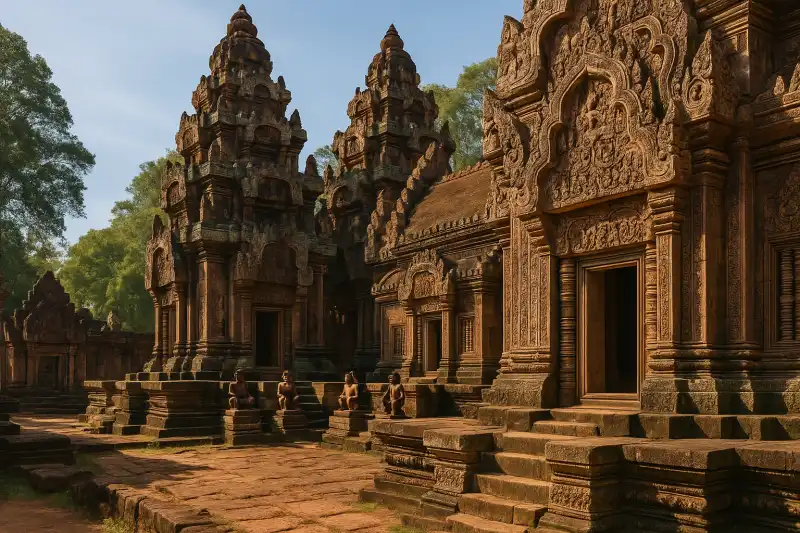
The temple’s surviving masonry is one of its defining features. Khmer builders used construction methods that balanced monumentality with precision, and even where walls or towers have partially collapsed, the logic of the original design often remains visible. Laterite blocks may form the bulk of surviving walls or platforms, while sandstone elements draw the eye through finer craftsmanship. Doorframes, threshold stones, or carved fragments can suggest how carefully sacred entry points were emphasized. In Cambodian sunlight, these materials change character over the course of a day, from muted earth tones in the morning to sharper contrasts under the midday sun.
Another key feature is the site’s scale. Prasat Preah Vihear Chendaeng does not overwhelm; it invites close reading. Travelers can often walk the grounds in a relatively short time, but the experience deepens if you slow down. The remains may include a central sanctuary area, traces of enclosure, and scattered architectural fragments whose original positions can be imagined from surviving alignments. This is where the temple becomes especially engaging for visitors interested in archaeology. The ruin asks you to reconstruct it mentally, to picture rooflines, ritual movement, and the ceremonial importance of what now appears fragmentary.
The rural setting is inseparable from the architecture. Trees, grasses, open land, and the sounds of village life shape the atmosphere as much as the stone itself. The temple feels embedded in northern Cambodia rather than separated from it. This quality distinguishes many provincial Khmer sites from heavily curated monuments. Here, the boundaries between archaeological site and lived landscape are softer. You may arrive via dirt roads, pass farms or small settlements, and step almost directly into the remains. That transition from ordinary countryside to ancient sacred space is one of the most memorable aspects of the visit.
There is also value in the temple’s relative obscurity. Because it is not among Cambodia’s most photographed landmarks, visitors often encounter it with fewer preconceptions. You are free to notice what matters to you: the proportions of a surviving doorway, the resilience of a cracked lintel, or the evidence of centuries of weathering. In some ways, sites like Prasat Preah Vihear Chendaeng offer a more intimate architectural experience precisely because they have not been overexplained. They reward patience and observation.
For photographers, the best features are often atmospheric rather than purely monumental. Early and late daylight can bring out relief in stone surfaces and create a sense of depth around ruined walls and scattered blocks. Wide shots can emphasize the site’s isolation, while close frames reveal tool marks, erosion, and the craftsmanship of surviving carved pieces. Even in incomplete condition, Khmer temples maintain a disciplined visual language, and this site still communicates that heritage.
Finally, Prasat Preah Vihear Chendaeng’s greatest feature may be what it represents within Cambodia’s broader heritage map. It stands for the many ancient places that lie beyond the classic itineraries, places that expand the story of the Khmer world. Visiting it reminds you that Cambodia’s past was never limited to a handful of celebrated monuments. It was distributed across a landscape of shrines, reservoirs, roads, and communities. This temple, quiet and weathered though it may be, remains part of that larger and richer story.
Getting There
Reaching Prasat Preah Vihear Chendaeng usually requires planning, flexibility, and private transport. The most practical gateway is Tbaeng Meanchey, the provincial capital of Preah Vihear Province, though some travelers approach from Siem Reap as part of a longer temple-focused journey. Public transportation in the immediate area is limited, so most visitors hire a car, SUV, or motorbike with a local driver who knows current road conditions.
From Siem Reap, a private car to sites in Preah Vihear Province commonly costs around $90 to $150 for a full-day or long-distance charter, depending on route, fuel prices, and whether multiple temple stops are included. Shared minivans or buses to provincial towns can be cheaper, often in the $8 to $15 range, but they rarely take you directly to remote temple locations. If you first travel to Tbaeng Meanchey by bus or shared taxi, expect onward local transport to cost roughly $25 to $60 for a return trip by hired car or moto, depending on distance and negotiation.
Road quality can vary significantly by season. In the dry months, red-dirt and secondary roads are generally easier to navigate. In the rainy season, muddy sections may increase travel time and sometimes require sturdier vehicles. For that reason, a high-clearance car or 4x4 can be a worthwhile extra expense if conditions are uncertain.
Bring cash, water, snacks, and offline maps. Fuel stations and food options may be sparse outside town centers. Mobile signal can be inconsistent in remote areas, and signage may be minimal. If you enjoy independent travel, a motorbike offers freedom, but only confident riders should attempt rural routes, especially after rain.
When to Visit
The best time to visit Prasat Preah Vihear Chendaeng is during Cambodia’s dry season, especially from November to February. These months usually bring lower humidity, clearer skies, and more comfortable daytime temperatures, making the journey easier and the temple grounds more pleasant to explore. Morning visits are particularly rewarding, as the light is softer and the heat has not yet built to its afternoon peak.
March to May is still possible, but conditions can become very hot. In exposed areas, midday temperatures may be draining, and the lack of shade at some rural temple sites can make a visit feel much harder than expected. If you travel during this period, start early, carry plenty of water, and plan breaks in nearby towns or villages.
The rainy season, generally from May to October, transforms the landscape into a greener and often more beautiful setting. Vegetation thickens, and the countryside can look especially vivid. However, this is also the season when access becomes less predictable. Dirt roads may turn muddy, puddles can hide rough surfaces, and travel times often increase. If you value atmosphere and do not mind logistical uncertainty, the wet season can still be rewarding, but it is best approached with local advice and flexible scheduling.
For photography, the shoulder months around November and early December can be ideal, combining relatively good road conditions with clear air and softer seasonal color. Whatever the month, aim for early morning or late afternoon. The temple’s weathered stone, rural isolation, and quiet setting are most evocative when the light is angled and the day feels unhurried.
| Quick Facts | Details |
|---|---|
| Site Name | Prasat Preah Vihear Chendaeng |
| Country | Cambodia |
| Province | Preah Vihear Province |
| Civilization | Khmer |
| Period | Angkorian period |
| Best Time to Visit | November to February |
| Nearest City | Tbaeng Meanchey |
| Ideal Visit Length | 1-2 hours on site |
| Access | Best by private car, SUV, or motorbike |
| Visitor Experience | Remote, quiet, lightly interpreted temple ruin |
Prasat Preah Vihear Chendaeng may not appear on every Cambodia itinerary, and that is exactly why it stands out. It offers a more reflective kind of travel, one grounded in regional history, imperfect ruins, and the experience of moving through a landscape where the ancient world still feels close to the surface. For visitors who appreciate Khmer architecture beyond the headline monuments, the site provides a valuable counterpoint to Angkor’s grandeur. It is smaller, quieter, and less restored, yet no less meaningful.
A journey here asks for effort, but it gives something distinctive in return: a chance to encounter Cambodia’s past in a setting where silence, distance, and weathered stone carry as much meaning as formal interpretation. In that sense, Prasat Preah Vihear Chendaeng is not just a destination. It is an invitation to see the Khmer world more fully, through the places that endure at its edges as well as at its center.
Guided tours: worth it?
A guide can be genuinely useful at Prasat Preah Vihear Chendaeng, especially if you want help with transport, timing, tickets, or understanding a large site without losing half the day to logistics.
Best for
- First-time visitors who want context, not just photos
- Travelers who want transport, timing, or entry logistics handled
- Short visits where a planned route saves time
When to go self-guided
Go independently if you already have transport and tickets sorted, enjoy moving at your own pace, and are comfortable checking the latest official rules before you arrive.
What I’d avoid
Skip paid tours that bundle unrelated stops you do not actually want. The best option should either save meaningful planning time or add historical context you would miss on your own.
Preah Vihear Temple Tours
Useful when: you want to compare guided formats before deciding
Cambodia Ancient Temples Tours
Useful when: you want to compare guided formats before deciding
Siem Reap to Preah Vihear Day Trips
Useful when: transport or pickup logistics matter
Some tour links are affiliate links, which may earn Ancient Travel a small commission at no extra cost to you. I try to surface options that make practical sense for the site—not just anything bookable.
Frequently Asked Questions
Where is Prasat Preah Vihear Chendaeng located?
Prasat Preah Vihear Chendaeng is in Preah Vihear Province in northern Cambodia, in a region known for remote Khmer-era temple remains.
Is Prasat Preah Vihear Chendaeng the same as the famous Preah Vihear Temple?
No. It is a different archaeological site with its own local identity, though it belongs to the broader Khmer sacred landscape of northern Cambodia.
How do you get to Prasat Preah Vihear Chendaeng?
Most visitors arrange a private car or motorbike from nearby towns, often linking the visit with other temples in Preah Vihear Province or from Siem Reap.
Do I need a guide to visit?
A guide is not always mandatory, but hiring a local guide or driver is highly recommended because signage, road conditions, and on-site interpretation can be limited.
What should I bring when visiting?
Bring water, sun protection, sturdy shoes, cash for transport, and a charged phone or offline map, as facilities around the site may be minimal.
What is the best time of year to visit?
The dry season from roughly November to February is usually the most comfortable, with cooler temperatures and easier road access.
Nearby Ancient Sites
Banteay Chhmar
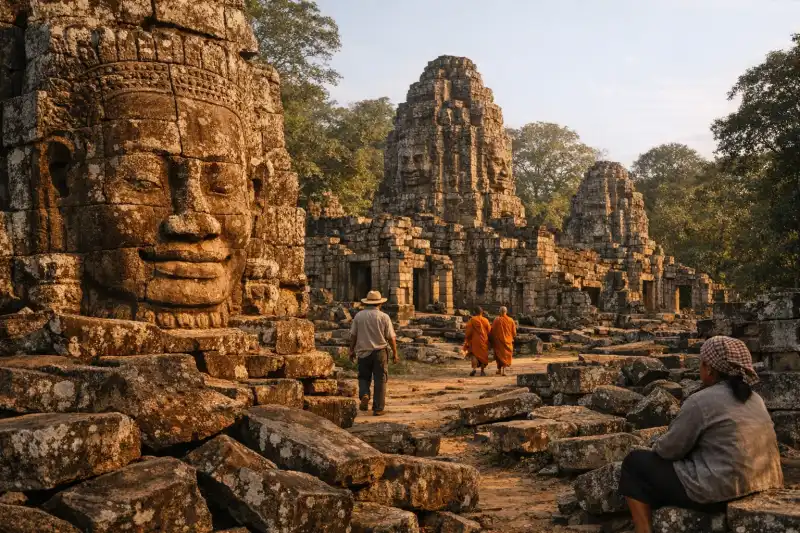
Khmer EmpireRemote Khmer temple complex in northwestern Cambodia known for monumental walls, serene towers, and ...
Angkor Thom Travel Guide 2026: Bayon Faces, Gates, and the Khmer Royal City
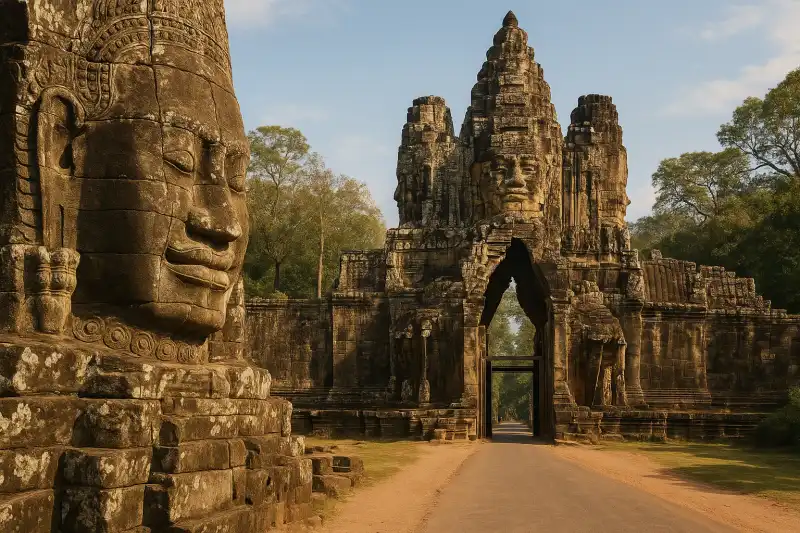
KhmerAngkor Thom was the last great capital of the Khmer Empire. This guide covers how to visit Bayon, th...
Angkor Wat Travel Guide 2026: Everything You Need to Know
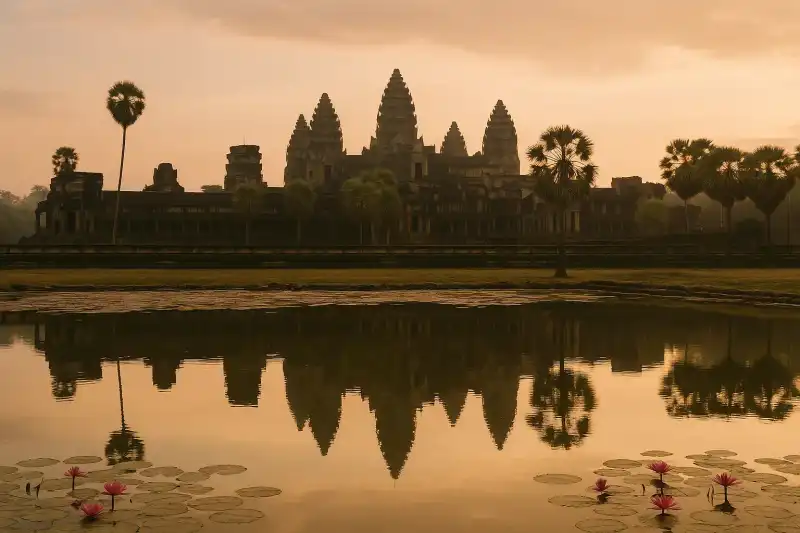
KhmerAngkor Wat, the world's largest religious monument, spans over 400 acres in the heart of Cambodia. T...
Banteay Srei Travel Guide 2026: Pink Sandstone Temple, Carvings, and Visit Tips
KhmerBanteay Srei is one of Cambodia’s most detailed Khmer temples, known for fine pink sandstone carving...