Quick Info
Curated Experiences
Angkor Thom and Prasat Suor Prat Guided Tour
Private Angkor Thom Tour with Bayon and Prasat Suor Prat
Full Day Angkor Highlights Tour Including Prasat Suor Prat
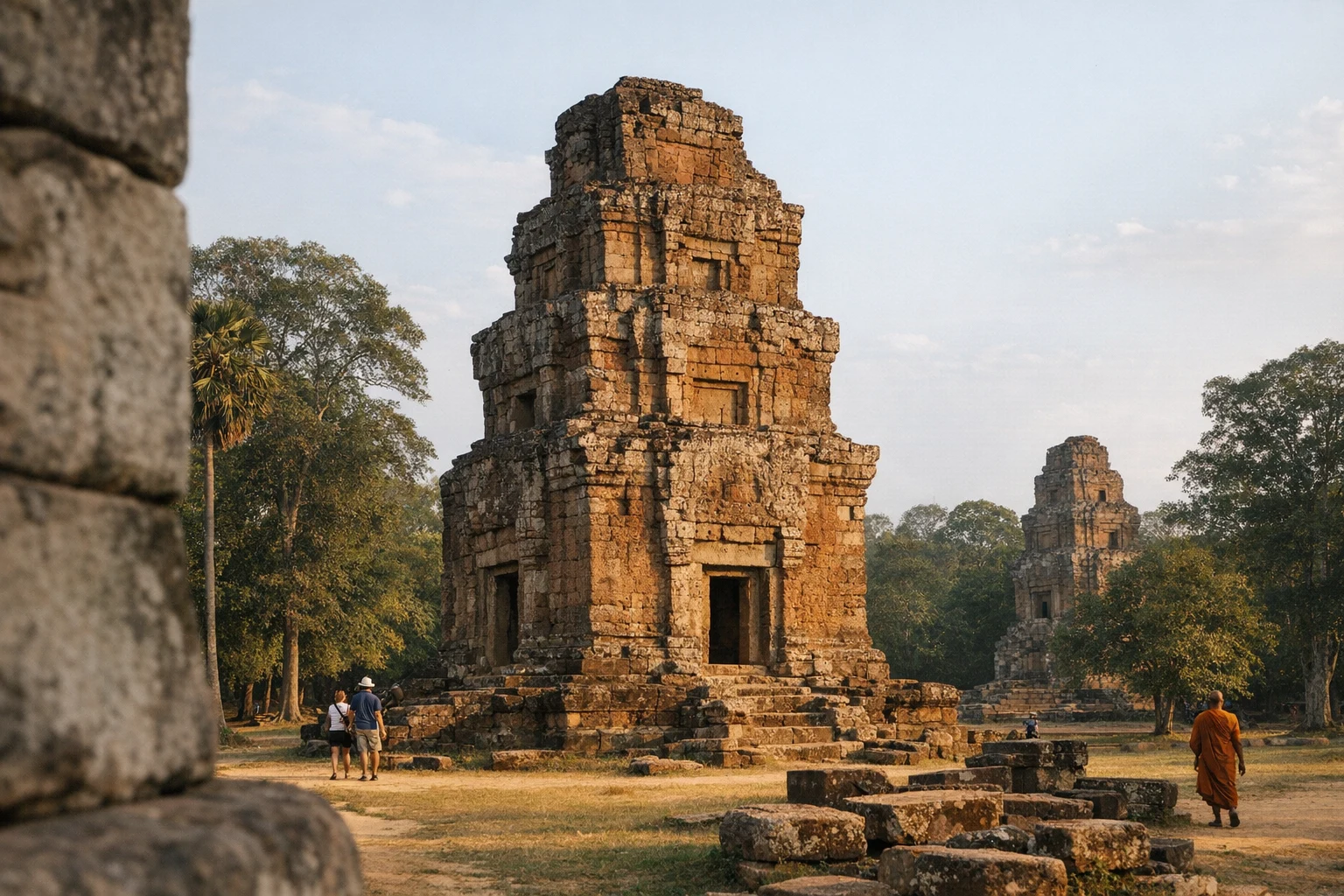
Prasat Suor Prat in Cambodia stands in one of the most historically charged spaces of Angkor Thom, yet it often surprises visitors by how quiet and enigmatic it feels. Facing the broad Royal Square north of Bayon, the site consists of a line of twelve towers set out with a kind of measured restraint that contrasts sharply with the sculptural density of Angkor’s more famous temples. At first glance, they can seem simple compared with the great faces of Bayon or the overwhelming scale of Angkor Wat. But that simplicity is deceptive. The towers mark space, define processional geometry, and help give the center of Angkor Thom its ceremonial shape. Seen in the slanting light of morning or late afternoon, they feel less like isolated buildings and more like architectural punctuation in a royal landscape.
What makes Prasat Suor Prat compelling is precisely its ambiguity. The towers look formal and deliberate, yet scholars still debate their exact purpose. They stand opposite the Terrace of the Elephants and near the royal precinct, suggesting a function tied to spectacle, governance, ritual, or controlled access. Their laterite cores and sandstone details speak clearly of Angkorian workmanship, but they do not announce their meaning as loudly as more image-rich shrines. For travelers, this uncertainty is part of the appeal. Prasat Suor Prat invites you to read Angkor Thom as an urban and ceremonial whole rather than just a collection of blockbuster monuments. Here the city’s planning becomes visible: terraces, causeways, palace zone, towers, and open square all working together. It is one of the best places in Angkor to feel how architecture could structure imperial space without needing to overwhelm every surface with ornament.
History
Angkor Thom and the Imperial Center
Prasat Suor Prat belongs to the central urban and ceremonial landscape of Angkor Thom, the great walled capital created in its best-known form during the reign of Jayavarman VII in the late 12th and early 13th centuries. This was a period of extraordinary building activity in the Khmer Empire. After warfare and political disruption, Jayavarman VII reshaped the imperial capital on a massive scale, constructing or refashioning roads, monasteries, temples, hospitals, and the monumental city of Angkor Thom itself. Within that capital, space was highly organized. Major state temples, royal enclosures, terraces, and ceremonial plazas all participated in a carefully ordered urban vision.
Prasat Suor Prat occupies one of the most revealing positions in this arrangement. The towers line the eastern side of the Royal Square, facing the Terrace of the Elephants and standing close to the Royal Palace area, Bayon, and other central monuments. Their placement suggests that they were integral to the staging of movement, audience, or spectacle in the heart of the city. Even before scholars resolve every question of function, the towers’ location makes clear that they mattered in how Angkor Thom’s public center was experienced.
Construction and Dating Debates
Most scholars place Prasat Suor Prat in the late 12th or early 13th century, often connecting it with the architectural program of Jayavarman VII or with a closely related phase. Some debate remains over whether elements of the towers may incorporate earlier traditions or whether construction extended across different reigns. This is not unusual at Angkor, where monuments often evolved, were modified, or reused over time. The towers themselves are relatively slender and modest in plan compared with the city’s grand temples, but their repetition and alignment indicate a formal project rather than ad hoc building.
Architecturally, the towers are constructed mainly from laterite with sandstone elements, a combination common in Angkorian building. They rise in a line, divided by pathways and set opposite the royal terraces, giving them a more urban and spatial role than that of a typical isolated shrine. Their dating matters not only for chronology but for interpretation. If they belong squarely to Jayavarman VII’s vision of Angkor Thom, they become part of a larger Buddhist-inflected royal city. If they represent a more complex development, they may reveal how the urban center adapted across generations. Either way, they speak to the flexibility of Angkor’s monumental core.
Legend, Function, and Historical Uncertainty
Prasat Suor Prat is one of those Angkor monuments whose historical uncertainty has generated especially vivid interpretation. The name often translated as “Towers of the Rope Dancers” comes from a later tradition suggesting they were used in connection with acrobatic performances or ceremonial displays involving ropes stretched between the towers. Whether this is historically accurate is doubtful, but the persistence of the name is telling. It reflects how striking rows of towers in a royal square naturally invite explanation through spectacle.
Other theories have proposed that the towers served administrative, judicial, or ceremonial functions. The Chinese envoy Zhou Daguan, who visited Angkor in the late 13th century, described a practice involving towers used in judgments or disputes, though the exact correlation with Prasat Suor Prat remains debated. Some have suggested the towers may have housed dignitaries or ritual participants, or that they acted as viewing or symbolic structures related to public events in the Royal Square. The lack of definitive evidence means no single explanation has closed the matter.
Rather than treating this uncertainty as a weakness, it is better to see it as part of the site’s importance. Prasat Suor Prat reveals that even in the best-known ancient capitals, not every architectural feature yields its meaning easily. The towers remain valuable precisely because they preserve a piece of Angkor Thom’s ceremonial logic without surrendering all of its mystery.
Decline, Rediscovery, and Modern Archaeology
As the political center of the Khmer world shifted and Angkor’s urban system declined, Prasat Suor Prat, like much of Angkor Thom, entered a long period of neglect. Vegetation, weathering, and partial structural failure affected the towers, though their line remained visible enough to preserve their role in the city’s monumental outline. Colonial-era French archaeologists and later Cambodian and international teams documented, cleared, stabilized, and studied the towers as part of the broader effort to understand Angkor Thom as an urban complex.
Modern conservation has helped preserve the towers’ forms and their relationship to the terraces and open square around them. Unlike more sculpturally dense sites, Prasat Suor Prat often depends for its impact on context rather than isolated decorative brilliance. Archaeology has therefore been essential not only in stabilizing the structures but in keeping their urban setting readable. Today, visitors encounter the towers within a protected Angkorian landscape that increasingly emphasizes city planning, hydrology, ritual movement, and imperial performance alongside temple art alone.
Key Features
The defining feature of Prasat Suor Prat is the line of twelve towers itself. Their repetition creates an effect quite different from the singular monumentality of nearby Bayon or the immense enclosure logic of Angkor Wat. Here, the power lies in rhythm. Each tower is relatively slender and self-contained, but together they establish a long architectural screen along the eastern edge of the Royal Square. This line helps frame the open space opposite the Terrace of the Elephants and gives the center of Angkor Thom a sense of processional order. They are not decorative afterthoughts. They are urban markers that shape how the royal heart of the city was perceived.
The towers’ material character is another important feature. Built primarily of laterite with sandstone details, they lack the lavish surface carving that draws crowds elsewhere in Angkor. Yet this relative austerity is part of their interest. Their forms are clear, their silhouettes readable, and their textures reveal how Angkorian architects could achieve authority through composition and placement as much as through ornament. Weathering has softened some details, but the essential geometry remains strong. In certain light, especially when shadows deepen the recesses and openings, the towers feel almost abstract in their calm regularity.
Prasat Suor Prat’s greatest strength may be its relationship to the surrounding monuments. Standing here, it becomes easier to understand Angkor Thom as a deliberately staged ceremonial center. To the west lies the Terrace of the Elephants, a grand platform likely used for royal audiences, processions, and public display. Nearby are the Terrace of the Leper King, the Royal Palace enclosure, Baphuon, and Bayon. The towers sit within this ensemble not as isolated shrines, but as pieces in a larger spatial drama. That is why the site often becomes more interesting the longer you stay. Instead of demanding attention through one overwhelming icon, it teaches you how to see the city.
The open square in front of the towers is itself a feature. Angkor is often experienced as temple after temple, dense with galleries and carvings, but Prasat Suor Prat gives relief through openness. The broad space between the towers and the terraces allows visitors to appreciate scale, alignment, and ceremonial distance. It also makes the site especially good for photography and for mentally reconstructing how crowds, ritual, or courtly events might once have unfolded here. In a city as architecturally rich as Angkor Thom, emptiness can be as meaningful as stone.
Another notable feature is the site’s air of unresolved purpose. Because Prasat Suor Prat is not fully explained by a single scholarly consensus, it remains one of the places where visitors can feel the interpretive edge of Angkor archaeology. This does not make it obscure in a bad way. On the contrary, it gives the towers a kind of intellectual magnetism. You are not only looking at a monument; you are looking at a question preserved in architecture. That is rare, and it makes the visit more memorable than a casual glance might suggest.
Getting There
Prasat Suor Prat is located inside Angkor Thom near the center of the Angkor Archaeological Park, just north of Bayon and opposite the Terrace of the Elephants. Most visitors reach it from Siem Reap, which is the main base for all Angkor sightseeing. From central Siem Reap, the journey to Angkor Thom usually takes around 20 to 35 minutes by tuk-tuk, taxi, car, or organized tour depending on traffic and your hotel location. A tuk-tuk hired for an Angkor small circuit or grand circuit often includes Prasat Suor Prat as part of the day’s flexible route, with half-day or full-day transport rates varying widely but commonly falling in the range of about USD 15 to 30 for tuk-tuks and more for air-conditioned cars.
Because the towers sit so close to other major Angkor Thom attractions, most travelers see them as part of a combined visit with Bayon, Baphuon, the Terrace of the Elephants, and the Royal Palace area. This makes logistics easy. Once you arrive in Angkor Thom, you can explore the area on foot in sections, though the heat means many visitors prefer to move between stops with their driver and then walk each cluster individually. Guided tours are especially useful here because the significance of Prasat Suor Prat is tied to its placement in the city rather than obvious standalone spectacle.
You will need an Angkor pass to enter the archaeological park. Bring water, sun protection, and comfortable shoes. The site is open and exposed, so even a short stop can feel hot if mistimed. Luckily, it fits naturally into any serious Angkor Thom route.
When to Visit
The best time to visit Prasat Suor Prat is during Cambodia’s cooler dry season, generally from November through February, when walking around Angkor Thom is far more comfortable. These months offer the most pleasant temperatures, clearer skies, and easier conditions for moving between open terraces and tower lines. The site is especially good in early morning or late afternoon, when the lower sun gives the towers more shape and shadow and the Royal Square feels less harshly exposed.
Early morning works well if you are exploring Angkor Thom before larger groups build up around Bayon. The towers can feel almost meditative then, and the soft light helps bring out their texture against the open square. Late afternoon is also excellent, especially if you want warmer tones and a better sense of depth across the terraces and adjoining monuments. Midday is the least rewarding time because the light flattens the towers and the open setting can become intensely hot.
The rainy season, roughly May through October, gives Angkor a greener and moodier atmosphere, and Prasat Suor Prat can look striking against darkening skies. But paths may be muddier, and sudden downpours can interrupt walking plans. If you travel then, flexibility helps. Whatever the season, the key is to approach the towers as part of Angkor Thom’s wider choreography rather than as a rushed box to tick between headline sites. They give back more when you slow down.
| Quick Facts | Details |
|---|---|
| Location | Angkor Thom, Siem Reap Province, Cambodia |
| Best Known For | Twelve aligned towers facing the Royal Square in Angkor Thom |
| Cultural Tradition | Khmer Empire, Angkor period |
| Likely Date | Late 12th to early 13th century CE |
| UNESCO Context | Part of the Angkor World Heritage Site |
| Nearby Highlights | Bayon, Terrace of the Elephants, Royal Palace area, Baphuon |
| Recommended Visit Length | 20 to 45 minutes |
| Best Base | Siem Reap |
| Best Time to Visit | Early morning or late afternoon in the dry season |
| Practical Tip | View the towers together with the Royal Square to appreciate their full ceremonial and urban context |
Frequently Asked Questions
What is Prasat Suor Prat best known for?
Prasat Suor Prat is best known for its striking row of twelve slender towers lining the eastern side of Angkor Thom’s royal square near Bayon.
What does the name Prasat Suor Prat mean?
The name is often translated as the 'Towers of the Rope Dancers,' though the exact historical origin of that association remains uncertain.
Who built Prasat Suor Prat?
The towers are generally dated to the late 12th or early 13th century, likely associated with the reign of Jayavarman VII or a closely related Angkor period phase.
How much time should you spend at Prasat Suor Prat?
Most visitors spend 20 to 45 minutes here, usually as part of a larger Angkor Thom visit that also includes Bayon, Baphuon, and the Royal Palace area.
Is Prasat Suor Prat worth visiting if you are already seeing Bayon?
Yes. While less elaborate than Bayon, Prasat Suor Prat helps explain the ceremonial layout of Angkor Thom and gives the royal square a much clearer sense of scale.
When is the best time to visit Prasat Suor Prat?
Early morning or late afternoon is best, when the light is softer, the towers are easier to photograph, and the open terrace area is less hot.
Nearby Ancient Sites
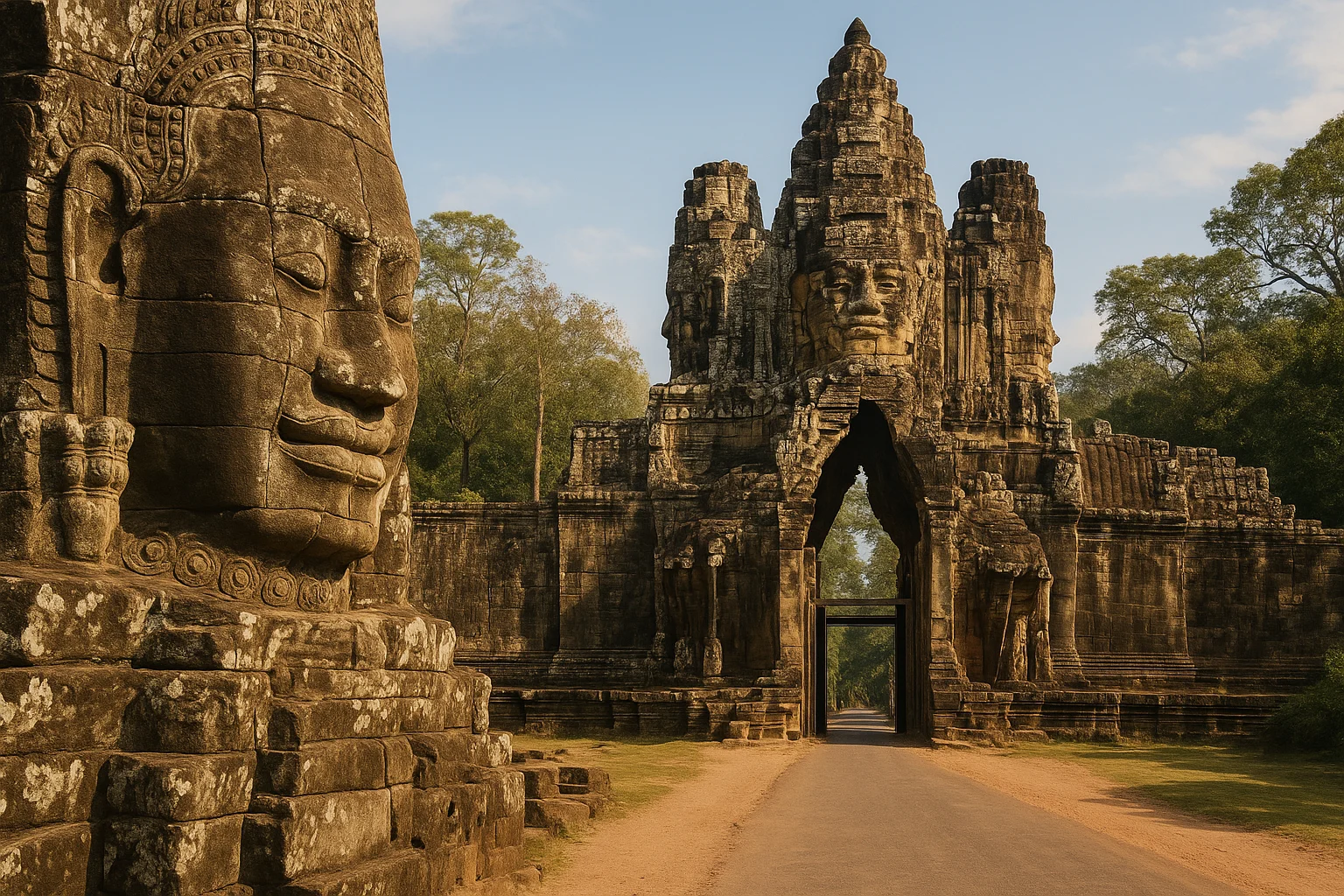
Angkor Thom Travel Guide 2026: Bayon Faces, Gates, and the Khmer Royal City
KhmerAngkor Thom was the last great capital of the Khmer Empire. This guide covers how to visit Bayon, th...
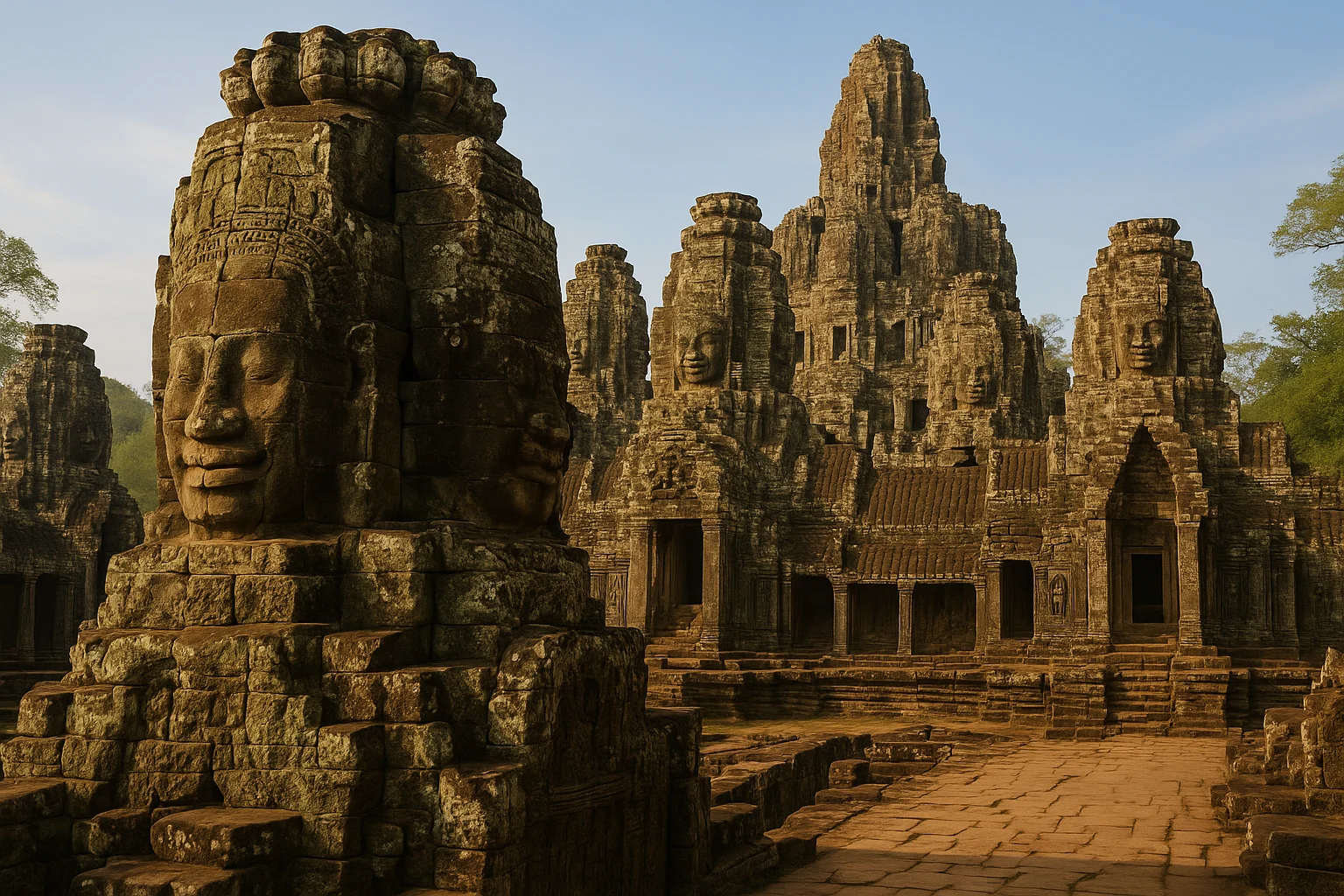
Bayon Temple Travel Guide 2026: Face Towers, Bas-Reliefs, and Best Visit Timing
KhmerBayon Temple sits at the center of Angkor Thom and is famous for its carved stone faces. This guide ...
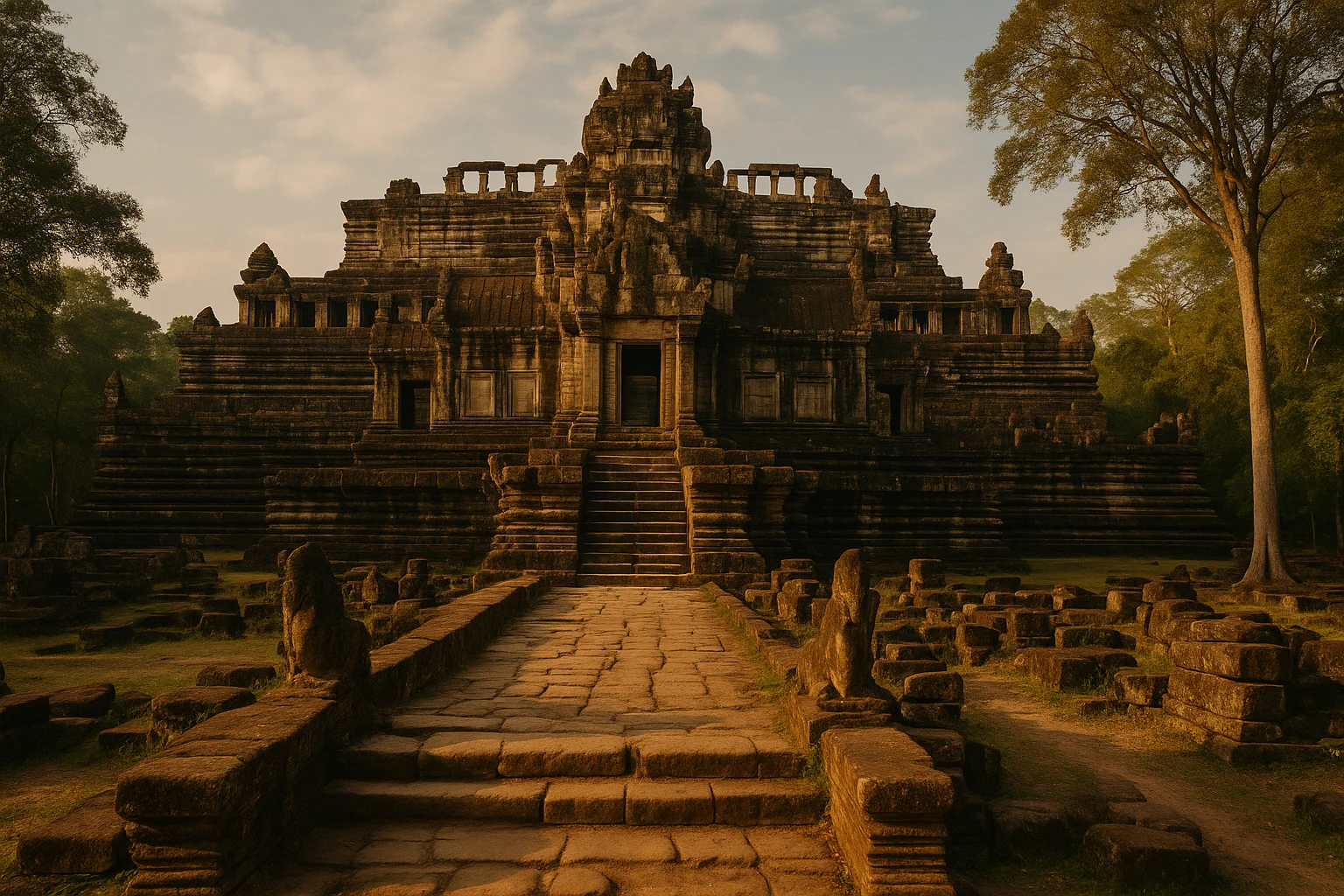
Baphuon
Khmer EmpireAn 11th-century sandstone temple mountain in Angkor Thom, Cambodia, renowned for its monumental recl...
Royal Palace (Angkor Thom)
Khmer EmpireThe sacred royal compound at the heart of Angkor Thom, where Khmer kings ruled from a gilded city of...
Angkor Wat Travel Guide 2026: Everything You Need to Know
KhmerAngkor Wat, the world's largest religious monument, spans over 400 acres in the heart of Cambodia. T...