Quick Info
Curated Experiences
Preah Khan Temple Guided Tour from Siem Reap
Angkor Grand Circuit Full-Day Tour Including Preah Khan
Private Angkor Temples Tour with Expert Guide
Deep within the forest-fringed outer reaches of Cambodia’s Angkor Archaeological Park, Preah Khan rises from the jungle as one of the most atmospheric and haunting temple complexes ever assembled by the Khmer Empire. Its name translates as “Sacred Sword” in Khmer — an echo of a legendary blade that kings once wielded as the symbol of rightful rule — and something of that charged, elemental quality permeates every moss-covered corridor and tree-fractured stone of this sprawling 12th-century sanctuary. Unlike the soaring towers of Angkor Wat or the serene stone faces of the Bayon, Preah Khan invites exploration at ground level: a labyrinth of dim galleries, carved lintels, and crumbling gopuras (gateway towers) where the jungle presses in from every angle and the air carries the cool, fungal scent of centuries. Silk-cotton trees and strangler figs force enormous roots between stones laid eight hundred years ago, their trunks cantilevering across doorways in a slow-motion drama of nature reclaiming the built world.
The complex was consecrated in 1191 CE by Jayavarman VII — the greatest builder-king Angkor ever produced — and dedicated to his father. In its prime it was not merely a temple but a living city: home to thousands of monks, scholars, ritual dancers, and servants whose livelihoods depended on the rice and oil supplied by nearly a hundred thousand villagers across the empire. Its sheer scale reflects the ambition of a monarch who reshaped much of mainland Southeast Asia within a single extraordinary reign. Today Preah Khan is included in the standard Angkor Pass and sits along the Grand Circuit route, making it an accessible and deeply rewarding counterpoint to the more heavily visited temples nearby. Visitors who give it the time it deserves rarely feel anything but grateful they did.
History
The Rise of Jayavarman VII
Preah Khan’s story begins with one of the most dramatic reversals of fortune in Khmer history. In 1177 CE, the Cham kingdom of central Vietnam launched a devastating naval invasion up the Tonle Sap lake and sacked Angkor, the Khmer capital that had stood unchallenged for centuries. The reigning king was killed, the temples were plundered, and the empire suffered a humiliation without precedent. Into this chaos stepped a prince who had spent years in the margins of royal politics, rallying local forces and biding his time. By 1181 CE he had driven the Cham invaders from Khmer territory and crowned himself Jayavarman VII. What followed was the most intense construction campaign in the history of Southeast Asia: more stone monuments were built under Jayavarman VII than under all previous Khmer rulers combined, a fact that astonishes scholars who examine the engineering and logistics involved.
Foundation and Dedication, 1191 CE
Preah Khan was among Jayavarman VII’s earliest and most significant foundations. The temple’s foundation stele — a carved stone inscription recovered by French scholars in the 19th century — records that the complex was consecrated in 1191 CE and dedicated to the king’s father, Dharanindravarman II, who is venerated within as Lokesvara, the bodhisattva of compassion. The stele is one of the most informative documents to survive from the entire Khmer world. It lists the temple’s dependencies with remarkable precision: 5,000 villages supplied it with rice, oil, and wax; 97,840 servants and temple staff attended its rituals; and the complex maintained hospitals and rest houses along the royal roads radiating outward from Angkor for the benefit of travelers and pilgrims. Preah Khan was, in every sense, a city in stone.
The religious character of the complex was deliberately syncretic. Jayavarman VII was a devout Mahayana Buddhist, but he ruled a kingdom with deep Shaivite and Vishnuite roots, and Preah Khan reflects both orientations simultaneously. The main sanctuary enshrined a golden image of Lokesvara identified with the king’s deified father; subsidiary shrines housed Hindu deities, royal ancestral portraits, and secondary Buddhist figures. This layering of traditions within a single complex was not contradiction but policy — an attempt to weave the new Buddhist dispensation into the existing fabric of Khmer religious life without rupturing it.
Transformation and Abandonment
After Jayavarman VII’s death, kings who returned to orthodox Hinduism modified much of what he had built. Seated Buddha images were chiseled from niches across Preah Khan and replaced with the lingam symbol of Shiva, and numerous inscriptions were altered or defaced. When the Khmer capital shifted south to Phnom Penh in the 15th century under pressure from Thai kingdoms, Preah Khan was gradually relinquished to the encroaching forest. French scholars of the École française d’Extrême-Orient began systematic study from the late 19th century, mapping the layout and translating key inscriptions. The World Monuments Fund assumed major conservation responsibility in the 1990s, stabilizing structurally dangerous sections and clearing dangerous debris while deliberately preserving the jungle’s dramatic presence within the ruins — a philosophy that has given Preah Khan a wildness matched among Angkor’s great temples only by Ta Prohm, though it receives a fraction of that temple’s tourist traffic.
Key Features
The Hall of Dancers
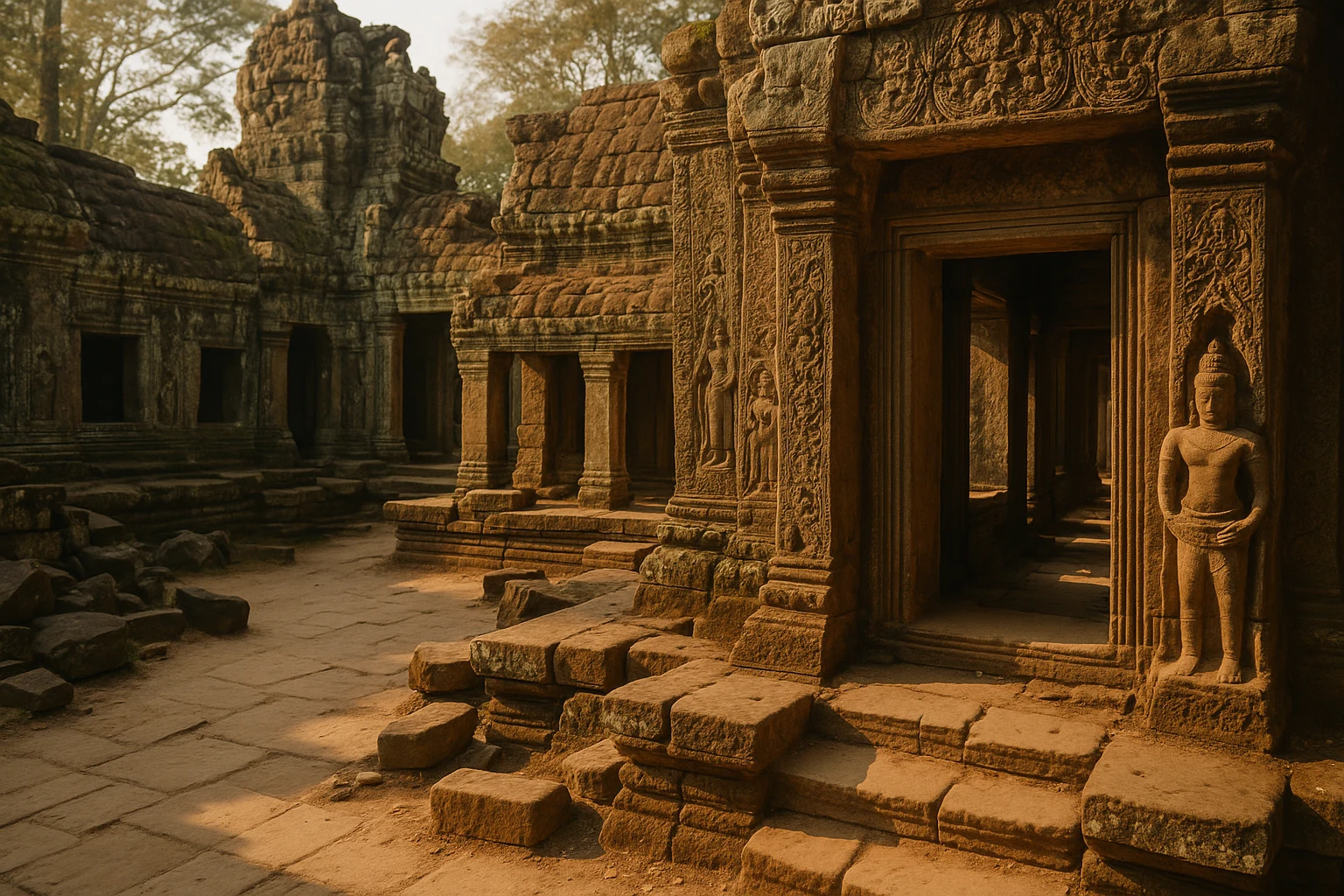
Approaching Preah Khan from its principal eastern causeway, visitors cross a moat edged by stone garudas — giant eagle-men clutching serpents — and pass through a succession of progressively more intimate enclosures. The first major architectural treasure is the Hall of Dancers, a long cruciform structure whose exterior walls carry registers of apsara carvings of extraordinary quality. These celestial dancers appear in clusters of two and three, their postures ranging from serene stillness to exuberant animation, their diadems, bracelets, and anklets carved with a fineness that seems almost implausible in sandstone. Scholars believe the hall functioned as a space for ritual dance performances tied to the temple’s ceremonial calendar, and despite centuries of weathering and partial collapse, it remains one of the finest concentrations of figurative carving within the entire Angkor complex. The diagonal afternoon light, entering through carved stone lattice windows, throws the relief work into dramatic relief and reveals details that midday flatness conceals.
The Two-Storey Pavilion
Among the strangest and most debated structures within all of Angkor is a small two-storey columned pavilion tucked in Preah Khan’s western section. Unlike anything else in Khmer architecture — which invariably favors corbelled vaults, towers, and horizontal courses — this pavilion has round freestanding columns stacked in two distinct tiers in a manner that has prompted scholars to speculate about ancient Indian or even Hellenistic influence transmitted through Indian Ocean trade routes. Whether it served as a ritual library, a symbolic lighthouse above a ceremonial pond that once lay beside it, or a repository for sacred texts and regalia remains genuinely uncertain. Visitors who find it half-hidden in undergrowth after navigating a series of narrow passages experience the particular and irreplaceable pleasure of genuine discovery — the sense that Angkor still holds surprises for those willing to wander from the main axis.
The Trees of Preah Khan
If a single visual defines Preah Khan for most visitors, it is the sight of enormous silk-cotton trees erupting through the temple’s gopuras and galleries, their pale, cable-like buttress roots spreading across stone walls like vast splayed hands. The largest specimens have trunks several meters in diameter and effectively function as living architecture, holding certain sections of masonry in equilibrium even as their slow growth exerts irresistible pressure on the joints. Strangler figs add a second layer of drama, sending aerial roots downward from the crowns of towers to form dense, organic lattices around stone columns and lintels. The conservation decision to leave these mature specimens in place — made by the EFEO in the early 20th century and reaffirmed by the World Monuments Fund — was partly pragmatic: removing root systems embedded deep into the foundations would cause greater structural damage than allowing them to remain. The result is a temple that achieves something no purely restored monument can replicate, a living argument between human order and vegetative patience that has been running for five centuries.
The Central Sanctuary and Subsidiary Shrines
The innermost sanctuary of Preah Khan — the theological and spatial heart of its mandala-like plan — originally enshrined the golden image of Lokesvara, now long vanished. What remains is a compact tower at the crossing of the temple’s two primary axes, surrounded by a dense cluster of subsidiary shrines and antechambers connected by narrow stone corridors barely wide enough for two people to pass. The dim interior passageways, lit by shafts of light filtered through carved stone lattice windows, create an atmosphere of profound antiquity that no number of visiting tour groups can fully dispel. The walls carry Buddhist and Hindu iconography in close proximity: nagas, garudas, multi-armed Vishnu figures, seated bodhisattvas, and dancing Shiva images appear within a few meters of one another, testifying to Preah Khan’s foundational role as a crossroads of competing yet coexisting religious traditions.
The Ceremonial Causeways and Outer Enclosure
Preah Khan’s outermost enclosure wall measures approximately 800 by 700 meters, enclosing a vast area that once contained gardens, ponds, residential quarters, and outbuildings for the temple’s thousands of permanent staff. Four monumental causeways lead to the cardinal gopuras, each flanked by two rows of stone figures performing the Churning of the Ocean of Milk — gods on the south side and demons on the north, hauling on the body of a great naga serpent coiled around the cosmic mountain Mandara. Many of these figures are headless or have toppled from their plinths, but enough survive to convey the grandeur and theological seriousness of the original processional experience. Walking these causeways in the early morning, when mist lingers above the surrounding moat and the light is still oblique and golden, is one of the quietly extraordinary experiences available in a park that is, after all, full of extraordinary experiences.
Getting There
Preah Khan sits approximately 9 kilometers northeast of central Siem Reap and roughly 3 kilometers north of Angkor Thom’s North Gate, along the road that forms the Grand Circuit through the outer Angkor complex. Any valid Angkor Pass covers entry; tickets must be purchased in advance at the official ticket centre on Charles de Gaulle Road in Siem Reap, not at the temple itself.
Tuk-tuks are the most popular and practical transport option. Drivers cluster outside hotels throughout Siem Reap and can be hired for a full Grand Circuit day — covering Preah Khan, Neak Pean, Ta Som, the East Mebon, and Pre Rup — for approximately $15–25 USD depending on the season. Many long-serving tuk-tuk drivers carry detailed knowledge of each site and can function as informal guides.
Renting a bicycle is a rewarding alternative for those with energy and time. The road from Angkor Thom’s North Gate to Preah Khan is flat, largely shaded by secondary forest, and makes for a pleasant 30–40 minute ride in the cooler morning hours. Electric bicycles, available for rent at several Siem Reap guesthouses, suit those who prefer assisted pedaling. Private car hire with a driver-guide costs roughly $40–55 USD per day and provides air-conditioned comfort between sites.
Siem Reap International Airport connects to Bangkok, Kuala Lumpur, Singapore, Ho Chi Minh City, and several Chinese hubs. Phnom Penh is reachable from Siem Reap by road in approximately six hours via National Route 6, with several comfortable bus services operating daily.
When to Visit
Cambodia’s climate divides into a dry season (November through April) and a wet season (May through October), and each has genuine advantages for visitors to Preah Khan.
The dry season brings reliably clear skies, lower humidity, and daytime temperatures in the low-to-mid 30s Celsius. December and January offer the coolest and most comfortable conditions and represent peak tourist season across Angkor; the famous temples see large crowds, though Preah Khan rarely feels genuinely overwhelmed even at peak times. February and March are warm but noticeably less crowded, making them an excellent window for unhurried exploration of the outer circuit.
The wet season transforms Angkor’s forest setting into something almost impossibly lush. Afternoon thunderstorms are common from June through September, but they typically arrive in the mid-to-late afternoon and clear quickly. Preah Khan in the wet season benefits dramatically from the rains: the moss on its stones glows emerald, shallow reflections appear in flooded gallery floors, and the jungle canopy presses in with a tropical intensity that the dry-season photographs rarely capture. Tourist numbers drop significantly; in June or September, it is entirely possible to have long sections of the temple to yourself. The main practical drawbacks are muddy outer paths, afternoon downpours that can last an hour, and higher humidity in the mornings.
November is broadly considered the single best month to visit Siem Reap: the rains have just ended, the countryside remains vividly green, temperatures are moderate, and the December tourist surge has not yet arrived. Whatever the season, arriving at Preah Khan before 9 am secures the best jungle light and the greatest solitude.
| Quick Facts | |
|---|---|
| Country | Cambodia |
| Region | Siem Reap Province |
| Consecrated | 1191 CE |
| Builder | Jayavarman VII |
| Religion | Mahayana Buddhism (with Shaivite elements) |
| Dedication | Dharanindravarman II, king’s father |
| Entry | Angkor Pass (1-day $37 / 3-day $62 / 7-day $72) |
| Opening Hours | 7:30 am – 5:30 pm daily |
| Nearest City | Siem Reap (~9 km) |
| Coordinates | 13.4378° N, 103.8600° E |
| UNESCO Status | Part of Angkor World Heritage Site (inscribed 1992) |
Frequently Asked Questions
Is Preah Khan included in the Angkor Pass?
Yes. Preah Khan lies within the Angkor Archaeological Park, so any valid Angkor Pass — 1-day ($37), 3-day ($62), or 7-day ($72) — covers entry. Passes are purchased at the official ticket centre on Charles de Gaulle Road in Siem Reap; they cannot be bought at individual temples.
How long does it take to visit Preah Khan?
Most visitors spend 1.5 to 2 hours at Preah Khan. The complex is large and sprawling, with four long axial corridors and four enclosures to explore, so budget closer to two hours if you want to walk all the wings, find the two-storey pavilion, and linger at the Hall of Dancers.
What is Preah Khan famous for?
Preah Khan is famous for its atmospheric jungle setting, where silk-cotton and strangler-fig trees grow directly through the stone walls and towers. It is also renowned for its Hall of Dancers covered in apsara reliefs, a mysterious two-storey Hellenistic-style pavilion unique in the Angkor complex, and a far quieter atmosphere than Ta Prohm despite similar vegetation.
Who built Preah Khan and why?
King Jayavarman VII built Preah Khan and consecrated it in 1191 CE, dedicating it to his father Dharanindravarman II, who is venerated within as the bodhisattva Lokesvara. The complex served simultaneously as a Buddhist monastery, a royal city, a center of learning, and a memorial shrine — the Khmer equivalent of a cathedral city.
What is the best time of day to visit Preah Khan?
Early morning between 7 and 9 am is ideal. The light filters beautifully through the jungle canopy, temperatures are manageable, and the large tour groups that arrive mid-morning have not yet gathered. Late afternoon from 4 to 6 pm is a strong second choice for warm golden light and thinning crowds.
How do I get from Siem Reap to Preah Khan?
Preah Khan is approximately 9 km from central Siem Reap, just north of Angkor Thom's North Gate. Tuk-tuks hired for a full day on the Grand Circuit (around $15–25 USD) are the most popular option. Bicycle rental is also excellent — the road from Angkor Thom's North Gate is flat and forested. Private car hire with a driver-guide costs roughly $40–55 USD per day.
Can I combine Preah Khan with other Angkor temples in one day?
Yes. Preah Khan is the natural anchor of the Grand Circuit, which also includes Neak Pean, Ta Som, the East Mebon, and Pre Rup — all manageable in a single full day. Many visitors also combine Preah Khan with Ta Prohm and Angkor Thom's main monuments (the Bayon, Baphuon, and the Terraces) for an ambitious but rewarding day across both circuits.
Nearby Ancient Sites
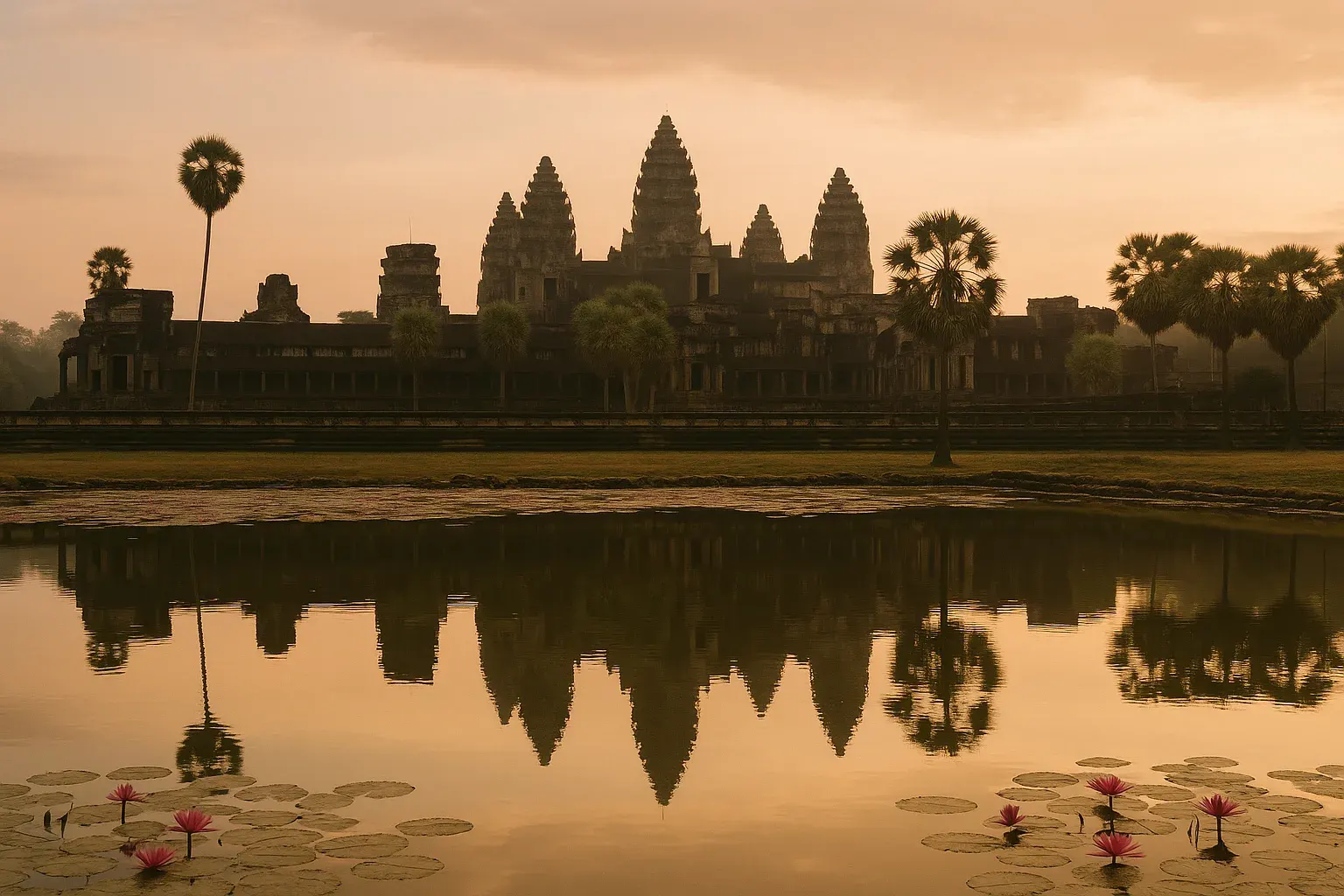
Angkor Wat Travel Guide 2026: Everything You Need to Know
KhmerAngkor Wat, the world's largest religious monument, spans over 400 acres in the heart of Cambodia. T...
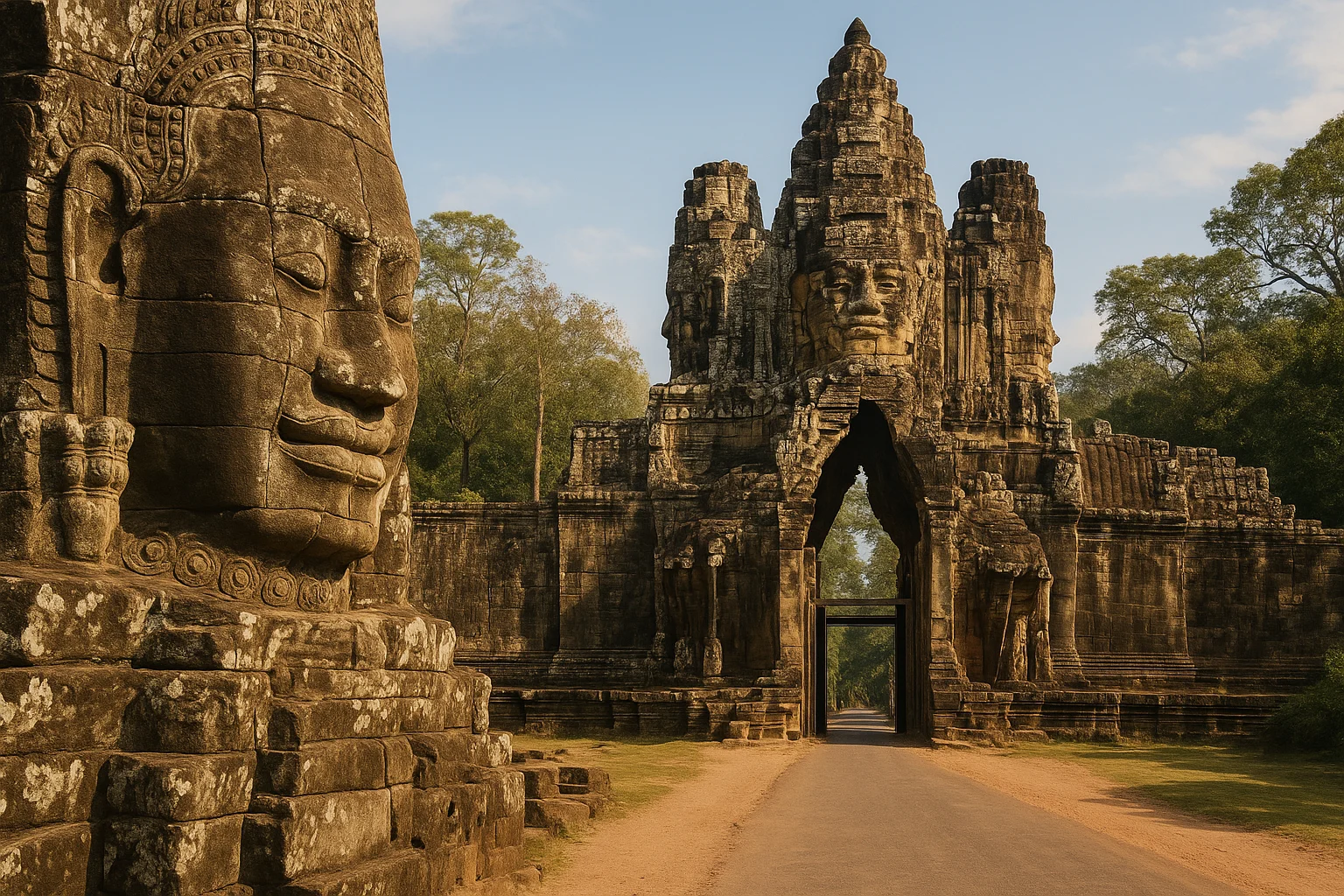
Angkor Thom Travel Guide 2026: Bayon Faces, Gates, and the Khmer Royal City
KhmerAngkor Thom was the last great capital of the Khmer Empire. This guide covers how to visit Bayon, th...
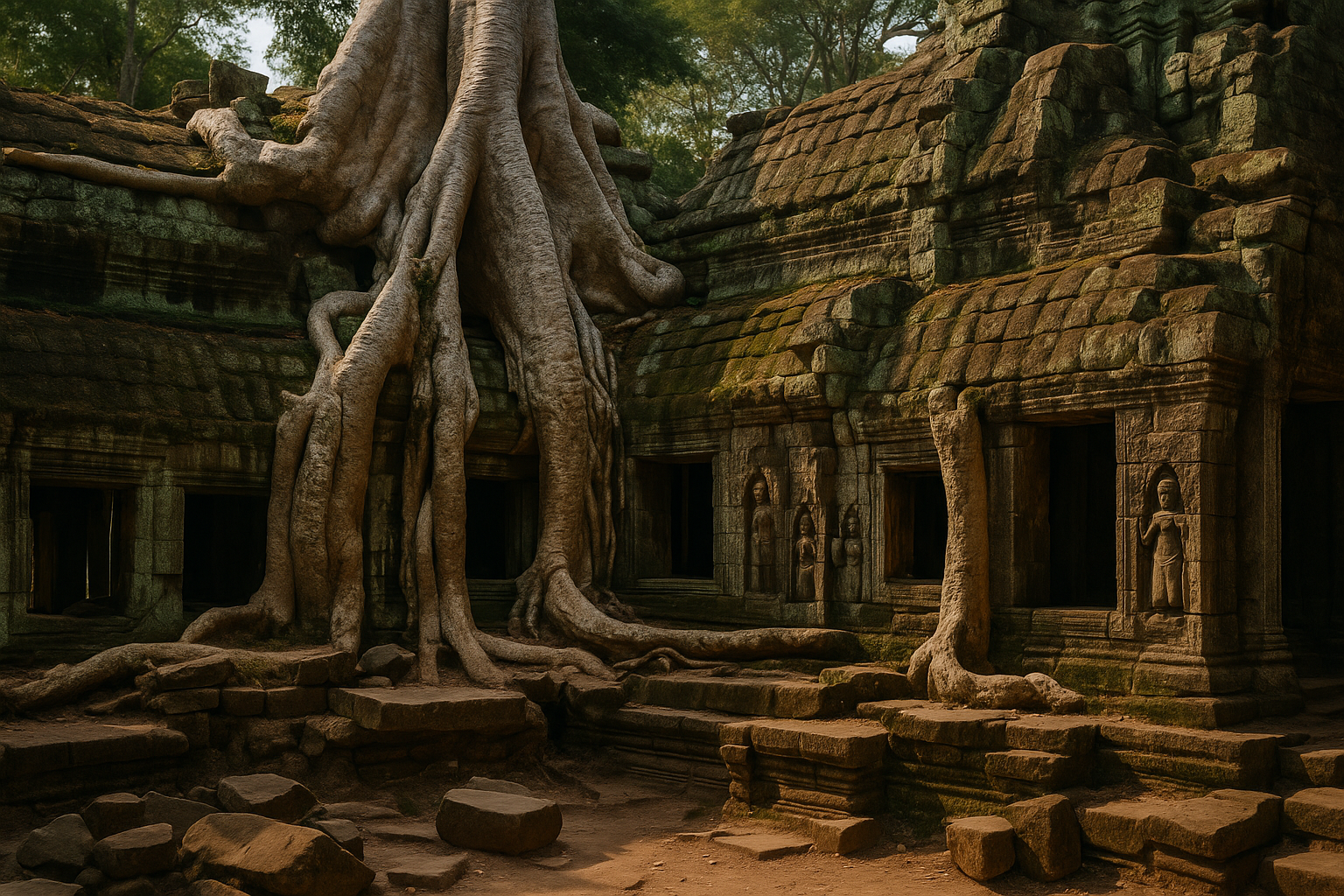
Ta Prohm Travel Guide 2026: Temple of the Trees, Routes, and Photo Timing
KhmerTa Prohm is one of Angkor’s most atmospheric temples, where giant roots and sandstone galleries merg...
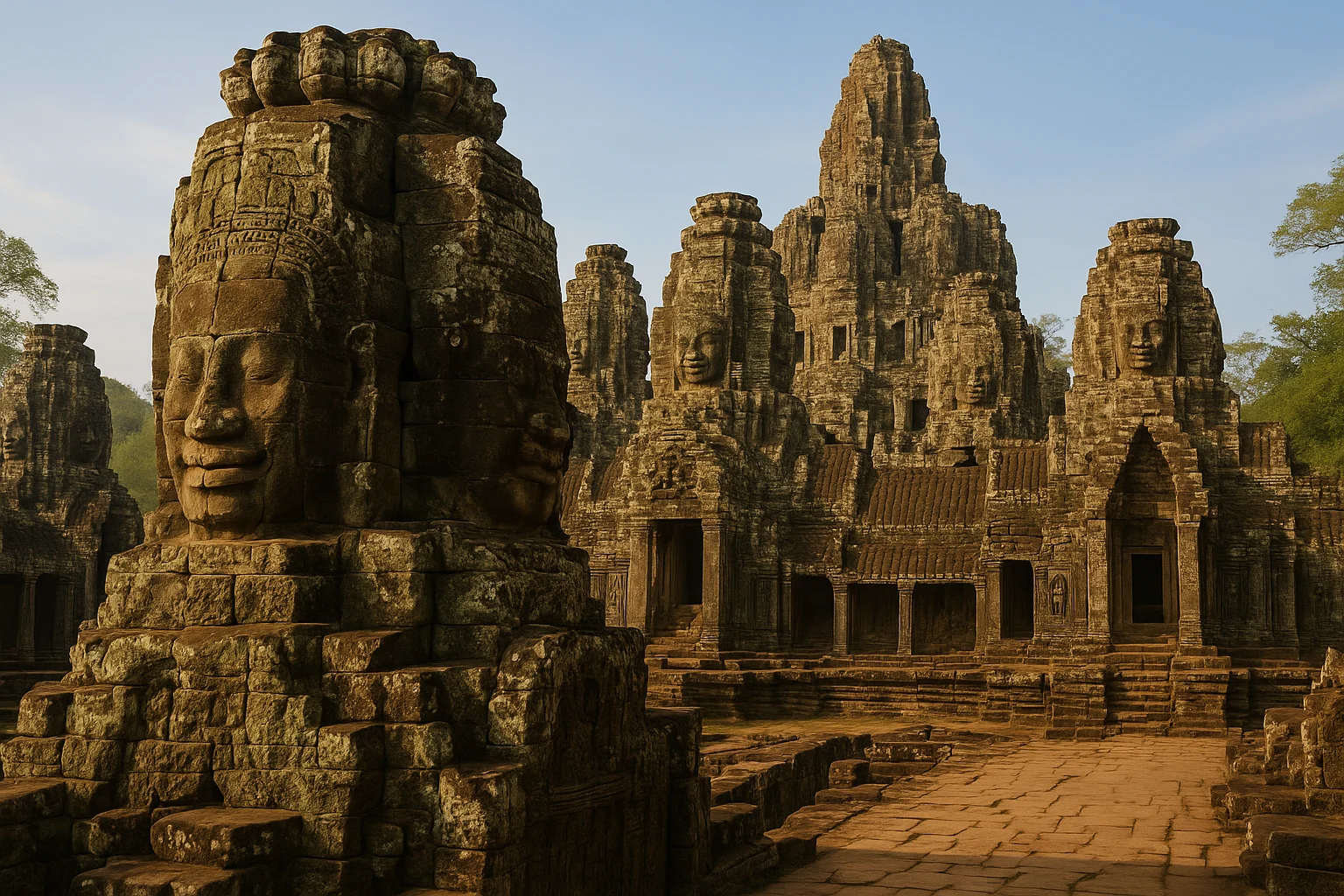
Bayon Temple Travel Guide 2026: Face Towers, Bas-Reliefs, and Best Visit Timing
KhmerBayon Temple sits at the center of Angkor Thom and is famous for its carved stone faces. This guide ...
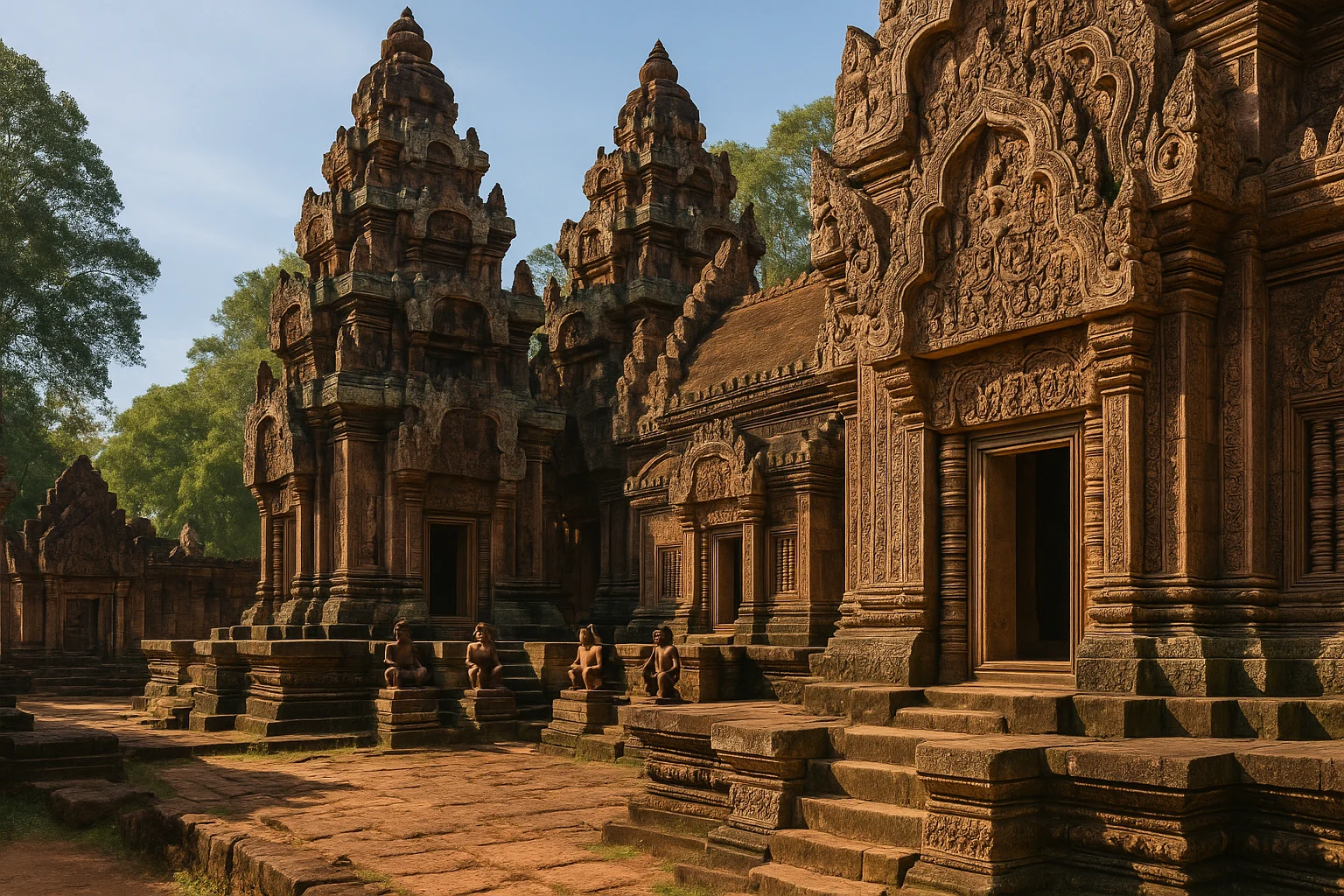
Banteay Srei Travel Guide 2026: Pink Sandstone Temple, Carvings, and Visit Tips
KhmerBanteay Srei is one of Cambodia’s most detailed Khmer temples, known for fine pink sandstone carving...