Quick Info
Curated Experiences
Priene Miletus and Didyma Day Tour from Kusadasi
Private Ephesus Miletus Didyma Tour with Lunch
Private Priene Miletus Didyma Tour from Kusadasi
At Priene, Turkey, the first impression is geometric rather than monumental. You stand on a steep hillside above the old Maeander plain and see an ancient city laid out with unusual clarity, streets crossing at right angles as if someone had pressed a rational plan onto a dramatic landscape. Then the details begin to emerge: a temple terrace framed by mountain light, a theater tucked into stone, civic buildings arranged with deliberate civic logic rather than imperial excess. Priene does not overwhelm you by sheer size. It persuades you by coherence.
That coherence is exactly why this Priene Turkey travel guide matters for travelers exploring western Anatolia. Priene is one of the clearest surviving examples of planned Hellenistic urbanism, and it pairs naturally with nearby Miletus and Didyma for a full historical arc in one day. Where Miletus feels expansive and Didyma feels ceremonial, Priene feels intellectually designed, a city where politics, religion, and daily life were arranged in conversation with both topography and theory. This guide covers Priene’s layered history, the monuments worth your time, transport options from Kusadasi and Selcuk, practical ticket and seasonal advice, and the best way to combine the site with neighboring classics without turning your day into a blur.
History: A Planned Ionian City on the Mountain Edge
Earlier landscape and city refoundation (before c. 4th century BCE)
The region around Priene was occupied long before the classical city you visit today, with communities moving through the wider Maeander basin across Bronze and Iron Age phases. The famous archaeological site, however, largely represents a deliberate refoundation in the 4th century BCE, when civic leaders established a new settlement on the slope of Mount Mycale. This was not accidental growth over centuries. It was planned placement. Streets, housing blocks, and civic zones were organized from the beginning with unusual discipline, turning Priene into a model of Ionian and early Hellenistic urban thought.
Classical and early Hellenistic development (4th century BCE-3rd century BCE)
Priene’s strongest growth came in the era after Alexander’s campaigns reshaped Anatolia. The city gained monumental architecture, including the famed Temple of Athena Polias, whose design is often associated with architect Pytheos. The orthogonal grid made social hierarchy visible in space: public institutions on defined terraces, domestic quarters in ordered blocks, and sacred points controlling visual focus. Priene was not the largest city in Ionia, but it was one of the most legible. Inscriptions and architectural remains suggest a politically active polis culture where assemblies, councils, and ritual life all had architecturally marked settings.
Hellenistic to Roman transition (3rd century BCE-3rd century CE)
As larger regional powers competed for western Anatolia, Priene adjusted to changing political realities while maintaining local civic identity. Under Roman influence, the city continued to function, though it never became a giant metropolitan center like Ephesus. Instead, Priene remained a medium-scale city with strong institutional architecture and a clear urban footprint. Buildings were repaired, adapted, and reused; sacred and civic spaces remained active, though priorities shifted. What makes the site so valuable today is that later monumental overbuilding was limited, preserving the earlier planning framework in ways many larger cities lost.
Late antiquity, Byzantine continuity, and contraction (4th century CE-13th century CE)
Like many Anatolian cities, Priene changed religiously and economically in late antiquity. Christianization altered the civic landscape, and some classical spaces were repurposed as political and devotional systems evolved. Environmental transformation in the Maeander delta also mattered: coastline and harbor relationships shifted over centuries, affecting trade and regional connectivity. Priene did not disappear instantly, but it contracted, adapted, and eventually declined as settlement patterns moved. The city survived in fragments rather than continuous urban momentum, leaving a remarkably readable archaeological shell.
Modern rediscovery and archaeological work (18th century-present)
European travelers described Priene’s ruins in the early modern period, but systematic work accelerated in the 19th century, especially with German-led excavations. Archaeologists mapped the grid, documented civic buildings, and reconstructed phases of the temple and theater with unusual precision. Because Priene’s plan is so clear, it became central to scholarship on ancient city design, citizenship space, and Hellenistic architecture. Ongoing conservation now focuses on stabilizing masonry, managing erosion on sloped terrain, and improving visitor interpretation. For travelers, this means Priene is both a beautiful site and a field classroom in how archaeology reconstructs urban logic from stone lines and broken walls.
The Key Monuments: What to See at Priene
The Temple of Athena Polias
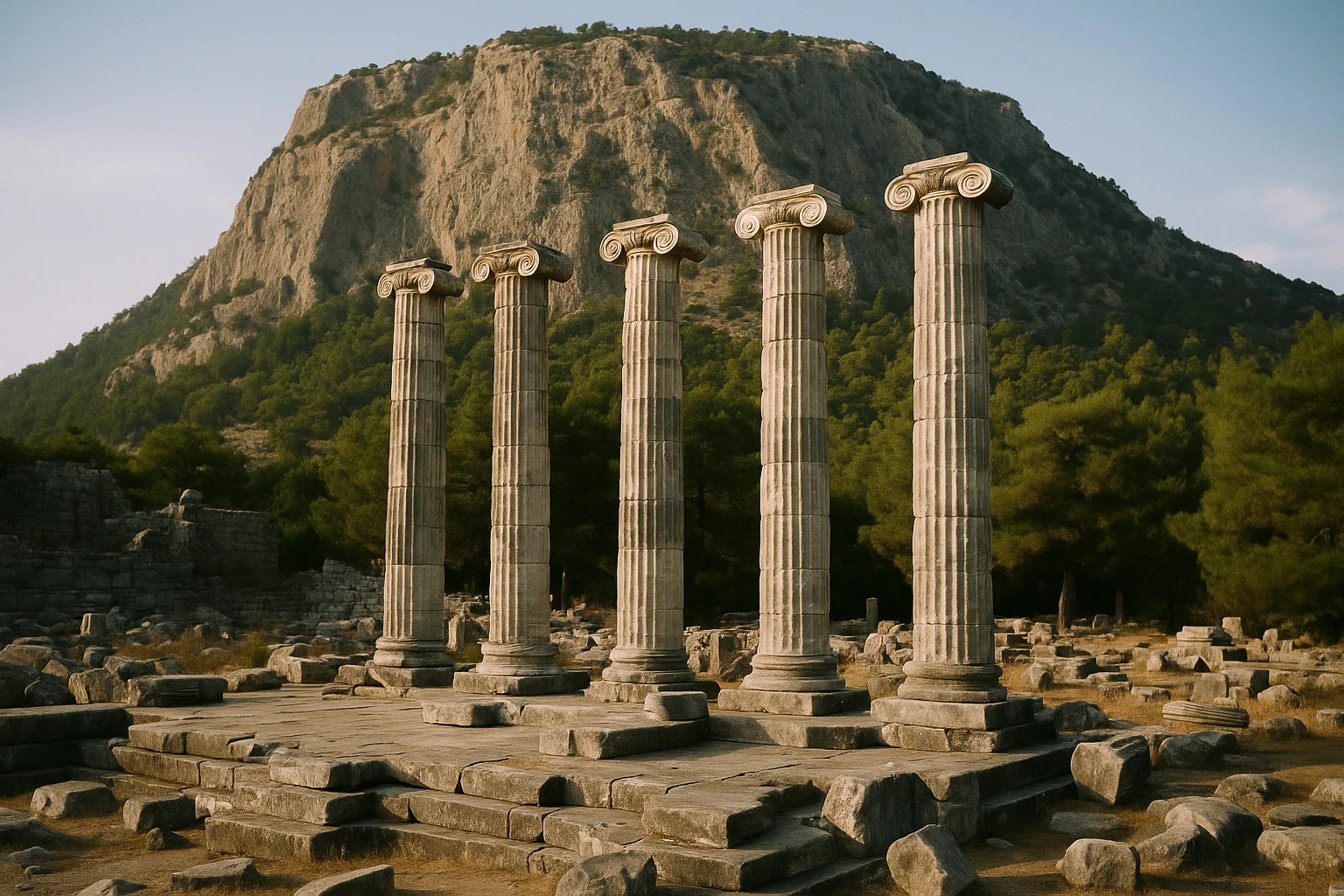
The Temple of Athena Polias is Priene’s defining monument and the visual anchor of the entire site. Built in the 4th century BCE in refined Ionic form, it occupied a commanding terrace that linked sacred authority to civic identity and landscape control. The surviving columns and foundations are modest compared with mega-sites, yet the setting gives them outsized force. From this platform, you can read both theology and politics: Athena as city protector, temple as statement of shared order, and architecture as argument for disciplined public life. The mountain backdrop intensifies the scene, especially in low-angle light. For photography, early morning gives the cleanest contrast between pale stone, shadowed terrace lines, and the valley beyond.
The theater
Priene’s theater is steep, intimate, and unexpectedly elegant. Cut into the slope with Hellenistic proportions and later Roman modifications, it offers one of the best opportunities in western Turkey to feel how performance and citizenship overlapped. This was not only entertainment space. It was a civic instrument where announcements, festivals, and social hierarchy became visible in seating geometry. From the upper rows, sightlines sweep across urban terraces and the plain, making the city itself part of the stage set. The preserved seating and orchestra zone are readable enough that even non-specialists quickly understand the building’s logic. Late afternoon light works beautifully here, pulling texture from every row.
The Bouleuterion and civic council zone
The Bouleuterion and nearby civic structures are where Priene’s reputation as a planned city becomes concrete. This council house hosted political deliberation, embedding governance directly into the urban grid rather than isolating it in palace architecture. The scale is human, not imperial, and that is the point: Priene’s civic life depended on institutional spaces sized for citizens, magistrates, and procedural order. Walking this area after the temple and theater helps you connect religious symbolism, public performance, and political process as parts of one designed system. If you care about how cities organize power, this is one of the most rewarding sectors on site.
Domestic blocks and street grid
Priene’s residential quarters are among its most important features, even if they attract fewer quick photos than the temple. The regularized blocks, street alignments, and drainage logic reveal an urbanism built around planning principles rather than incremental medieval layering. You can trace how houses sat within standardized parcels and how streets negotiated steep terrain while preserving grid intent. This is where debates about Hippodamian planning stop being abstract and become walkable reality. Even fragmentary walls show thresholds, room sequences, and neighborhood organization. Spend at least 20 to 30 minutes here and the city shifts from “ruins” to “urban blueprint.”
The city walls, gates, and mountain-edge views
Priene’s fortification lines and gate approaches tie the site together at landscape scale. Defensive architecture adapted to the slope while controlling access from the plain, and surviving wall sections still communicate strategic placement. The views from these edges are not a side attraction; they are evidence. You see why this location worked politically and symbolically, and you also grasp how environmental change transformed the region over centuries. Today, the sea sits far from where ancient coastlines once mattered to regional exchange. Standing at the margins, Priene reads as both city and topographic argument.
Getting There: Transportation and Access
Priene is most practical as a road-access archaeological stop, and nearly everyone reaches it by private vehicle, tour transport, or a taxi arrangement from nearby hubs.
From Kusadasi
Kusadasi is the most common base for international visitors and cruise passengers. The route inland is straightforward, and Priene is usually combined with Miletus and Didyma in one circuit.
- Taxi/private transfer: Around 60-80 minutes each way, usually 2,600-4,200 TRY ($82-132 USD) round trip with waiting time negotiated.
- Guided day tour: Typically 8-9 hours with two additional sites, often 3,800-6,000 TRY ($120-190 USD) per person depending on inclusions.
- Rental car: Roughly 1 hour to 1 hour 15 minutes; easiest option for flexible pacing and viewpoint stops.
From Selcuk or Soke
Selcuk works for independent travelers, while Soke is the nearest practical town connection for local routing.
- Bus to Soke + local transfer/taxi: Usually 2 to 2.5 hours total from Selcuk depending on connections; around 300-600 TRY ($9-19 USD).
- Taxi/private car from Selcuk: About 70-90 minutes each way, often 2,800-4,400 TRY ($88-138 USD) round trip.
- From Soke by taxi: Around 25-35 minutes, commonly 700-1,200 TRY ($22-38 USD) one way.
From Didim or Bodrum side
If you are based near Didim, Priene is realistic as a half-day extension. From Bodrum, it is a longer but manageable archaeology day.
- From Didim by car/taxi: About 45-60 minutes depending on route and season.
- Local minibus combinations: Possible but less predictable for precise schedules; often best only for flexible travelers.
- From Bodrum by rental car: Usually 1.5 to 2 hours, with summer traffic variability.
Practical Information
Admission and hours
Ticket prices and pass eligibility can shift, so verify current rates at the official entrance. As a working benchmark, expect approximately 8-15 EUR equivalent in Turkish lira (around 280-520 TRY, or $9-16 USD) for standard adult entry. Türkiye museum pass products often include Priene and can deliver strong value if you are visiting multiple government-run sites in western Turkey.
Opening windows are typically longer in summer and shorter in winter. Plan to arrive early, especially between June and September, because Priene’s slope increases heat load as the day advances. Card payment is common at larger sites but not guaranteed for every small purchase around the area, so carry some cash.
What to bring
- Sun protection: Hat, sunscreen, and breathable layers are essential because shade is limited on upper terraces.
- Water: Carry at least 1 to 1.5 liters per person in warm months.
- Footwear: Grippy walking shoes matter on uneven stones, inclines, and stepped sections.
- Camera/phone battery: The site rewards wide landscape shots and slower architectural framing.
- Cash: Useful for local transport gaps, parking, and small vendors.
Accessibility and etiquette
Priene is visually spectacular but physically demanding. Uneven surfaces, elevation changes, and stairs make full access difficult for many mobility-limited visitors. Some upper viewpoints can still be enjoyed with careful drop-off planning, but a complete circuit requires stable footing and time. Respect barriers, avoid climbing fragile masonry, and keep distance from unstable edges on terrace walls.
When to Visit: Seasonal Considerations
Spring (March-May)
Spring is the best all-around season for Priene, with typical daytime temperatures around 15-26°C (59-79°F). The hillside can be green, visibility is usually clear, and walking conditions are comfortable for longer circuits. Crowds are moderate outside holiday spikes. For most travelers, spring is the ideal balance of weather, light, and pace.
Summer (June-August)
Summer often reaches 30-37°C (86-99°F), and the sloped terrain amplifies fatigue when the sun is high. Visit at opening time, move through upper terraces early, and carry more water than you expect to need. Midday can be punishing because exposed stone reflects heat. Summer visits are still rewarding if you treat timing as non-negotiable.
Autumn (September-November)
Autumn is excellent for archaeology travel, especially late September through October, with typical ranges around 18-30°C (64-86°F) easing cooler in November. Crowds generally thin compared with high summer, and golden-hour light is particularly strong on temple and theater stone. Many repeat visitors consider autumn nearly as good as spring, sometimes better for itinerary flexibility.
Winter (December-February)
Winter is quiet and atmospheric, with daytime temperatures often around 8-16°C (46-61°F). Rain and wind are possible, and slick stones require caution, but crowd pressure drops significantly. If you prefer contemplative ruins over peak-season energy, winter can be deeply satisfying. Bring a light waterproof layer and plan a slower, steadier route.
Combining Priene with Miletus and Didyma
Priene is at its best when it opens the day. Start on site by 8:30 AM, while air temperatures are lower and the temple terrace still holds soft directional light. Spend roughly two hours moving from the Temple of Athena to the theater and then down into the civic quarter, so the city’s logic is clear before fatigue sets in. By 10:45 AM, depart for Miletus, where broader terrain and monument spacing suit the late morning window.
Arrive at Miletus around 11:15 AM and focus first on the Great Theater, then the Faustina Baths. Around 12:45 PM, break for lunch in or near Didim, where local lokanta options are usually faster and more authentic than resort-strip menus. Continue to Didyma by 2:00 PM for the Temple of Apollo in warmer afternoon light, when the colossal columns cast dramatic shadows and the sanctuary reads as pure monumentality. This sequence creates a meaningful progression: planned polis at Priene, large civic-urban force at Miletus, and sacred oracle architecture at Didyma.
If you only have half a day, Priene alone still works. Begin early, prioritize the temple-theater-council circuit, and leave space to sit with the landscape views rather than rushing every corner. Travelers based in Kusadasi can complete the full three-site route in about 9 to 10 hours door to door, but private transport is strongly recommended for schedule control. Public connections exist, yet transfer uncertainty can turn a coherent itinerary into a fragmented one.
Why Priene Matters
Priene matters because it shows that ancient greatness is not only about imperial spectacle. Some sites impress through sheer mass; Priene impresses through intelligence. Its terraces, streets, and institutions reveal a city imagined as an ordered civic system, where religion, politics, and daily life were spatially coordinated rather than accidentally layered. That makes it one of the most teachable archaeological landscapes in Turkey and one of the most rewarding for travelers who like to understand, not just observe.
It also offers a rare emotional experience in classical travel: clarity. You can stand in one place and read relationships between buildings, then between city and mountain, then between past and present plain below. The result is less cinematic ruin romance and more something better: a direct encounter with how people once tried to organize a common life. When the wind moves across the hillside and the Athena terrace catches late light, Priene feels precise, human, and unexpectedly modern.
Quick Facts
| Attribute | Details |
|---|---|
| Location | Gullubahce (near Soke), Aydin Province, Turkey |
| Ancient Name | Priene |
| UNESCO Status | Not independently inscribed; part of wider Aegean classical heritage landscape |
| Established | c. 4th century BCE planned city |
| Distance from nearest hub | ~16 km from Soke (about 25-35 min by car) |
| Entry Fee | Typically ~280-520 TRY ($9-16 USD), verify current rates |
| Hours | Seasonal schedule; generally morning to early evening |
| Best Time | Spring and autumn, especially early morning |
| Suggested Stay | 2-3 hours (full day when combined with Miletus and Didyma) |
Explore More Turkey
- Miletus: A former port giant with an immense theater, Roman baths, and visible environmental history.
- Didyma: Home to the monumental Temple of Apollo and one of the ancient Mediterranean’s great oracle sanctuaries.
- Ephesus: Turkey’s flagship classical city, with exceptional Roman streetscape preservation.
Plan your wider route with our Turkey Ancient Sites Guide. For trip design, see our Aegean archaeology itinerary guide.
Frequently Asked Questions
How much time should I plan for Priene?
Plan 2 to 3 hours for a solid visit, including the Athena Temple terrace, theater, and lower civic areas. If you enjoy architecture or slow photography, 3.5 hours is more comfortable. Most travelers pair Priene with Miletus and Didyma in a full-day loop from Kusadasi.
Is Priene included in Turkey museum passes?
Priene is typically part of Türkiye's state archaeological ticketing system and is often covered by museum pass products, though rules can change by season. If you are visiting multiple major sites in western Turkey, a pass is usually better value than separate tickets. Confirm current terms at the official ticket office before entering.
How do I get to Priene from Kusadasi without a guided tour?
The easiest independent option is rental car or private driver, usually around 1 hour to 1 hour 15 minutes each way depending on traffic. Public transport is possible with bus connections toward Soke and local transfers, but timing is less convenient for tight itineraries. Most visitors choose a tour or private car when combining three sites in one day.
What are the highlights at Priene?
The main highlights are the Temple of Athena, the steeply set Hellenistic theater, the Bouleuterion, and the orthogonal street plan climbing the hillside. The city is compact enough to understand as a whole, which makes it excellent for first-time classical archaeology travelers. Valley views over the Maeander plain are also a major part of the experience.
When is the best time of day to visit Priene?
Early morning is best for cooler temperatures, softer light, and easier uphill walking, especially from May through September. Late afternoon can also be beautiful for landscape views, but some tours arrive mid-afternoon when heat is still strong. Midday is workable in cooler months but can feel exposed in summer.
Is Priene difficult for visitors with mobility limitations?
Priene has uneven stones, inclines, and stepped sections, so it can be challenging for wheelchairs and anyone with limited mobility. You can still enjoy select viewpoints near upper approaches if traveling by car with close drop-off, but full-site access requires steady footing. Supportive shoes, water, and a slower pace make a big difference.
Nearby Ancient Sites
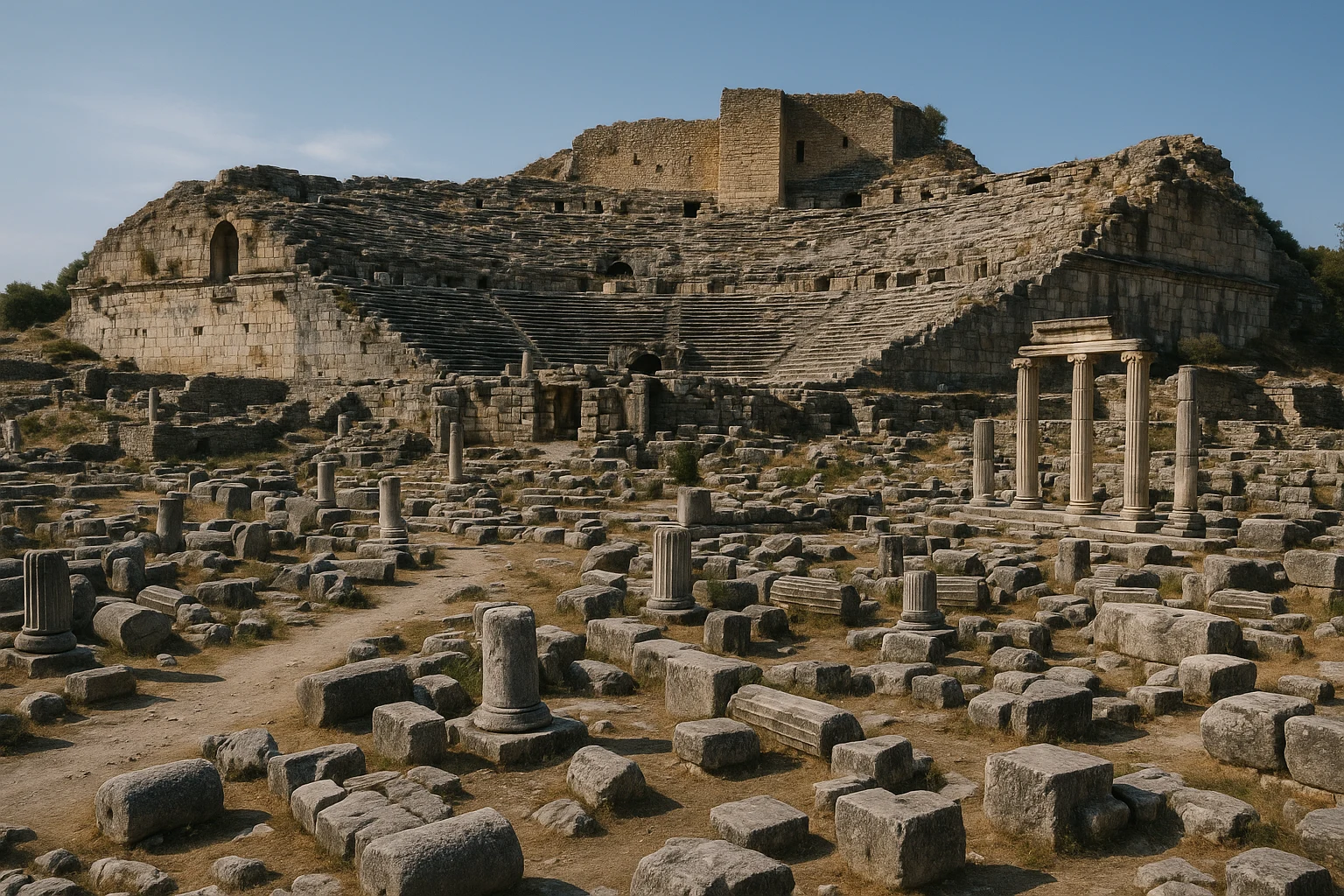
Miletus Turkey Guide 2026: Great Theater & Faustina Baths
Carian-Ionian-Persian-Hellenistic-Roman-ByzantineUse this Miletus, Turkey guide to explore its great theater, Roman baths, history, tickets, and tran...
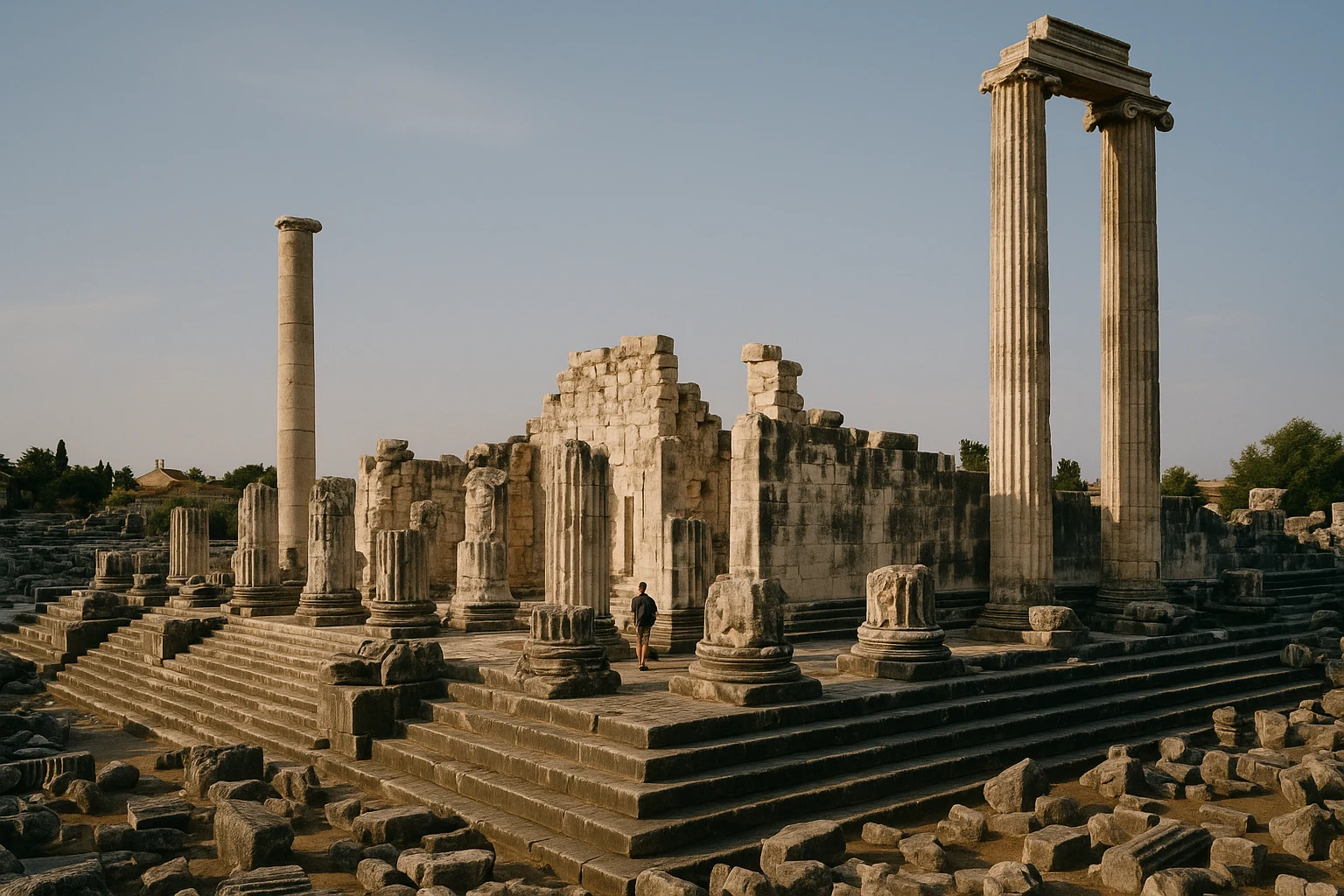
Didyma Turkey Guide 2026: Temple of Apollo & Sacred Way
Ionian-Hellenistic-Roman-ByzantinePlan your Didyma, Turkey visit with history, transport, tickets, and what to see at the vast Temple ...
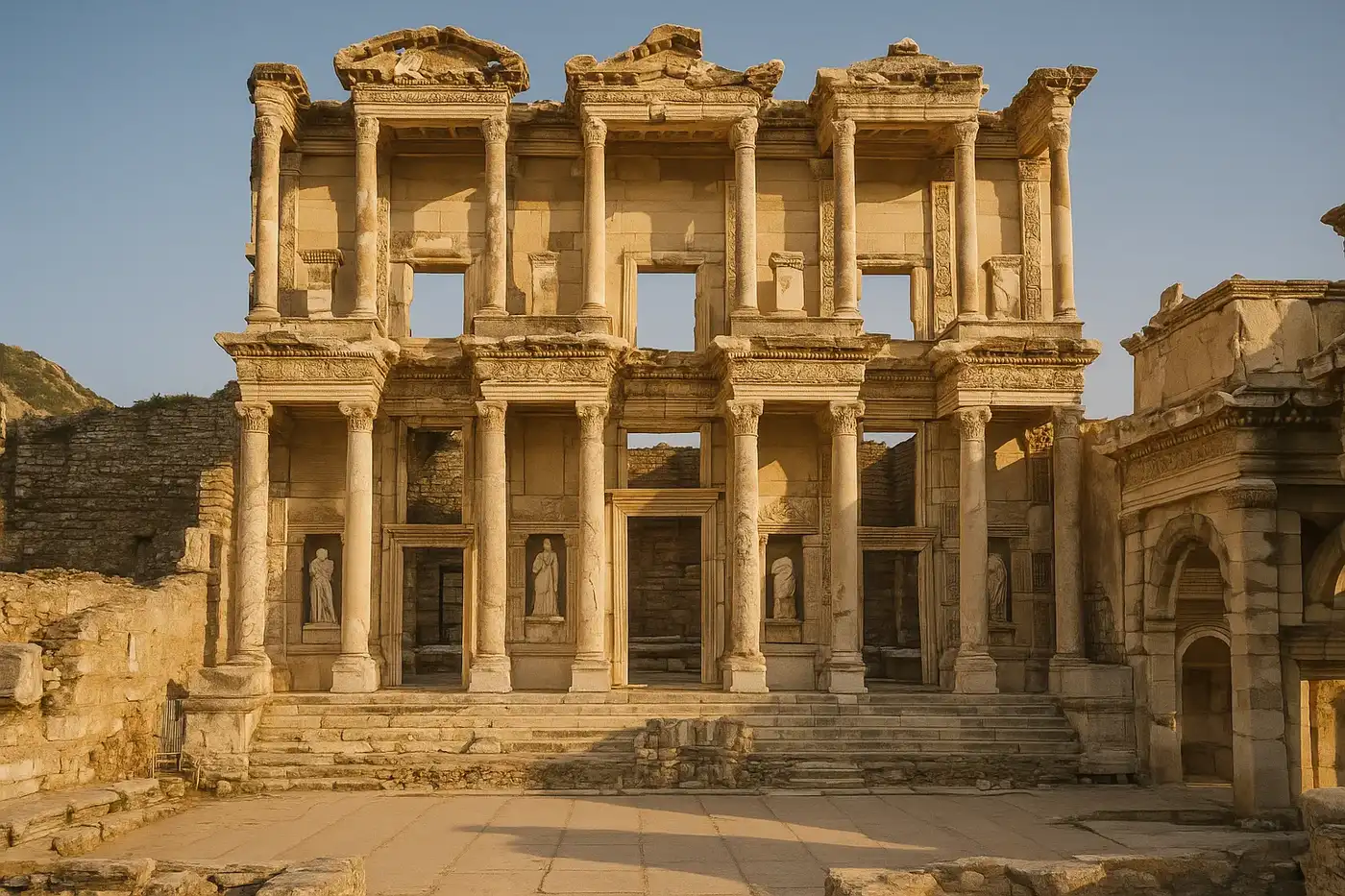
Ephesus Turkey Travel Guide: Library of Celsus & Terrace Houses
Greco-RomanDiscover Ephesus, the best-preserved ancient city in the Mediterranean. Our complete guide covers th...