Quick Info
Curated Experiences
Pula Arena and Roman Heritage Walking Tour
Private Pula City Tour with Arena
Istria Highlights Tour Including Pula Arena
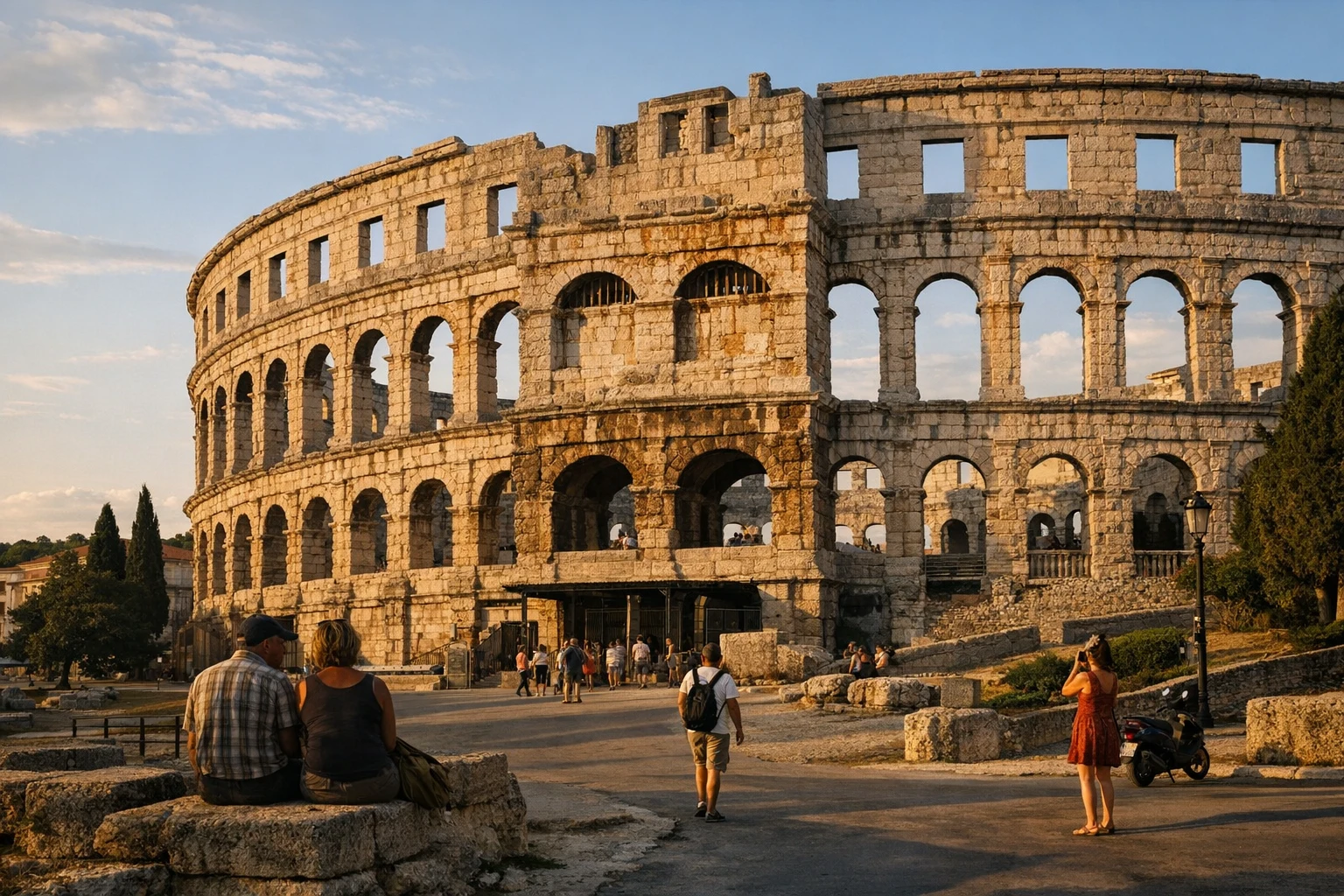
Pula Arena in Croatia is one of those monuments that manages to feel both improbably grand and surprisingly accessible. Rising near the harbor in the Istrian city of Pula, the amphitheater appears almost suddenly among streets, apartment blocks, and everyday urban life, its pale limestone arcades lifting above the city as if the Roman Empire never entirely left the Adriatic. Many travelers arrive expecting a smaller provincial cousin of the Colosseum. What they find is something more distinctive: a Roman arena whose outer shell survives with remarkable clarity, whose setting close to the sea gives it unusual atmosphere, and whose continued use for performances keeps it from feeling like a frozen relic. It is a monument of imperial entertainment, but also of urban continuity.
That continuity is part of the site’s appeal. Pula Arena was built for spectacle, and in some sense it still delivers exactly that, just in a different form. The structure’s elliptical geometry remains legible at first glance, the arcades and surviving towered corners still establish a powerful silhouette, and the experience of moving through the stone feels immediate rather than abstract. Yet the arena is not detached from the city around it. It belongs to Pula’s wider Roman inheritance, which includes temples, gates, streets, and fragments embedded in later urban layers. Visiting the arena means seeing not only an amphitheater, but the way a port city absorbed, reused, and lived alongside Roman architecture for centuries. Few amphitheaters in Europe make that relationship between ruin and city quite so vivid.
History
Roman Pula and the Birth of the Arena
The story of Pula Arena begins with the Roman transformation of the Istrian peninsula. Pula, known in antiquity as Colonia Pietas Iulia Pola Pollentia Herculanea, developed into an important Roman settlement after the expansion of Roman power into the Adriatic. Its harbor, strategic coastal position, and integration into imperial trade routes made it a natural location for urban growth. Like other Roman cities, Pula expressed its status through public architecture: forums, temples, gates, roads, and eventually an amphitheater. These structures were not mere amenities. They were declarations that the city belonged fully to the Roman world.
The arena likely began in a more modest wooden or earlier stone phase before reaching its monumental form in the 1st century CE. Most of the surviving structure is generally dated to the period spanning Augustus and especially Vespasian, placing it in the same broad era of amphitheater building that produced some of Rome’s most famous entertainment architecture. Its construction reflects Pula’s prosperity and ambition. A city did not receive a major amphitheater unless it had the resources, population, and civic importance to sustain one.
Imperial Entertainment and Civic Identity
In the Roman world, amphitheaters served as places of mass spectacle, including gladiatorial combat, animal hunts, public ceremonies, and various forms of staged entertainment. Pula Arena fit squarely within that imperial culture. The building was not only for leisure in a modern sense; it was a political machine for displaying Roman order, hierarchy, and urban identity. Crowds gathered according to status, elites were visibly separated from the wider populace, and the arena floor became a space where power and violence were ritualized in public.
Pula’s amphitheater was large for its setting, capable of holding thousands of spectators. Its scale tells us something about the aspirations of the city and the role of spectacle in Roman civic life. The arena was meant to be seen, approached, and inhabited collectively. It transformed local identity by placing the city within a recognizable imperial architectural language. To visit the arena today is to stand inside one of the clearest surviving reminders that Pula was once fully integrated into Rome’s system of political theater.
Late Antiquity, Medieval Reuse, and Survival
As the Roman Empire changed and gladiatorial culture declined, amphitheaters across the empire entered uncertain afterlives. Some were dismantled, some turned into quarries, and others absorbed into new settlement patterns. Pula Arena survived more fully than many because it remained useful, visible, and valued in changing ways across the centuries. Like many Roman monuments, it was subject to stone robbing and practical reuse, but it was never wholly erased. Its enduring shell made complete disappearance difficult, and local memory continued to attach significance to the structure.
During the medieval and early modern periods, the arena existed in a city shaped by successive powers, including Byzantine, Venetian, and Habsburg influence. Each era altered Pula’s broader urban environment, yet the amphitheater remained one of the city’s defining presences. There were periods when its stones were threatened by removal for building elsewhere, and legends grew around the structure, as they often do when a monumental ruin outlasts the world that produced it. The fact that Pula Arena survived at all in such strong form is not accidental. It reflects a combination of durability, civic identity, and the gradual emergence of preservation-minded attitudes.
Restoration and the Modern Heritage Monument
From the 19th century onward, growing archaeological interest, nationalist awareness, and cultural preservation efforts helped secure the future of Pula Arena. Restoration campaigns aimed to stabilize the structure and remove accumulated alterations that obscured its Roman form. Unlike some ruins that only survive as fragments, Pula Arena remained legible enough that restoration could emphasize continuity rather than reconstruction from near-total collapse.
In the modern period, the arena became both a heritage icon and a living venue. This dual identity is one of its defining characteristics today. The monument is protected, studied, and presented as one of Croatia’s most important Roman sites, but it is also used for concerts, film festivals, performances, and public gatherings. This can be controversial in principle at some ancient sites, but in Pula it often feels strangely appropriate. The building was made for crowds and collective spectacle. Modern cultural events, when managed well, allow the arena to retain a public life that aligns unexpectedly well with its ancient purpose. The site survives not only because it is old, but because the city has kept finding reasons to gather there.
Key Features
The most striking feature of Pula Arena is the survival of its outer shell. Unlike many Roman amphitheaters where only fragments of arcades or foundations remain, Pula still preserves an impressive ring of limestone exterior walls with their repeated arches and upper rectangular openings. This outer envelope gives the arena a clarity that is immediately legible from the surrounding city. It is easy to understand the building’s scale and original intent because the architecture still frames space so convincingly. Seen from a distance, the arena’s pale stone against the Adriatic sky produces one of the most recognizable urban silhouettes in Croatia.
The four side towers are another distinguishing element. These tower-like projections are not decorative quirks but functional features linked to circulation and possibly awnings or structural systems. Their survival helps set Pula Arena apart from many other amphitheaters whose external articulation is more heavily damaged. They also contribute to the monument’s memorable profile, giving it a sense of rhythm and anchoring the ellipsoid form with strong vertical accents. For visitors who have seen many Roman ruins, this is one of the features that makes Pula immediately feel distinct.
Inside, the arena floor and lower areas reveal how Roman entertainment architecture worked as a system. Visitors can walk through spaces that once organized crowd movement, service access, and the machinery of spectacle. The subterranean sections, often used for exhibitions on olive oil and viticulture or on local Roman life, add interpretive depth. These displays can be unexpectedly useful because they connect the amphitheater to the wider economy and daily culture of Roman Istria rather than leaving it as a purely theatrical shell. The contrast between the open sky above and the enclosed lower chambers below also helps convey how layered Roman public architecture really was.
The setting near the harbor is a feature in itself. Pula Arena does not stand isolated in countryside fields or detached archaeological parkland. It rises inside a working city close to the waterfront, where seagulls, traffic, and evening life frame the monument. This relationship between ancient stone and living urban texture is one of the site’s greatest strengths. It allows visitors to feel how the arena still belongs to Pula rather than merely sitting beside it as a museum object. The sea light, especially in late afternoon, gives the stone a luminous quality that differs from inland Roman sites and reinforces the Adriatic character of the place.
Finally, the continued use of the arena for performances makes it unusually vivid. Even if you do not attend an event, knowing that films, music, and public gatherings still animate the structure changes the emotional reading of the site. Pula Arena was built for collective experience, and in some sense it still serves that role. This continuity of public use, however transformed, gives the monument a degree of life that many ruins no longer possess.
Getting There
Pula Arena is located in the city of Pula in Istria County, and it is very easy to reach once you are in town. The amphitheater sits close to the center and near the harbor, making it walkable from many hotels, the bus station, and much of the old town. If you are arriving by bus or ferry, it may be only a short walk or a quick taxi ride away. Local taxi rides within central Pula are usually brief and relatively inexpensive, often in the rough range of €5 to €10 depending on distance and time of day.
For visitors coming from elsewhere in Istria, driving is straightforward, and Pula also has an airport with seasonal and regional connections. From the airport, taxis or private transfers to the city center generally take around 15 to 20 minutes. Car rental can be useful if you are exploring the wider peninsula, but once in central Pula you may prefer to park and continue on foot. Guided city tours often include the arena together with the Temple of Augustus, the Arch of the Sergii, and other Roman remains.
Because the site is embedded in the city, there is little logistical complexity compared with more remote archaeological destinations. The main practical questions are whether you want to arrive early for fewer crowds, combine it with a walking tour, or time your visit around an evening event. Bring water in summer, and check performance schedules if you hope to see the arena both as a monument and as a venue.
When to Visit
The best time to visit Pula Arena is usually late spring through early autumn, especially May, June, September, and early October. These months offer warm weather, long daylight, and a lively city atmosphere without always hitting the busiest summer peaks. Because the arena is largely open to the sky, pleasant temperatures make a real difference. Spring and early autumn are ideal if you want to enjoy both the monument and the surrounding old town on foot.
Summer is the most vibrant season, and there is a strong case for visiting then if you want to experience the arena as a living venue. Film festivals, concerts, and evening events can make the site feel uniquely alive. The tradeoff is higher visitor numbers and hotter midday conditions. If visiting in summer, early morning or late afternoon is best for calm exploration, while evening is perfect for atmosphere. The low Adriatic light also flatters the stone more beautifully at these times than the harsher noon sun.
Winter is quieter and can be rewarding for travelers who prefer a slower city experience, though weather is less predictable and the broader tourist energy of Pula is reduced. The arena remains impressive year-round, but the combination of light, warmth, and urban life is strongest from spring through early autumn. If you can, try to see it twice: once in daylight for architecture, and once in evening light when the monument begins to glow against the city.
| Quick Facts | Details |
|---|---|
| Location | Pula, Istria County, Croatia |
| Best Known For | One of the best-preserved Roman amphitheaters in the world |
| Historical Period | 1st century CE, Roman Empire |
| Main Function | Amphitheater for gladiatorial games and public spectacles |
| Signature Feature | Nearly complete outer walls with surviving towered corners |
| Urban Setting | Near Pula harbor and old town |
| Recommended Visit Length | 1 to 2 hours |
| Best Season | Late spring to early autumn |
| Modern Use | Concerts, film festival screenings, and public events |
| Practical Tip | Visit in daylight for architecture and again at night if an event or illumination schedule allows |
Frequently Asked Questions
What is Pula Arena best known for?
Pula Arena is best known as one of the best-preserved Roman amphitheaters in the world, notable for its nearly complete outer walls and seaside urban setting.
How old is the Pula Arena?
The arena was built in the 1st century CE, mainly during the reigns of Augustus and Vespasian, making it nearly two thousand years old.
Can you go inside Pula Arena?
Yes, visitors can enter the amphitheater, walk the arena floor and lower areas, and often see exhibitions in the subterranean sections.
How much time should you spend at Pula Arena?
Most visitors should allow 1 to 2 hours for the arena itself, with more time if they also want to explore the rest of Pula’s Roman and Venetian old town.
Is Pula Arena still used today?
Yes. The amphitheater still hosts concerts, festivals, film screenings, and public events, which is part of what makes it feel unusually alive.
When is the best time to visit Pula Arena?
Late spring and early autumn are ideal, with warm weather, manageable crowds, and good conditions for combining the arena with a wider Pula walk.
Nearby Ancient Sites
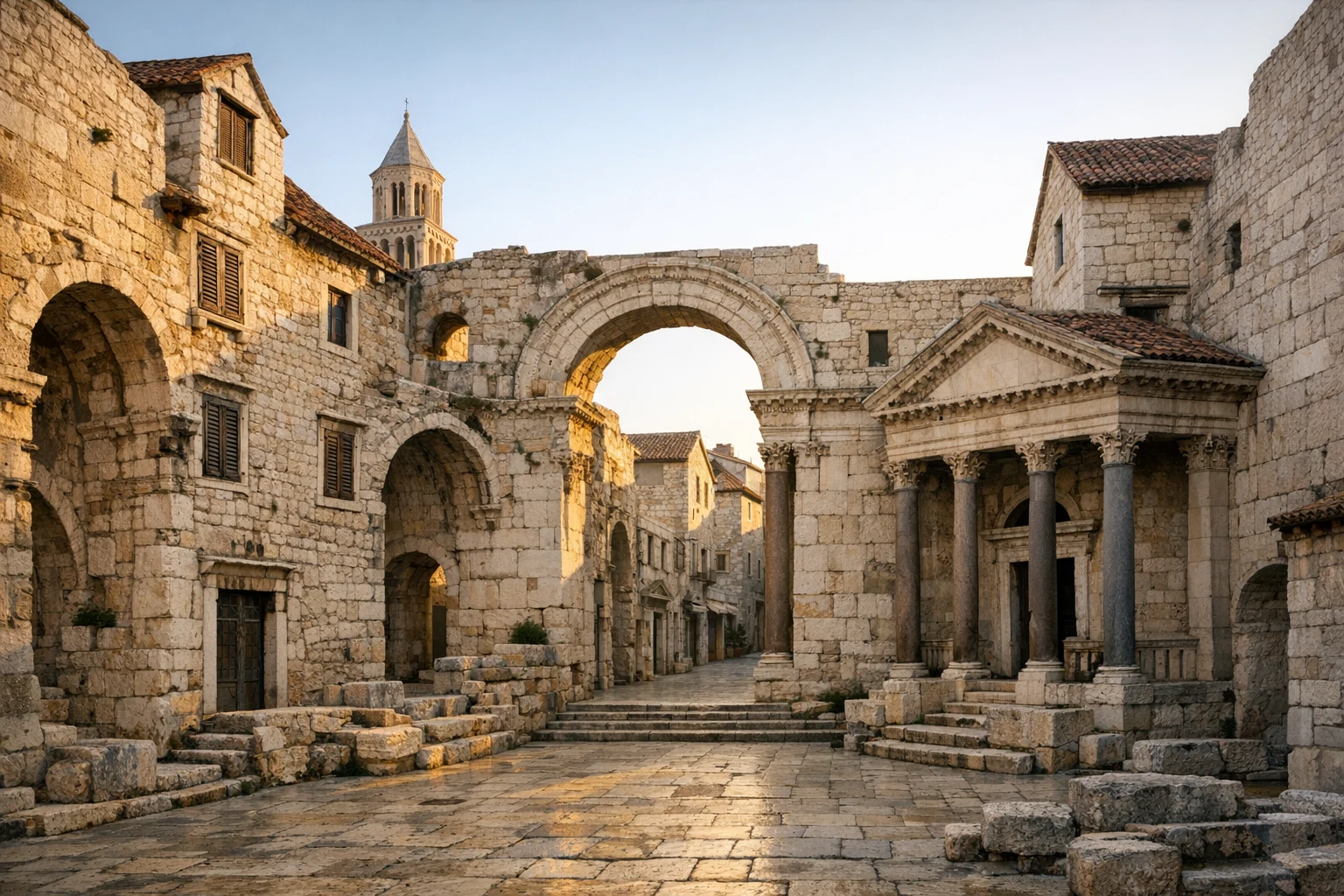
Diocletian's Palace
RomanA Roman emperor's retirement fortress turned living city, Diocletian's Palace in Split, Croatia rema...
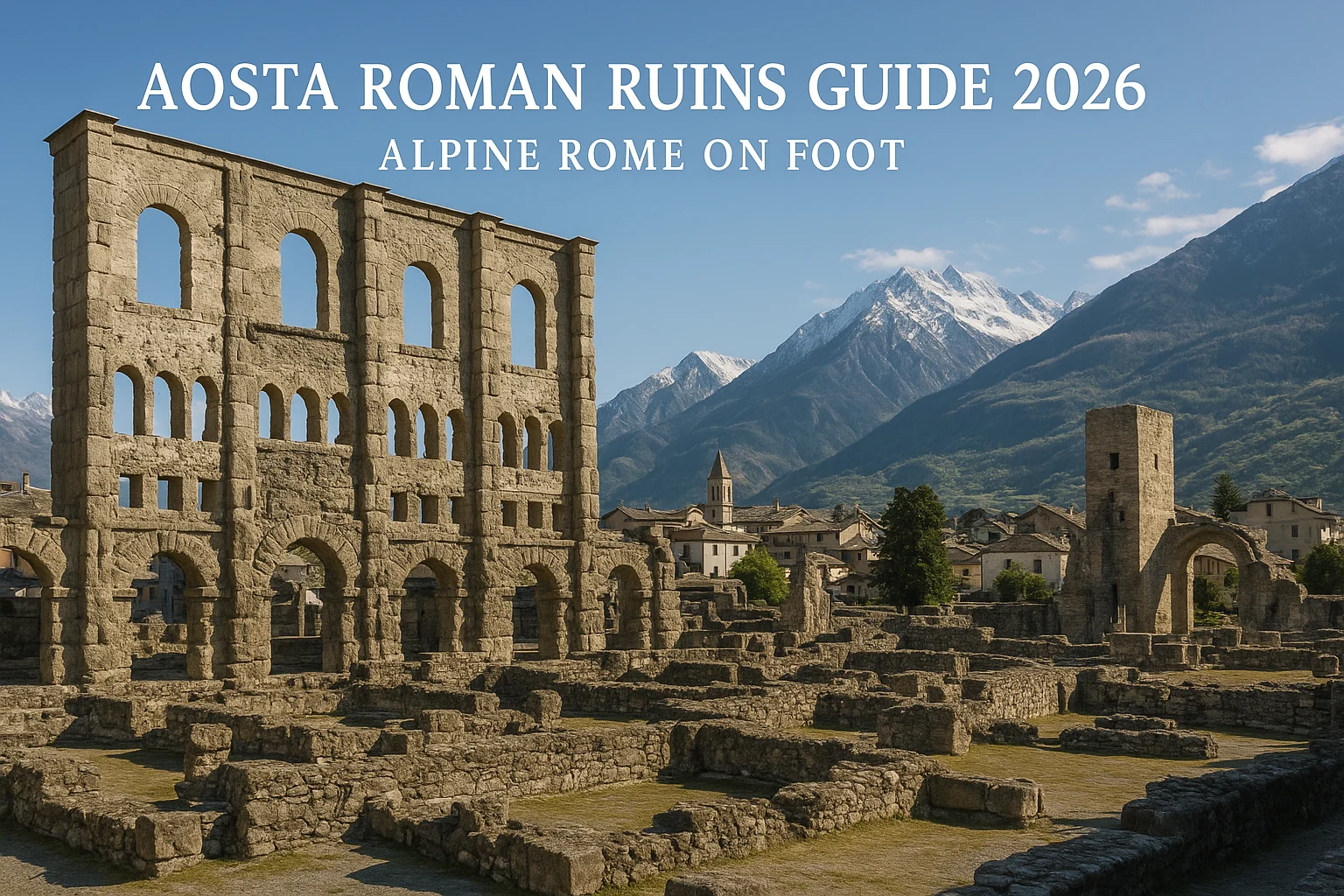
Aosta Roman Ruins Guide 2026: Alpine Rome on Foot
RomanPlan a practical visit to Aosta's Roman remains, including the Arch of Augustus, theater, city walls...
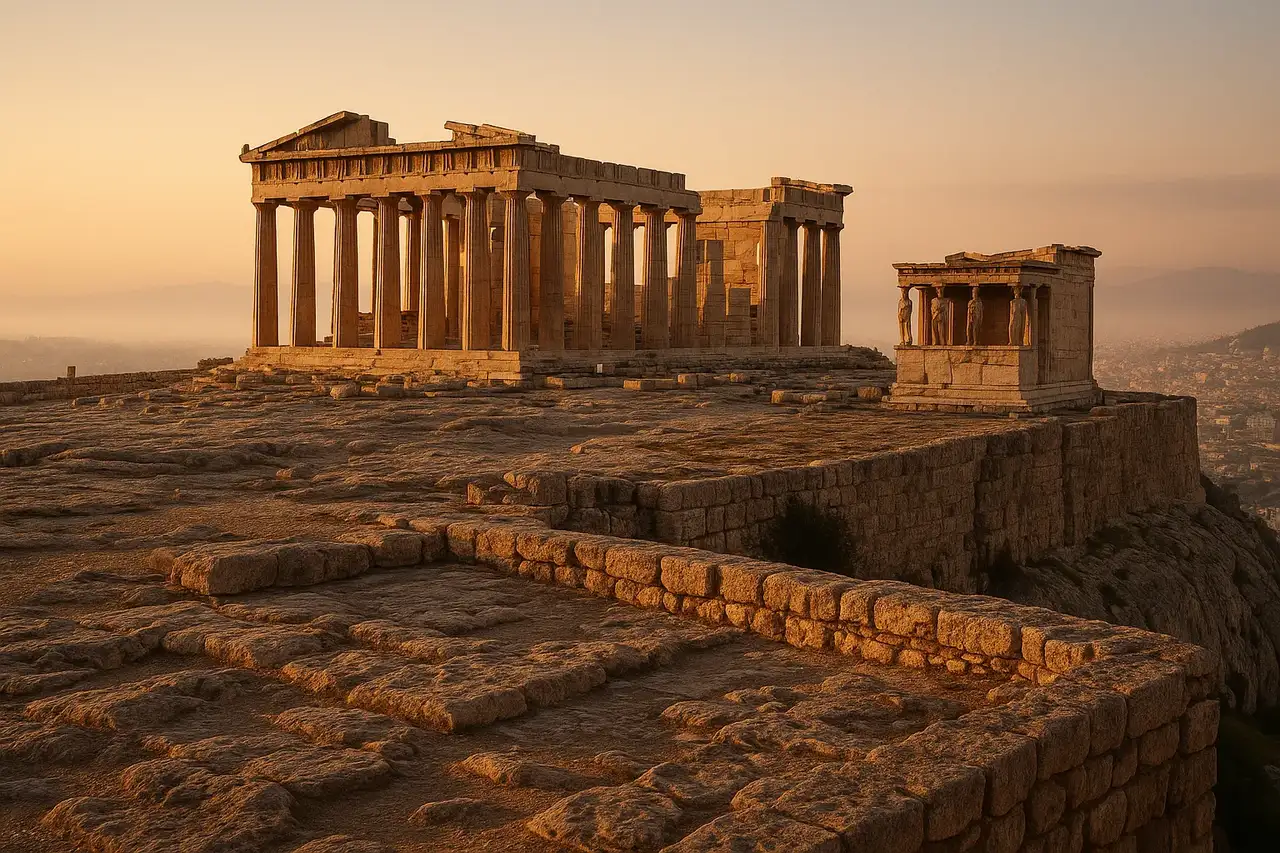
The Complete Acropolis Athens Travel Guide: Temples
Ancient GreecePlan the perfect visit to the Acropolis of Athens with our 2026 guide. Discover the Parthenon, best ...