Quick Info
Curated Experiences
Giza Pyramids and Sphinx Half-Day Tour from Cairo
Giza Pyramids, Sphinx and Solar Boat Museum Tour
Giza Camel Ride and Pyramid Tour
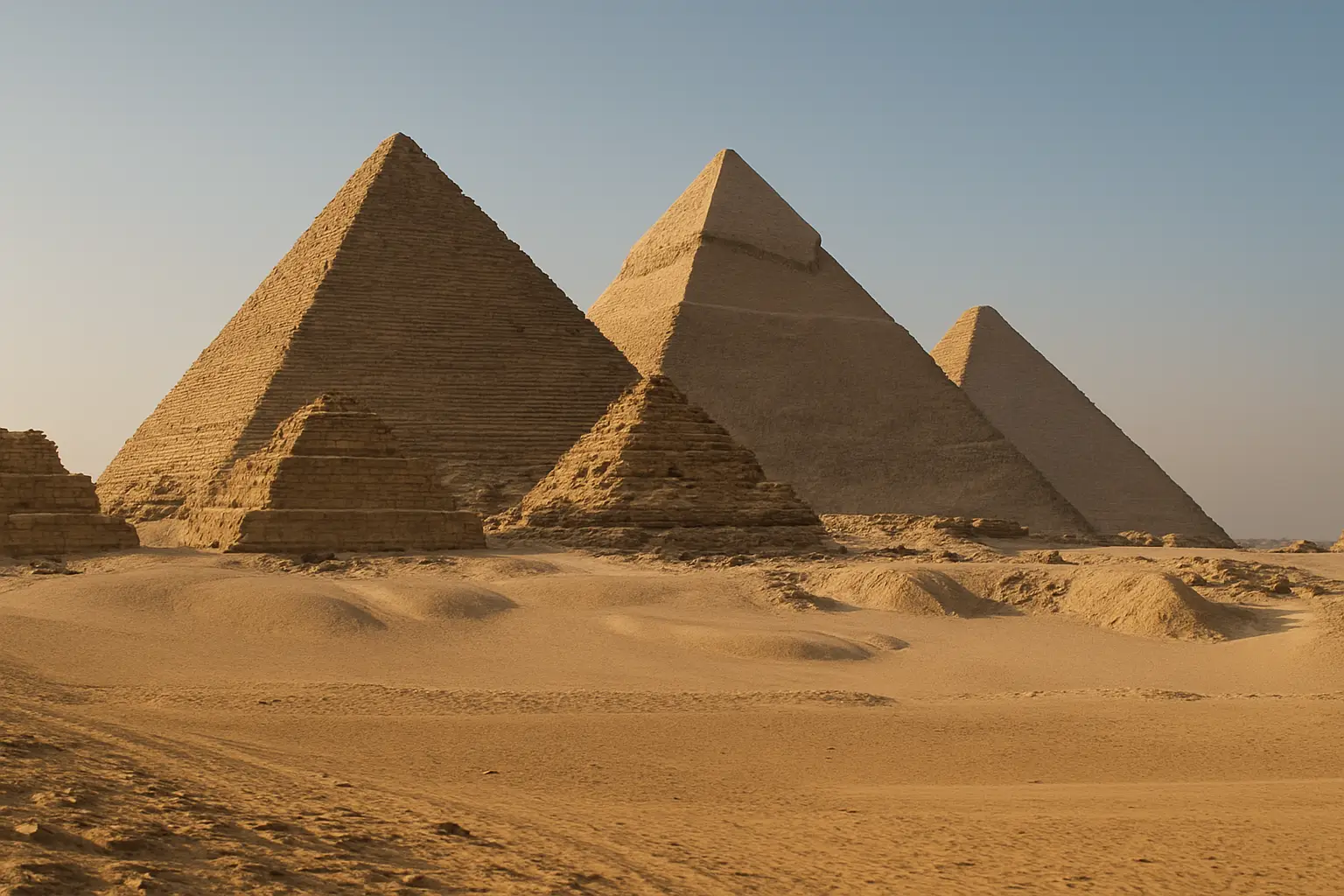
The first thing the Giza plateau teaches you is that photographs lie. Every image you have ever seen of the pyramids compresses their mass into geometry, reduces 6 million tons of limestone to a triangle silhouetted against sky. In person, the Great Pyramid does not read as a shape. It reads as a landscape — a man-made mountain of 2.3 million stone blocks rising 138 meters above the desert floor, each course of masonry taller than you are, stacked with a precision that modern surveying equipment struggles to improve upon. You do not look at it. You stand beneath it and recalibrate your understanding of what organized human labor can accomplish.
Three successive pharaohs of Egypt’s Fourth Dynasty — Khufu, Khafre, and Menkaure — built their eternal monuments on this limestone escarpment between roughly 2580 and 2510 BCE. The result is not three isolated pyramids but an entire funerary city: valley temples, causeways, mortuary chapels, workers’ quarters, subsidiary queens’ pyramids, and the Great Sphinx carved from the bedrock itself. This is the only surviving Wonder of the Ancient World, and the only one that seems likely to outlast every structure we have built since.
Visiting Giza well requires preparation. The plateau is vast, exposed, and relentlessly hot. Vendors are persistent. The ticketing system rewards those who arrive early. This guide gives you the practical information to handle all of that, so you can focus on what actually matters: standing in the presence of something 4,500 years old that still commands awe.
Historical Context
The ancient Egyptians called this place Akhet Khufu — the Horizon of Khufu — and the name captures the ambition behind it. The Old Kingdom pharaohs of the Fourth Dynasty were not simply building tombs. They were constructing machines for resurrection, stone vessels designed to transport a divine king into eternal life among the gods. Every element of the Giza complex served this theological purpose: the pyramid preserved the royal body, the mortuary temple sustained the cult of offerings, the causeway connected the living world of the Nile Valley to the dead world of the western desert, and the valley temple received the royal corpse from its funeral barge.
Khufu began the Great Pyramid around 2580 BCE, and its construction consumed approximately twenty years and a workforce that recent archaeology estimates at 20,000 to 30,000 laborers — not enslaved peoples, as popular myth insists, but organized teams of skilled and semi-skilled workers housed in a purpose-built settlement south of the plateau. They quarried limestone locally, floated granite from Aswan 850 kilometers upstream, and moved blocks averaging 2.5 tons each using ramps, sledges, and techniques that remain debated. The result held the record as the tallest human-made structure on earth for nearly 3,800 years.
Khafre, Khufu’s son, built the second pyramid on slightly higher ground around 2558 BCE, creating the optical illusion that his monument matches or exceeds his father’s. He also commissioned the Great Sphinx and the valley temple beside it — the most complete mortuary complex on the plateau. His grandson Menkaure completed the triad around 2510 BCE with a smaller but more refined pyramid partially cased in red Aswan granite.
By the New Kingdom, a thousand years later, the pyramids were already ancient monuments attracting pilgrims and tourists. Medieval Arab rulers stripped the Tura limestone casing for Cairo’s mosques and fortifications. Napoleon’s savants measured and cataloged the complex in 1798. Victorian-era archaeologists crawled through passages with candles. And still the pyramids resist complete explanation — not because they are genuinely mysterious, but because the civilization that built them was extraordinarily capable, and the written record of their methods has not survived.
What to See
The Great Pyramid of Khufu
The largest, oldest, and most significant structure on the plateau. The base stretches 230.4 meters along each side with a maximum discrepancy between sides of just 4.4 centimeters. The four faces align with true north to within a fraction of a degree. Originally standing 146.5 meters tall with a polished white Tura limestone casing and a gilded capstone, the pyramid now reaches 138.8 meters after medieval stripping. Stand at the base and look up: each course of masonry is roughly chest height, and 203 courses stack above you.
The interior, accessible for a separate 400 EGP ticket limited to 300 visitors per day, is physically demanding but unforgettable. You enter through a medieval breach in the northern face, crouch through a passage barely a meter wide at a sustained 26-degree incline in temperatures exceeding 40 degrees Celsius, and emerge into the Grand Gallery — a corbelled vault 47 meters long and 8.6 meters high that has not shifted since the day it was sealed. Beyond it lies the King’s Chamber, lined in red Aswan granite with an empty lidless sarcophagus. Buy your interior ticket first thing at the booth before exploring the exterior.
The Pyramid of Khafre
Slightly shorter than Khufu’s pyramid at 136 meters but built on a 10-meter rise in the bedrock, Khafre’s monument appears taller from most angles on the plateau. Its distinguishing feature is a cap of original Tura limestone casing still crowning the summit — the only surviving glimpse of how all three pyramids looked when complete: gleaming white peaks visible from the Nile Delta. Khafre’s valley temple beside the Sphinx enclosure is built from enormous granite monoliths and stands to its full original height, making it the best-preserved Old Kingdom building at Giza. The interior (100 EGP) is less physically challenging than Khufu’s and offers a worthy underground experience.
The Pyramid of Menkaure
The smallest of the three at 65.5 meters, Menkaure’s pyramid compensates with material elegance. Its lower courses were cased in polished red Aswan granite — still visible today — with white limestone above, creating a two-toned profile more textured than its neighbors. Three subsidiary queens’ pyramids stand alongside. The interior descent is gentler than Khufu’s and accessible to a wider range of visitors. A basalt sarcophagus found inside by 19th-century excavators was loaded onto a ship bound for England, which sank in the Mediterranean. The chamber is empty now.
The Great Sphinx
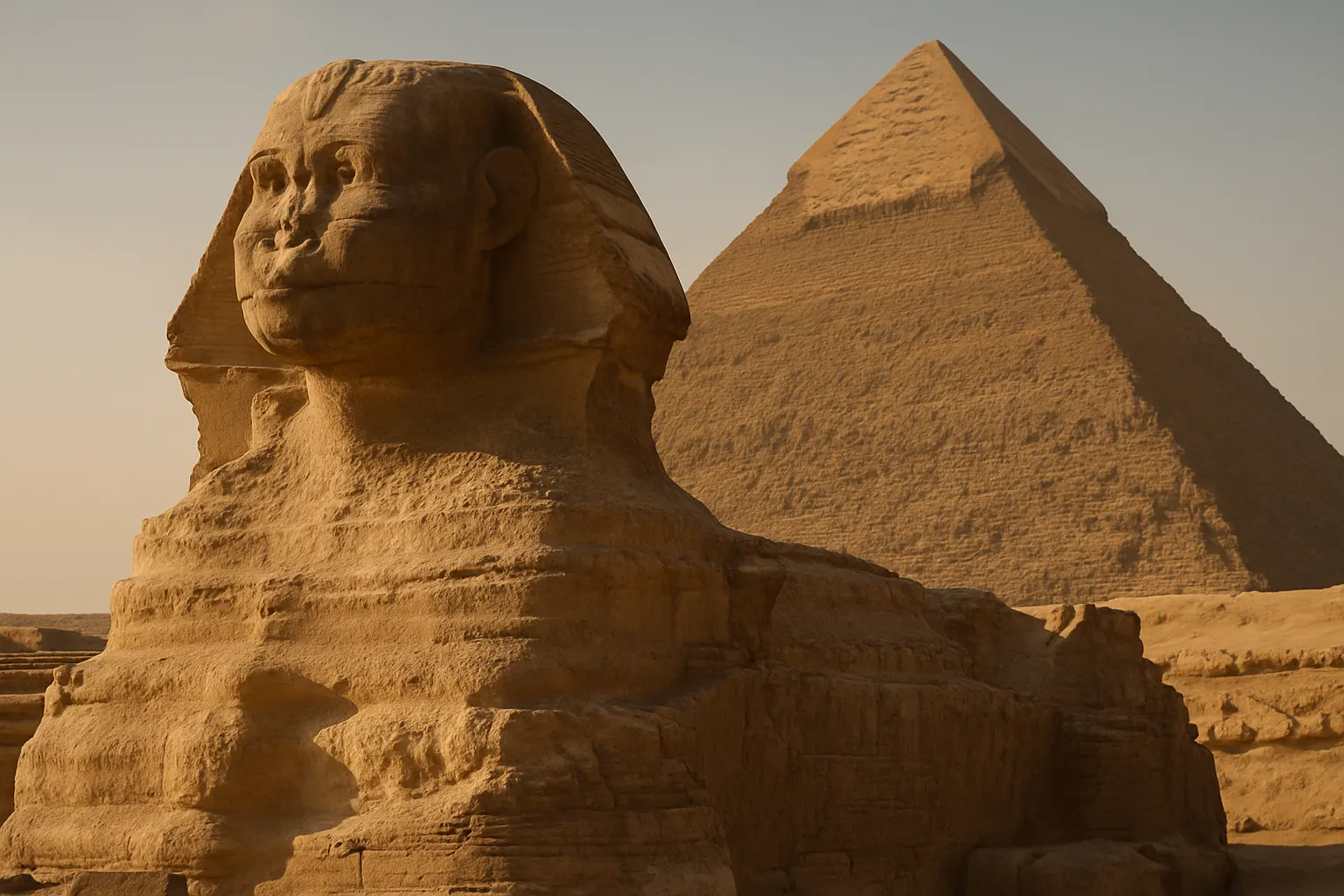
Carved from a natural limestone outcrop left standing after quarrying for Khafre’s pyramid, the Sphinx is the largest monolithic statue on earth: 73 meters long, 20 meters tall, with a face 5 meters wide. It almost certainly bears Khafre’s face and guarded his mortuary complex. The Dream Stela between its paws, erected by Pharaoh Thutmose IV around 1400 BCE, records the Sphinx promising him the throne if he cleared the sand that was burying it. Walk the full perimeter of the enclosure rather than settling for the frontal photograph — the profile view reveals the enormous leonine body that head-on shots compress into flatness.
The Solar Boat Museum
A climate-controlled building beside the Great Pyramid houses a 43.6-meter royal vessel of Lebanese cedar, buried in 1,224 pieces around 2500 BCE and reassembled over fourteen years by Egyptian archaeologist Ahmed Youssef Moustafa. Whether it served as Khufu’s funeral barge or his vessel for the afterlife journey with the sun god, it is the finest surviving ancient boat in the world. Entry costs 100 EGP. Allow 30 to 45 minutes. The museum draws a fraction of the pyramid crowds and is one of the most peaceful stops on the plateau.
The Desert Panorama Point
Walk or ride south past the Menkaure complex to the elevated desert plateau behind the pyramids for the classic three-pyramid alignment photograph — all three receding diagonally against open sky. This is also where camel and horse rides operate. Negotiate the price, duration, and tip inclusion before mounting. A 30-minute ride runs 200 to 400 EGP depending on your negotiation skills.
Timing and Seasons
October through April delivers the best conditions: warm days of 20 to 28 degrees Celsius, minimal rain, and manageable crowds. December and January are the most popular months, but the plateau is large enough that density rarely becomes oppressive outside the Sphinx enclosure.
May through September brings extreme heat of 35 to 45 degrees Celsius. Summer visits are viable only if you arrive at the 7 AM opening and leave by 10 AM. Midday on the shadeless plateau in July is genuinely dangerous for heat exhaustion.
Within any day, the 7 to 9 AM window is consistently the best: cool air, soft directional light that traces every stone course in amber and pink, sparse crowds, and vendors not yet at full intensity. Late afternoon from 4 PM is the second-best window, with golden light and thinner crowds. Avoid 10 AM to 3 PM when heat, tour bus surges, and vendor pressure all peak simultaneously.
The Sound and Light Show runs after dark (tickets around 300 EGP / $10 USD), projecting colored lights and narration onto the Sphinx and pyramids. The narration is melodramatic, but illuminated ancient stone against a desert night sky is genuinely atmospheric.
Tickets, Logistics and Getting There
The Giza plateau sits 15 kilometers southwest of central Cairo, roughly 30 to 60 minutes by road depending on Cairo’s notorious traffic. Taxis and Uber cost 50 to 100 EGP ($1.50 to $3 USD) each way. Organized half-day tours running $35 to $65 include transport, a licensed guide, and entrance fees — the most efficient option for first-time visitors and the best defense against vendor encounters.
General site entry costs 200 EGP (approximately $6.50 USD). The Great Pyramid interior costs an additional 400 EGP ($13 USD), limited to 300 tickets per day — buy these first before exploring the exterior. Khafre and Menkaure interiors cost 100 EGP each. The Solar Boat Museum adds 100 EGP. Camel or horse rides run 200 to 500 EGP for 30 to 60 minutes; negotiate firmly before mounting.
Site hours run 7 AM to 7 PM in summer (April through September) and 8 AM to 5 PM in winter (October through March). Metro Line 1 reaches Giza station with a microbus or taxi transfer to the plateau — cheap but confusing without Arabic. The Grand Egyptian Museum, when fully opened near the plateau entrance, will add a major attraction to the Giza visit.
Practical Tips
- Bring at least two liters of water per person. Dehydration on an open, shadeless limestone plateau in full Egyptian sun is a medical risk, not a precaution.
- Sun protection is non-negotiable: hat, sunglasses, SPF 50+ sunscreen applied before arrival. There is essentially no shade on the plateau outside the Solar Boat Museum.
- Wear closed shoes with real grip. Loose sand, uneven ancient stone, and the steep pyramid interiors demand secure footing. Sandals are a mistake.
- Carry cash in small denominations for tips, entrance supplements, camel rides, and drinks. Card payment is unreliable or unavailable at most points on the plateau.
- A firm, consistent “la, shukran” (no, thank you) repeated without eye contact deflects most vendor approaches. Never accept anything handed to you as a gift — payment will be demanded.
- If you want a camel or horse ride, agree on price, duration, route, and whether the guide’s tip is included before mounting. Confirm the total cost with no ambiguity.
- Hiring a licensed guide through your hotel or a reputable tour operator is the single most effective way to improve your visit. A good guide deflects vendors, provides historical context that transforms the experience, and navigates the plateau efficiently.
- Plan for 3 to 5 kilometers of walking across sand and uneven stone over a typical half-day visit. Pace yourself accordingly.
Suggested Itinerary
7:00 AM — Arrive at the plateau entrance at opening. Buy your general entry ticket and your Great Pyramid interior ticket immediately at the booth.
7:15 AM — Head directly to the Great Pyramid of Khufu. Enter the interior while it is still relatively cool and uncrowded. Allow 30 to 45 minutes for the interior experience.
8:00 AM — Explore the exterior of the Great Pyramid. Walk the base perimeter to appreciate the scale. Photograph the remaining casing stones at the base of the northern face.
8:30 AM — Walk south to the Pyramid of Khafre. Examine the original Tura limestone cap at the summit and visit the valley temple beside the Sphinx enclosure.
9:00 AM — Enter the Sphinx enclosure. Walk the full perimeter. Read the Dream Stela between the paws. Take the classic photograph from the northeast corner with Khafre’s pyramid rising behind the Sphinx’s head.
9:45 AM — Continue south to the Pyramid of Menkaure and its three queens’ pyramids. Note the red granite casing on the lower courses.
10:15 AM — Walk or ride to the desert panorama point behind the pyramids for the three-pyramid alignment photograph.
10:45 AM — Visit the Solar Boat Museum beside the Great Pyramid. Allow 30 to 45 minutes in the air-conditioned space.
11:30 AM — Exit the plateau. Total visit time: approximately 4.5 hours.
Nearby Sites
Great Sphinx of Giza — Located within the same plateau complex, the Sphinx is included in your general entry ticket and sits beside Khafre’s valley temple. Allow 45 minutes to an hour for the enclosure.
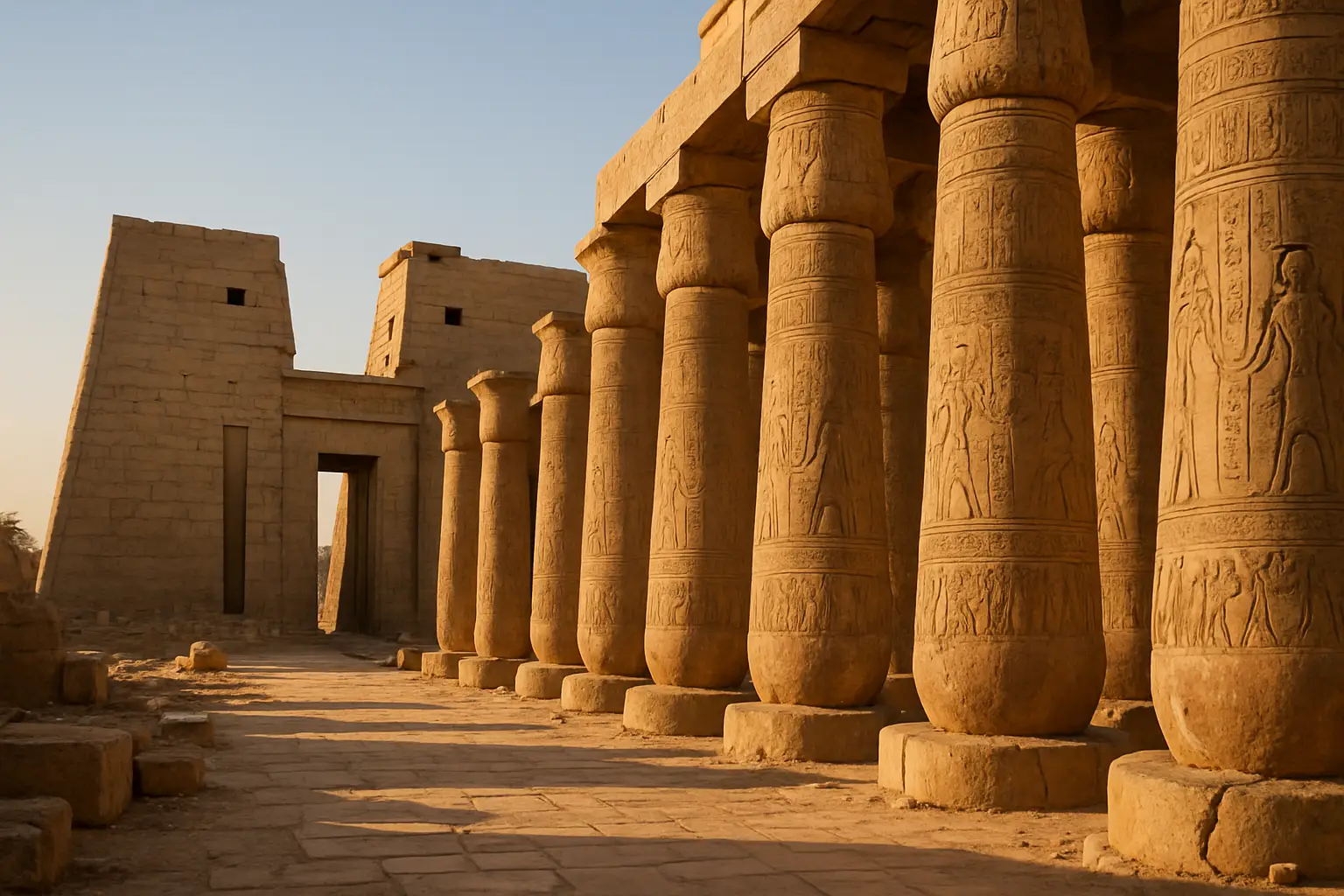
Karnak Temple Complex — Egypt’s greatest temple, 700 kilometers south in Luxor. Most visitors fly Cairo to Luxor (1 hour) or take the overnight sleeper train. Karnak represents the New Kingdom at its peak — a useful counterpoint to the Old Kingdom achievements at Giza.
Valley of the Kings — The royal necropolis on Luxor’s west bank where the pharaohs abandoned pyramid burial for hidden tombs cut into cliff faces. A day trip from Luxor combines naturally with Karnak and Luxor Temple.
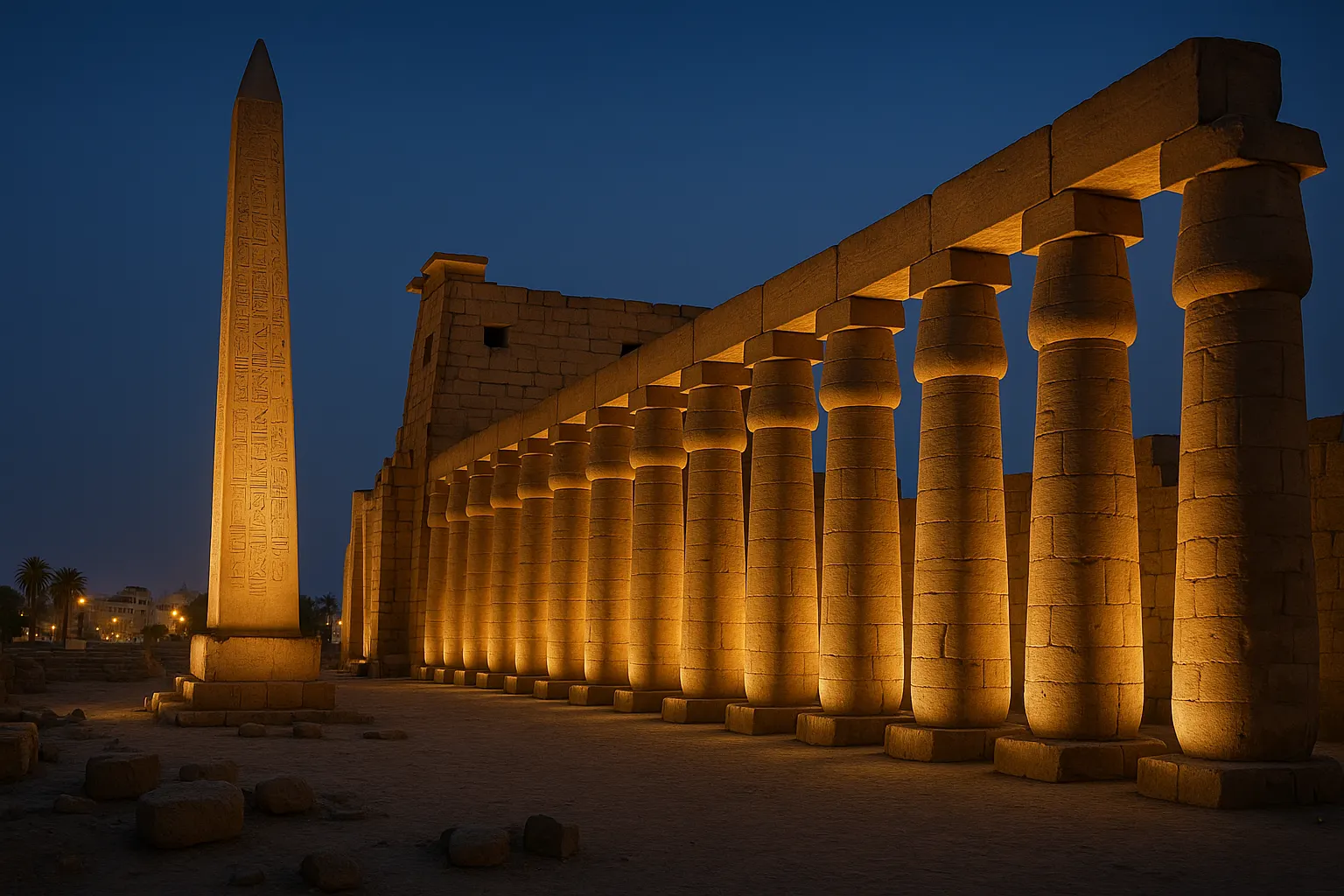
Luxor Temple — The elegant east bank temple illuminated dramatically at night, connected to Karnak by the restored Avenue of Sphinxes. Best visited in the evening after a morning at the west bank tombs.
The Measure of Everything
Standing at the base of the Great Pyramid, you can reach out and touch individual blocks that weigh more than a car, fitted together with joints accurate to one-hundredth of an inch by workers who had no iron tools, no wheeled vehicles, and no written engineering manuals that have survived to explain how they accomplished what they accomplished. The pyramid does not ask you to believe anything supernatural. It asks you to reckon with what human beings organized and executed 4,500 years ago using intelligence, labor, and stone.
The Giza plateau will outlast every building you have ever entered. It will outlast the city that sprawls to its eastern edge. The pharaohs who built it believed they were constructing vessels for eternity, and on the evidence so far, they were right. Come early, bring water, negotiate firmly with the camel drivers, and give yourself enough time to simply stand and look. The pyramids have waited forty-five centuries for you. They can wait while you catch your breath.
Discover More Ancient Wonders
- Great Sphinx of Giza: The enigmatic limestone guardian on the same plateau
- Karnak Temple Complex: Egypt’s greatest temple, 2,000 years of construction at Luxor
- Valley of the Kings: Painted royal tombs cut into the cliffs of Luxor’s west bank
- Luxor Temple: The elegant Nile-side temple illuminated at night
For practical preparation, see our beginner’s guide to visiting ancient sites and our advice on photographing ruins.
Quick Facts
| Attribute | Details |
|---|---|
| Location | Giza Plateau, west of Cairo, Egypt |
| Country | Egypt |
| Region | Giza |
| Ancient Name | Horizon of Khufu (Akhet Khufu) |
| Civilization | Ancient Egyptian |
| Historical Period | c. 2580—2510 BCE (Fourth Dynasty, Old Kingdom) |
| Established | c. 2580 BCE |
| UNESCO Status | World Heritage Site (1979) |
| Coordinates | 29.9792, 31.1342 |
| Distance from Cairo | 15 km southwest; 30—60 minutes by taxi |
| Best Time | October—April; arrive at 7 AM opening |
| Entry Fee | 200 EGP (~$6.50 USD) general; Great Pyramid interior 400 EGP extra |
| Hours | Summer 7 AM—7 PM; Winter 8 AM—5 PM |
| Suggested Stay | Half day (4—5 hours) to full day |
Frequently Asked Questions
Can you go inside the Great Pyramid?
Yes, but it requires a separate ticket (400 EGP/$13 USD) and is not included in general admission. The interior features narrow passages, the Grand Gallery, and the King's Chamber with its empty granite sarcophagus. It's hot, cramped, and claustrophobic—not recommended for those with mobility issues, claustrophobia, or respiratory problems. Limited to 300 visitors per day; arrive early to secure tickets.
How do I get to the Pyramids of Giza from Cairo?
The Giza plateau is 15 km southwest of central Cairo. Taxis/Uber cost 50-100 EGP ($1.50-3 USD). Organized tours ($35-65) include transport and guide. Metro Line 1 goes to Giza station; transfer by microbus or taxi. Most visitors spend half a day (4-5 hours) at the site, combining pyramids, Sphinx, and Solar Boat Museum.
Which pyramid should I prioritize if time is limited?
The Great Pyramid of Khufu (Cheops) is the largest, oldest, and only surviving Ancient Wonder of the World. Enter if you can handle the claustrophobic passages. For photos, the pyramids of Khafre and Menkaure offer excellent angles without crowds. The view from the desert plateau behind the pyramids is iconic—hire a camel or horse to reach it (negotiate price firmly).
When is the best time to visit the Pyramids of Giza?
Early morning (7-9 AM) offers cooler temperatures, soft light for photography, and fewer crowds. Late afternoon (4-6 PM) provides golden light and thinner crowds. Avoid midday (10 AM-3 PM) when heat, crowds, and persistent vendors peak. Winter (November-February) offers the most pleasant weather overall.
What are the Solar Boats at Giza?
The Solar Boat Museum displays a full-sized ancient Egyptian royal boat, disassembled and buried beside the Great Pyramid around 2500 BCE. Reassembled in the 1960s, the 43-meter cedar vessel represents the boat that carried Pharaoh Khufu's body to Giza or served his sun god journey in the afterlife. A second boat remains buried and unexcavated. Entry is 100 EGP ($3 USD).
How do I avoid scams and aggressive vendors at Giza?
The Giza plateau is notorious for persistent touts. Strategies: (1) Firmly say 'la, shukran' (no, thank you) repeatedly; (2) Don't make eye contact or engage in conversation; (3) Never accept 'gifts'—they'll demand payment; (4) If taking camel/horse rides, negotiate price and duration explicitly beforehand; (5) Report harassment to tourist police if needed; (6) Consider a reputable guide who can deflect vendors. Staying on marked paths reduces encounters.
Nearby Ancient Sites
Great Sphinx of Giza Egypt Travel Guide 2026: Guardian of the Pyramids
Ancient EgyptianVisit the Great Sphinx, Egypt's enigmatic limestone guardian. Our guide covers the Sphinx's history,...
Karnak Temple Complex Egypt Travel Guide 2026: Egypt's Greatest Temple
Ancient EgyptianExplore Karnak, the world's largest ancient religious complex. Discover the Hypostyle Hall, Sacred L...
Luxor Temple Egypt Travel Guide 2026: The Elegant Temple of Luxor
Ancient EgyptianVisit Luxor Temple, the most elegant temple in Egypt. Discover the Avenue of Sphinxes, Colonnade of ...