Quick Info
Curated Experiences
Desert Castles Day Trip from Amman
Eastern Jordan Desert Castles Private Tour
Jordan Pass: 40+ Attractions including Desert Castles
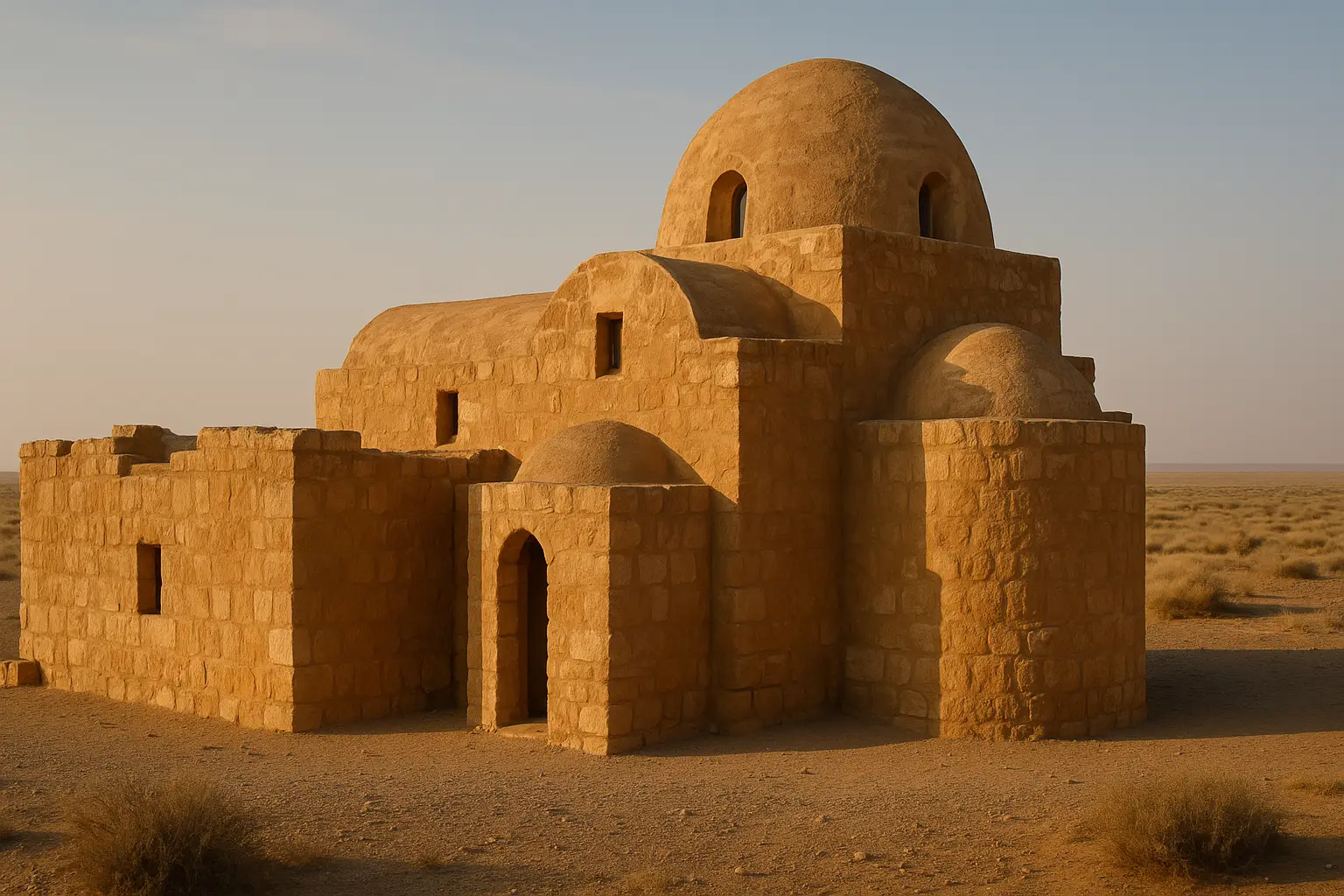
In Jordan’s eastern desert, where the steppe grades into sand and the sky dominates every horizon, a small stone building contains the most extraordinary evidence of what early Islamic culture looked like before it became what we now recognize as Islam. Qasr Amra is modest in size — a few rooms, a bath complex, a compact footprint you could walk in five minutes. But its walls are covered in frescoes that, by any later reckoning of Islamic art, should not exist: nude women bathing, a prince receiving conquered rulers on his throne, musicians mid-performance, and hunters pursuing thirty-five species of desert game labeled in both Arabic and Greek. Above it all, a domed ceiling maps the northern hemisphere’s night sky — the oldest surviving astronomical painting in the Islamic world.
The figures are confident, sensuous, and charged with pleasure. They were painted barely a century after the Prophet Muhammad’s death, in a cultural moment of extraordinary openness that closed behind it almost as soon as the pigments dried. Within a generation, figural art largely vanished from Islamic palatial architecture. Qasr Amra survives as a window into the cosmopolitan Umayyad court that synthesized Byzantine, Persian, and Arabian traditions with the ease of an empire that had recently conquered them all — curious about everything it inherited, exuberant about everything it had become, not yet hemmed in by the rules that would govern its successors.
Getting here takes commitment. The castle sits 80 kilometers east of Amman on a flat desert highway, surrounded by nothing but steppe and sky. That isolation is part of its power. You arrive at a place that was built precisely to be remote — a pleasure retreat where court life could unfold far from the scrutiny of religious authorities and urban expectations. The desert that insulated the prince now insulates the visitor.
Historical Context
The Umayyad Caliphate (661-750 CE) ruled history’s largest empire at its peak, stretching from the Iberian Peninsula to the borders of India. Its princes and caliphs constructed a string of desert retreats — palatial complexes known as qusur — across the Jordanian steppe and Syrian desert. Some served as hunting lodges. Others managed agricultural estates or sheltered caravans. Some existed simply to provide escape from the formalities of Damascus, where a prince could drink wine, commission poetry, and entertain company that urban propriety might otherwise forbid.
Qasr Amra was almost certainly built for Walid ibn Yazid, known to history as Walid II, who served as Umayyad caliph from 743 to 744 CE before his assassination ended one of Islam’s most artistically adventurous reigns. An inscription within the castle names the master craftsman who directed the fresco program — a specificity remarkable in early Islamic art, where artists typically remained anonymous. That the artisan’s name was carved into the structure suggests a patron who valued individual artistic achievement and a cultural moment willing to celebrate it.
The building is deliberately intimate. Unlike the grand Umayyad palaces at Anjar in Lebanon or Khirbat al-Mafjar near Jericho — sprawling complexes designed to project dynastic power across the landscape — Qasr Amra was never meant to impress with scale. Its exterior is plain cut limestone, its footprint compact. The power is entirely interior: a modest shell that opens into a world of painted imagery unlike anything else surviving from the early Islamic centuries.
The fresco program represents a moment of cultural synthesis unique in early Islamic history. The painters drew simultaneously on Byzantine figural traditions, Persian courtly imagery, and Hellenistic scientific illustration, producing a body of work that reveals how thoroughly the Umayyad elite had absorbed the civilizations they conquered. This was not mimicry. It was confident appropriation by a ruling class that saw no contradiction between Islamic faith and the visual pleasures of the pre-Islamic Mediterranean and Persian worlds. That confidence would not last. The Abbasid revolution of 750 CE overthrew the Umayyads and inaugurated a more austere relationship between faith and figural art. Qasr Amra’s paintings preserve the moment before that door closed.
What to See
The Reception Hall
The entrance leads directly into the main reception hall, a tripartite vaulted chamber where the prince received guests and held audiences. Three barrel-vaulted bays run parallel, every surface coated in lime-washed plaster and painted with the confidence of craftsmen who knew exactly what they were doing. The most celebrated image is a vast hunting scene unfolding like a continuous panorama across a full wall: riders on horseback, nets strung across the desert floor, beaters driving game toward waiting hunters. Thirty-five species of animals are depicted with enough naturalistic precision that modern zoologists can identify them — onager, oryx, gazelle, hare, fox — each labeled in both Arabic and Greek. The bilingual inscriptions speak directly to the court’s cosmopolitan character: an Arab prince commissioning art that acknowledged Greek learning without finding it necessary to choose between the two traditions. Elsewhere on the walls, nude women bathe in scenes drawn from the Byzantine tradition of the Three Graces. Musicians play. Craftsmen work their trades. The hall presents Umayyad civilization as a culture that absorbed everything around it and found the result entirely to its liking.
The Six Kings Panel
Among the reception hall’s most historically significant images, a formal composition shows an enthroned Umayyad figure receiving the symbolic submission of six rulers representing the extent of the known world. Scholars have proposed identifications including the Byzantine emperor, the Sassanid Persian king, the Visigothic ruler of Spain, the king of Axum in East Africa, and rulers from China and Central Asia. The painting functions as political theology: the Umayyad caliph sits at the center of a universe that radiates outward to its farthest recognizable peripheries. The confidence is not fantasy. The Umayyad Caliphate had genuinely defeated or absorbed most of these powers within living memory of the painting’s creation. The Sassanid Empire had been destroyed entirely. The Byzantines had been driven from Syria, Egypt, and North Africa. The Visigoths had been conquered in a single campaign. The Six Kings panel is memory rendered in pigment by a court that had watched the world reorganize itself around a new center.
The Astronomical Ceiling
The domed bay above the reception hall carries the complex’s most intellectually ambitious image: a rendering of the northern hemisphere’s night sky executed with careful attention to astronomical accuracy. The twelve zodiac constellations are painted as recognizable figures — Scorpius poised above Orion, Gemini facing each other across the curved surface, Taurus lowering its horns. Alongside the inherited Greek zodiacal tradition, the painting incorporates the Arabic system of lunar mansions (manazil al-qamar) that governed timekeeping and navigation across the Islamic world. This is the oldest surviving astronomical painting in the entire Islamic tradition, and its significance extends well beyond art history. The ceiling demonstrates that Umayyad court culture had absorbed and valued Greek astronomical learning transmitted through Byzantine intermediaries, considering it worthy of permanent display in a private palace. Stand directly beneath the dome and look up — despite fading and cracking, the composition remains legible, a curved sky mapped onto a curved ceiling by a craftsman who understood that the stars belonged as much to an Arab prince as to any Greek astronomer who had charted them centuries before.
The Bath Complex
Behind the reception hall lies the functional heart of Qasr Amra: a bath suite whose three-room sequence follows the Roman model — hot room (caldarium), warm room (tepidarium), and cold room (frigidarium). Archaeologists have traced hypocaust channels beneath the floors that once carried hot air from a furnace, the same engineering Romans deployed from Britain to the Euphrates. The bath rooms continue the fresco program at a correspondingly intimate scale. Bathers appear on the walls in relaxed postures. The quality of light in the smaller vaulted rooms differs from the reception hall — lower, more enclosed — and the paintings feel correspondingly personal. The bath was not merely functional. It was a choreographed movement through degrees of heat and steam, conducted in rooms designed to slow the visitor down and encourage conversation. The building as a whole — reception hall opening directly into bath suite — reflects a conception of hospitality in which physical comfort and intellectual pleasure were inseparable.
Timing and Seasons
Opening hours run 8:00 AM to 6:00 PM in summer and 8:00 AM to 4:00 PM in winter; verify current hours before your visit, as they occasionally shift seasonally. Morning light is best for viewing the frescoes, when natural illumination through the windows supplements artificial lighting without overpowering it.
Spring (March through May) is the ideal season, with temperatures between 68-82°F (20-28°C) and occasional desert wildflowers covering the steppe. Autumn (September through November) offers similar conditions with fewer visitors. Summer temperatures regularly exceed 95°F (35°C) by midday — if visiting June through August, arrive at opening and plan to leave by 11:00 AM. Winter brings cold winds and occasional rain but remains manageable in layers; temperatures range from 45-60°F (7-16°C).
The castle itself provides shade, but the approach, exterior, and surrounding grounds are fully exposed. The interior is compact enough that 45-60 minutes covers everything if you look carefully. The frescoes reward slow attention — rush through and you miss the labeled animal species, the bilingual inscriptions, and the subtleties of the astronomical dome.
Tickets, Logistics, and Getting There
Admission is 3 JOD (approximately $4 USD) at the gate. The Jordan Pass includes entry along with Petra, Jerash, the Amman Citadel, and more than 40 other sites — strongly recommended for any visitor spending more than a day in Jordan.
By car from Amman, take Highway 40 east toward Azraq. The road is fully paved and a standard sedan handles it without difficulty. Brown tourist signs mark the turnoff. Journey time is approximately 90 minutes. Fill your fuel tank in Amman or Zarqa — stations become sparse once the desert begins. Download offline maps before leaving, as cell service across much of the route is unreliable. Public transport to Qasr Amra is effectively nonexistent.
Organized tours from Amman cost $90-120 per person and typically combine Qasr Amra with Qasr Kharana and Qasr Azraq in a half-day circuit. The guide commentary transforms what might otherwise be puzzling painted walls into a coherent narrative about Umayyad civilization, and the logistics of desert driving are handled for you. For independent drivers, the full desert castle loop (Amra, Kharana, Azraq) takes 4-5 hours from Amman including driving and visiting time.
The site has basic restroom facilities and a small visitor center but no water vendors or food stalls. A parking area accommodates cars and tour buses.
Practical Tips
- Bring at least two liters of water per person. The desert is dry, hot in summer, and the nearest reliable refreshment is back in Zarqa or Azraq.
- Flash photography is prohibited throughout the interior. It degrades the pigments. Use a slow shutter in the low-light rooms or increase your ISO.
- A wide-angle lens is essential for capturing the astronomical ceiling and the reception hall frescoes from within the compact vaulted rooms.
- A small flashlight helps for examining fresco details in the dimmer corners of the bath rooms.
- Wear sturdy footwear. The desert floor around the site is uneven limestone and gravel.
- If driving independently, start early. The desert roads are straightforward but the distances are real, and you want to see the frescoes in morning light.
- The drive itself is part of the experience. Watch for the moment when cultivated fields give way to open steppe, and the moment when the steppe begins showing its first patches of sand. These transitions define the Jordanian landscape.
Suggested Itinerary
Desert Castle Loop (4 to 5 hours from Amman):
Depart Amman by 8:00 AM heading east on Highway 40. Stop first at Qasr Kharana (30 minutes), the imposing square fortress with no decoration and many unanswered questions about its function. Continue 15 kilometers to Qasr Amra (60 minutes), taking time with the frescoes, the astronomical ceiling, and the bath rooms. Drive 25 kilometers further east to Qasr Azraq (30 minutes), the black basalt fortress where T.E. Lawrence based his Arab Revolt operations in 1917-1918. Return to Amman by early afternoon, arriving in time for a late lunch and an afternoon visit to the Amman Citadel to see the Umayyad Palace that continues the story.
Qasr Amra focused visit (half day):
If short on time, drive directly to Qasr Amra without the other castles. Spend a full hour inside, dividing time between the reception hall frescoes (25 minutes), the astronomical ceiling (15 minutes), and the bath complex (15 minutes). Use the remaining time to walk the exterior and photograph the building in its desert setting. Return to Amman by noon.
Nearby Sites
Amman Citadel is the natural companion to Qasr Amra. The Citadel’s Umayyad Palace complex represents the dynasty’s official, public face — administrative architecture on a hilltop commanding a major city. Qasr Amra represents the private face — pleasure, art, and intellectual curiosity deployed in a desert retreat. Together, they offer the most complete picture of Umayyad culture available in Jordan.
Jerash, one hour north of Amman, is the best-preserved Roman provincial city in the Middle East. Its colonnaded streets, temples, and theatres provide the deeper chronological context for understanding the Greco-Roman world that the Umayyads inherited and transformed. A day combining the Citadel, Jerash, and the desert castle loop covers the full arc of Jordan’s ancient history from Rome to early Islam.
Umm Qais, ancient Gadara of the Decapolis, sits on a dramatic hilltop in northern Jordan with views across the Sea of Galilee and the Golan Heights. Reachable as a day trip from Amman (2 hours north), it extends the Roman-period story that Jerash and the Citadel begin.
Final Take
Qasr Amra is small. You can walk through it in ten minutes. But what it contains — the oldest astronomical painting in Islam, the only surviving figural frescoes from the Umayyad court, a bilingual hunting encyclopedia, and a bathing suite that transplants Roman social engineering into the Arabian desert — makes it one of the most significant buildings in the entire Islamic world. The desert drive to get here strips away everything except landscape and sky, and then this small stone structure opens its doors and shows you a civilization in its most unguarded moment: confident, curious, and completely alive. There is nothing else like it. See it while the frescoes still have color.
Discover More Ancient Jordan
- Amman Citadel: Temple of Hercules and Umayyad Palace overlooking Jordan’s capital
- Jerash: The best-preserved Roman city in the Middle East, one hour north
- Umm Qais: Ancient Gadara’s hilltop ruins with views across the Sea of Galilee
- Plan your complete journey with our Jordan Ancient Sites Guide
Quick Facts
| Attribute | Details |
|---|---|
| Location | Amman, Zarqa, Jordan |
| Country | Jordan |
| Region | Zarqa |
| Civilization | Umayyad |
| Historical Period | c. 743 CE |
| Established | c. 723-743 CE |
| UNESCO Status | World Heritage Site (1985) |
| Admission | 3 JOD (~$4 USD); included with Jordan Pass |
| Hours | Summer 8 AM-6 PM; Winter 8 AM-4 PM |
| Time Needed | 45-60 min (castle); half-day for loop |
| Coordinates | 31.8022, 36.5886 |
Frequently Asked Questions
How do I get to Qasr Amra from Amman?
Drive east on Highway 40 toward Azraq (80 km, 1.5 hours). The castle is well-signposted. A standard car is sufficient—the road is paved. Public transport is limited; organized tours ($95) or rental car are recommended. The site lies in Jordan's eastern desert, 80 km from Amman.
Why are the Qasr Amra frescoes significant?
The frescoes are exceptional because they represent early Islamic figural art at a time when Islamic art was supposedly aniconic (avoiding human figures). The paintings depict hunting scenes, nude women bathing, musicians, and rulers—images that would soon disappear from Islamic art. They provide crucial evidence for understanding early Islamic cultural practices.
What will I see at Qasr Amra?
The small stone structure contains a reception hall and bath complex with extraordinary frescoes: a hunting scene with 35 species of animals identified by Arabic and Greek labels, nude female bathers, musicians, craftsmen, and a famous domed ceiling showing the zodiac, northern hemisphere constellations, and early Islamic astronomical knowledge.
How much time do I need at Qasr Amra?
Plan 45-60 minutes for the castle itself. The desert castles loop (Qasr Amra, Qasr Kharana, Qasr Azraq) requires a half-day (4-5 hours) from Amman. Each castle is small but distinct—Amra for frescoes, Kharana for architecture, Azraq for history.
What is the best time to visit Qasr Amra?
Spring (March-May) and autumn (September-November) offer pleasant temperatures (20-30°C). Summer visits (June-August) should start early (8 AM opening) as temperatures exceed 35°C by midday. Winter can bring cold winds and occasional rain. Morning light is best for viewing frescoes.
What are the other desert castles near Qasr Amra?
The three main Umayyad desert castles form a popular loop: Qasr Amra (frescoes), Qasr Kharana (imposing fortress architecture, no decoration), and Qasr Azraq (black basalt fortress where T.E. Lawrence based his operations in 1917). All are within 1 hour's drive of each other.
Nearby Ancient Sites
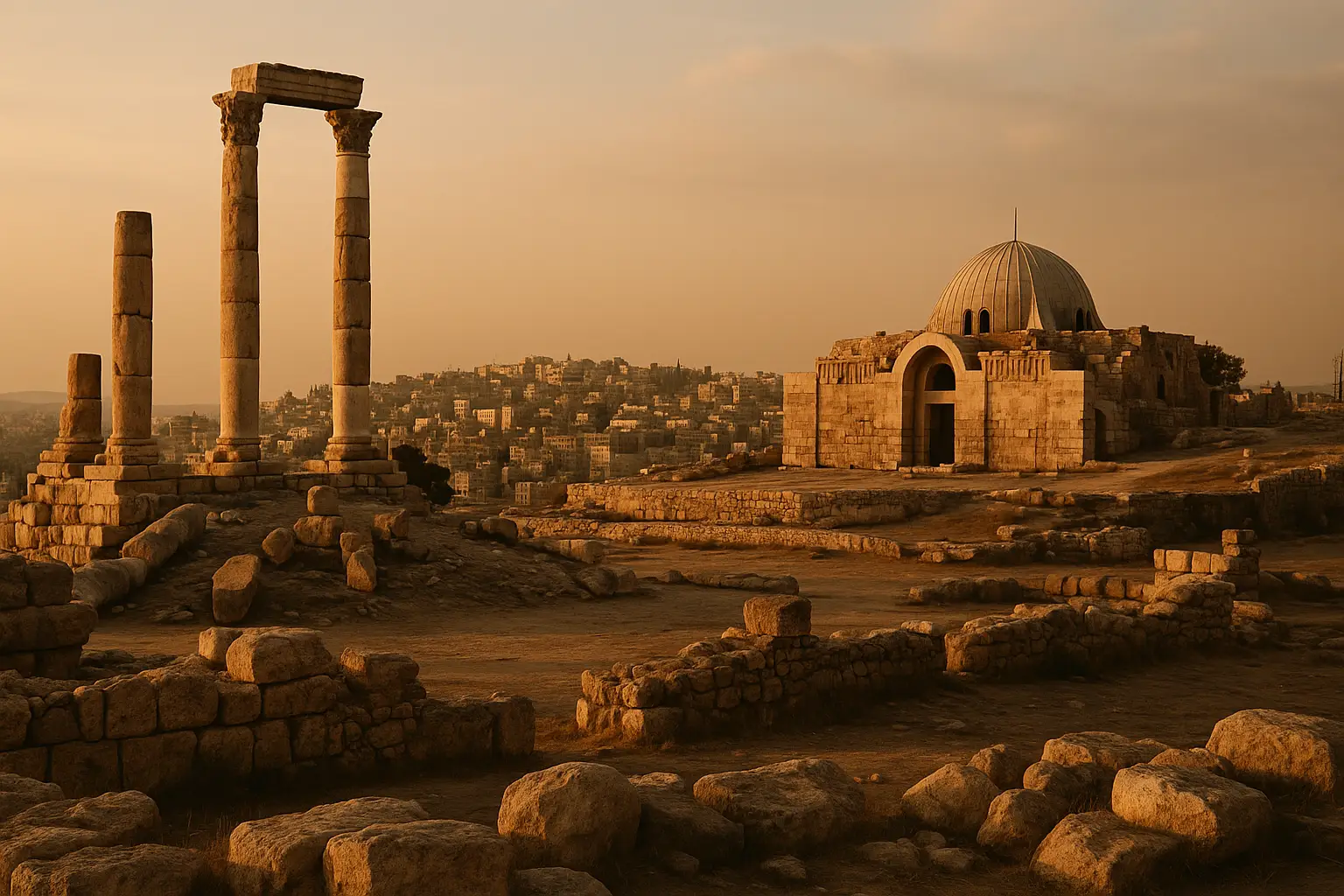
Amman Citadel Jordan Guide 2026: Temple of Hercules & Ancient Rabbah
Ammonite-Roman-UmayyadExplore Jordan's ancient citadel overlooking modern Amman. Discover the Temple of Hercules, Umayyad ...
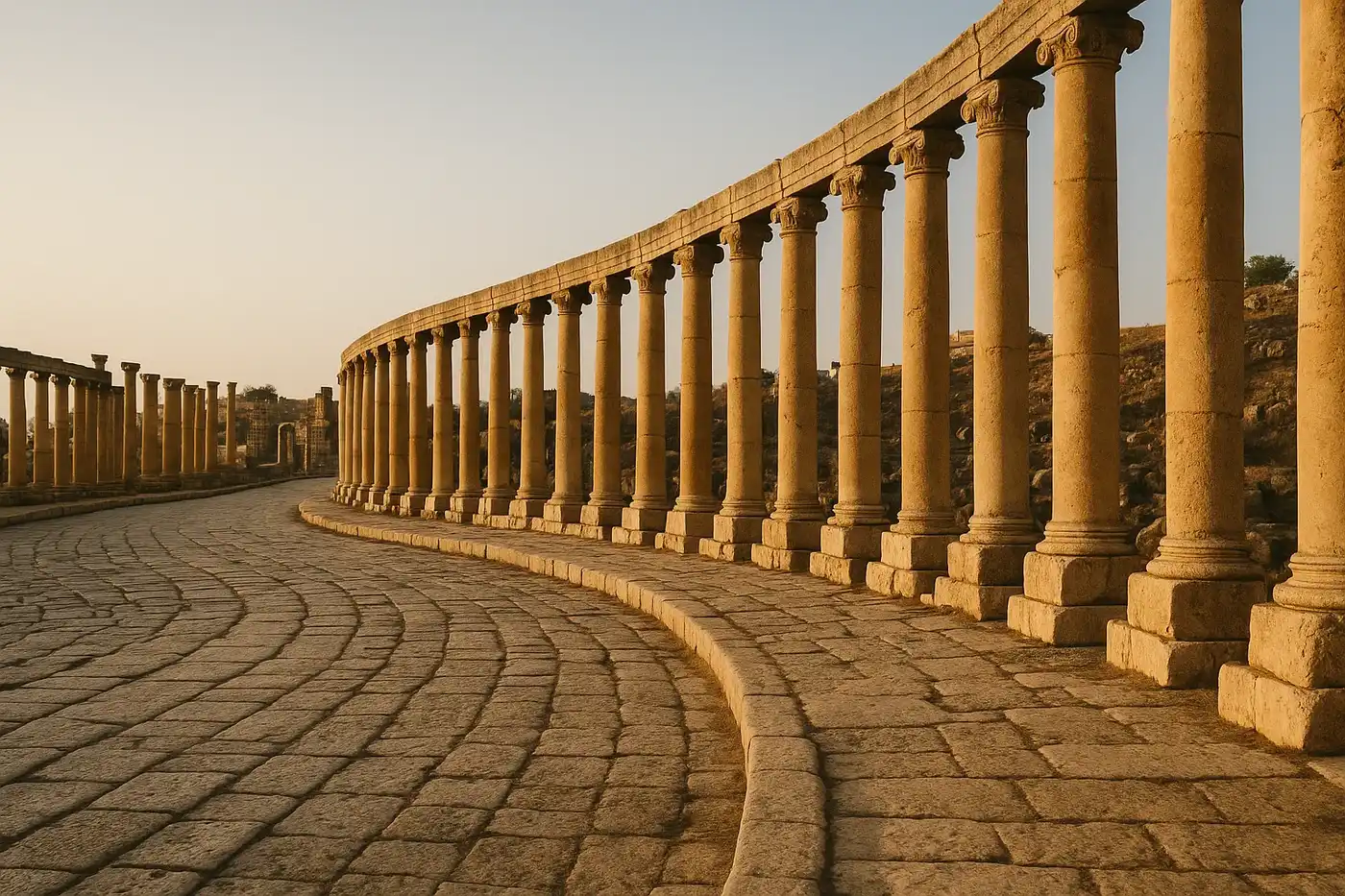
Jerash: The Pompeii of the East and Jordan's Best-Preserved
Roman / NabataeanDiscover Jerash, Jordan's remarkable Roman ruins. Walk the colonnaded streets of ancient Gerasa, exp...
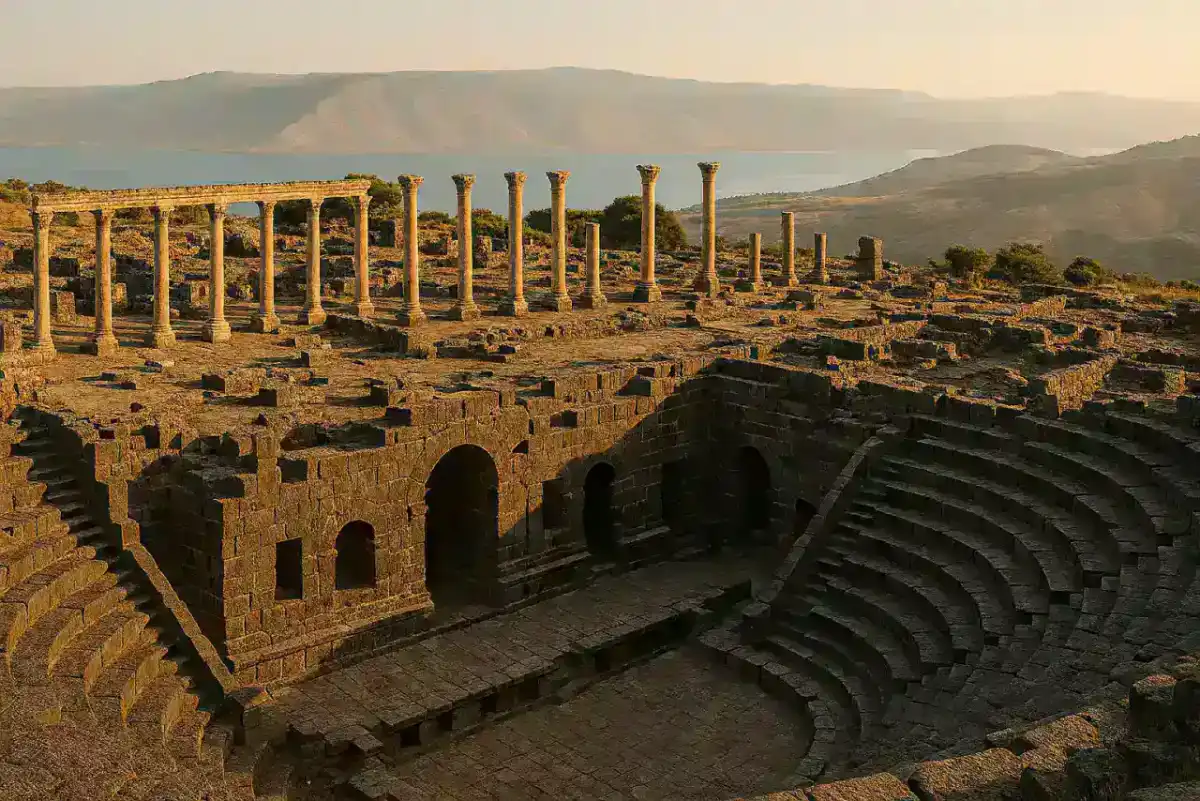
Umm Qais Jordan Travel Guide 2026: Gadara & Views to Galilee
Greco-Roman (Decapolis)Visit Umm Qais, ancient Gadara, for dramatic views over the Sea of Galilee, Golan Heights, and Jorda...