Quick Info
Curated Experiences
Salamis and Famagusta Full-Day Tour from Nicosia
Private Trip to Salamis and Saint Barnabas Monastery
Ancient Salamis and Varosha Guided Excursion
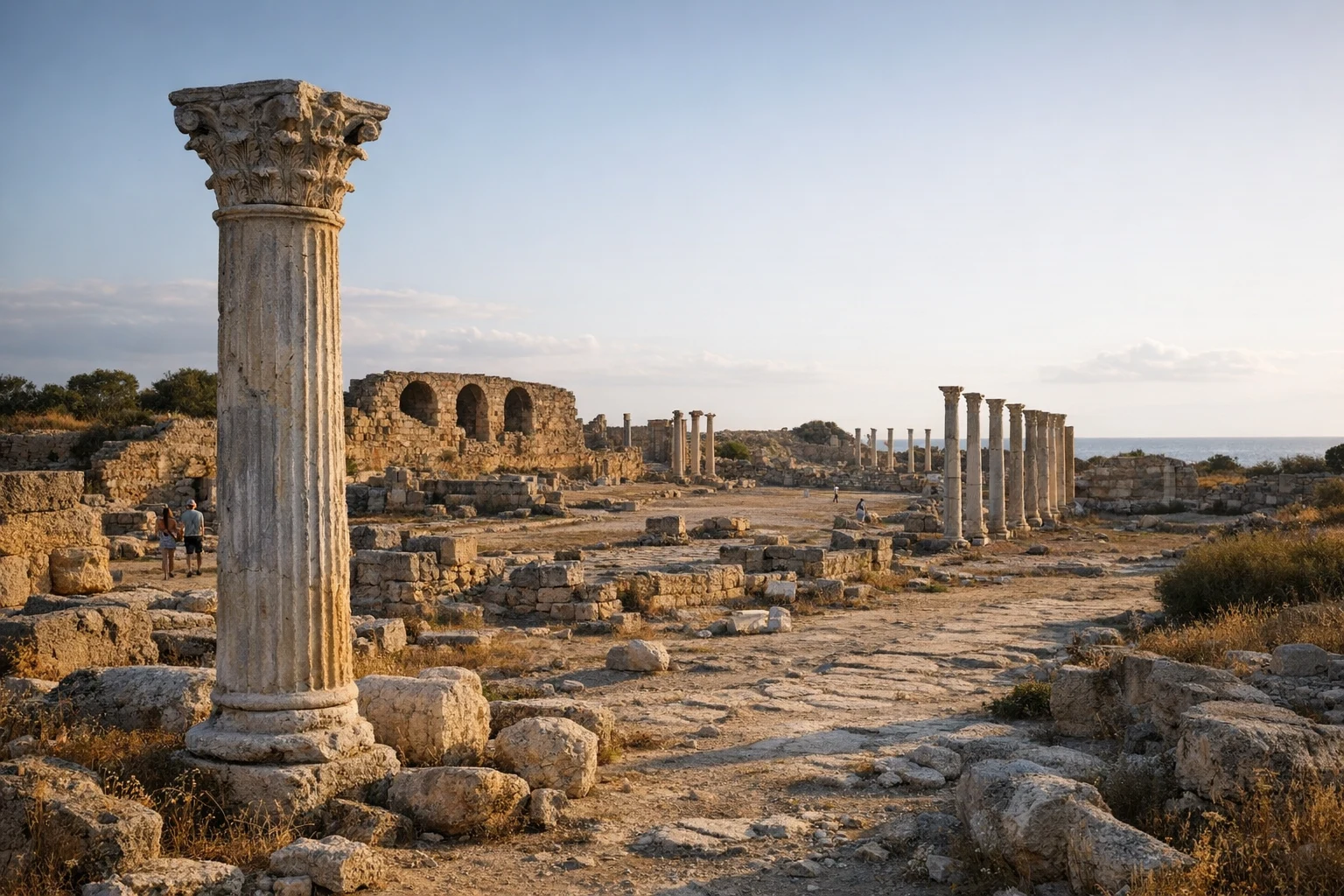
Ghosts of ancient grandeur linger in the Cypriot air as the sun climbs the horizon over Salamis, one of the Mediterranean’s most enthralling archaeological sites. Situated on the east coast of Cyprus in the Famagusta District, Salamis unfurls along the shores of the turquoise Mediterranean, mere kilometers north of modern Famagusta (Gazimağusa). Here, the distant sounds of the sea mingle with the memories of millennia: marble columns rising from fields of golden sage, haunting mosaics glimmering beneath ancient pine, and staircases that once echoed with the footsteps of Greeks, Persians, Romans, and Byzantines. Cyprus, at the crossroads of continents and empires, preserved Salamis as a vivid testament to ancient ambition and downfall, a city continually reshaped and reborn over nearly two thousand years.
Wandering through Salamis today is every bit an adventure as it was for the ancients—imagine gladiators competing in the enormous gymnasium, poets performing in the amphitheater, or priests climbing the marble steps to honor their gods. Nature has slowly woven Salamis into the coastal landscape, transforming grand avenues into floral meadows while leaving peristyles and columns as silent sentinels of resilience. The site’s sprawling ruins evoke a city that once rivaled the great ports of the eastern Mediterranean. Even after centuries of earthquakes, invasions, and shifting sands, the stones of Salamis speak: they tell of legendary founders like Teucer, of Hellenistic kings and Roman emperors, of resilience in the face of devastation, and of the enduring Cypriot spirit that persists in every fragment, frieze, and torso unearthed from the fertile dust of this dramatic shoreline.
History
Foundation and Mythic Beginnings
The origins of Salamis are entwined with myth and epic. According to legend—recorded by writers both ancient and medieval—Salamis was founded by Teucer, a hero of the Trojan War exiled by his father King Telamon of Salamis (the Greek island) for failing to avenge his brother Ajax. Sailing to Cyprus, Teucer established a new city, naming it Salamis in memory of his homeland. While archaeological evidence places the earliest settlement at Salamis around the 11th century BCE, the city’s association with Greek myth was essential to its later prestige.
In reality, the site’s strategic coastal position had made it a vital trading post long before the classical Greeks arrived, with links to Anatolia, the Levant, and Egypt. During the Late Bronze Age, Salamis began to flourish as an economic hub, thanks in part to Cyprus’s rich copper resources and fertile lands.
Archaic and Classical Salamis
Salamis rapidly became the leading city-kingdom of Cyprus by the 8th century BCE. Existing under the wide shadow of empires, the city toggled between independence and vassalage as the Phoenicians, Assyrians, and especially the Persians vied for control of the island. By the 5th century BCE, Cypriot Greek rulers of Salamis played pivotal roles in revolts against Persian dominance. Most famous among them was King Evagoras I (reigned c. 411–374 BCE), a visionary who asserted autonomy for Salamis, promoted Greek language and culture, and modernized the city’s administration. Under Evagoras, the city was a beacon of Greek identity and power in the eastern Mediterranean.
Hellenistic and Roman Rule
The conquest of Cyprus by Alexander the Great in 333 BCE brought profound changes—Salamis was absorbed into the Hellenistic world. Under the Ptolemies of Egypt, the city enjoyed considerable prosperity, evident in civic and religious structures that sprang up, many of whose foundations are visible today. Salamis’s prominence only grew with the advent of Roman rule from 58 BCE onward.
During the Roman period, Salamis truly thrived as the capital of Cyprus. Public works projects flourished: an immense gymnasium, bath complexes, a grand theater, sanctuaries, and opulent villas were constructed, testifying to the cosmopolitan status of the city. Salamis became a regional hub for administration, learning, and trade. Its population at times rivaled 100,000, making it one of the largest and most vibrant urban centers in the Roman East.
Destruction and Decline
Despite its grandeur, Salamis was vulnerable to disaster. A major earthquake in the 4th century CE—followed closely by another devastating quake just decades later—wrecked large portions of the city. Emperor Constantius II sponsored the reconstruction of Salamis around 350 CE, and the city was renamed Constantia in his honor. Yet plague, economic decline, and the changing course of trade routes conspired against recovery. The Arab raids of the 7th century dealt a final blow, leading to the permanent abandonment of the site as surviving inhabitants relocated to what would become Famagusta.
Thus, the rise and fall of Salamis encapsulates the history of Cyprus itself: a story of prosperity and creativity grafted onto tragedy and resilience, always adapting to the tides of history and conquest.
Key Features
The archaeological expanse of Salamis is a sprawling tapestry where centuries overlap—a place where the bones of antiquity lay sun-bleached atop the soft Cypriot earth. Approaching from the modern entrance, visitors are greeted by the sprawling gymnasium and adjacent bath complex, one of the most impressive in the region. The gymnasium’s immense colonnaded courtyard, framed by fluted marble pillars and overlooked by sculpted fragments of imperial statuary, conjures the lively scene of young men training in wrestling or discus beneath the shade of porticoes. The attached Roman baths, still containing sections of mosaic flooring and a myriad of hidden hypocaust channels, reveal the sophistication of ancient Cypriot engineering. These baths, with their cold, tepid, and hot rooms, not only served practical needs but offered a social space central to daily life.
Nearby is Salamis’s vast Roman theater, originally built under Augustus and restored by Trajan and Hadrian. Seating up to 15,000 spectators, the theater was an epicenter of performance and oration. Its cavea (audience seating) and orchestra remain impressive, and the stage, though partly reconstructed, stands testament to the city’s cultural importance. Optimum acoustics and sightlines allowed crowds to be swept up in Greek tragedies, Roman comedies, and civic announcements.
Moving beyond the arena, winding streets and scattered ruins lead to the forum, the city’s economic heart during the Roman period. Here, fragments of arcades, inscriptions, and column drums hint at bustling markets and cosmopolitan gatherings. Other features of immense interest include the so-called “Cellarga” or cisterns—tunnels and reservoirs that provided the city with water—an ingenious adaptation to the region’s ever-changing climate.
Religious monuments dot the landscape. Among the most evocative is the Basilica of Kampanopetra, a 5th-century AD building showcasing intricate floor mosaics. The marble altar and column stubs bring to mind the Christian transformation of urban life in late antiquity. Earlier shrines, including those dedicated to Zeus and Apollo, are less preserved but their outlines and associated artifacts add further depth to the layers of worship at Salamis.
Excavations have also revealed opulent private houses, agorae, temples, and a complex network of city walls and towers. The statuary—much of it beheaded in antiquity, likely due to later iconoclasms—adds a haunting grace to the city’s avenues and alcoves. Every visit turns up new details: Greek inscriptions weathered to illegibility, shards of painted pottery glinting in the dust, and the endless echo of the past in the lonely shade of a fig tree.
Nature now frames the ruins, offering glimpses of wildflowers and the distant shimmer of the Mediterranean between the stones. As you explore, it is not hard to reconstruct the grandeur that once was Salamis: a thriving metropolis shaped by gods and emperors, battered by earthquake and war, yet never wholly surrendered to oblivion.
Getting There
Reaching Salamis today is surprisingly straightforward, due to its proximity to Famagusta (Gazimağusa), Cyprus’s principal eastern city. If you are arriving from the southern (Republic of Cyprus) side, Nicosia (Lefkosia) is roughly 70 km to the west and serves as a gateway. From Nicosia, you will need to cross the Green Line/UN buffer zone (ensure you have your passport and check latest crossing policies), then take a bus or shared taxi toward Famagusta. Regular intercity buses run between Nicosia and Famagusta, with fares typically around €6–€10 one-way.
From Famagusta, local buses and minibuses can take you directly to Salamis’s main entrance in 15–20 minutes for around €1.50–€2 each way, though some services may require a short walk from the highway to the site itself. Alternatively, taxis from central Famagusta are readily available and typically charge €10–€15 for a one-way trip, offering flexibility and convenience, especially during hot or busy periods.
If coming by car, follow the main route north along the coast (the Dumlupınar Avenue becomes Salamis Road), with clear signage as you approach the site. On-site parking is free and ample, making driving an easy option—especially for those exploring Cyprus’s more remote treasures.
Numerous guided tours are available, departing from Nicosia, Larnaca, and Famagusta, often combining Salamis with sites such as Saint Barnabas Monastery and Varosha. These tours, which generally cost between €35–€70 per person depending on group size and inclusions, provide expert insights and help navigate both archaeological complexities and modern logistical boundaries. When planning your journey, remember that the site is in Northern Cyprus, so keep local customs and regulations in mind.
When to Visit
Cyprus’s Mediterranean climate makes Salamis a year-round destination, but your experience will differ significantly by season. Spring (March to May) is, for many, the ideal time to visit: temperatures are mild (18–24°C/65–75°F), wildflowers blanket the ruins, and sea breezes keep the ancient stones cool. This is the period when the landscape is most vibrant, crowds are thinner, and sunlight flatters the site’s honey-colored columns.
Summer (June to September) brings high heat—often exceeding 33°C (91°F)—and a relentless sun that can make midday visits physically demanding. If you visit in summer, plan to explore early in the morning or late in the afternoon, carry plenty of water, sunblock, and a hat, and take regular breaks in the shade. The longer days allow for unhurried exploration and beautiful sunsets over the ruined walls, making evenings particularly magical.
Autumn (October to November) is another excellent window, as the weather cools but remains pleasant, the Mediterranean is still warm enough for swimming, and there is a peaceful lull before the winter rains.
The winter months (December to February) are mild but peppered with wind and occasional rain, though temperatures rarely drop below 10°C (50°F). During this time, opening hours are more limited and some areas may be muddy or slippery, but the tranquility and absence of crowds can make the site uniquely atmospheric.
Festivals and local events sometimes align with holidays or Orthodox celebrations—if you plan your trip accordingly, you might catch performances or guided walks that bring Salamis’s history to life. Regardless of the season, wear good walking shoes and allow at least two to three hours to appreciate the expanse of this timeless city.
Quick Facts
| Feature | Detail |
|---|---|
| Location | Near Yeni Boğaziçi, Famagusta District, Cyprus |
| Founded | Estimated 11th century BCE (legend: post-Trojan War, c. 1100 BCE) |
| Major Civilizations | Cypriot-Greek, Phoenician, Persian, Hellenistic, Roman, Byzantine |
| Highlights | Gymnasium, Roman baths, theater, basilica, mosaics, city walls |
| Opening Hours | Typically 8:00–19:00 (summer), 8:00–17:00 (winter); check for seasonal variation |
| Admission Fee | ~€4.50 per adult |
| Visitor Facilities | Restrooms, small café/shop, on-site parking |
| Closest Major City | Famagusta (Gazimağusa), approx. 6 km |
| Recommended Visit Time | 2–3 hours minimum |
| Accessibility | Some areas uneven; main paths navigable with care |
| Best Visiting Season | Spring (March–May) and Autumn (October–November) |
Wandering amidst Salamis’s colonnades, you become not just a spectator, but a participant in the evolving tale of Cyprus—a place where every ruined block and faded mosaic holds the memory of a world both distant and dazzlingly present.
Frequently Asked Questions
What are the opening hours of Salamis?
Salamis is generally open every day from 8:00 to 19:00 in summer and closes as early as 17:00 in winter months. Always check locally for updated open times as they may vary due to restoration works or local events.
How much does it cost to enter Salamis?
The entrance fee for Salamis is typically around €4.50 per adult. Discounts may be available for students or groups. Tours may have separate pricing.
Can you visit Salamis independently?
Yes, visitors can explore Salamis on their own. However, guided tours are recommended for deeper historical insights and access to less-frequented sections.
Are there facilities at Salamis, such as restrooms or a café?
Yes, there are basic facilities including restrooms and a small café/shop at the entrance. It's advisable to bring water and sun protection, especially in summer.
Is Salamis accessible by public transport from major Cypriot cities?
Yes, public buses and shared taxis run from Famagusta and Nicosia to the vicinity of Salamis. Some may require a short taxi journey or walk from the bus stop to the site entrance.
Nearby Ancient Sites
The Complete Acropolis Athens Travel Guide: Temples
Ancient GreecePlan the perfect visit to the Acropolis of Athens with our 2026 guide. Discover the Parthenon, best ...
Akrotiri
Minoan / CycladicExplore Akrotiri, the Bronze Age Minoan city buried under volcanic ash on Santorini around 1613 BCE ...