Quick Info
At a glance
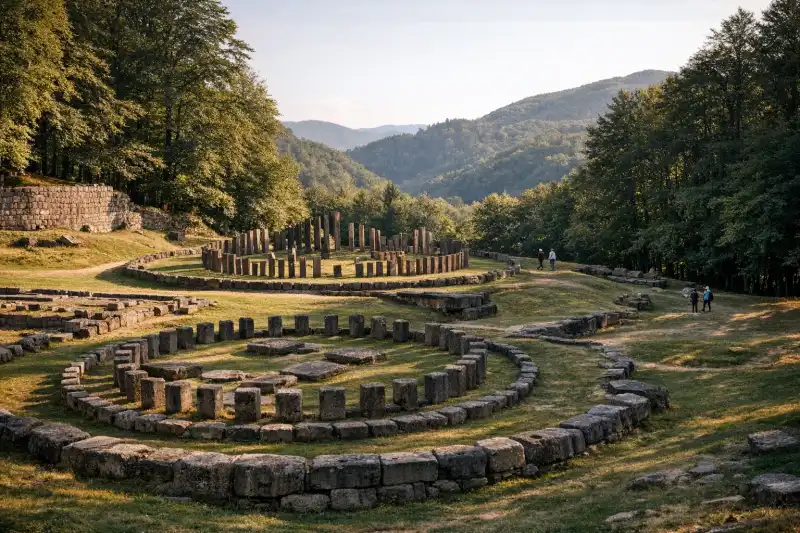
Sarmizegetusa Regia in Romania sits high in the forested Orăștie Mountains, where stone terraces, sacred circles, and old defensive walls emerge from beech and oak woodland with an almost theatrical sense of revelation. Even before you reach the archaeological core, the setting explains part of the site’s power. This was not a city placed on an easy plain or beside a great harbor. It was a mountain capital, chosen for command, protection, and symbolism. The climb into the hills still gives visitors a feeling of entering a secluded stronghold, hidden yet deliberate, remote yet unmistakably central to the world that created it.
For travelers interested in ancient Europe beyond the best-known Greek and Roman landmarks, Sarmizegetusa Regia offers something rarer: the remains of a civilization often described through its enemies’ accounts rather than its own monuments. Here, in the last major capital of the Dacian Kingdom, history becomes physical. You can follow paved processional routes, trace the outlines of elite residences and workshops, and stand in the sacred area where circular and rectangular sanctuaries once framed rituals that remain only partly understood. The silence of the forest adds to the experience. There are no vast reconstructed facades, no urban crowds, and no monumental marble axes. Instead, there is atmosphere, topography, and a site whose meaning comes from the interplay of landscape, engineering, belief, and resistance on the eve of Rome’s expansion into the Carpathian region.
History
The rise of the Dacian heartland
The story of Sarmizegetusa Regia begins in the late Iron Age, when the Dacians emerged as a powerful force north of the Danube. The Orăștie Mountains became the core zone of Dacian political and military organization, and over time a network of fortified sites developed across the ridges and valleys. Sarmizegetusa Regia was the most important of them all. It was not simply a fortress in isolation, but the central place in a wider defensive and administrative landscape that included strongholds such as Costești, Blidaru, and Piatra Roșie.
Its ascent is tied especially to the consolidation of power under King Burebista in the 1st century BCE. Under his rule, the Dacian Kingdom expanded dramatically, and a mountain center like Sarmizegetusa Regia made strategic sense. The site commanded approaches through rugged terrain, offered natural defenses, and sat within a sacred and political geography that elevated royal authority. Archaeology suggests that this was not a spontaneous settlement but a carefully planned complex, combining military fortification with ceremonial architecture and elite occupation.
Under Decebalus and the Roman threat
By the late 1st century CE, Sarmizegetusa Regia had become the seat of King Decebalus, the most famous ruler of Dacia. This was the period when Dacia entered direct conflict with Rome. Rich in resources, especially precious metals from the wider region, the kingdom was a major target for imperial ambition. Decebalus proved an able and determined opponent, balancing diplomacy, warfare, and mountain defense to preserve his state.
Roman campaigns against Dacia intensified under Emperor Domitian and then culminated under Trajan. During these decades, Sarmizegetusa Regia functioned as both symbolic capital and practical command center. The fortifications were strengthened, terraces organized, and water systems maintained with considerable sophistication. The site’s elevated position did not make it invulnerable, but it did make any advance difficult. Roman armies had to penetrate not just a single city but a whole defended mountain system.
Ancient sources and archaeological evidence together indicate a tense frontier world in which engineering and endurance mattered as much as battlefield success. Dacian warfare, hilltop fortresses, and knowledge of the terrain allowed resistance far beyond what a casual glance at the map might suggest.
Conquest and destruction
The decisive moment came during Trajan’s Dacian Wars, especially the second campaign of 105–106 CE. Roman forces pushed deep into the Dacian heartland and eventually captured Sarmizegetusa Regia. The fall of the capital marked the collapse of organized resistance. Decebalus died shortly afterward, and Dacia was turned into a Roman province.
The archaeological record shows destruction at the site, including damage to fortifications and sacred structures. This was not unusual in the context of Roman conquest. Capturing an enemy capital was not only a military necessity but also an ideological act. Sarmizegetusa Regia, with its sanctuaries and royal associations, represented the heart of Dacian identity. Its defeat sent a message as powerful as any inscription or triumphal relief in Rome.
It is important to distinguish this site from Ulpia Traiana Sarmizegetusa, the Roman colonial capital founded later in a different location. The similarity of names often confuses visitors. Sarmizegetusa Regia was the Dacian capital in the mountains; Ulpia Traiana Sarmizegetusa was the Roman city established afterward on lower ground to anchor the new provincial order.
Rediscovery and modern significance
After antiquity, the mountain capital faded into the forest. Its memory survived in scholarship, local tradition, and historical debate, but systematic archaeological study took shape much later. Excavations in the modern era revealed defensive walls built in the distinctive murus Dacicus style, sanctuaries of remarkable plan, and evidence of complex occupation across multiple terraces.
Today, Sarmizegetusa Regia is recognized as part of the UNESCO World Heritage ensemble known as the Dacian Fortresses of the Orăștie Mountains. That status reflects both the site’s national importance in Romania and its broader place in European history. It offers rare insight into a non-classical ancient state confronting Rome on its own terms. For visitors, that makes the site especially compelling: this is not a provincial imitation of the Mediterranean world, but the center of a distinct civilization whose political and sacred landscape still speaks through stone, earthworks, and mountain silence.
Key Features
What makes Sarmizegetusa Regia memorable is not one isolated monument but the way its parts combine into a coherent mountain capital. The approach first introduces the defensive logic of the site. The fortress area occupies a high, strategic position, where stone walls followed the contours of the ridge and controlled movement across the summit. These fortifications were built using the murus Dacicus technique, a characteristic Dacian method combining carefully cut stone facings with an earthen and rubble core reinforced by timber. Even in fragmentary form, the walls suggest both engineering skill and a clear understanding of how to build durable defenses in difficult terrain.
Beyond the military core, the terraces are among the most striking elements of the landscape. These were not merely practical cuts in the hillside, but organized platforms that supported buildings, circulation routes, and elite functions. As you walk them today, the stepped arrangement helps you imagine a settlement spread vertically through the forest, its architecture adapting to the mountain rather than trying to erase it. Some terraces likely held residences and administrative buildings, while others served workshops or storage. The result was a capital that felt distributed yet integrated, connected by paths and retaining structures rather than by broad urban streets.
The sacred area is the site’s best-known and most distinctive feature. Here, several sanctuaries stood on prepared terraces, including circular and rectangular constructions made from stone and timber elements. Their precise purpose remains debated, but they clearly formed a ceremonial center of great significance. The large circular sanctuary, often compared in outline to other prehistoric or ancient ritual spaces, is especially evocative. Its surviving stone settings do not reveal everything, yet they create an unmistakable sense of order, alignment, and intentional design. Standing there, visitors often feel the shift from fortress to sacred precinct, from political power to ritual authority.
The so-called “andesite sun,” a circular stone installation, is another iconic feature associated with the site’s ceremonial reputation. Though interpretations vary and some older claims about astronomical functions can be overstated, it remains one of the most recognizable archaeological elements at Sarmizegetusa Regia. What matters for visitors is less any single theory than the evidence of sophisticated planning. The sacred zone was not improvised. It was laid out with care, integrating architecture, open space, and movement in a way that suggests formal ritual use tied to kingship and identity.
Equally impressive, if less immediately dramatic, is the water system. Archaeologists have identified ceramic pipes and channels that supplied water to sectors of the settlement. In a mountain capital under pressure from Rome, reliable water infrastructure was vital. Its presence underscores how developed the site was. This was not a temporary refuge or a crude hill fort, but a complex center capable of supporting elite life, religious activity, and prolonged occupation.
Then there is the setting itself. Many ancient sites are visited despite their modern surroundings; Sarmizegetusa Regia is visited partly because of them. The forest has reclaimed much of the visual field, softening the ruins and intensifying the atmosphere. Light moves across the terraces differently throughout the day, and mist or rain can make the sanctuaries feel almost hidden again. The environment does more than beautify the ruins. It helps explain them. The Dacian capital depended on terrain, seclusion, and control of access. To walk here is to understand that geography was part of the architecture.
Getting There
Sarmizegetusa Regia is easiest to reach by car, and for most travelers this is the most practical option. The site lies in Hunedoara County in the Orăștie Mountains, with the usual driving approach coming via Orăștie, Călan, or Hațeg depending on your wider itinerary in Transylvania. From Orăștie, the drive typically takes around 1.5 to 2 hours because the final mountain roads are slower and winding. Rental cars from Sibiu, Cluj-Napoca, or Timișoara are common choices; expect roughly €30–€60 per day for a standard vehicle, plus fuel.
Public transport is possible but less straightforward. You can take a train or bus to Orăștie or Deva from major Romanian cities. Train fares from Bucharest to Orăștie usually range from about 80 to 180 RON depending on service type, while regional rail from Sibiu or Alba Iulia is cheaper. From Orăștie, onward connections toward the mountain villages are limited and schedules may not align well with a same-day independent visit. In practice, many travelers arrange a taxi for the final leg or book a local driver. A one-way taxi or transfer from Orăștie can cost roughly 150–250 RON depending on season, waiting time, and road conditions.
Organized tours are often the simplest compromise if you do not want to self-drive. Day trips from Hunedoara-area bases or broader Transylvania itineraries can combine transport with context on Dacian history. Whichever method you choose, leave early, carry water, and check road conditions before departure, especially outside summer.
When to Visit
The best time to visit Sarmizegetusa Regia is from late spring through early autumn, when mountain roads are more reliable and the forested setting is at its most inviting. May, June, and September are especially appealing. Temperatures are usually comfortable for walking, greenery is vivid, and the site tends to feel peaceful without the midsummer intensity of heat or holiday traffic. Spring can bring rain, but the fresh foliage and softer light make the terraces and sanctuaries particularly photogenic.
July and August offer the warmest conditions and the longest daylight hours, which are useful if you are combining the site with other destinations in Hunedoara County. Still, summer has trade-offs. Midday can feel hot on exposed sections, and afternoon storms are not unusual in mountain environments. If you visit in high summer, aim for morning or late afternoon and bring sun protection as well as a light waterproof layer.
Autumn is one of the most atmospheric seasons. The surrounding woods begin to turn, and the ruins take on a quieter, more dramatic character. Cooler air makes walking easier, and photographs often benefit from the golden forest tones. October can be excellent, though weather becomes less predictable later in the month.
Winter visits are possible but less advisable for most travelers. Snow, ice, fog, and difficult road conditions can complicate access, and the site experience may be shortened by cold and early darkness. If you do go in winter, check conditions locally and prepare for a more demanding outing. Overall, shoulder seasons offer the best balance of accessibility, comfort, and atmosphere.
| Quick Facts | Details |
|---|---|
| Location | Orăștie Mountains, Hunedoara County, Romania |
| Type | Ancient Dacian capital, fortress, and sacred complex |
| UNESCO Status | Part of the Dacian Fortresses of the Orăștie Mountains |
| Main Period | 1st century BCE to 106 CE |
| Civilization | Dacian |
| Best Visit Length | 2–3 hours |
| Nearest Base | Orăștie |
| Best Season | May–June and September–October |
| Access | Best by car or organized tour |
| Terrain | Forest paths, stone remains, light uphill walking |
Sarmizegetusa Regia rewards a certain kind of traveler: one willing to trade monumental urban ruins for a site where landscape and archaeology are inseparable. It is not the easiest ancient destination in Europe, and that is part of its appeal. The effort of reaching it sharpens the experience, making the surviving walls, sanctuaries, and terraces feel less like museum pieces and more like traces of a capital rediscovered in its natural stronghold. For anyone interested in the ancient Balkans, Rome’s frontiers, or the diversity of Europe before imperial integration, this mountain sanctuary-fortress is one of Romania’s most compelling places to visit.
Guided tours: worth it?
A guide can be genuinely useful at Sarmizegetusa Regia, especially if you want help with transport, timing, tickets, or understanding a large site without losing half the day to logistics.
Best for
- First-time visitors who want context, not just photos
- Travelers who want transport, timing, or entry logistics handled
- Short visits where a planned route saves time
When to go self-guided
Go independently if you already have transport and tickets sorted, enjoy moving at your own pace, and are comfortable checking the latest official rules before you arrive.
What I’d avoid
Skip paid tours that bundle unrelated stops you do not actually want. The best option should either save meaningful planning time or add historical context you would miss on your own.
Sarmizegetusa Regia tours
Useful when: you want to compare guided formats before deciding
Hunedoara and Sarmizegetusa day tours
Useful when: you want to compare guided formats before deciding
Transylvania archaeology tours
Useful when: you want to compare guided formats before deciding
Some tour links are affiliate links, which may earn Ancient Travel a small commission at no extra cost to you. I try to surface options that make practical sense for the site—not just anything bookable.
Frequently Asked Questions
What is Sarmizegetusa Regia?
Sarmizegetusa Regia was the political, military, and religious center of the ancient Dacian Kingdom, located in the Orăștie Mountains of Romania.
Is Sarmizegetusa Regia a UNESCO World Heritage Site?
Yes. It is part of the UNESCO-listed Dacian Fortresses of the Orăștie Mountains.
How difficult is the visit?
Most visitors can manage the site comfortably, but expect uneven forest paths, light uphill walking, and limited facilities compared with urban archaeological parks.
How much time do you need at Sarmizegetusa Regia?
Plan for around 2 to 3 hours on site to walk through the fortress area, sacred precinct, terraces, and viewpoints at a relaxed pace.
Can you visit Sarmizegetusa Regia without a car?
Yes, but it is easier with a car or organized tour. Public transport gets you only part of the way, and the final approach usually requires a taxi or prearranged transfer.
What should you bring when visiting?
Wear sturdy shoes and bring water, weather protection, and a light jacket, as mountain conditions can change quickly even in summer.
Nearby Ancient Sites
Acropolis Travel Guide 2026: Parthenon, Tickets, and Best Time
Ancient GreecePlan an efficient Acropolis visit with practical ticket timing, key monuments, and museum pairing ti...
The Complete Acropolis Athens Travel Guide: Temples
Ancient GreecePlan the perfect visit to the Acropolis of Athens with our 2026 guide. Discover the Parthenon, best ...
Ancient Agora of Athens Travel Guide 2026: Route, Tickets, and Context
Classical GreekPlan a better Ancient Agora visit with practical timing, monument priorities, and clear historical c...