Quick Info
At a glance
Sayil in Mexico sits quietly among low forest and limestone hills, a Maya city whose surviving buildings seem to rise out of the Yucatán landscape with more elegance than force. It is one of the key archaeological sites of the Puuc region, an area celebrated for finely cut stone, geometric mosaics, mask-like decorative elements, and palaces that feel both monumental and surprisingly refined. Travelers who come here often do so after hearing about Uxmal, but Sayil rewards a slower kind of attention. Its appeal is not only in a single famous structure, but in the way the city unfolds through causeways, terraces, hidden platforms, and long views through the trees.
What makes Sayil memorable is its atmosphere. The forest softens the ruins, birds and insects supply the soundtrack, and the architecture reveals itself in stages. One moment you are standing before a grand facade lined with columns; the next, you are walking along a sacbe, the raised white road used by the Maya, imagining the movement of elites, workers, traders, and ritual participants through a once-busy urban center. Sayil is not the largest Maya city in Mexico, nor the most heavily reconstructed, but that is part of its power. It offers a more intimate encounter with the Puuc world, one in which craftsmanship, planning, and adaptation to a demanding environment become easier to appreciate.
History
Early settlement and the rise of the Puuc region
Sayil developed in the Puuc hills of what is now Yucatán, a zone whose environmental conditions shaped the cities that emerged there. Unlike parts of the Maya lowlands that had access to rivers or large permanent surface water sources, the Puuc region depended heavily on rainwater collection and storage. This limitation encouraged sophisticated planning and close attention to the landscape. Communities in the wider region existed earlier, but Sayil’s major florescence came relatively late in Maya history, especially during the Late Classic and Terminal Classic periods, roughly between the 8th and 10th centuries CE.
By this time, the Maya world was a network of city-states and regional centers connected through trade, diplomacy, competition, and shared cultural traditions. In the northern lowlands, and particularly in the Puuc region, architecture became a major expression of status and identity. Sayil grew within this context, benefiting from the broader prosperity and artistic energy of nearby centers such as Uxmal, Kabah, Labná, and Xlapak. Its location within a constellation of Puuc settlements suggests that it was part of a dense and interconnected regional system rather than an isolated city.
Peak prosperity and urban growth
Sayil appears to have expanded rapidly during its height. Archaeologists have identified a dispersed urban layout, with civic, elite, and residential compounds linked by causeways and arranged across a broad zone. The city’s core included impressive palatial structures and public architecture, while surrounding areas contained terraces, house platforms, and evidence of intensive occupation. This pattern reflects a substantial population and a social hierarchy in which elite families likely controlled resources, labor, and ceremonial life.
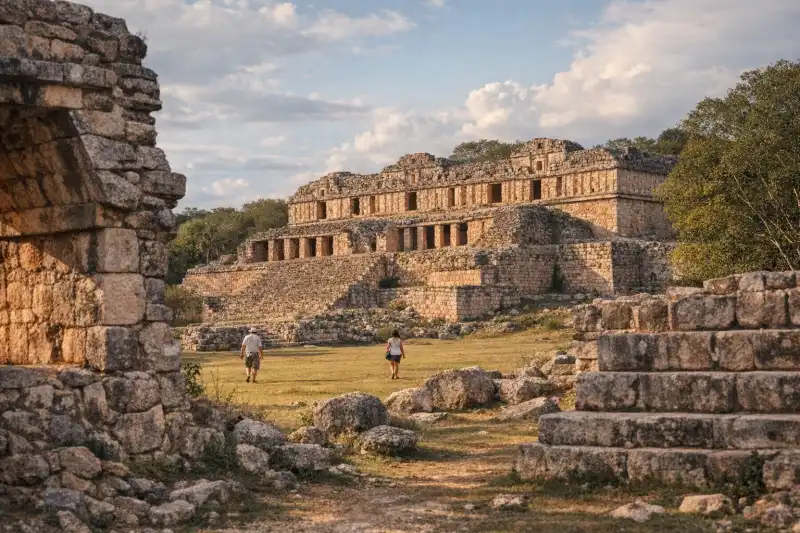
The best-known monument at Sayil, often called the Great Palace or simply the Palace, reflects this period of prosperity. Its multi-level construction, long facade, and numerous rooms suggest administrative, residential, and ceremonial functions. The building demonstrates the hallmarks of Puuc style: carefully fitted lower walls, richly ornamented upper zones, repeated column motifs, and decorative programs that turned architecture into an assertion of prestige. Such structures were not merely shelters or offices. They were visual statements about political authority, lineage, and access to specialized craftsmanship.
Sayil’s growth also depended on managing the environment effectively. The Maya of the Puuc region built chultuns, bottle-shaped underground cisterns cut into the limestone, to collect and store rainwater. Agricultural terraces and land-use strategies helped support the population. The city’s prosperity, therefore, was rooted as much in engineering and ecological adaptation as in political influence.
Regional change and decline
Like many Maya centers, Sayil did not remain at its peak indefinitely. The Terminal Classic period was a time of major transformation across the Maya world. In some southern areas, cities experienced demographic collapse, shifting power structures, and reduced monumental construction. In the north, including Yucatán, some centers continued to thrive for a time, but instability eventually affected them as well.
At Sayil, archaeological evidence suggests that occupation and building activity declined relatively quickly after its main flourishing phase. The reasons were likely complex. Environmental stress, pressure on agricultural land, water management challenges, political fragmentation, shifting trade routes, and broader regional realignments may all have played a role. Rather than a dramatic single event, decline was probably a process: elite projects ceased, buildings were used differently, maintenance faltered, and population levels dropped.
This pattern fits wider debates about Maya “collapse,” which scholars now understand less as a uniform disappearance and more as a patchwork of regional transitions. Sayil’s story is one of contraction and abandonment after a remarkable, but comparatively brief, period of urban success.
Rediscovery, archaeology, and conservation
After the end of its ancient prominence, Sayil was gradually reclaimed by vegetation. Local knowledge of ruins in the region persisted, but systematic archaeological documentation came much later, particularly in the 19th and 20th centuries, when explorers, photographers, and researchers began recording the monumental remains of the Puuc area. Their reports helped establish Sayil as one of the significant sites of northern Maya civilization.
Modern archaeological work has focused on mapping the city, studying its architecture, understanding settlement patterns, and placing it within the larger Puuc cultural landscape. Conservation efforts have stabilized major structures and made parts of the site accessible to visitors. Today, Sayil is often visited as part of the Ruta Puuc, a route linking several archaeological sites and underscoring the remarkable concentration of Maya architecture in this part of Yucatán. Though quieter than more famous destinations, it remains essential for understanding the sophistication and diversity of the northern Maya lowlands.
Key Features
The most striking structure at Sayil is the Great Palace, and it immediately explains why the site matters. Long and imposing without feeling heavy, it stretches horizontally across a terrace, its rooms arranged in a way that speaks to both ceremonial display and elite residence. The facade combines disciplined geometry with decorative richness. Columns divide doorways in repeating rhythms, while the upper sections carry the ornate stonework associated with Puuc architecture. Looking closely, you can see how the Maya masons balanced precision and embellishment. The lower parts of the building tend to be comparatively plain and solid, emphasizing engineering control, while the upper zones become a surface for visual invention.
The Palace also creates one of Sayil’s strongest emotional impressions: scale without crowding. Unlike some sites where central plazas dominate the visitor experience, Sayil feels stretched across the landscape. Its architecture is encountered in sequence, and the Palace serves as the anchor from which the rest of the city can be imagined. Standing before it, it is easy to picture attendants, officials, family members, and visitors moving through its many doorways and chambers. The building suggests an elite household that was at once political, administrative, and ceremonial.
Beyond the Palace, Sayil’s causeways are among its most important features. These sacbeob, or raised roads, linked architectural groups and organized movement through the city. For modern visitors, walking these routes helps reveal Sayil as an urban system rather than a collection of isolated ruins. The roads draw attention to planning and connectivity. They also hint at ritual movement, processions, and the social choreography of civic life. In a forested setting where many ancient structures are partially concealed, causeways provide a narrative line through the site.
Other structures reinforce the city’s complexity. Residential compounds, smaller palatial buildings, and secondary groups demonstrate that Sayil’s prosperity extended beyond a single ceremonial core. Some buildings show colonnaded facades, others include vaulted rooms or decorative fragments that preserve the visual language of Puuc design. The arrangement of these groups across uneven ground reveals how the Maya adapted architecture to local topography. Platforms and terraces level the terrain where needed, but the city never feels imposed upon the landscape; instead, it seems negotiated with it.
The decorative style at Sayil deserves special attention. Puuc architecture is often admired for its mosaics, masks, lattice patterns, and layered stone compositions. At Sayil, these features appear in a more restrained way than at some flashier sites, but that restraint is part of the site’s character. The artistry lies in balance. Repetition of columns, carefully proportioned walls, and rhythmically arranged openings create an effect of measured elegance. This is architecture built to communicate legitimacy and cultivated taste.
Environmental adaptation is another key feature, even if it is less visually obvious than the monuments. The Puuc region’s dependence on seasonal rainfall meant that urban life required water storage and management. Chultuns and related systems supported daily life and made larger populations possible. Though these do not always dominate a visitor’s photo collection, they are central to understanding how Sayil functioned. The city’s very existence depended on practical ingenuity as much as on elite ambition.
Finally, Sayil’s landscape setting is itself one of its defining qualities. The surrounding scrub forest and low hills create a sense of enclosure and discovery. The experience of moving through the site is quieter and more contemplative than at many major tourist hubs. You are often aware of absence as much as presence: spaces where structures once stood, mounds still covered in vegetation, and long stretches where nature now occupies what was once urban ground. That interplay between visible monumentality and hidden cityscape makes Sayil especially rewarding for travelers interested in archaeology beyond the headline sites.
Getting There
Sayil is most commonly reached from Mérida, the main gateway city for travelers exploring inland Yucatán. By car, the journey typically takes around 1.5 to 2 hours depending on traffic and your exact route. Rental cars in Mérida often start at about MXN 700 to 1,400 per day before insurance, with fuel extra. Driving is the most flexible option because Sayil is frequently combined with Uxmal, Kabah, Labná, and other Puuc sites in a single outing. Roads in the region are generally straightforward, though it is wise to start early and download offline maps.
Guided tours from Mérida are another practical choice. Full-day Puuc Route or Uxmal-and-surrounds tours often range from about USD 60 to 150 per person, depending on whether transport, entrance fees, lunch, and bilingual guiding are included. Private tours cost more but allow extra time at Sayil, which many archaeology-minded travelers appreciate.
Public transport is possible but less convenient. Buses and colectivos toward towns in southern Yucatán may get you part of the way, but schedules can be limited and final access may require a taxi. If using this approach, expect combined transport costs to vary roughly between MXN 150 and 400 each way, with more uncertainty in return connections. For most visitors, self-drive or organized tours are more reliable.
Bring water, sunscreen, a hat, and cash for small purchases or incidental expenses. Facilities in archaeological areas outside the biggest hubs can be limited, and the heat in Yucatán can be intense by late morning.
When to Visit
The best time to visit Sayil is usually during the dry season, from November through April. These months tend to offer lower humidity, clearer skies, and more comfortable walking conditions, especially if you plan to explore multiple sites along the Puuc Route in one day. Mornings are particularly pleasant, with softer light for photography and cooler temperatures for walking between architectural groups.
From May into October, Yucatán becomes hotter, more humid, and rainier. Afternoon showers can be intense, and the summer heat can make long archaeological visits tiring. That said, the rainy season also brings greener vegetation and, at times, fewer visitors. If you travel then, start as early as possible and build in shade and hydration breaks. Light rain gear can be useful, though the bigger concern is usually humidity and heat exposure rather than cold or prolonged storms.
December to February often provides the most comfortable overall climate, but this is also a popular period for travel in Yucatán, especially around holidays. Sayil is quieter than marquee attractions, so crowds are rarely overwhelming, yet nearby hotels and tours can book up faster in peak season.
Whenever you go, aim for an early arrival. Midday sun can be punishing, and stone surfaces reflect heat. Early visits also preserve the site’s strongest quality: silence. Sayil is a place best appreciated when the ruins, the forest, and the long lines of ancient masonry can be taken in without rush.
| Quick Facts | Details |
|---|---|
| Location | Puuc region, Yucatán, Mexico |
| Civilization | Maya |
| Main period | Late Classic to Terminal Classic |
| Flourished | c. 700-900 CE |
| Best known for | Great Palace, Puuc-style facades, sacbeob |
| Nearest major city | Mérida |
| Typical visit length | 1.5-3 hours |
| Best season | November to April |
| Best way to reach | Rental car or guided day tour |
| Combine with | Uxmal, Kabah, Labná, other Puuc sites |
Sayil rewards travelers who want more than a checklist stop. Its ruins do not overwhelm through sheer height or spectacle; instead, they invite close looking and slow reconstruction in the mind. The Palace shows the ambition of elite Maya architecture, but the broader site reveals something more interesting still: a carefully planned city adapted to difficult environmental conditions and integrated into a larger regional world of trade, artistry, and power. The causeways, terraces, and dispersed compounds speak of a settlement that was lived in at scale, not merely built for ceremony.
For visitors to Yucatán, Sayil is also a reminder that the Maya past cannot be reduced to one famous pyramid or one easy narrative of rise and fall. Here, in the quieter reaches of the Puuc hills, you can see a different expression of urban life: elegant rather than colossal, ordered rather than theatrical, and deeply shaped by the demands of landscape and water. It is one of those places where the details matter. A carved stone pattern, a line of columns, a road disappearing into trees—each contributes to a fuller sense of the city that once stood here.
If you make the journey, give Sayil time. Walk beyond the first grand facade, pause in the shade, and imagine the city as a network of households, officials, craftspeople, and ritual spaces spread through the forested terrain. The reward is not only a better understanding of Maya architecture in Mexico, but a more intimate connection to the rhythms of an ancient place that still carries its dignity lightly.
Guided tours: worth it?
Self-guided works here, but a guide can add real value if you want the ruins explained as a living place rather than just a sequence of monuments.
Best for
- First-time visitors who want context, not just photos
- Short visits where a planned route saves time
When to go self-guided
Go independently if you prefer setting your own pace, reading as you go, and checking official hours or ticket rules directly before you arrive.
What I’d avoid
Skip paid tours that bundle unrelated stops you do not actually want. The best option should either save meaningful planning time or add historical context you would miss on your own.
Puuc Route day tours from Merida
Useful when: transport or pickup logistics matter
Uxmal and Sayil archaeological tours
Useful when: you want to compare guided formats before deciding
Yucatan Maya ruins private tours
Useful when: you want flexible timing or a private guide
Some tour links are affiliate links, which may earn Ancient Travel a small commission at no extra cost to you. I try to surface options that make practical sense for the site—not just anything bookable.
Frequently Asked Questions
Where is Sayil located?
Sayil is in the Puuc region of Yucatán state in Mexico, southwest of Mérida and not far from Uxmal and other Maya sites along the Puuc Route.
What is Sayil known for?
Sayil is best known for its elegant multi-story palace, richly decorated Puuc-style architecture, columned facades, and causeways connecting civic and residential groups.
How much time should I plan for a visit?
Most travelers spend 1.5 to 3 hours at Sayil, though architecture enthusiasts may want longer, especially if combining it with nearby Puuc sites in a full-day itinerary.
Can you climb the structures at Sayil?
Access rules can change, but climbing is generally restricted at many Mexican archaeological sites to protect the remains, so check current signage and guidance from staff on arrival.
Is Sayil easy to visit independently?
Yes. Sayil is commonly visited by rental car from Mérida or as part of a guided Puuc Route trip. Independent visitors should bring water, sun protection, and cash for any local expenses.
What is the best season to visit Sayil?
The dry season from roughly November to April is usually the most comfortable, with lower humidity and less chance of heavy rain than the summer and early autumn months.
Nearby Ancient Sites
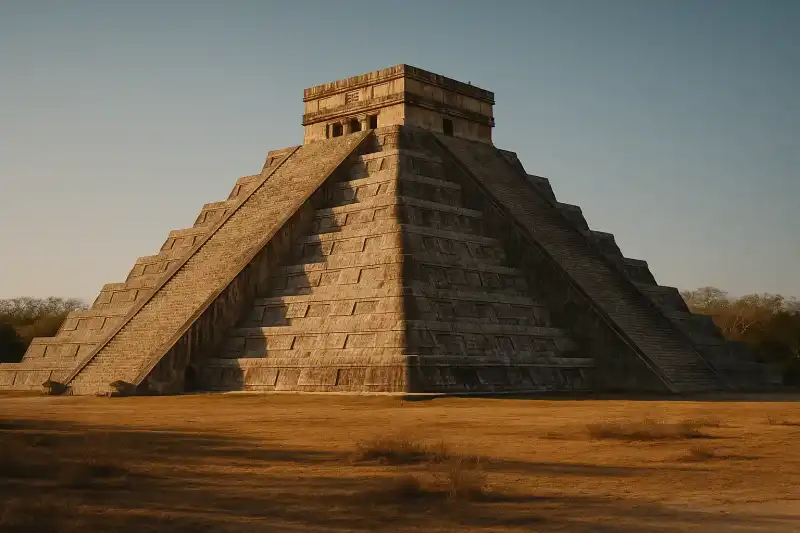
Chichen Itza Travel Guide 2026: Maya Secrets, Sacred Cenote, and Smart Timing
MayaChichen Itza stands as the most visited ancient site in Mexico, showcasing the architectural genius ...
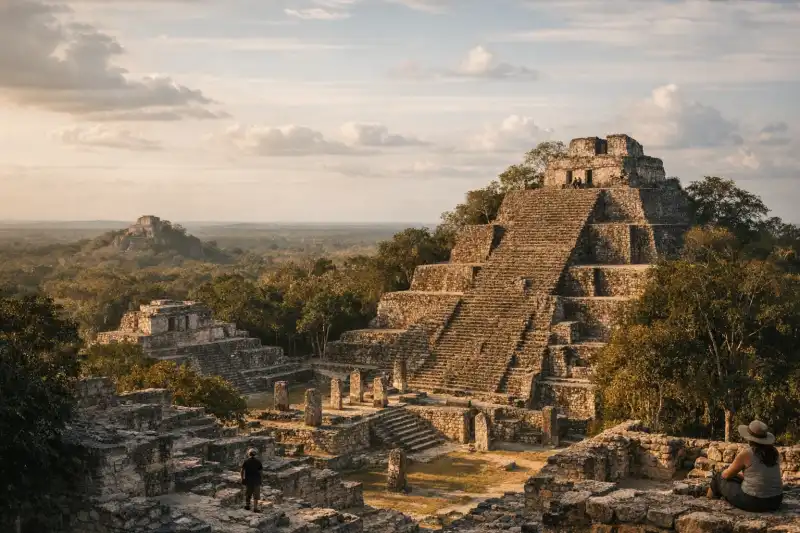
Calakmul
MayaExplore Calakmul, a vast Maya city deep in the forests of Campeche, Mexico, known for towering pyram...
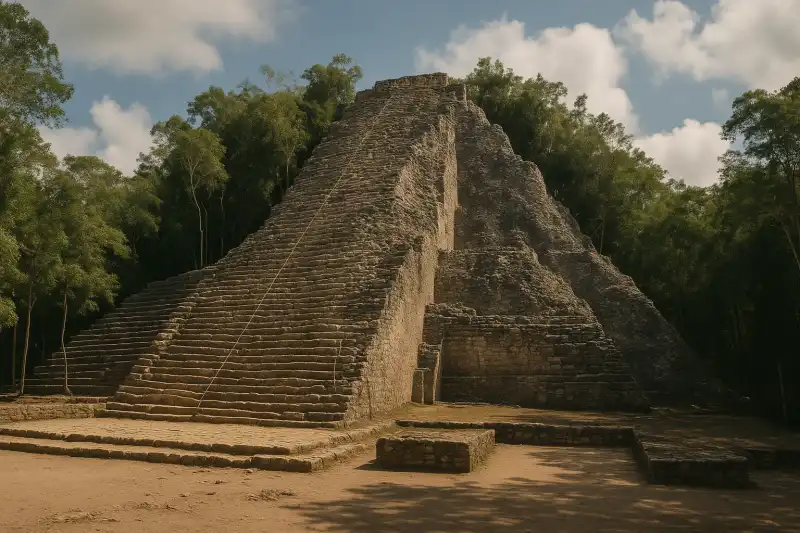
Coba Travel Guide 2026: Ruins Route, Timing, and Practical Day Planning
MayaPlan a better Coba visit with route strategy, realistic timing from Tulum or Cancun, and practical t...