Quick Info
Curated Experiences
Sipán and Royal Tombs Museum Day Tour from Chiclayo
Northern Peru Archaeology: Sipán, Túcume and Lambayeque Museum
Chiclayo Archaeological Highlights Private Tour
The first surprise at Sipán is not the gold. It is the silence. In northern Peru, where desert light can feel almost metallic by noon, the story of the Sipán Royal Tombs begins in shadowed chambers, sealed for centuries, where Moche elites were buried with the theatrical precision of a court performance. This is one of the most consequential archaeological discoveries in the Americas, and it reshaped what scholars understood about authority, ritual, and wealth on Peru’s north coast. If your primary goal is to understand pre-Inca power in a way that feels immediate rather than abstract, this is the place. A Sipán Royal Tombs Peru travel guide is not just about a museum stop; it is about entering a complete political world built through ceremony, violence, and astonishing artistry.
Ancient Travels recommends Sipán as a northern Peru anchor because it offers rare narrative clarity. You can follow the arc from excavation at Huaca Rajada to curated interpretation in the Royal Tombs Museum, then connect those findings to nearby Moche and Lambayeque landscapes. In this guide, you will find the site’s historical timeline, what to prioritize in the galleries, practical transport from Chiclayo, realistic ticket and timing advice, seasonal strategy, and ways to combine Sipán with nearby destinations for a full archaeology-focused day.
History: A Desert Court Revealed
Before Sipán: regional foundations (c. 1500 BCE-100 CE)
Long before the famous tombs were constructed, Peru’s northern coastal valleys sustained complex societies that mastered irrigation, ceremonial architecture, and long-distance exchange. Early cultural traditions, including Cupisnique influences and later regional developments, established the symbolic and technical language that Moche rulers would refine. These communities worked in a demanding desert environment where agricultural success required social coordination and hydraulic planning. By the first centuries CE, elite ritual spaces had become central to political legitimacy, and burial programs increasingly encoded rank through objects, costume, and spatial hierarchy. Sipán emerges from this longer trajectory rather than appearing as an isolated miracle.
The Moche apex at Huaca Rajada (c. 100-750 CE)
The tombs associated with Sipán belong to the Moche civilization, whose regional polities governed through a blend of ritual performance, military force, and controlled redistribution of prestige goods. At Huaca Rajada, elite burials were staged with extraordinary symbolism: high-status individuals accompanied by attendants, guards, and offerings arranged to reinforce cosmic and social order. Regalia in gold, silver, copper alloys, shell, and stone marked office rather than simple wealth, signaling that rulership was embodied through dress and ceremony. The famous Lord of Sipán burial demonstrated just how stratified Moche society could be, and how political ideology was materialized in funerary architecture.
Transition and legacy after Moche rule (c. 750-1470 CE)
As Moche political formations fragmented, later societies in the north coast valleys reworked inherited landscapes and sacred geographies. Lambayeque (Sicán) traditions and then Chimú authority drew on earlier ceremonial precedents while developing new artistic and administrative systems. Even when specific dynasties changed, elite burial, metallurgical sophistication, and monument-centered power remained durable themes across the region. Sipán’s significance therefore extends beyond one ruler or one moment: it provides evidence for long-term continuity in how Andean coastal societies represented status, obligation, and divine sanction through objects and built space.
Inca and colonial overlays (c. 1470-19th century)
The Inca Empire absorbed much of the north coast through military and political incorporation, integrating local economies into broader imperial systems. After the Spanish conquest in the 16th century, colonial institutions transformed settlement, labor, and religious practice. Over generations, many pre-Hispanic sites were abandoned, repurposed, or looted, and knowledge of specific tomb complexes faded from public memory. Yet the material record persisted beneath the surface, especially in arid zones where preservation can be unusually strong. This deep stratigraphy of occupation and disruption is part of why modern Sipán discoveries felt so dramatic: they reopened an archive thought largely lost.
Modern rediscovery and archaeological turning point (1987-present)
In 1987, archaeologist Walter Alva and his team began systematic work at Huaca Rajada after looting activity drew attention to the area. What followed changed global perceptions of ancient Peru. Controlled excavations revealed intact elite Moche burials, including the celebrated Lord of Sipán, with contextual integrity rare in New World archaeology. The subsequent conservation and museological effort led to the Royal Tombs Museum in Lambayeque, where architecture and display sequencing intentionally echo the descent into tomb space. Sipán became both a scientific benchmark and a cultural symbol, highlighting the stakes of site protection, anti-looting enforcement, and community-centered heritage stewardship.
The Key Monuments: What to See at Sipán Royal Tombs
Royal Tombs of Sipán Museum (Museo Tumbas Reales de Sipán)
The museum itself is the primary monument experience, and it is designed as a narrative architecture rather than a neutral container. Its form references truncated pyramidal volumes associated with north coast ceremonial structures, and the gallery sequence leads you downward and inward, recreating the psychological logic of excavation. The most powerful rooms present reconstructed burial contexts and associated regalia: pectorals, ear spools, nose ornaments, crowns, and ritual blades arranged to emphasize rank and role. Look for the interplay of metals and color symbolism, especially where turquoise, shell, and gold combine in formal compositions. Photography tip: if permitted in your visit window, use lower ISO and steady framing near case edges to avoid glare from protective glass.
The Lord of Sipán burial assemblage
The centerpiece is the assemblage tied to the Lord of Sipán, one of the richest known pre-Columbian elite burials in the hemisphere. What makes this display exceptional is not just quantity but contextual choreography. You see how ornaments mapped onto the body, how weaponry and insignia defined office, and how companion burials reinforced courtly hierarchy. The curatorial reconstruction helps visitors understand that Moche rulership was performed through codified costume, not merely inherited title. In practical terms, slow down here; many details are easy to miss at first pass, including miniature symbolic objects and finely worked surfaces that reveal workshop-level technical mastery.
Old Lord and priestly-context burials
Beyond the famous principal burial, the museum presents additional high-status contexts, including figures often described as an Old Lord and individuals linked to ritual authority. These galleries are crucial because they prevent a one-person reading of Sipán. Instead, they reveal a system: multiple ranked roles, layered ceremonial offices, and differential treatment in death. You can compare object sets, body positions, and attendant relationships across tomb contexts to see how social order was encoded materially. This comparative perspective is where Sipán becomes intellectually rich for repeat visitors, especially anyone interested in governance, religion, or mortuary anthropology.
Huaca Rajada archaeological complex
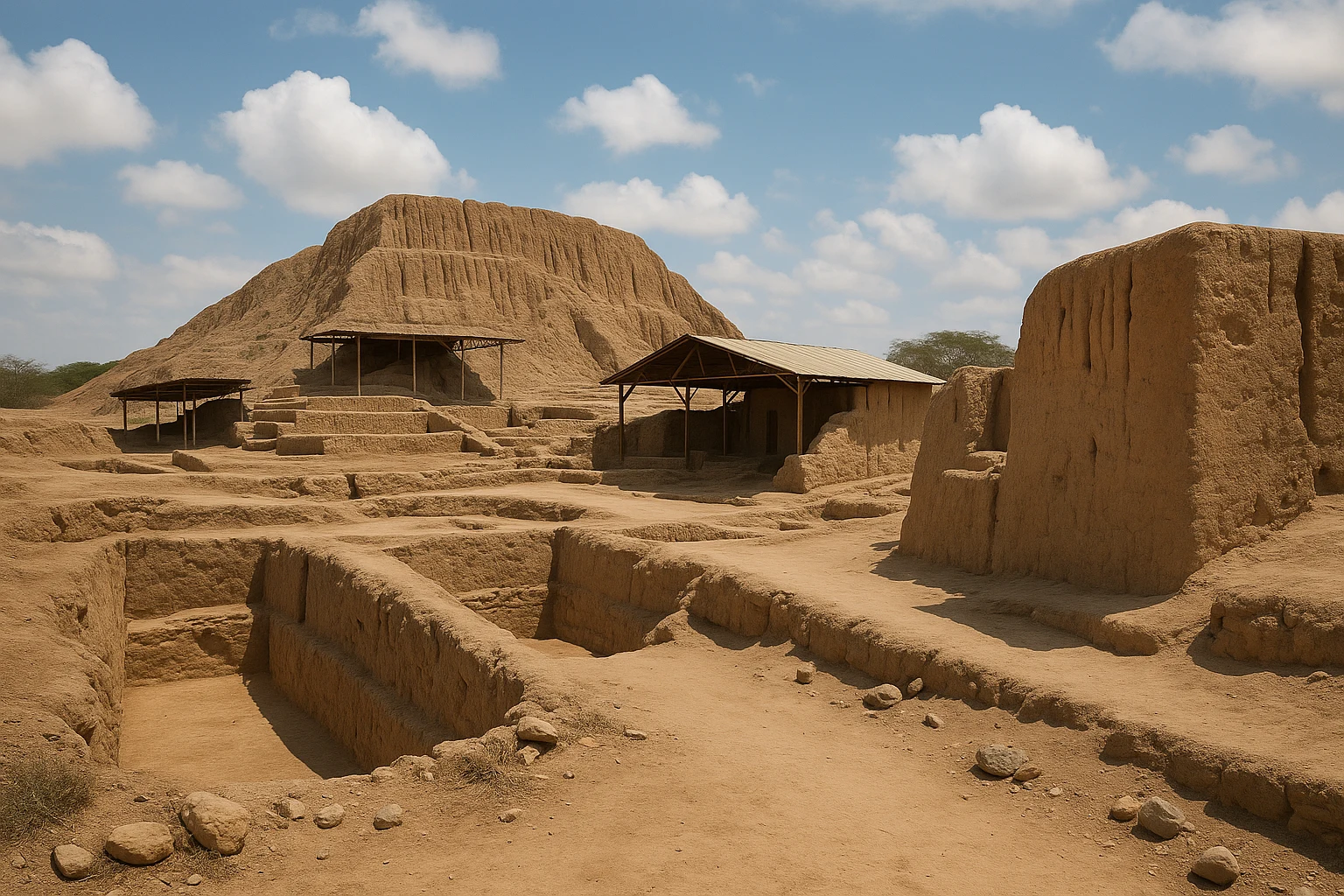
If your schedule allows, pair the museum with Huaca Rajada, the excavation zone where key tombs were uncovered. The landscape feels spare compared with the museum’s theatrical interior, but that contrast is useful. Standing at the source clarifies excavation constraints, preservation challenges, and the vulnerability that made looting such a threat before systematic intervention. On-site interpretation varies, so a guide can add real value by connecting visible architecture to specific find contexts. Photography tip: late afternoon can produce warmer relief on earthen surfaces, but morning light is often clearer for documenting site geometry and profile lines.
Lambayeque in regional context: complementary collections
Sipán is strongest when viewed alongside nearby museums and monuments in the Lambayeque Valley. Supplemental collections help you track continuities in iconography, metallurgy, and elite symbolism across Moche and post-Moche traditions. If you only visit one site, Sipán still delivers a complete experience. But if you can expand the circuit, you begin to see a broader political landscape rather than a single spectacular discovery. That shift, from treasure narrative to civilizational narrative, is exactly what makes northern Peru so rewarding for serious travelers.
Getting There: Transportation and Access
Sipán is straightforward to reach from Chiclayo, and most travelers can organize transport the same morning without difficulty.
From central Chiclayo
From downtown Chiclayo, the Royal Tombs Museum area in Lambayeque is a short regional transfer, and travel times are usually manageable outside rush windows.
- Taxi: Typically S/25-45 ($7-12 USD) one way depending on traffic, pickup point, and negotiation; around 25-40 minutes.
- Colectivo or local bus: Usually S/3-8 ($1-2 USD) with variable comfort and stopping frequency; around 35-60 minutes total.
- Rental car: Practical for combining multiple sites; expect 30-45 minutes plus parking and orientation time near museum areas.
From Chiclayo airport (CIX)
Airport arrivals can reach Sipán the same day, though timing is easier if you store luggage at your hotel first and travel lighter.
- Airport taxi/private transfer: Often S/45-70 ($12-19 USD) depending on arrival hour and demand; roughly 35-55 minutes.
- Public transit via Chiclayo center: Budget option at about S/5-12 ($1-3 USD) total, but includes transfers and extra waiting.
- Rental car pickup: Good for travelers continuing to Túcume or other valley sites; driving is manageable in daylight with offline maps.
Admission and Hours
Ticket policies can shift, but general museum entry is commonly around S/10-20 ($3-5 USD), with possible discounts for students, children, or residents. Carry soles in small notes even if card payment is available, especially when pairing museum and site visits. Operating hours are generally daytime and often reduced or adjusted on Mondays and holidays. The best strategy is arriving near opening for cooler galleries, quieter circulation, and better pacing before group tours peak. If you are combining with Huaca Rajada, start at the museum for interpretation, then head to the archaeological zone with context already in mind.
When to Visit: Seasonal Considerations
Spring (September-November)
Spring in northern Peru is usually mild to warm, around 19-28°C (66-82°F), and this is one of the most comfortable periods for full-day archaeology circuits. Crowds are moderate, with fewer domestic holiday peaks than deep summer windows. Visibility is often good for both museum and site photography. For most travelers, this is an excellent shoulder season that balances weather, logistics, and manageable visitor density.
Summer (December-March)
Summer temperatures often range from 23-33°C (73-91°F), with stronger midday heat in exposed archaeological zones. Museums remain very doable, but outdoor stops like Huaca Rajada feel harder after noon. Crowd levels can rise during holiday stretches and school breaks. Visit early, hydrate aggressively, and keep a flexible lunch break in air-conditioned space. If you only have one day, prioritize indoor galleries during peak heat.
Autumn (April-May)
Autumn often settles into 20-30°C (68-86°F), with a noticeable easing of heat intensity versus high summer. Visitor flow is usually moderate, making it easier to linger at key displays without feeling rushed by group movement. This period is often ideal for travelers who want to combine Sipán with a second major site in the same day. Morning-to-late-afternoon itineraries are comfortable with basic sun protection.
Winter (June-August)
Winter on the north coast is mild compared with Andean highland cold, typically 17-25°C (63-77°F). Light overcast conditions are possible, and occasional humidity can soften contrast in outdoor photos, but overall conditions remain very travel-friendly. Crowds are generally lower outside school vacation spikes, and museum exploration is pleasant all day. For many visitors, winter is the most reliable season for calm pacing and fewer heat constraints.
Combining Sipán Royal Tombs with Chiclayo and Lambayeque
Sipán works best as a structured half-day or full-day archaeology arc anchored in Chiclayo. The most rewarding sequence begins with the Royal Tombs Museum at 9:00 AM, when galleries are quieter and you can move room by room without bottlenecks around the flagship displays. By 11:30 AM, you will have enough interpretive context to understand symbols, rank markers, and burial choreography, which makes your next stop dramatically more meaningful.
From there, transfer toward Huaca Rajada for an on-the-ground view of excavation geography. A typical journey takes under an hour depending on route and traffic, and many travelers arrive by 1:00 PM after a quick lunch in Lambayeque. The site visit itself is often concise but important; in roughly 60-90 minutes, you connect museum reconstructions to terrain, architecture, and preservation realities. If you are traveling with a guide, this is where detailed commentary on stratigraphy and anti-looting history adds depth.
By 3:30 PM, return toward Chiclayo for coffee or an early dinner around central districts where transport is easy to secure. If you prefer a slower pace, skip Huaca Rajada and spend extra time inside the museum’s secondary galleries, then explore Lambayeque town before sunset. Either way, the combined experience typically runs 6 to 8 hours door-to-door. For travelers with limited time in northern Peru, this is one of the highest-value day plans you can build.
Practical Information
What to Bring
- Sun protection: Hat, sunscreen, and lightweight long sleeves, especially if adding open-air archaeological stops.
- Water: At least 1 liter per person for a museum-plus-site day; buy extra before leaving central Chiclayo.
- Footwear: Closed, comfortable shoes with grip for dusty, uneven surfaces around excavation zones.
- Camera setup: A lens or phone mode that handles low indoor light and reflective display cases.
- Cash in soles: Small denominations for fares, snacks, and ticket counters where card service may vary.
Dress code and etiquette
There is no strict ceremonial dress code for the museum, but respectful, modest travel attire is always appropriate in regional cultural institutions. Speak softly in galleries and avoid blocking cases during guided groups; many spaces are narrow and shared. Do not touch barriers, plinths, or any exposed reconstruction elements at archaeological areas.
Accessibility
The museum is generally more accessible than open-air earthen sites, but conditions vary by gallery layout, ramp availability, and temporary installations. Huaca Rajada includes uneven terrain and can be challenging for visitors with reduced mobility. If accessibility is a key need, contact local operators or the museum in advance to confirm current access routes and assistance options.
Why Sipán Royal Tombs Matters
Sipán matters because it gives you a rare chance to watch political power become visible. In many ancient sites, authority is inferred from broken walls and fragments. Here, authority is assembled in front of you through regalia, burial order, and ritual design so deliberate that the social logic still reads across centuries. You are not only seeing beautiful objects; you are seeing a governing system that linked cosmology, status, and performance in material form.
For Peru, Sipán also broadens the travel narrative beyond the Inca world most visitors already know. It reminds you that the Andes and coastal valleys produced many centers of innovation, each with distinct aesthetics and statecraft. That plural history is one of the country’s deepest strengths. When you leave the galleries and step back into Lambayeque’s light, the memory that stays is not simply gold in a case, but the sense that an entire court has spoken again after a long silence.
Quick Facts
| Attribute | Details |
|---|---|
| Location | Lambayeque region near Chiclayo, Peru |
| Ancient Name | Huaca Rajada-Sipán funerary complex |
| UNESCO Status | Not individually inscribed; part of Peru’s protected archaeological heritage |
| Established | c. 100 CE elite Moche funerary complex |
| Distance from nearest hub | About 15-35 km from central Chiclayo, roughly 25-60 minutes depending on stop sequence |
| Entry Fee | Usually around S/10-20 ($3-5 USD), category dependent |
| Hours | Daytime schedule, commonly late morning to early evening; holiday/Monday variations |
| Best Time | April-November mornings for cooler conditions and lighter crowds |
| Suggested Stay | 2-3 hours museum only; 6-8 hours with Huaca Rajada circuit |
Explore More Peru
- Chan Chan: Explore the monumental adobe capital of the Chimú, one of the largest earthen cities in the world.
- Huaca del Sol and Luna: See major Moche ceremonial architecture and vivid mural programs near Trujillo.
- Caral-Supe: Walk one of the oldest urban centers in the Americas and trace deep Andean civilization roots.
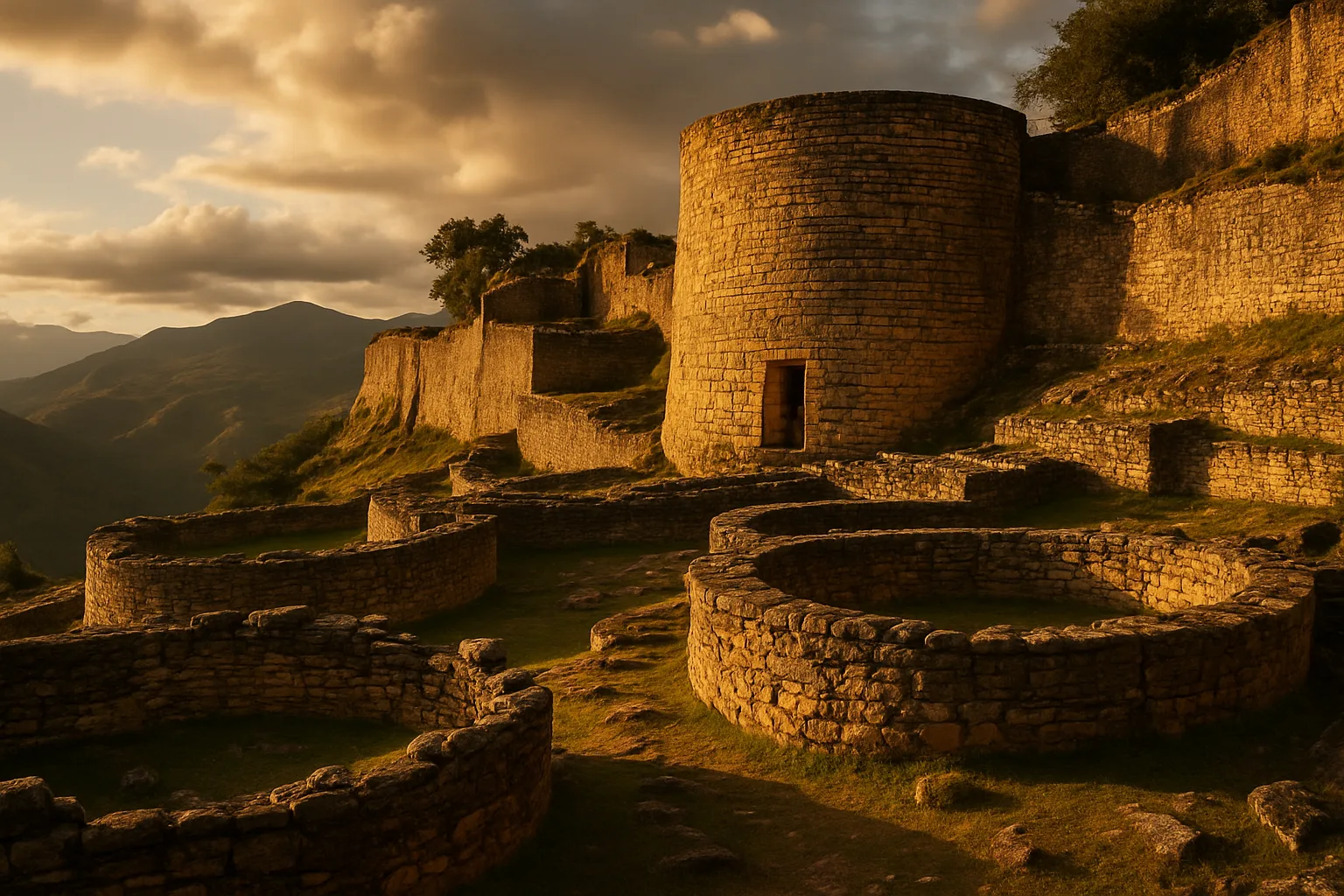
- Kuelap: Visit the mountain fortress-city of the Chachapoya for a radically different highland archaeology experience.
Plan your complete Peru journey with our Peru Ancient Sites Guide. For route planning, read How to Plan a Multi-Site Peru Archaeology Itinerary.
Frequently Asked Questions
How much time should I plan for Sipán Royal Tombs?
Plan 2 to 3 hours for the museum itself if you read labels and move at a steady pace. If you also visit Huaca Rajada, the original excavation zone, reserve a half day. Travelers who love archaeology often stay longer because the artifact rooms are dense with detail.
Is Sipán better as a day trip from Chiclayo or Trujillo?
Sipán is easiest from Chiclayo, where travel time is short and transport options are frequent. From Trujillo, the journey is much longer, so most visitors either overnight in Chiclayo or join a structured multi-site tour. For comfort and timing, Chiclayo is the practical base.
How much do tickets cost at the Sipán Royal Tombs Museum?
General entry is usually priced in Peruvian soles and is affordable compared with major capital-city museums, typically around S/10-20 ($3-5 USD) depending on visitor category and temporary policy updates. Carry small cash in soles even if cards are accepted at the desk. If you are combining sites, ask about bundled or student/resident rates.
What are the opening hours and best visit time?
The museum generally operates daytime hours, often around late morning through early evening with Monday variations, but schedules can shift on holidays. The best experience is early in the day when school groups are fewer and galleries are cooler. Arriving close to opening gives you quieter viewing and cleaner photo opportunities in display halls.
What will I actually see at Sipán?
You will see one of the richest elite burials ever excavated in the Americas: gold and silver regalia, turquoise and shell ornaments, ritual knives, and reconstructed tomb contexts. The displays explain rank, sacrifice, and ceremonial power in Moche society. It is both an art experience and a deep historical archive.
Is Sipán safe and suitable for independent travelers?
Yes, the museum complex is straightforward for independent visitors, and day trips from Chiclayo are common. Use normal city awareness for taxis and valuables, and pre-arrange return transport if visiting multiple rural stops. As with most archaeology routes in northern Peru, daylight travel is the easiest and most comfortable option.
Nearby Ancient Sites
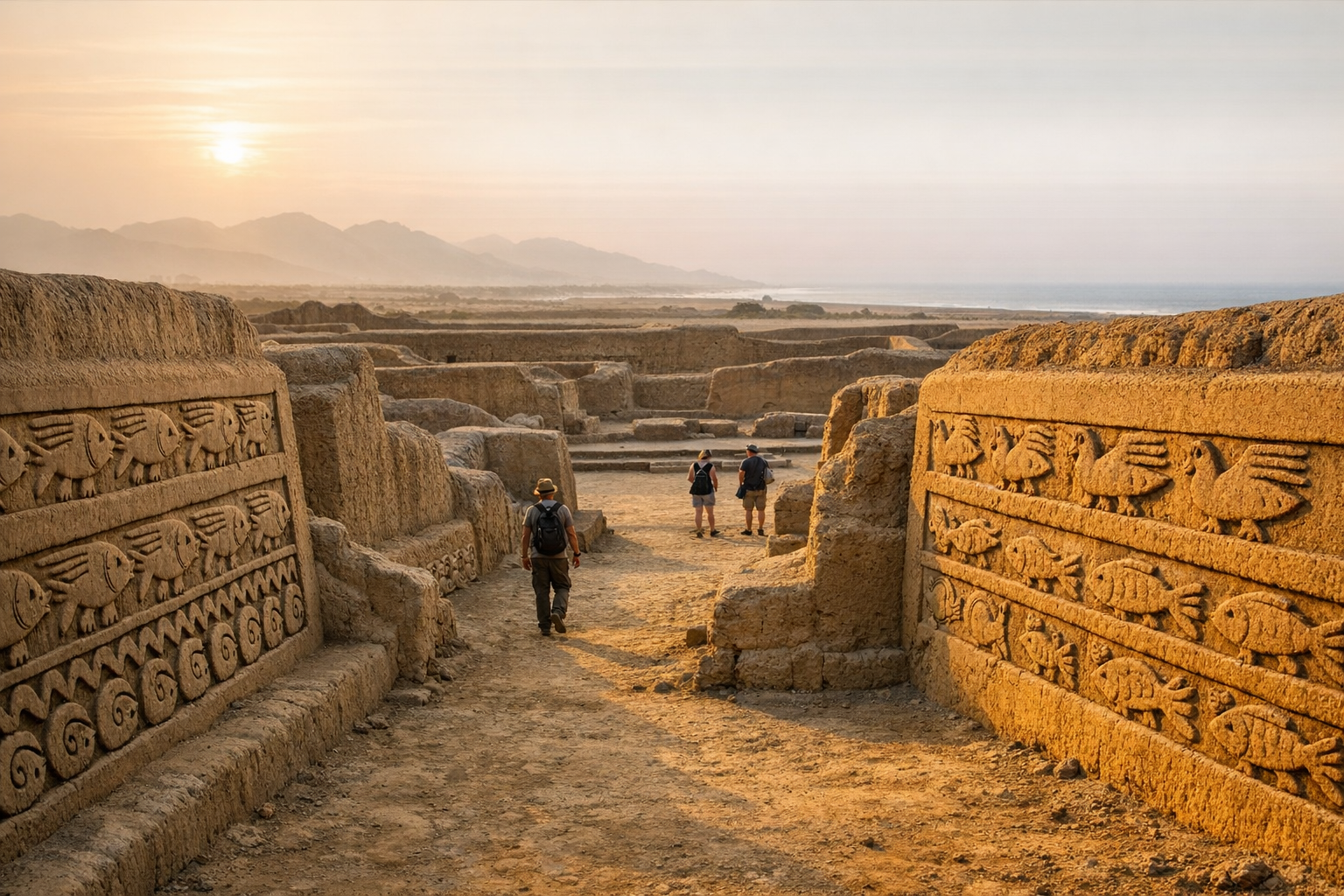
Chan Chan Peru Guide 2026: Chimu Capital & Adobe Citadels
ChimuExplore Chan Chan near Trujillo — the largest pre-Columbian city in the Americas. Discover the Chimu...
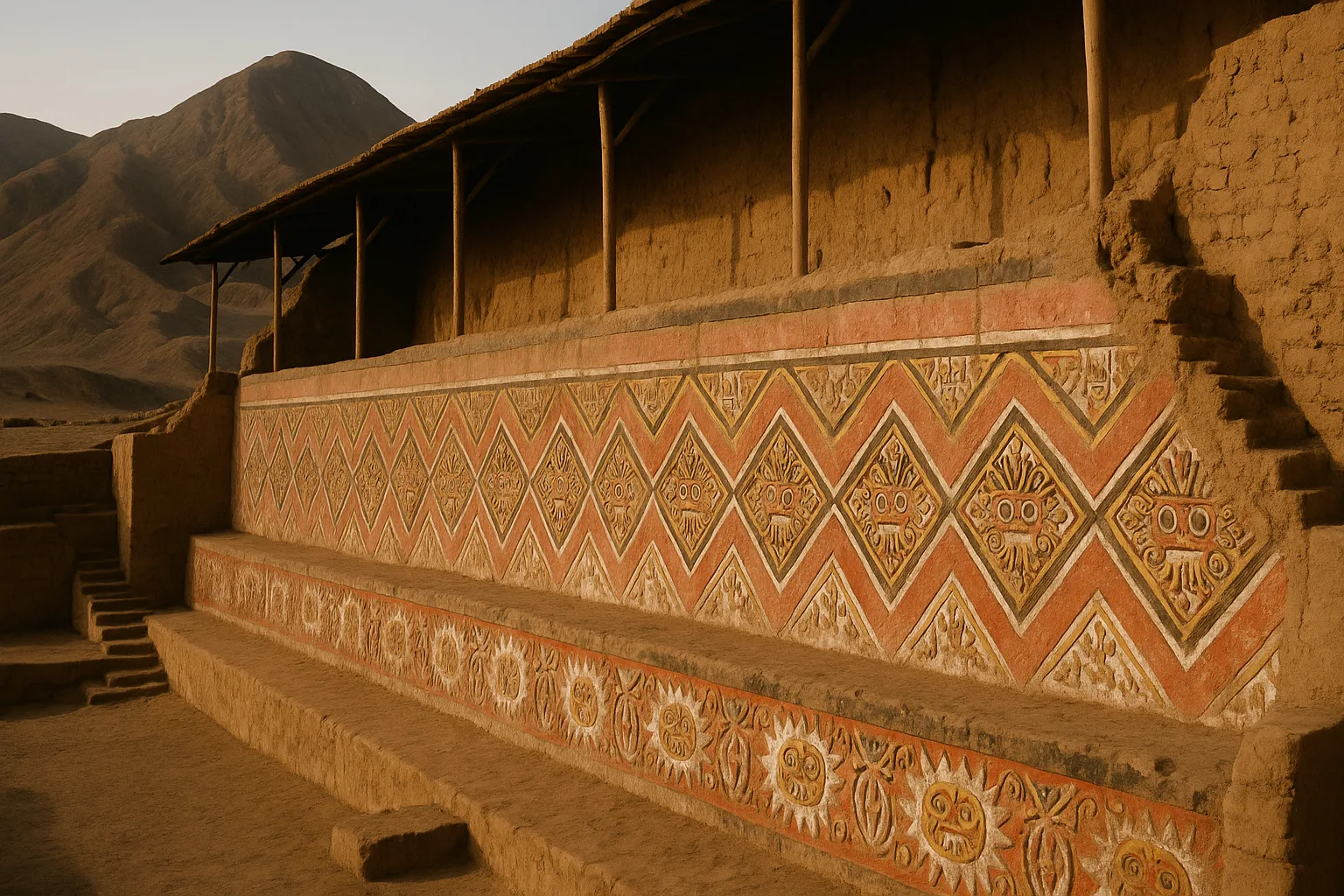
Huaca del Sol and Luna Peru Guide 2026: Moche Pyramids at Trujillo
Moche-Chimu-IncaExplore Huaca del Sol and Huaca de la Luna near Trujillo: Moche mural archaeology, practical access ...
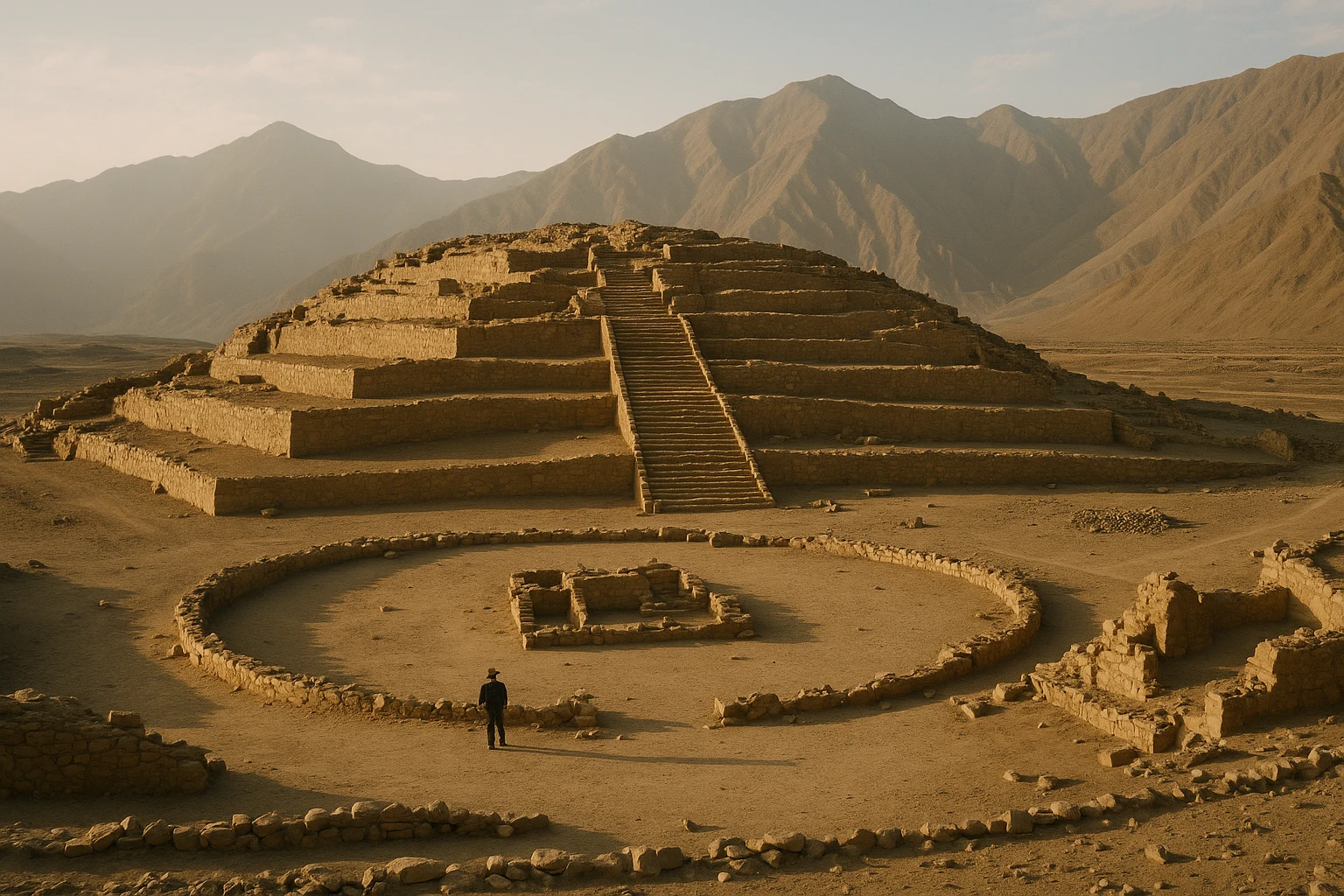
Caral-Supe Peru Guide 2026: Sacred Pyramids & the First Andean City
Norte-Chico-CaralVisit Caral-Supe in Peru, the oldest known city in the Americas, with practical transport from Lima,...
Kuelap Peru Guide 2026: Chachapoyas Cloud Fortress
ChachapoyasExplore Kuelap, the massive Chachapoyas cloud fortress in northern Peru. Reach it by cable car from ...