Quick Info
At a glance
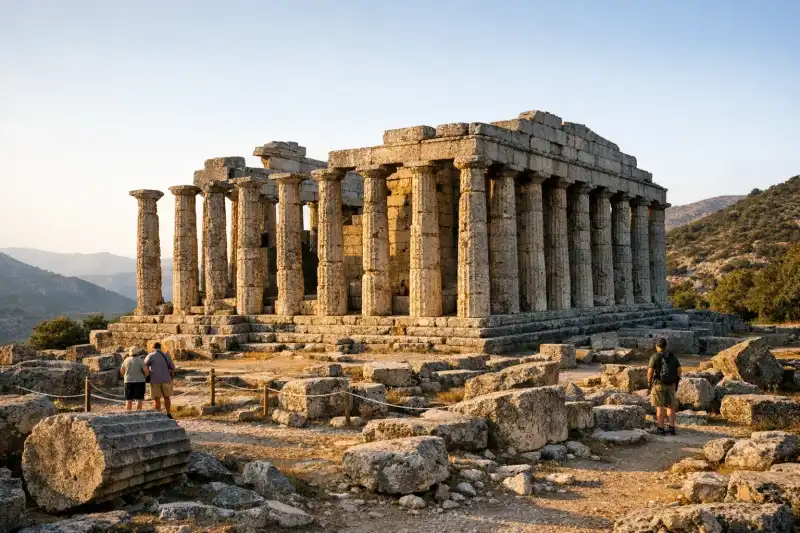
High in the rugged mountains of the Peloponnese, the Temple of Apollo Epicurius at Bassae in Greece feels less like a ruin stumbled upon by chance and more like a deliberate encounter with the ancient world. Far from the coastal plains and major city centers that draw most first-time visitors to Greece, this sanctuary stands in Arcadia’s lonely uplands, where wind, rock, and changing light still shape the mood of the landscape. That remoteness is part of its power. Even today, the journey to Bassae creates a sense of approach and expectation that suits a temple built for a god associated with healing, prophecy, and order.
Unlike many famous Greek monuments that survive amid dense urban settings or heavily developed tourist zones, Bassae retains an atmosphere of isolation. The temple rises above steep valleys, with mountain ridges stretching around it, making the experience feel unusually close to what ancient worshippers might have known. It is also one of the most sophisticated temples of classical Greece, celebrated for its inventive design and its blend of Doric, Ionic, and early Corinthian elements. Although the structure is now protected beneath a modern shelter to aid conservation, its essential elegance remains unmistakable. For travelers interested in Greek architecture, sacred landscapes, or UNESCO World Heritage sites beyond the usual circuit, Bassae offers something rare: a masterpiece that rewards both effort and attention.
History
Origins of the sanctuary
The Temple of Apollo Epicurius at Bassae occupies a remote site in ancient Arcadia, an inland region of the Peloponnese known in antiquity for upland settlements, pastoral life, and strong local identities. The epithet “Epicurius” is usually translated as “the helper” or “the bringer of aid,” and ancient tradition connected Apollo here with deliverance from plague or hardship. The sanctuary served the people of nearby Phigaleia, an ancient city whose inhabitants are believed to have commissioned the temple as part of a regional cult landscape rather than an urban monumental program.
Before the famous classical temple was built, the site likely had earlier sacred use. Like many Greek sanctuaries, Bassae seems to have developed over time, with worship rooted in place as much as architecture. The mountain setting was not accidental. Greek sanctuaries often drew meaning from their surroundings, and at Bassae the dramatic isolation may have reinforced Apollo’s presence as a protector whose aid was sought beyond the ordinary boundaries of city life.
Construction in the 5th century BCE
The standing temple is generally dated to the later 5th century BCE, often around 450–400 BCE, during a period when the Greek world was marked by both cultural brilliance and political conflict. Many scholars attribute the design to Ictinus, the architect associated with the Parthenon in Athens, though direct proof is lacking. Whether or not the attribution is correct, the sophistication of the building suggests the hand of a designer working at the highest level of classical architectural thought.
Bassae is remarkable not simply because it is old, but because it is experimental. The temple is primarily Doric on the exterior, yet it includes Ionic features within and is famous for what is often considered the earliest known Corinthian capital in architecture. The plan is also unusual in orientation and interior arrangement. These elements make the building one of the key monuments for understanding how Greek temple design evolved in the classical period.
Its materials and workmanship reflect both local conditions and broader artistic ambition. Built from local gray limestone with decorative marble elements, the temple balanced practical adaptation with visual refinement. Even in antiquity, it would have stood out for its elegance and originality.
Hellenistic, Roman, and late antique survival
In the centuries after its construction, the sanctuary continued to exist within a changing Greek world. Under Hellenistic kingdoms and later Roman rule, many sanctuaries retained prestige even as political power shifted elsewhere. Bassae’s remote position may have limited its later monumental development, but that same remoteness probably helped preserve it from the heavy rebuilding, quarrying, or urban encroachment that transformed other ancient sites.
The temple’s sculpted Ionic frieze, one of its greatest artistic treasures, eventually drew antiquarian attention in the modern era. In antiquity, however, such sculptural decoration would have contributed to the sanctuary’s ritual and visual impact, linking local worship to wider Greek mythic themes. Over time, as pagan cult practices declined in the late Roman and early Christian periods, the temple lost its original religious function. Yet unlike many classical monuments, it was not entirely dismantled.
Rediscovery and modern conservation
European travelers and antiquarians began to take renewed interest in Bassae in the 18th and early 19th centuries. In 1811–1812, foreign explorers excavated and removed the famous frieze, which is now in the British Museum. That removal remains part of the wider story of early archaeological collecting, when major works of ancient art were often transported abroad rather than preserved in place.
Even so, the architectural monument itself survived in unusually substantial condition. Its mountain setting reduced opportunities for later stone reuse, and the site gradually became recognized as one of the best-preserved temples of the ancient Greek world. In 1986, the Temple of Apollo Epicurius at Bassae was inscribed on the UNESCO World Heritage List, notably becoming the first Greek site to receive that designation.
Modern conservation has focused on protecting the temple from weathering, seismic risks, and structural instability. The large protective tent-like shelter now covering the monument can surprise first-time visitors, but it reflects a serious effort to preserve a fragile masterpiece in an exposed mountain environment. Although the shelter changes the visual presentation, it also allows the temple to endure for future generations while ongoing study and restoration continue.
Key Features
The greatest strength of Bassae is that it combines architectural importance with a memorable sense of place. Even before examining details, visitors notice the setting: the temple stands on a high terrace surrounded by mountains, with a feeling of separation from ordinary routes and settlements. This is not a site that blends into a townscape. Instead, it appears as a carefully placed sacred building in a severe landscape, and that relationship between monument and terrain is central to its identity.
Architecturally, the temple is most famous for its unusual synthesis of the three classical orders. The exterior is Doric, with the solid, disciplined character associated with many mainland Greek temples. Yet the interior introduces Ionic columns and details that create a more complex visual rhythm. Most famously, a single Corinthian capital stood within the cella, often described as the earliest known example of the Corinthian order in architecture. For students of ancient design, this makes Bassae a landmark in the evolution of Greek forms. It is not merely a beautiful temple; it is a crucial experiment in architectural language.
The plan itself is also distinctive. Unlike the more typical east-west orientation of many Greek temples, Bassae is aligned north-south, a choice that has generated much scholarly discussion. The reasons may involve the topography, the earlier sanctuary, ritual requirements, or the desire to manipulate light in a particular way. Whatever the cause, the result is a building that feels subtly different from more familiar temples, even to visitors without formal architectural training.
Inside, the arrangement of engaged Ionic columns along the walls contributes to a sense of controlled interior complexity. The temple’s designers were clearly interested in guiding movement and framing sacred space, not simply enclosing it. Ancient visitors would also have experienced painted surfaces and sculptural decoration that are now largely gone, so the surviving stonework represents only part of the original visual effect.
Among the temple’s most celebrated lost elements is the Ionic frieze, which depicted mythological battles including Greeks against Amazons and Lapiths against Centaurs. Though no longer on site, the frieze remains essential to understanding Bassae’s status. Such imagery connected the sanctuary to wider Greek ideas about order, civilization, and heroic struggle. The temple was not a provincial monument in a narrow sense; it engaged fully with the artistic and symbolic vocabulary of the classical world.
The columns themselves are another highlight. Several remain standing, allowing visitors to grasp the scale and proportions of the peristyle. The stone has a restrained, almost austere beauty, especially in changing mountain light. Because the monument is sheltered, visitors can often study details more carefully than at sites exposed to harsher elements. The protective covering may reduce the romance of an open-air ruin, but it increases the chance to appreciate structural relationships and preserved masonry.
Another important feature is the site’s atmosphere. Bassae lacks the crowds of Athens and the dramatic tourist choreography of some major archaeological parks. What it offers instead is quiet concentration. On many days, the wind and the mountain silence become part of the visit. You come here not for urban spectacle but for clarity: a temple, a highland sanctuary, and a rare opportunity to encounter classical architecture in a setting still shaped by isolation. That combination explains why Bassae leaves such a strong impression on travelers willing to go beyond Greece’s standard itinerary.
Getting There
Reaching the Temple of Apollo Epicurius at Bassae requires planning, and that is one reason the site feels so rewarding. The easiest and most practical option is to drive. From Kalamata, the trip usually takes around 2 to 2.5 hours depending on road conditions and your route through the mountain interior. A rental car from Kalamata commonly starts at about €35–€60 per day in the shoulder season, often more in summer, with additional fuel costs of roughly €20–€35 for the round trip depending on your vehicle and starting point. From Tripoli or Olympia-area bases, travel times are also generally in the 2 to 3 hour range.
Public transport exists but is limited and not ideal for same-day independent sightseeing. Buses may connect larger towns such as Kalamata or Pyrgos to villages in the region, but schedules can be infrequent, seasonal, and poorly aligned with site opening hours. If you attempt the trip without a car, expect at least one transfer and the possibility of needing a taxi for the final leg. Taxi fares from Andritsaina or nearby towns can vary, but a short local transfer may cost around €20–€40 each way.
Guided day tours are less common than for major Greek landmarks, but private drivers or custom Peloponnese tours can sometimes include Bassae, especially when paired with mountain villages or other inland sites. These usually cost significantly more, often from €180 upward for a private excursion, but they remove the stress of navigation on winding roads. However you arrive, carry water, confirm current opening times, and do not rely on frequent roadside services in the immediate area.
When to Visit
Spring and autumn are generally the best times to visit Bassae. From April to early June, the mountains of Arcadia are green, temperatures are comfortable, and the roads are usually pleasant for driving. Wildflowers and clear light add to the sense of remoteness, making this one of the most rewarding seasons for photography and slow exploration. September and October are similarly attractive, with warm days, cooler mornings, and fewer domestic holiday crowds than high summer.
Summer brings the most reliable road conditions and long daylight hours, but the Peloponnese can be hot, and even mountain sites may feel intense around midday. The protective shelter over the temple changes the direct sun exposure at the monument itself, yet the journey and surrounding open areas can still be very warm. If visiting in July or August, arrive early, bring water, and avoid assuming that the mountain location guarantees cool weather. Summer is also when rental cars and accommodation in larger regional hubs are usually at their most expensive.
Winter offers a different experience: sharper mountain air, quieter roads, and a striking sense of solitude. But this season requires more caution. Weather can change quickly in upland Arcadia, with cold, rain, fog, and occasional snow affecting driving conditions. Opening schedules may also be shorter. For travelers comfortable with flexible plans, winter can be atmospheric, but spring and autumn remain the safest and most balanced choices.
Time of day also matters. Morning visits are often best for softer light, cooler conditions, and a calmer mood. Because Bassae is a site of atmosphere as much as architecture, the quality of the day can shape the experience more than at busier, more urban monuments.
| Quick Facts | Details |
|---|---|
| Location | Bassae, near Andritsaina, Arcadia, Peloponnese, Greece |
| UNESCO Status | World Heritage Site since 1986 |
| Date | c. 5th century BCE |
| Dedication | Apollo Epicurius (“Apollo the Helper”) |
| Architectural Orders | Doric, Ionic, and early Corinthian |
| Best Base | Kalamata, Tripoli, or Andritsaina |
| Recommended Visit Length | 45 minutes to 1.5 hours |
| Best Season | Spring and autumn |
| Access | Best reached by rental car |
| Famous Feature | Earliest known Corinthian capital in a Greek temple |
Guided tours: worth it?
A guide can be genuinely useful at Temple of Apollo Epicurius at Bassae, especially if you want help with transport, timing, tickets, or understanding a large site without losing half the day to logistics.
Best for
- First-time visitors who want context, not just photos
- Travelers who want transport, timing, or entry logistics handled
- Short visits where a planned route saves time
When to go self-guided
Go independently if you already have transport and tickets sorted, enjoy moving at your own pace, and are comfortable checking the latest official rules before you arrive.
What I’d avoid
Skip paid tours that bundle unrelated stops you do not actually want. The best option should either save meaningful planning time or add historical context you would miss on your own.
Bassae Temple and Arcadia day tours
Useful when: you want to compare guided formats before deciding
Peloponnese archaeological tours from Kalamata
Useful when: transport or pickup logistics matter
Ancient Greece history tours in the Peloponnese
Useful when: you want to compare guided formats before deciding
Some tour links are affiliate links, which may earn Ancient Travel a small commission at no extra cost to you. I try to surface options that make practical sense for the site—not just anything bookable.
Frequently Asked Questions
Where is the Temple of Apollo Epicurius at Bassae?
The temple stands in the mountains of Arcadia in the southwestern Peloponnese of Greece, near the village of Andritsaina and the archaeological area of Bassae.
Why is the Temple of Apollo Epicurius important?
It is one of the most significant temples of classical Greece, admired for its unusual design, refined proportions, early use of the Corinthian order, and dramatic mountain setting.
Who designed the Temple of Apollo Epicurius at Bassae?
The temple is traditionally attributed to Ictinus, the architect associated with the Parthenon, though some details remain debated by scholars.
Can you visit the interior of the temple?
Visitors can usually view the monument within its protective shelter, but access conditions can vary depending on conservation work, so it is best to check current site information before traveling.
How much time should I allow for a visit?
Most travelers spend 45 minutes to 1.5 hours at the site, though those interested in architecture, photography, or the surrounding Arcadian landscape may stay longer.
What is the best way to reach Bassae?
The easiest option is by rental car from Kalamata, Tripoli, or other Peloponnese bases, since public transport connections are limited and often require transfers.
Nearby Ancient Sites
Acropolis Travel Guide 2026: Parthenon, Tickets, and Best Time
Ancient GreecePlan an efficient Acropolis visit with practical ticket timing, key monuments, and museum pairing ti...
The Complete Acropolis Athens Travel Guide: Temples
Ancient GreecePlan the perfect visit to the Acropolis of Athens with our 2026 guide. Discover the Parthenon, best ...
Ancient Agora of Athens Travel Guide 2026: Route, Tickets, and Context
Classical GreekPlan a better Ancient Agora visit with practical timing, monument priorities, and clear historical c...