Quick Info
Curated Experiences
Temple of Heaven and Forbidden City Full-Day Tour
Temple of Heaven Half-Day Tour
Beijing Morning Exercise and Temple Tour
Where Heaven and Earth Were Joined
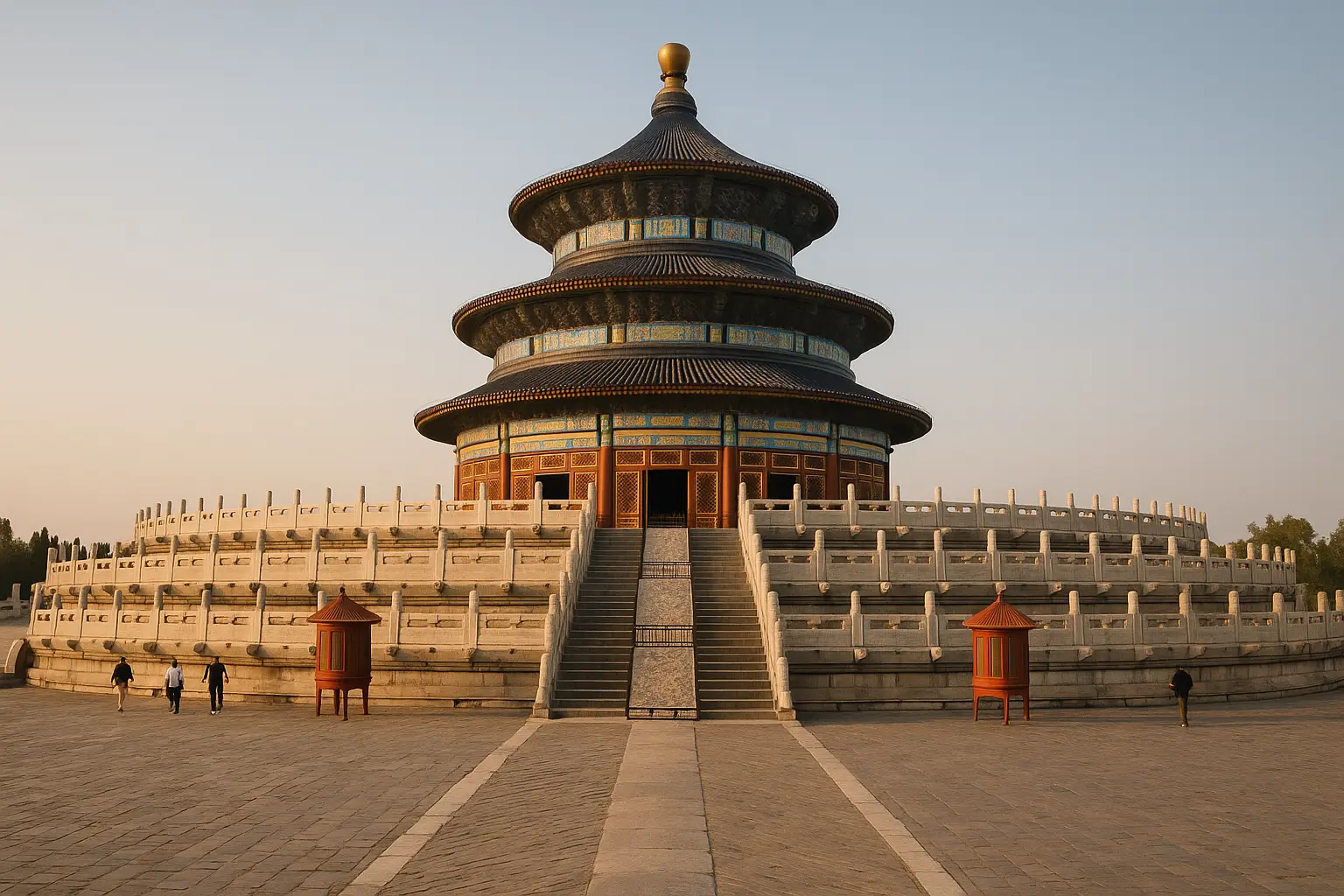
In the southern quarter of Beijing, where the geometric certainty of the Forbidden City gives way to ancient cypress groves and open sky, lies the most important ritual space in imperial Chinese history—a 273-hectare complex where the fate of the harvest, and with it the welfare of hundreds of millions, was placed before the heavens each year. The Temple of Heaven, known in Chinese as Tiantan, was not a place of public worship in any sense recognizable to Western visitors. It was a stage for the most solemn performance of imperial authority: the annual ceremony in which the Son of Heaven, intermediary between celestial powers and earthly subjects, knelt on an open marble platform and appealed directly to the cosmos. For nearly five centuries, from the reign of the Yongle Emperor in 1420 to the final Qing ceremony in December 1911, no commoner could witness this rite. Today the space belongs to everyone—to the elderly Beijingers who arrive at dawn for tai chi and sword dancing, to kite-flyers threading elaborate designs through the sky, to musicians playing erhu in the shade of trees that were already old when the last emperor offered his prayers. The Hall of Prayer for Good Harvests, with its triple-tiered blue roof rising 38 meters without a single nail, remains one of the most perfect buildings ever raised in the ancient world. To walk the same elevated stone causeway that imperial processions once followed, and to arrive at a marble altar open to the sky where heaven could hear—this is to touch the deepest roots of Chinese civilization.
The Son of Heaven: Five Centuries of Ceremony
The Temple of Heaven was built in 1420 by the Yongle Emperor simultaneously with the Forbidden City, conceived as two halves of a single cosmological statement. The Forbidden City expressed the emperor’s earthly sovereignty; the Temple of Heaven expressed his connection to the forces that governed that sovereignty. Chinese cosmology held that the emperor was Tianzi—the Son of Heaven—uniquely positioned to mediate between the celestial realm and the human world. Harvest failures, floods, and famines were not merely natural disasters; they were signs that heaven’s mandate had been withdrawn, and the emperor had failed in his cosmic duties. The annual ceremonies at Tiantan were a form of divine diplomacy, conducted with painstaking ritual precision to maintain the agreement between heaven and earth.
The Qing Dynasty inherited the complex in 1644 when Manchu forces displaced the Ming. Far from abandoning these ceremonies, the Qing rulers adopted them with equal solemnity, understanding that performing these rites was essential to legitimizing their claim over a predominantly Han population. For 267 years the ceremonies continued uninterrupted, until 1889 when lightning destroyed the original Hall of Prayer in a fire that spread with terrifying speed through the lacquered wooden interior. The reconstruction that followed was completed within a year—a testament to the urgency with which the Qing court viewed the restoration—and the rebuilt hall closely matched the lost original. The last ceremony took place in December 1911, just weeks before the dynasty itself collapsed. In 1918 the complex opened as a public park. In 1998 it received UNESCO World Heritage designation as “a masterpiece of architecture and landscape design.”
Hall of Prayer for Good Harvests: Architecture as Cosmology
The Hall of Prayer for Good Harvests—Qiniandian in Chinese—is arguably the most accomplished piece of wooden architecture in the world. The building is circular, 36 meters in diameter, and rises 38 meters on three diminishing tiers of blue-glazed roof that seem to compress the sky downward toward the altar within. It was assembled without a single nail, relying instead on interlocking wooden brackets and the extraordinary precision of its 28 columns. The four innermost columns, each rising to the full height of the building, represent the four seasons. The twelve columns of the middle ring represent the twelve months of the year. The twelve outer columns represent the twelve shichen—the traditional Chinese units into which a day is divided. Every structural element carries numerical meaning.
The circular form is not an aesthetic choice but a philosophical one: in Chinese cosmology, heaven is round and earth is square—a belief encoded throughout the complex’s design. Blue tiles represent heaven; the outer wall of the complex is square while the inner enclosure is circular; the building faces south, as heaven is south in traditional Chinese orientation. Standing inside the hall beneath the towering lacquered columns, with the dome rising overhead in concentric rings of red and gold, it becomes possible to understand how those who entered during the imperial period might have genuinely felt they were stepping closer to the celestial. The current building dates to 1889 but replicates its 1420 predecessor with fidelity; what visitors see today is essentially what the Yongle Emperor built, recreated with the materials and techniques of his time.
The Circular Mound Altar: Praying Under Open Sky
While the Hall of Prayer is the complex’s most celebrated image, the actual ritual of the Winter Solstice ceremony took place south of it, at the Circular Mound Altar—Huanqiutan. This three-tiered platform of white marble, perfectly proportioned and oriented to the cardinal directions, has no roof. That is the point. Here the emperor knelt in the open air, exposed to wind and winter cold and the immensity of the sky above, to make his offerings and speak his prayers directly upward. No intermediary architecture stood between the Son of Heaven and heaven itself.
The altar’s geometry encodes the same numerical symbolism found throughout the complex. The uppermost tier—where the emperor stood at the center stone—is paved in nine concentric rings of marble slabs, each ring containing a multiple of nine stones. Nine was the highest yang number in Chinese numerology, associated with heaven and masculine power. The center stone itself produces a remarkable acoustic effect: a voice spoken there seems amplified and returned, as if the sky is answering. This is not mysticism but physics—the circular marble walls reflect sound waves back to the speaker—yet the experience, especially in the silence of early morning, carries something of the uncanny.
Echo Wall and Imperial Vault: Sound as Sacred Engineering
Between the Hall of Prayer and the Circular Mound Altar stands a smaller but extraordinary structure: the Imperial Vault of Heaven, a single-gabled circular building that housed the spirit tablets used in the ceremonies. The vault is surrounded by the Echo Wall—Huiyinbi—a perfectly circular enclosure approximately 65 meters in diameter whose smooth, curved inner surface creates one of the ancient world’s most remarkable acoustic phenomena. A whisper spoken close to the wall at one side travels clearly around the entire circumference and arrives audible at the opposite side, a distance of 65 meters. Two people standing at opposite ends of the wall, facing the stone, can hold a quiet conversation as if standing side by side.
This effect was not accidental. The wall’s curvature, height, and surface smoothness were calculated to produce it—evidence that Ming Dynasty architects and engineers possessed a sophisticated working understanding of sound wave behavior. Whether this acoustic property was a deliberate sacred feature or a demonstration of technical virtuosity is debated by scholars; what is certain is that the builders knew what they were creating. The effect delights visitors today as it must have startled initiates in the imperial era, offering a small but vivid demonstration of how this complex consistently embedded natural philosophy into its physical fabric.
The Danbi Bridge and the Cypress Groves
Connecting the Hall of Prayer to the Imperial Vault and Circular Mound Altar is the Danbi Bridge, a raised stone causeway 360 meters long. In imperial times the central strip of this bridge was reserved for the exclusive use of the emperor—flanking sections accommodated the officials, musicians, and ceremonial attendants who accompanied him. Walking the central path today, as visitors are free to do, offers a small transgression against five centuries of protocol. The procession that once moved along this axis was choreographed with theatrical precision: musicians played specific pieces at specific moments, incense burned at intervals, and the emperor’s palanquin moved at a pace calibrated to the ceremonial music.
The cypress trees that flank the main axis and fill the park’s outer areas are among the oldest living things in Beijing. Many are more than 600 years old, predating the Ming construction, planted in an era when this ground was already considered sacred. Their gnarled trunks and dense shade give the park a quality that is rare in Beijing’s relentlessly modernizing landscape—a sense of continuity that no reconstruction can manufacture. In mist or winter frost these ancient trees become the most evocative element of the entire complex.
Dawn at Tiantan: The Living Temple
No description of the Temple of Heaven is complete without an account of what happens here at six o’clock in the morning, when the park opens and Beijing’s elderly population flows through the gates as they have every day for decades. The cypress alleys fill with tai chi practitioners moving in slow synchrony. Women in bright exercise clothes perform fan dances and sword routines on the open plazas. Couples waltz to music from portable speakers. Erhu players draw long, mournful notes from two-stringed fiddles. Men concentrate over chess boards while spectators crowd around to observe critical positions. Kite-flyers send elaborate dragons and birds into the sky above the Hall of Prayer’s blue roof.
This transformation of an imperial ritual space into a democratic community park represents something genuinely remarkable in the history of heritage sites. Most ancient monuments are preserved by exclusion—kept at a distance, behind barriers, accessed on schedules. The Temple of Heaven functions as both UNESCO monument and neighborhood park, and the two roles do not conflict. The elderly Beijingers who have practiced tai chi here for thirty or forty years are not desecrating a historic site; they are extending its life as a place of living culture. Arriving at six in the morning, before the ticketed buildings open at eight, offers an hour of atmosphere that no guided tour can replicate.
Practical Guide: Tickets, Timing & Getting There
Essential Planning FAQs
How do I get to the Temple of Heaven from Beijing?
Metro Line 5 to Tiantan Dongmen Station serves the East Gate, closest to the Hall of Prayer—the most convenient option for most visitors. Line 8 to Tianqiao Station serves the West Gate area near the Fasting Palace. By taxi, request “Tiantan” and expect 20–40 CNY ($3–6 USD) from central locations. Organized tours ($45–75) include transport and are often combined with the Forbidden City for a full day.
How much does it cost to visit?
Park entry is 10 CNY ($1.40 USD)—this covers the grounds but not the historical buildings. The through ticket covering the Hall of Prayer, Imperial Vault/Echo Wall, and Circular Mound Altar costs 28 CNY ($4 USD) from April through October, and 20 CNY ($2.80 USD) from November through March. Audio guides in multiple languages cost 40 CNY ($6 USD) with a 100 CNY deposit. Virtually all visitors should purchase the through ticket.
What is the best time to visit?
Early morning (6–8 AM) is the single best window: the park is alive with tai chi, musicians, and kite-flyers, and the light is superb before the tour groups arrive. The ticketed buildings open at 8 AM. Spring (April–May) and autumn (September–October) offer the most pleasant temperatures and clear skies. Summer is hot and humid but the gardens are lush. Winter is cold but uncrowded and atmospheric. Avoid Chinese public holidays and weekend middays entirely.
How long do I need?
A focused visit covering the Hall of Prayer, Echo Wall, and Circular Mound Altar requires 2–3 hours. A full morning—arriving at 6 AM to experience the local activity, then exploring the ticketed structures when they open at 8—makes for a satisfying 4-hour visit. The Fasting Palace and Divine Music Administration are worth an additional hour for those with deep interest in the ceremonial context.
Which gate should I enter?
The East Gate (Tiantan Dongmen) is the main entrance and closest to the Hall of Prayer—the right choice for most visitors. The South Gate is more convenient if you want to begin at the Circular Mound Altar and work northward. The West Gate serves the Fasting Palace. The North Gate is rarely used.
Quick Facts
| Attribute | Details |
|---|---|
| Location | Beijing, Beijing, China |
| Country | China |
| Region | Beijing |
| Civilization | Chinese Imperial |
| Historical Period | 1420–1911 CE |
| Established | 1420 CE |
| Coordinates | 39.8822, 116.4066 |
Explore More of China
- Forbidden City: The imperial palace at the heart of Beijing’s dynastic history
- Summer Palace: Imperial gardens and Kunming Lake northwest of the city
- Great Wall at Badaling: China’s iconic northern fortification
|-----------|---------| | Location | Southern Beijing, China | | Chinese Name | Tiantan (天坛) | | UNESCO Status | World Heritage Site (1998) | | Built | 1420 CE (Ming Dynasty, Emperor Yongle) | | Period of Use | 1420–1911 CE (Ming and Qing dynasties) | | Complex Area | 273 hectares | | Hall of Prayer Height | 38 meters | | Entry Fee | 10 CNY park; 28 CNY through ticket (Apr–Oct); 20 CNY (Nov–Mar) | | Opening Hours | Park: 6:00 AM; Buildings: 8:00 AM | | Best Time | April–May, September–October; early morning visits | | Nearest Metro | Line 5, Tiantan Dongmen (East Gate) |
Frequently Asked Questions
How do I get to the Temple of Heaven from Beijing?
The Temple of Heaven is in central Beijing, easily accessible by Metro Line 5 to Tiantan Dongmen Station (East Gate) or Line 8 to Tianqiao Station. Buses 6, 34, 35, 36, and others serve the park. Taxis cost 20-40 CNY ($3-6 USD) from most central locations. The park has four gates—East Gate is closest to the Hall of Prayer, South Gate near the Circular Mound Altar. Organized tours ($45-75) include transport.
How much time do I need at the Temple of Heaven?
Plan 2-3 hours to see the main structures: Hall of Prayer for Good Harvests, Echo Wall/Imperial Vault of Heaven, and Circular Mound Altar. A full morning (3-4 hours) allows relaxed exploration of the park grounds where locals exercise and socialize. The park opens at 6 AM; the ticketed historical buildings open at 8 AM. Many visitors combine with the nearby Hongqiao Pearl Market or the Forbidden City.
What is the Hall of Prayer for Good Harvests?
The Hall of Prayer for Good Harvests (Qiniandian) is a magnificent triple-gabled circular building, 36 meters in diameter and 38 meters tall, built entirely of wood without using nails. Its blue-tiled roof represents heaven, and its circular shape reflects the ancient Chinese belief that heaven is round. Emperors prayed here annually for good harvests. The current structure is a 1889 reconstruction after the original was struck by lightning. It's the Temple of Heaven's most iconic building.
When is the best time to visit the Temple of Heaven?
Early morning (7-9 AM) offers magical atmosphere as locals practice tai chi, dance, play music, and fly kites. The park is a vibrant community space at this hour. The historical buildings open at 8 AM. Spring (April-May) and autumn (September-October) offer pleasant weather. Visit on weekdays to avoid crowds. Winter (November-March) is cold but peaceful with fewer tourists.
How much does it cost to visit the Temple of Heaven?
Park entry is 10 CNY ($1.40 USD). The through ticket for historical buildings (Hall of Prayer, Echo Wall, Circular Mound Altar) is 28 CNY ($4 USD) April-October, 20 CNY ($2.80 USD) November-March. Total cost is very reasonable compared to other Beijing attractions. Audio guides are 40 CNY ($6 USD) with deposit. Most visitors should purchase the through ticket to see the main structures.
What is the Echo Wall?
The Echo Wall (Huiyinbi) surrounds the Imperial Vault of Heaven and creates remarkable acoustic effects due to its perfectly circular construction and smooth surface. Whispers travel clearly along the wall—one person can speak at one side and be heard distinctly at the other side, 65 meters away. The Circular Mound Altar also features acoustic properties where voices appear amplified at the center stone. These effects demonstrate sophisticated Ming Dynasty understanding of sound wave behavior.
Nearby Ancient Sites
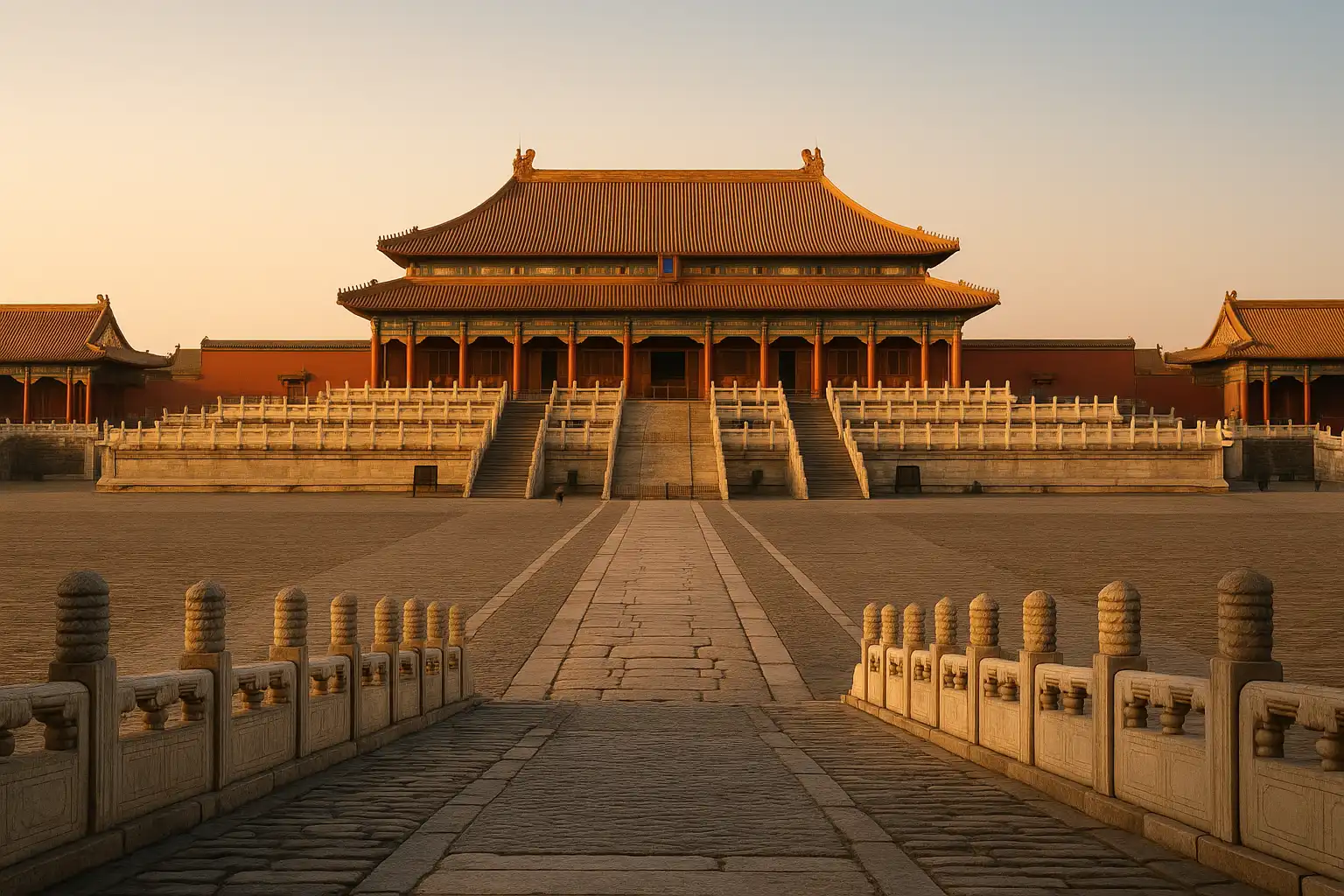
Forbidden City China Travel Guide 2026: Imperial Palace of Beijing
Chinese ImperialExplore the Forbidden City, China's imperial palace for 500 years. Discover the Hall of Supreme Harm...
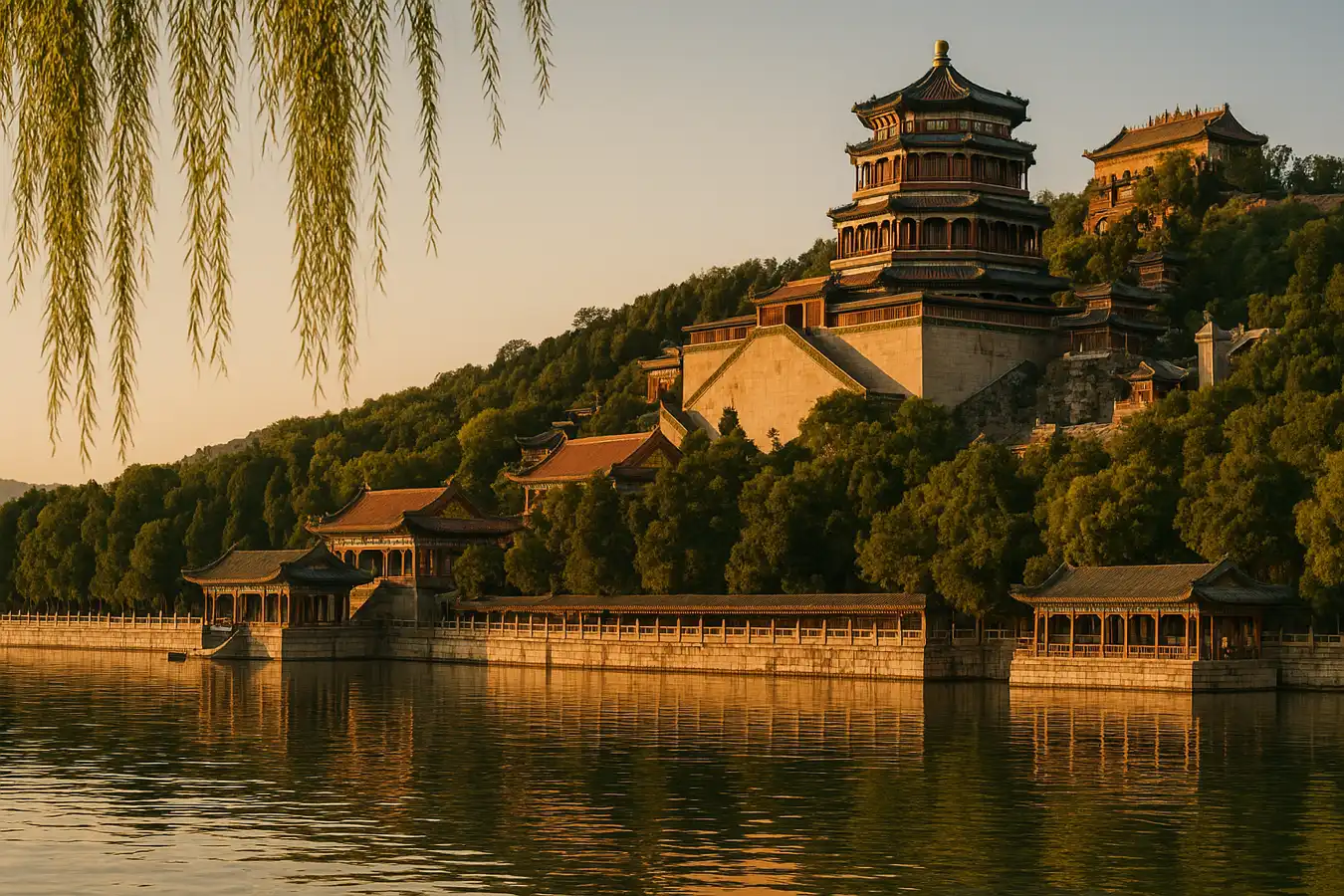
Summer Palace China Travel Guide 2026: Imperial Gardens of Beijing
Chinese ImperialExplore the Summer Palace, China's masterpiece of imperial garden design. Discover Kunming Lake, Lon...
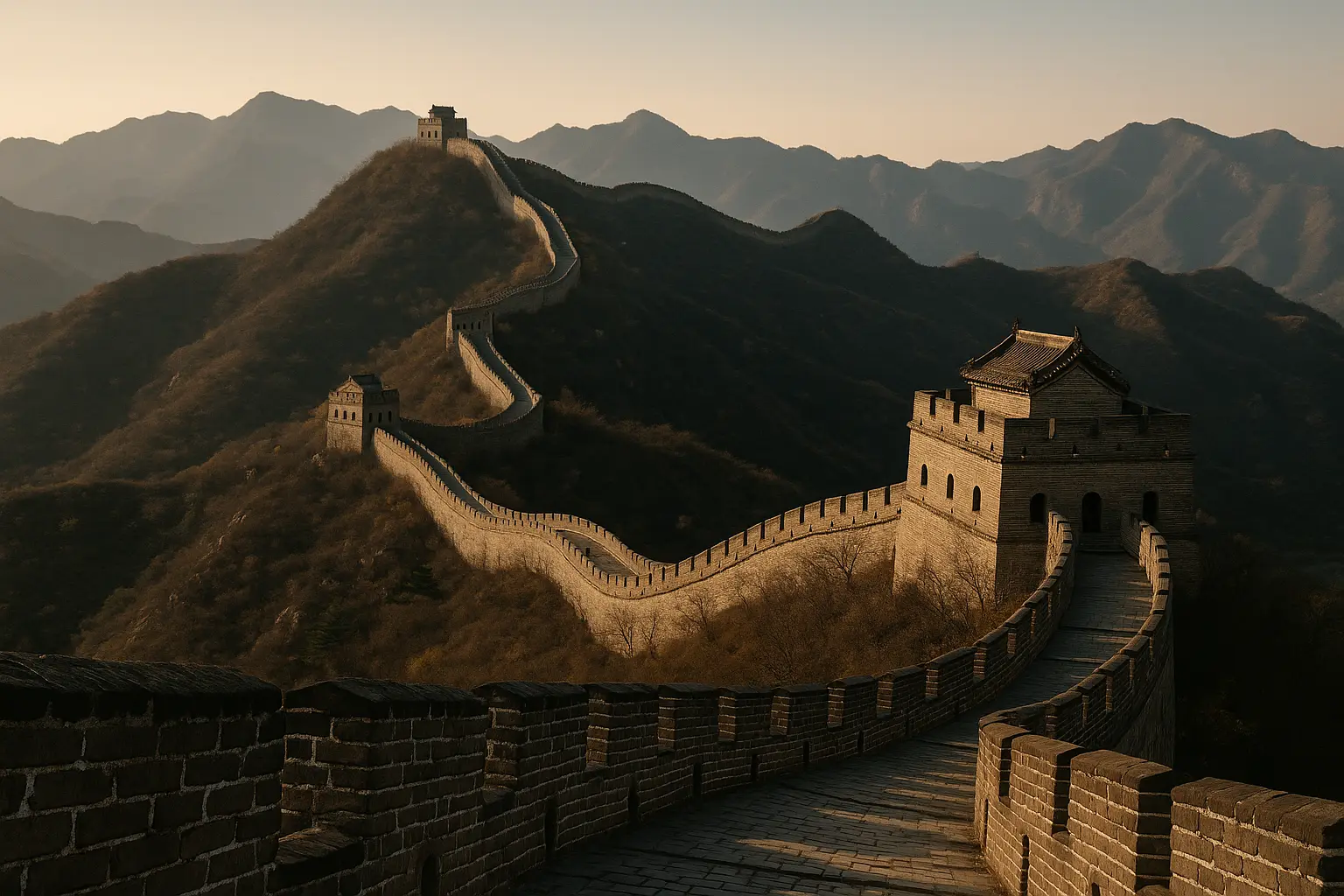
Great Wall of China Badaling Travel Guide 2026: Iconic Fortification
Chinese ImperialVisit Badaling, the most famous section of the Great Wall of China. Our guide covers tickets, cable ...