Quick Info
Curated Experiences
Terracotta Warriors Half-Day Tour from Xi'an
Terracotta Warriors and Xi'an City Wall Full-Day Tour
Private Terracotta Warriors Tour with Pit 2 Access
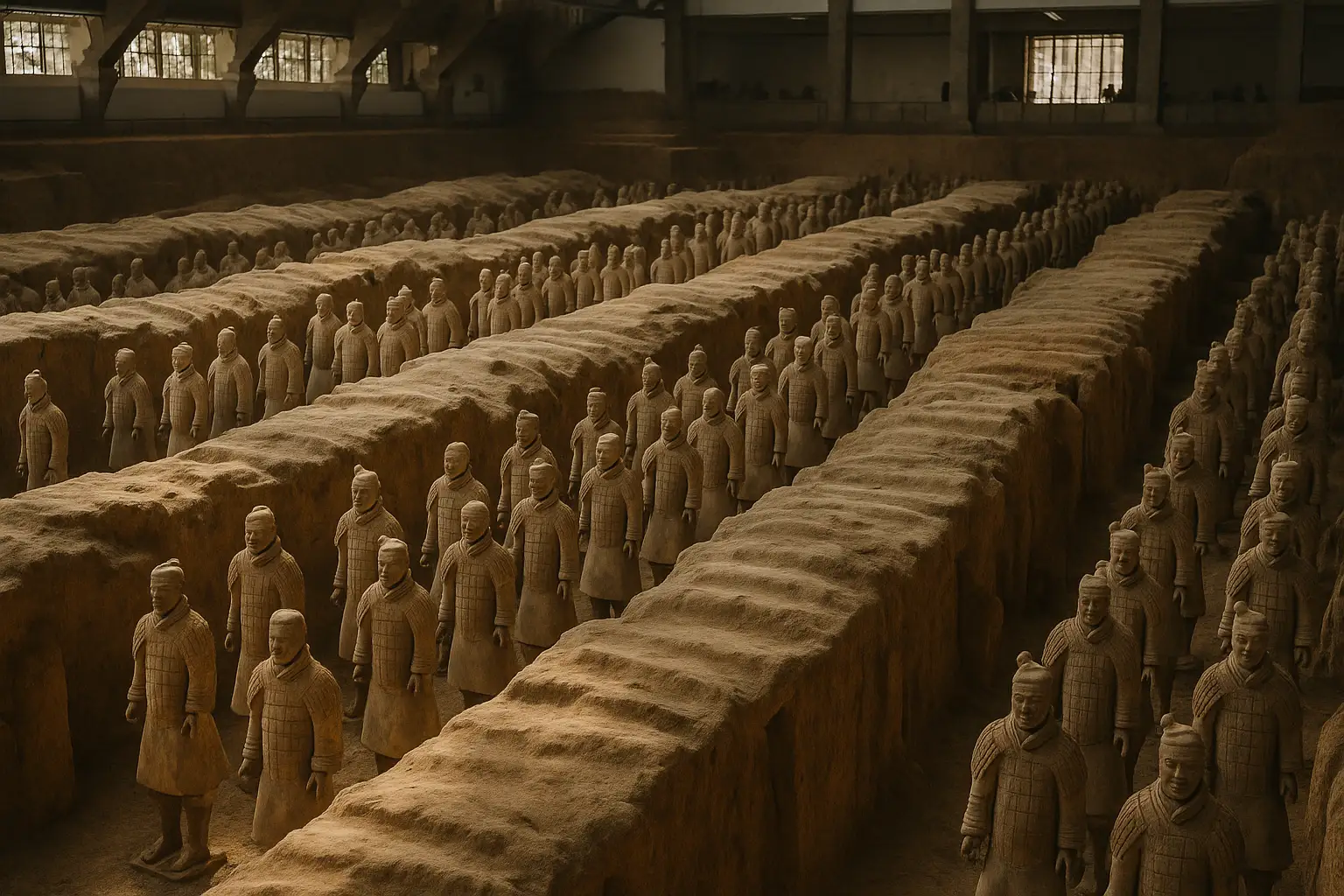
The building that covers Pit 1 is the size of an aircraft hangar, and the silence inside it is wrong. You expect noise from something this large—the shuffle of a regiment, the creak of armor, the stamp of horses. Instead, there is only the hush of visitors and the faint click of camera shutters, because the army that fills this excavation is made of clay, and it has been standing at attention for 2,200 years.
Row after row of life-sized soldiers stretch into shadow, each face distinct, each posture holding a specific military rank and function. Infantry in the vanguard, armored columns behind, cavalry and chariots anchoring the flanks. The Terracotta Army was built to guard the tomb of the man who unified China, and visiting it is not like visiting a museum exhibit—it is like stepping onto a battlefield that was frozen in time the moment the last sculptor set down his tools and the earth closed over everything.
Forty kilometers east of Xi’an, in the dry loess soil of Shaanxi Province, this is the kind of site that recalibrates your sense of what ancient civilizations were capable of. Eight thousand figures, no two faces alike, constructed by a workforce of 700,000 over nearly four decades. The scale is imperial in the truest sense. Come prepared, come early, and give it the time it demands.
Historical Context
Ying Zheng took the throne of the Qin state at thirteen years old in 246 BCE. Over the next quarter century, he systematically conquered the six remaining Warring States—Han, Wei, Zhao, Yan, Chu, and Qi—and unified China under a single imperial system for the first time. He renamed himself Qin Shi Huang, “First Emperor of Qin,” and immediately began reshaping the country in ways that would persist for two millennia. He standardized the writing system, coinage, weights, and measures. He connected existing fortifications into what would become the Great Wall. His legal and administrative reforms established the template for Chinese governance that endured until the fall of the Qing Dynasty in 1912.
Construction of his tomb began the year he ascended the throne, as was customary for Chinese rulers. What set Qin Shi Huang apart was the staggering ambition of the project. Ancient historian Sima Qian, writing a century after the emperor’s death, described a burial chamber beneath a mountain-sized mound: a ceiling inlaid with pearls to represent the stars, floors crossed by rivers of flowing mercury representing China’s waterways, and passages defended by automated crossbows set to fire at intruders. Modern soil analysis has confirmed unusually high mercury concentrations around the unexcavated mound, lending credibility to accounts once dismissed as legend.
The Terracotta Army occupies the eastern perimeter of this vast mortuary complex, positioned to face the territories of the states Qin had conquered—an eternal garrison guarding against threats from the afterlife’s eastern frontier. The emperor died in 210 BCE at age forty-nine, on a tour of his empire, still searching for the elixir of immortality. His dynasty collapsed within four years of his death, and the pits were likely damaged by fire during the ensuing rebellion. The army lay undisturbed beneath the Shaanxi earth until 1974, when farmers drilling a well struck a clay head staring up from the soil. It remains one of the most consequential accidental discoveries in the history of archaeology.
What survives today is both monumental and incomplete. Archaeologists estimate that only about a quarter of the total site has been excavated. The tomb mound itself—rising 76 meters above the surrounding plain—remains deliberately unopened, partly out of respect and partly because current technology cannot guarantee preservation of whatever lies inside. What has been uncovered across the three pits and the museum already constitutes one of the most significant archaeological finds of the twentieth century.
What to See
Pit 1: The Main Army
This is the image you know—the one printed on every guidebook cover and travel poster—but photographs cannot convey the sheer physical scale of standing above it. The excavation hall measures 230 meters long and 62 meters wide. Approximately 6,000 warriors stand in genuine Qin military formation: crossbow-armed vanguard infantry at the front, massed armored soldiers in the central columns, chariots and cavalry securing the flanks. The majority of figures remain buried beneath intact earthen berms that archaeologists have deliberately preserved for future excavation with better technology.
Walk the elevated viewing platforms that ring the pit. The western end offers the iconic head-on view of the formation stretching into distance. The eastern end lets you see ongoing restoration work where conservators painstakingly reassemble shattered figures from fragments. Spend time studying individual faces from the closest viewpoints—the level of portraiture is extraordinary. Age lines, different hairstyles, distinct facial structures, and varied expressions suggest these were modeled from real soldiers in the Qin army.
Practical tip: Arrive right at the 8:30 AM opening and head directly to Pit 1. By 10:00 AM, the viewing platforms fill with tour groups and photography becomes a contact sport. The first ninety minutes are transformative; midday is merely crowded.
Pit 2: The Mixed Forces
The L-shaped second pit, measuring 124 by 98 meters, contains the Qin military’s combined arms: cavalry with saddled horses, chariot teams, kneeling archers in firing position, and armored infantry. Much of this pit remains unexcavated or only partially exposed, giving it the atmosphere of an active archaeological dig rather than a finished display. The partially revealed figures emerging from compacted earth are in some ways more evocative than the fully restored ranks of Pit 1—you see the process of discovery itself.
The cavalry horses deserve particular attention. Nearly life-sized, their anatomy is rendered with a specificity that suggests the sculptors worked from live animals. Among the standout individual figures is the famous kneeling archer, whose face retains traces of green-tinted pigment that may indicate his unit’s regional origin. Glass display cases along the pit’s edge hold individual figures removed for conservation, allowing you to examine details—braided hair, armor rivets, the soles of shoes—at arm’s length.
Practical tip: Pit 2 is less crowded than Pit 1 throughout the day. If you have a guide, this is where their expertise pays the highest dividend, since the partially excavated state makes interpretation more challenging for unassisted visitors.
Pit 3: The Command Center
The smallest pit, just 21 by 17 meters, is arguably the most revealing. Its 68 figures are not arranged in battle formation but in the inward-facing guard posture of an honor escort, protecting a central chariot that almost certainly represents the army’s command vehicle. The officers here wear elaborate armor and tall headdresses, and their faces show a range of expression—composure, alertness, authority—that rewards the kind of slow, careful looking that Pit 1’s overwhelming scale can make difficult.
Where Pit 1 demonstrates the army’s brute force and Pit 2 its tactical diversity, Pit 3 reveals its organizational sophistication. This was the brain of the operation, and its intimate scale makes it the pit where you are most likely to feel a genuine human connection to the figures.
Practical tip: Pit 3 takes only 15-20 minutes but is essential for understanding the army’s hierarchy. Do not skip it.
The Bronze Chariots Museum
In a separate exhibition hall, two half-scale bronze chariots discovered near the tomb mound command their own space. These are not terracotta. They are cast and hammered bronze, each assembled from more than 3,400 individual parts—axles, wheels with thirty spokes apiece, articulated horse harnesses, canopy frames—all jointed and functional. The metalworking sophistication is staggering. Bronze weapons recovered from the pits reinforce the point: swords, crossbow triggers, and arrowheads retain their edges after two millennia, preserved by a chrome-oxide coating that was not independently developed in the West until the twentieth century.
Practical tip: The museum’s controlled lighting and glass cases make this the best environment for photography of individual artifacts. Budget 30-45 minutes here.
The Faces: Individuality Across Two Millennia
The bodies were assembled from standardized sections shaped around clay coils and kiln-fired at 900 to 1,000 degrees Celsius. The heads, however, were individually finished by hand, each departing from roughly eight basic structural templates to produce a face that belongs to no other figure in the army. Some read as young recruits; others as weathered veterans. Some show Central Asian or non-Han features, reflecting the multi-ethnic character of the armies that conquered the warring states. This is what stops visitors in their tracks and what photographs cannot fully convey: the unsettling certainty that each face records a real person who lived and served 2,200 years ago.
Timing and Seasons
Best months: April through May and September through October deliver the most comfortable conditions for the journey from Xi’an, with temperatures between 15 and 25 degrees Celsius. The pits are covered and climate-controlled, so weather matters less here than at open-air sites, but the walks between structures in summer heat (30-35 degrees Celsius in July and August) are genuinely unpleasant.
Best time of day: The 8:30 AM opening is non-negotiable for a quality experience. The window from opening until roughly 10:00 AM offers manageable crowds in Pit 1 and the best photography conditions. Midday, from 11:00 AM to 2:00 PM, sees the heaviest congestion as organized tour groups cycle through. Late afternoon, after 3:00 PM, brings a second window of relative calm as day-trippers begin returning to Xi’an.
Crowds to avoid: Chinese national holidays are a different category of crowded entirely. Golden Week (October 1-7), Spring Festival (late January or February), and the May Day holiday (May 1-5) bring visitor numbers that transform the site from memorable to miserable. If your travel dates are flexible, avoid these periods without reservation. Weekends year-round are noticeably busier than weekdays.
Winter advantage: November through February is cold (lows near freezing) but peaceful. Ticket prices drop to 80 CNY, and you may find yourself sharing the viewing platforms with only a handful of other visitors. The pits are covered, so rain and cold are manageable with proper layers.
Tickets, Logistics and Getting There
Admission: High season (March 16 through November 15) costs 120 CNY ($17 USD). Low season (November 16 through March 15) costs 80 CNY ($11 USD). Both prices include all three pits and the bronze chariot museum. Audio guides run 40 CNY ($6 USD) and are worth it—the English commentary adds genuine depth. The IMAX cinema near the entrance costs an additional 40 CNY ($6 USD) and is skippable.
From Xi’an by public bus: Tourist Bus 306, also labeled Bus 5, departs from the East Square of Xi’an Railway Station every ten to fifteen minutes starting at 7:00 AM. The fare is 7 CNY (approximately $1 USD) and the journey takes about one hour. Buses 914 and 915 also serve the site but are less convenient. This is the cheapest option and perfectly functional.
By taxi or Didi: A taxi or ride-hail costs 150-200 CNY ($21-28 USD) each way and takes forty-five to sixty minutes depending on traffic. Negotiate the round-trip fare in advance or use the Didi app for transparent pricing.
By organized tour: Half-day tours from Xi’an run $55-85 USD including transport, guide, and entrance fees. Full-day tours ($85-120) typically combine the warriors with Huaqing Palace or the Xi’an City Wall. For most first-time visitors, a guided tour offers the best value—the guide’s commentary transforms the experience, and the logistics are handled for you.
On-site logistics: The site is large. Electric carts (5 CNY / $0.70 USD) shuttle between the entrance and the pits if you want to save your legs. Plan on two to three kilometers of walking even with the carts. There are restaurants and shops near the entrance, but quality is tourist-grade at best—eat before you come or bring snacks.
Practical Tips
- Wear comfortable walking shoes. The site involves extensive walking on paved paths and standing on concrete viewing platforms.
- Photography is allowed throughout, without flash in the museum. A zoom lens or binoculars dramatically improves the experience in Pit 1, where the closest figures are still several meters from the viewing platform.
- Bring water and sun protection for the walks between buildings, even in cooler months. The covered pits are comfortable, but the open-air paths between them offer no shade.
- The on-site gift shops sell mass-produced replicas of varying quality. If you want a genuine miniature warrior, the museum shop near the exit offers the best selection at fixed prices—haggling is not expected there but is standard at the stalls outside.
- Beware of the “farmer who discovered the warriors” signing books near the exit. Multiple individuals have claimed this identity over the years. The actual discoverer, Yang Zhifa, did sign books at the site for years, but the authenticity of anyone currently doing so is uncertain. Buy one if you like the souvenir; just manage your expectations about provenance.
- If you read or speak any Mandarin, the Chinese-language audio guide is significantly more detailed than the English version.
Suggested Itinerary
8:30 AM — Arrive at opening. Head directly to Pit 1 and take the full circuit of the viewing platforms. Spend forty-five to sixty minutes absorbing the scale, studying individual faces, and watching restoration work at the eastern end.
9:30 AM — Move to Pit 3 while it is still uncrowded. Spend fifteen to twenty minutes examining the command center figures and their distinct expressions and armor.
10:00 AM — Enter Pit 2 for the mixed forces. Study the cavalry horses and the partially excavated figures. Examine the individual display cases along the edge. Allow thirty to forty-five minutes.
10:45 AM — Visit the Bronze Chariots Museum. Spend thirty to forty-five minutes with the half-scale chariots and the weapons display.
11:30 AM — Return to Pit 1 for a second pass if desired, now with the context of what you have seen in the other pits. Alternatively, browse the museum shop or visit the cinema.
12:00 PM — Depart for Xi’an or continue to Huaqing Palace (30 minutes west by car), where Tang Dynasty emperors bathed in hot springs and the Xi’an Incident of 1936 unfolded.
Nearby Sites
Forbidden City — Beijing’s imperial palace, seat of 24 emperors across two dynasties. A high-speed train connects Xi’an to Beijing in about four and a half hours, making this a natural pairing for any trip focused on Chinese imperial history.
Temple of Heaven — The circular altar complex in southern Beijing where emperors performed the rituals believed to maintain cosmic order. Combine with the Forbidden City for a full day in Beijing.
Great Wall at Badaling — The most accessible and heavily restored section of the wall, about 70 kilometers northwest of Beijing. A visit here rounds out the great trio of Chinese historical landmarks: the emperor’s army, the emperor’s palace, and the emperor’s wall.
Huaqing Palace — Just 30 minutes west of the Terracotta Warriors, this hot springs resort was used by rulers from the Qin Dynasty through the Tang. The site combines natural beauty, imperial history, and the dramatic story of the 1936 Xi’an Incident, making it an ideal half-day companion to the warriors.
The Weight of Clay
Standing on the viewing platform above Pit 1 in the quiet of early morning, before the tour groups arrive and the platforms fill, you feel the full weight of what was achieved here. An emperor so convinced of his own divinity that he commissioned an eternal military force to guard him beyond death. A workforce of hundreds of thousands who spent decades making it real. And the sculptors—anonymous craftsmen whose names are permanently lost—who looked at each figure and decided that a generic face was not enough, that every soldier deserved his own features, his own expression, his own identity.
The emperor who ordered them is long gone. His tomb remains sealed beneath its mound. But these faces, shaped by individual hands across a distance of 2,200 years, continue to look out across the pit with expressions that read, unmistakably, as human. That is the Terracotta Army’s deepest achievement, and no amount of preparation fully readies you for encountering it in person.
Discover More Ancient Wonders
- Forbidden City — The imperial palace at the heart of Beijing, where 24 emperors ruled China for five centuries
- Temple of Heaven — Where emperors performed the rites that held the cosmos in order
- Great Wall at Badaling — China’s defining monument, engineered across impossible terrain
- Explore our China ancient sites hub for more destinations across the Middle Kingdom
Quick Facts
| Attribute | Details |
|---|---|
| Location | Lintong District, 40 km east of Xi’an, Shaanxi Province |
| Country | China |
| Region | Shaanxi |
| Civilization | Chinese Imperial (Qin Dynasty) |
| Ancient Name | Mausoleum of the First Qin Emperor |
| UNESCO Status | World Heritage Site (1987) |
| Historical Period | c. 246-210 BCE |
| Distance from Xi’an | 40 km (25 miles); 45-60 minutes |
| Best Time | April-May, September-October |
| Entry Fee | 120 CNY ($17 USD) high season; 80 CNY ($11 USD) low season |
| Opening Hours | 8:30 AM-5:00 PM (high season); 8:30 AM-4:30 PM (low season) |
| Suggested Stay | Half day (3-4 hours minimum) |
| Coordinates | 34.3841, 109.2785 |
Frequently Asked Questions
How do I get to the Terracotta Warriors from Xi'an?
The Terracotta Warriors are 40 km east of Xi'an. Take Tourist Bus 306 (also called Bus 5) from Xi'an Railway Station (7 CNY/$1 USD, 1 hour). Bus 914 and 915 also serve the site. Taxis cost 150-200 CNY ($21-28 USD) each way. Organized tours ($55-85) include transport and guide. The journey takes 45-60 minutes depending on traffic. Most visitors allow a half-day (4-5 hours) for the visit.
How much time do I need at the Terracotta Warriors?
Plan 3-4 hours to properly see all three pits, the museum, and the cinema presentation. This allows time to absorb the scale of Pit 1, examine individual figures in Pits 2 and 3, and see the bronze chariots in the museum. Serious enthusiasts may want a full day. The site is large and requires extensive walking. Combine with other Xi'an attractions for a full day, or visit morning and return to Xi'an for afternoon exploration.
What are the three pits?
Pit 1 is the largest (230 x 62 meters) containing approximately 6,000 warriors in battle formation—the iconic image of rows of soldiers. Pit 2 contains mixed military forces including cavalry, chariots, and archers; many figures here remain unrestored. Pit 3 is the smallest, believed to be the command center with high-ranking officers. Each pit offers different perspectives on the army's organization and ongoing archaeological work.
How much does it cost to visit the Terracotta Warriors?
Entry is 120 CNY ($17 USD) March-November, 80 CNY ($11 USD) December-February. This includes all three pits and the museum. The IMAX cinema presentation is an additional 40 CNY ($6 USD) but is skippable. Electric carts (5 CNY/$0.70 USD) save walking between distant entrances. Audio guides are 40 CNY ($6 USD). Budget approximately 150-200 CNY ($21-28 USD) total including transport from Xi'an.
When is the best time to visit the Terracotta Warriors?
Early morning (8:30 AM opening) offers fewer crowds and better photography of Pit 1. Late afternoon (after 3 PM) also sees thinning crowds. Avoid Chinese holidays and weekends when the site is packed. Spring (April-May) and autumn (September-October) offer pleasant weather. Summer is hot and crowded; winter is cold but peaceful. The pits are indoors/under cover, making weather less critical than at outdoor sites.
Who built the Terracotta Army and why?
Emperor Qin Shi Huang, who unified China in 221 BCE and established the Qin Dynasty, commissioned the army. It was buried near his tomb to protect him in the afterlife, reflecting beliefs that the deceased needed servants, soldiers, and resources similar to earthly life. An estimated 700,000 workers constructed the army and tomb complex over approximately 38 years. The figures were discovered in 1974 by farmers digging a well—one of archaeology's greatest finds.
Nearby Ancient Sites
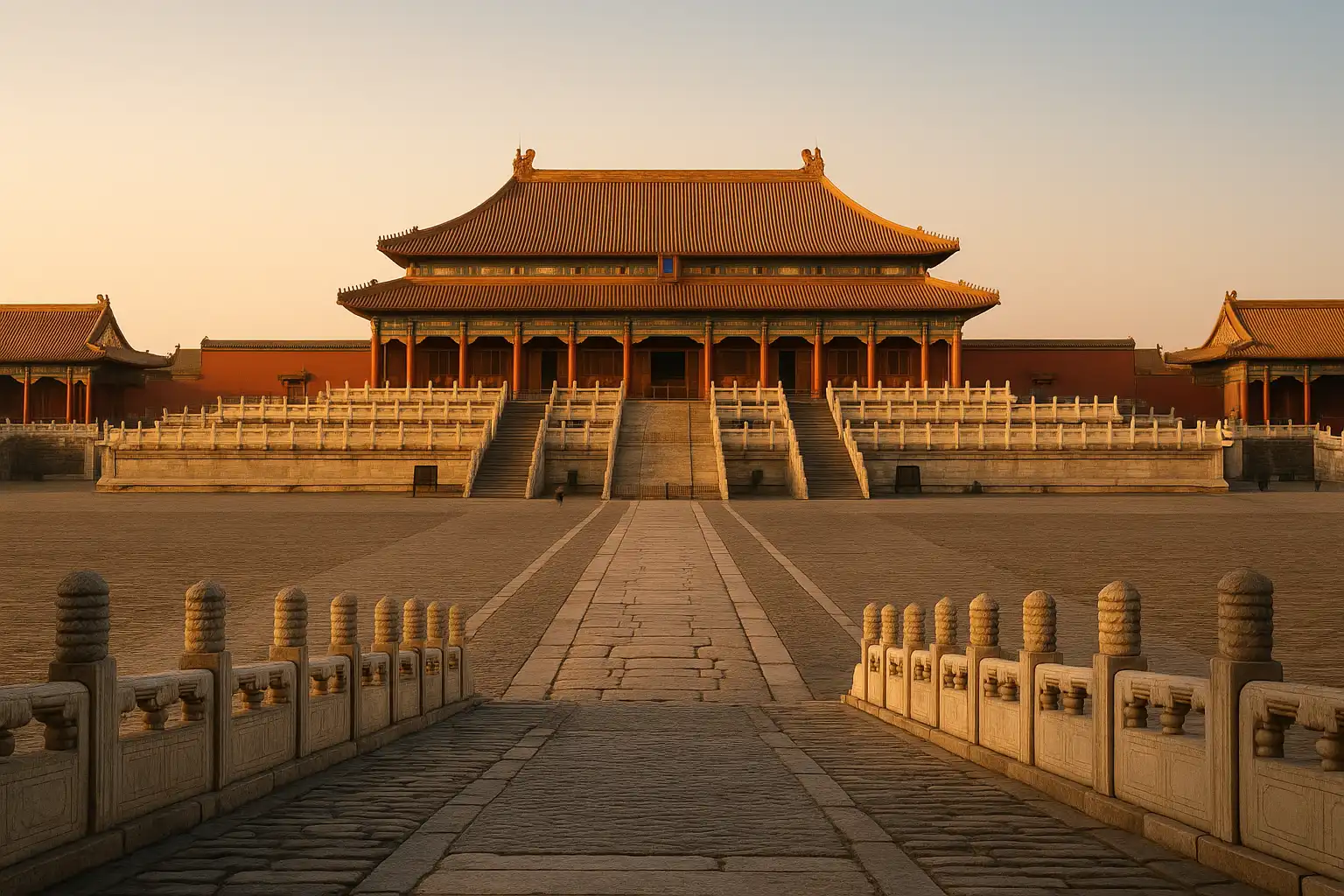
Forbidden City China Travel Guide 2026: Imperial Palace of Beijing
Chinese ImperialExplore the Forbidden City, China's imperial palace for 500 years. Discover the Hall of Supreme Harm...
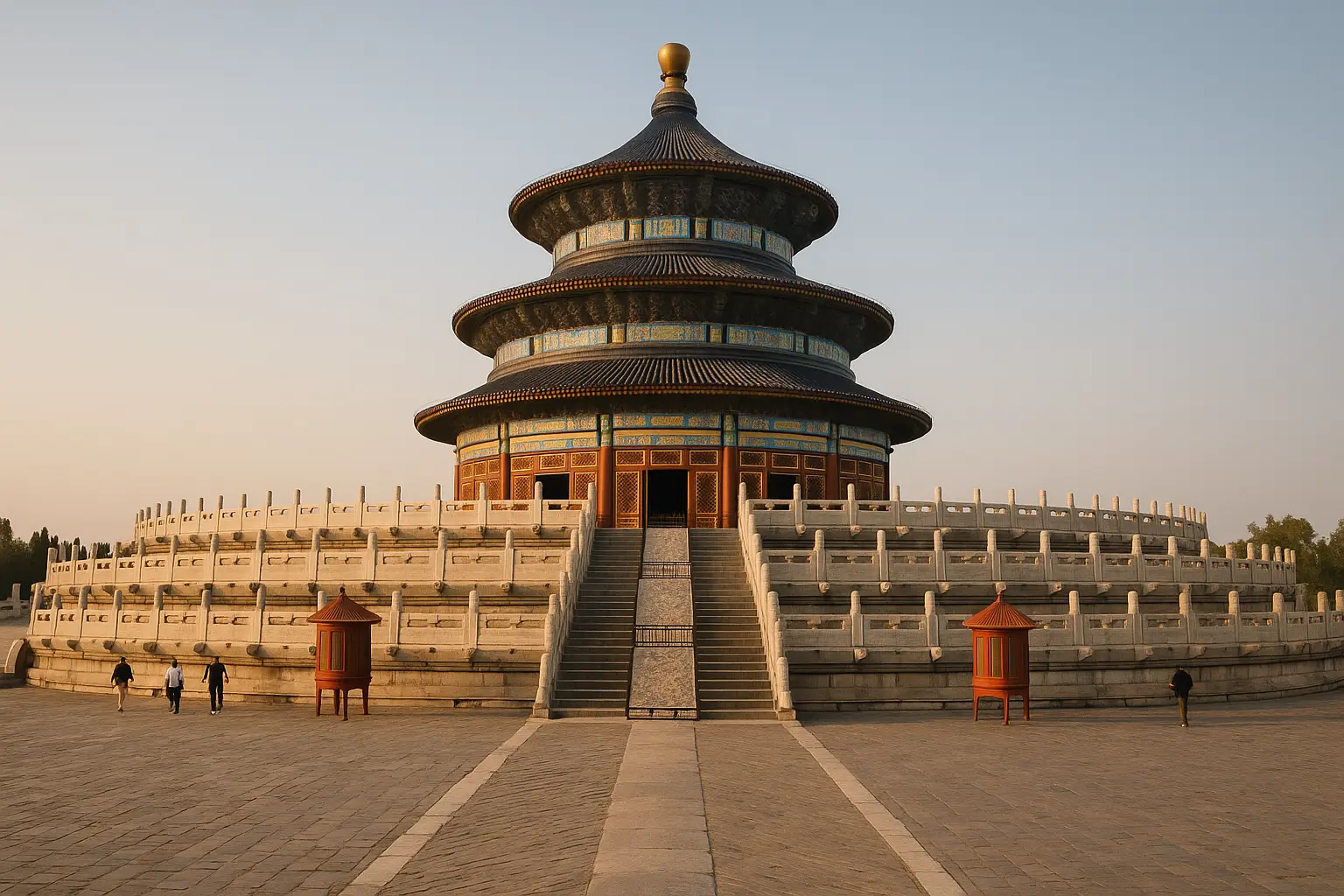
Temple of Heaven China Travel Guide 2026: Where Emperors Prayed
Chinese ImperialVisit the Temple of Heaven where Ming and Qing emperors prayed for good harvests. Explore the Hall o...
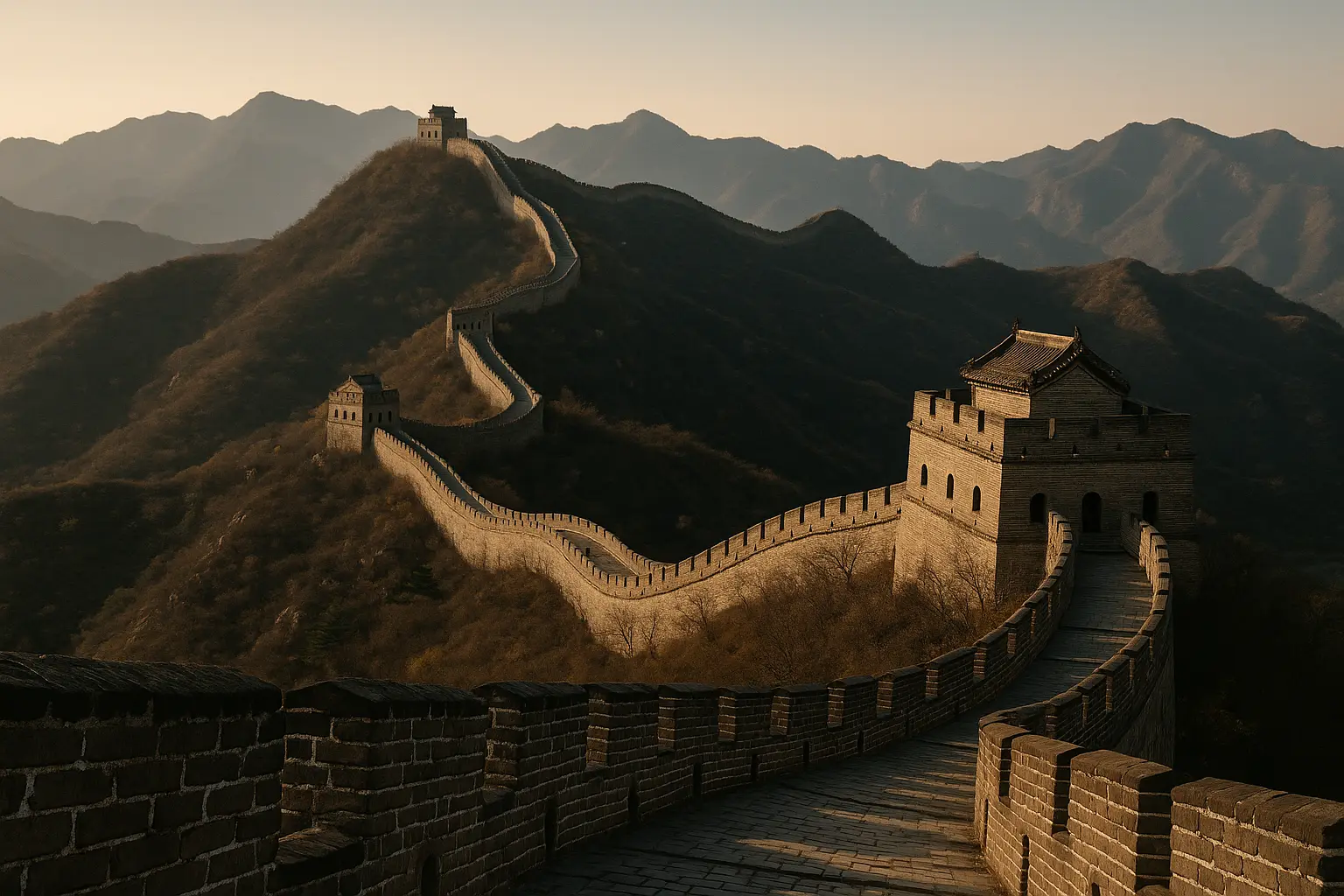
Great Wall of China Badaling Travel Guide 2026: Iconic Fortification
Chinese ImperialVisit Badaling, the most famous section of the Great Wall of China. Our guide covers tickets, cable ...