Quick Info
At a glance
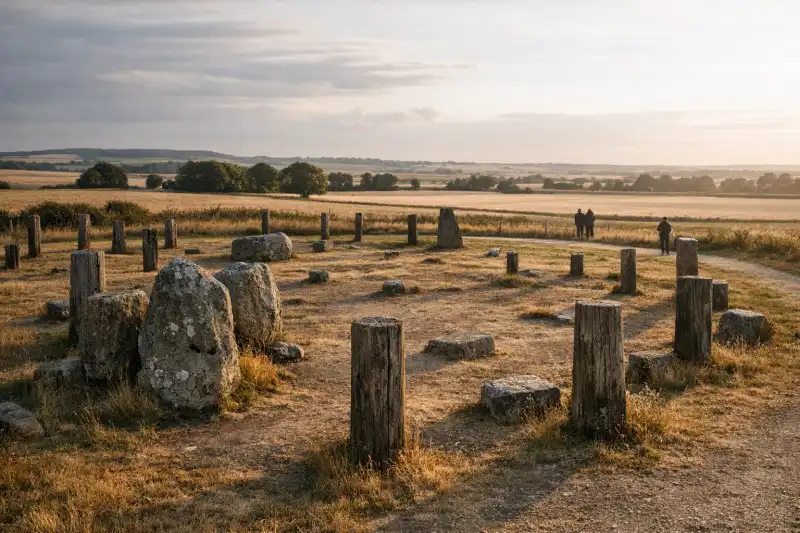
The Sanctuary (Avebury) in the United Kingdom sits on a rise of chalk downland where roads, fields, and modern traffic now pass through one of prehistoric Europe’s most enigmatic ceremonial landscapes. At first glance, it can look surprisingly modest: a circular arrangement of low concrete markers in open countryside, with broad skies overhead and the famous monuments of Wiltshire scattered nearby. Yet that simplicity is deceptive. This was once a major ritual focus at the end of the great West Kennet Avenue, a place where timber posts and later stones formed concentric rings and where ceremonies, movement, and memory converged over many centuries.
To visit The Sanctuary is to experience a monument that works through suggestion rather than spectacle. There are no towering standing stones here today, no reconstructed temple, no dramatic enclosure walls. Instead, the site asks visitors to imagine processions approaching from Avebury, gatherings on the chalk uplands, and an ancient landscape intentionally organized through avenues, barrows, henges, and sightlines. Its power lies in context. The Sanctuary is best understood not as an isolated ruin but as one node in a sophisticated ceremonial network that includes Avebury, Silbury Hill, West Kennet Long Barrow, and the River Kennet valley. For travelers interested in prehistoric Britain, it offers one of the clearest opportunities to stand inside a vanished monument and still feel the logic of the sacred geography that shaped it.
History
Origins in the Late Neolithic
The earliest phases of The Sanctuary date to the Late Neolithic, around the third millennium BCE, when communities across southern Britain were building monuments on a scale and complexity that still astonish archaeologists today. This was the era of henges, cursus monuments, avenues, long barrows, and great communal gathering places. In the Avebury region, people were reshaping the land into a ceremonial landscape of exceptional density, and The Sanctuary appears to have emerged within that broader movement.
Excavations suggested that the first version of the monument was largely of timber. Postholes indicate a series of concentric rings, probably with an open central area, creating a circular structure that may have served ritual, ceremonial, or processional purposes rather than domestic ones. Timber was an important material in prehistoric Britain, often associated with living or active ceremonial spaces, in contrast to stone, which in some interpretations represented permanence, ancestry, or the dead. While such symbolic distinctions remain debated, they offer one possible lens through which to view the site’s development.
Expansion and Connection to Avebury
Over time, The Sanctuary evolved. Stone elements seem to have been added to or substituted for earlier timber components, giving the monument a more enduring presence. This transformation may reflect changing ritual practices, shifts in social organization, or the desire to monumentalize a place that had already become significant through repeated use. What is especially striking is its placement at the southeastern end of the West Kennet Avenue, the long double line of stones that connected it to the Avebury henge and stone circles.
That connection is crucial. The Sanctuary was not a standalone shrine in the modern sense, but part of a carefully structured route and ceremonial setting. Processions may have moved between Avebury and The Sanctuary, linking spaces of assembly, transition, and performance. The avenue itself would have guided movement across the landscape, giving shape to ritual journeys and reinforcing the idea that places acquired meaning through relationships as much as through architecture.
The wider area was also active during this period. Silbury Hill, one of prehistoric Europe’s largest artificial mounds, rose nearby, while burial and ceremonial monuments accumulated across the downs and valleys. Together they speak of a society capable of coordinating labor, planning symbolic landscapes, and sustaining traditions over generations.
Bronze Age Change and Later Survival
By the Early Bronze Age, practices in the region were changing. Across Britain, collective monument traditions gave way in many places to new burial customs, including round barrows and more individualized funerary rites. The Sanctuary may have continued to hold significance, but like many prehistoric ceremonial sites, it likely passed through phases of adaptation, reduced use, and eventual abandonment as its original meanings became less immediate.
Despite this, its earth-fast remains endured beneath the soil. The site was not preserved in an obvious monumental form like Avebury’s great stones, and over the centuries agricultural activity and changing land use obscured much of what had once stood there. Yet traces remained for later investigators to identify.
Rediscovery and Archaeology
Interest in the prehistoric monuments of Wiltshire intensified in the eighteenth and nineteenth centuries, but it was in the twentieth century that The Sanctuary was more systematically examined. The archaeologist Maud Cunnington carried out excavations here in 1930, revealing the pattern of concentric rings and helping establish the monument’s likely sequence of timber and stone phases. Because the structural remains were largely underground, her work was essential in making the site legible.
Today, concrete markers indicate the positions of the former posts and stones. This method of presentation is intentionally understated but highly informative. Rather than rebuilding the monument with speculative materials, the markers allow visitors to grasp its dimensions while preserving a distinction between original archaeology and modern interpretation.
The Sanctuary now forms part of the protected Avebury section of the UNESCO World Heritage Site known as Stonehenge, Avebury and Associated Sites. Its historical importance lies not only in its own architecture but in what it reveals about prehistoric planning, ritual movement, and the long-lived sacred topography of the Wiltshire downs.
Key Features
The most distinctive feature of The Sanctuary is its concentric plan, now traced on the ground by a pattern of low concrete blocks. These markers represent the positions of postholes and stone settings discovered through excavation. For some visitors, the absence of surviving uprights can initially feel anticlimactic. But once the eye adjusts, the monument becomes unusually readable. You are not distracted by later restoration or dominant individual stones. Instead, you can stand within the circles and understand the geometry of the original design in a direct, almost diagrammatic way.
The monument’s circularity is central to its effect. Rings create enclosure without walls, a sense of ordered space open to the sky. Walking through the marked positions, you can appreciate how the arrangement would have structured movement and attention. The outer rings would have framed the approach, while the inner spaces may have drawn participants toward a focal center. Whether ceremonies here involved feasting, processions, rites of passage, or seasonal gatherings remains uncertain, but the architecture was clearly intended to choreograph experience.
Another important feature is the site’s position in the landscape. The Sanctuary occupies elevated ground near the end of the West Kennet Avenue. Even though the avenue is no longer complete in its original form, the relationship remains intellectually and physically important. This was a destination, an endpoint or perhaps a threshold, connected to Avebury by one of prehistoric Britain’s most impressive ceremonial routes. Seeing The Sanctuary in isolation is only part of the experience; understanding it as the terminus of movement gives it much greater significance.
The surrounding chalk landscape is also a feature in its own right. The broad openness of the Wiltshire downs, the changing light, and the visibility of nearby monuments all contribute to the atmosphere. Ancient builders did not place The Sanctuary randomly. It belongs to a terrain where natural ridges, valleys, and horizons were woven into ritual design. A visit here often sharpens awareness of the wider topography: Silbury Hill to the northwest, the route toward Avebury, and the nearby long barrows and burial mounds that reinforce the sense of a monumental landscape rather than a single attraction.
Interpretive simplicity is another strength. Unlike heavily reconstructed heritage sites, The Sanctuary leaves room for imagination while still providing enough archaeological evidence to anchor understanding. This balance can be especially rewarding for travelers who enjoy sites where uncertainty remains visible. The concrete markers are not glamorous, but they are honest. They show what has been found without pretending to solve every mystery. That restraint gives the place an intellectual seriousness often lost at more dramatized attractions.
The Sanctuary is also notable for the way it demonstrates prehistoric continuity and change. The timber origins and later stone use suggest that the monument developed over time rather than appearing fully formed in a single building episode. In practical terms, this means visitors are standing inside a place that recorded generations of choices: to return, to rebuild, to alter materials, and to preserve ritual importance. In a landscape already full of long-term planning, that layered history matters.
Finally, the site benefits from being part of a cluster. Many ancient monuments become difficult to interpret when detached from context. The Sanctuary is the opposite. It gains meaning from proximity to Avebury Stone Circle, the henge earthworks, West Kennet Long Barrow, and Silbury Hill. For that reason, one of its greatest features may be the way it encourages visitors to think spatially. It teaches you to read the land as prehistoric people may have done: as a connected ceremonial world.
Getting There
The Sanctuary is in rural Wiltshire, a short distance southeast of Avebury village and close to the A4 road, making it easiest to reach by car. From London, driving typically takes around 2 to 2.5 hours depending on traffic. From Bath, Oxford, or Bristol, allow roughly 1 to 1.5 hours. Parking options vary, but many visitors base themselves in Avebury’s main car park and then explore the broader landscape on foot. National Trust parking charges may apply if you use the main Avebury facilities; expect roughly £7 to £8 for standard daytime parking if you are not a member, though rates can change.
By public transport, the most practical route is usually to take a train from London Paddington to Swindon, Chippenham, or Pewsey. Advance single fares can start around £15 to £30, but last-minute tickets may be higher. From those stations, local buses are limited and may not align well with sightseeing plans, so many visitors continue by taxi. A taxi from Swindon to Avebury or The Sanctuary area can cost approximately £30 to £45 each way, while from Pewsey or Chippenham prices are often in a similar range depending on demand and time of day.
Walking between Avebury and The Sanctuary is one of the best ways to arrive if the weather is good. The route helps reveal the monument’s relationship to the broader prehistoric landscape, though you should wear sturdy shoes and be prepared for uneven ground, mud in wet months, and limited shelter. Cyclists can also explore the area comfortably using local roads and byways. However you come, check public transport schedules in advance: rural Wiltshire is rewarding, but not forgiving if you assume frequent services.
When to Visit
Spring and early autumn are often the best times to visit The Sanctuary. In April, May, September, and early October, the chalk landscape is usually at its most inviting: green, open, and bright without the busiest summer crowds. Temperatures are comfortable for walking between monuments, and the lower angle of the light can make the wider Avebury landscape especially atmospheric. These shoulder seasons are ideal if you want time to linger and imagine the site in relative quiet.
Summer brings longer days and the easiest conditions for combining The Sanctuary with Avebury, West Kennet Long Barrow, and Silbury Hill in one outing. June through August is the most convenient season for extended daylight, photography, and picnics in the surrounding countryside. The tradeoff is that nearby landmarks can be busier, especially on weekends, school holidays, and around solstice-related interest in prehistoric sites. The Sanctuary itself is usually calmer than Avebury’s main circles, but the overall area can still feel more crowded.
Winter visits can be memorable for those who enjoy stark landscapes and fewer people. Frost, low cloud, and dramatic skies often suit the monument’s mysterious character. But winter also brings muddy paths, stronger winds, and early darkness. If you plan to explore several nearby sites on foot, set out early and wear waterproof layers.
For photography, early morning and late afternoon usually provide the best results. Midday can flatten the subtle contours of the ground, while sunrise and sunset give shape to the rings and surrounding downs. If possible, avoid very wet days, as the site’s understated remains are best appreciated when you can move around comfortably and spend time taking in the broader setting.
| Quick Facts | Details |
|---|---|
| Site name | The Sanctuary (Avebury) |
| Location | Near Avebury, Wiltshire, England, United Kingdom |
| Type | Prehistoric ceremonial monument |
| Cultural period | Late Neolithic to Early Bronze Age |
| Date | c. 3000-2000 BCE |
| Main materials | Originally timber, later including stone |
| Best known for | Concentric rings and connection to the West Kennet Avenue |
| UNESCO context | Part of the Stonehenge, Avebury and Associated Sites World Heritage landscape |
| Typical visit length | 20-45 minutes for the site itself |
| Best combined with | Avebury, Avebury Stone Circle, Silbury Hill, West Kennet Long Barrow |
What makes The Sanctuary memorable is not dramatic preservation but archaeological clarity within an extraordinary landscape. It offers a rare chance to stand inside the footprint of a vanished ritual monument and understand how prehistoric Britain organized sacred space across miles of open country. For travelers willing to look beyond the obvious, it is one of Wiltshire’s most rewarding ancient places: quiet, intellectually rich, and inseparable from the larger ceremonial world of Avebury.
Guided tours: worth it?
Most travelers can visit The Sanctuary (Avebury) independently. Compare a tour only if you want a tighter history-focused visit, easier logistics, or a guide who can answer questions on the spot.
Best for
- Short visits where a planned route saves time
When to go self-guided
Go independently if you prefer setting your own pace, reading as you go, and checking official hours or ticket rules directly before you arrive.
What I’d avoid
Skip paid tours that bundle unrelated stops you do not actually want. The best option should either save meaningful planning time or add historical context you would miss on your own.
Avebury and Wiltshire Prehistoric Sites Tours
Useful when: you want to compare guided formats before deciding
Stonehenge and Avebury Day Tours
Useful when: you want to compare guided formats before deciding
Wiltshire Ancient Sites and Sacred Landscapes
Useful when: you want to compare guided formats before deciding
Some tour links are affiliate links, which may earn Ancient Travel a small commission at no extra cost to you. I try to surface options that make practical sense for the site—not just anything bookable.
Frequently Asked Questions
What is The Sanctuary (Avebury)?
The Sanctuary is a prehistoric ceremonial site near Avebury in Wiltshire, marked today by concrete posts showing where concentric timber and stone rings once stood.
Is The Sanctuary included in the Avebury World Heritage landscape?
Yes. The Sanctuary forms part of the wider Stonehenge, Avebury and Associated Sites UNESCO World Heritage landscape and is closely connected to Avebury by the West Kennet Avenue.
Do you need a ticket to visit The Sanctuary?
No. The site is open access and can usually be visited free of charge, though parking nearby may require payment depending on the location you use.
How long should I spend at The Sanctuary?
Most visitors spend 20 to 45 minutes at the site itself, though many combine it with Avebury, West Kennet Avenue, Silbury Hill, and West Kennet Long Barrow for a half-day or full-day outing.
Can you still see the original stones at The Sanctuary?
No original standing stones remain visible in place. The layout is indicated by modern markers that show the positions of the former rings and help visitors understand the monument's scale.
What is the best way to reach The Sanctuary without a car?
The easiest public transport option is usually a train to Swindon, Pewsey, or Chippenham followed by a taxi or local bus connection toward Avebury and the surrounding prehistoric sites.
Nearby Ancient Sites
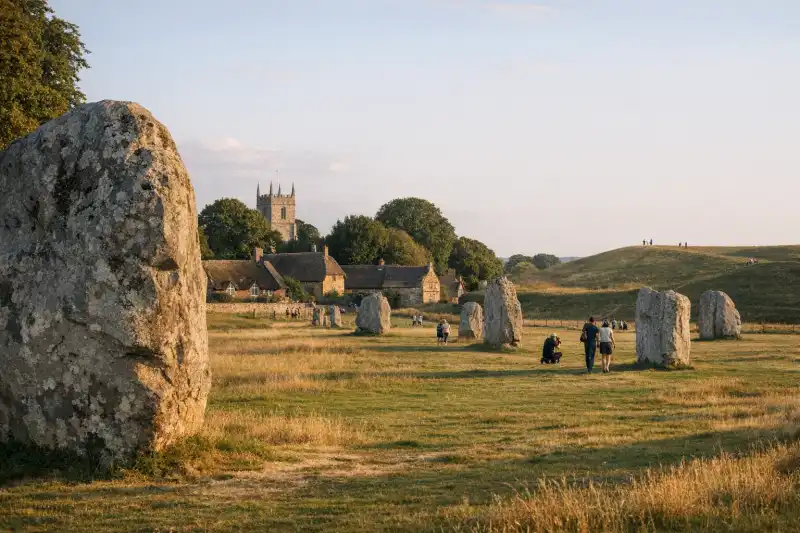
Avebury
Neolithic BritainExplore Avebury in the United Kingdom, a vast prehistoric stone circle and ritual landscape in the h...
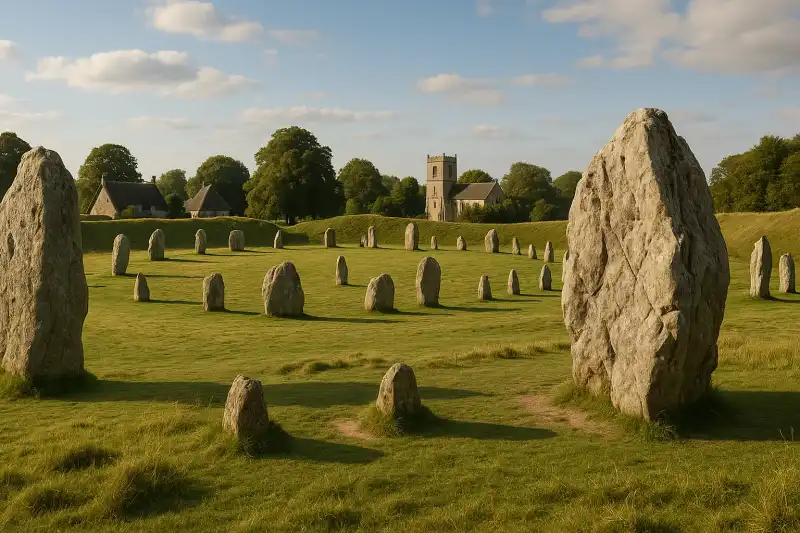
Avebury Stone Circle Travel Guide 2026: Best Walk Routes, History, and Visit Planning
Neolithic BritainPlan a stronger visit to Avebury Stone Circle with practical walking routes, landscape context, and ...
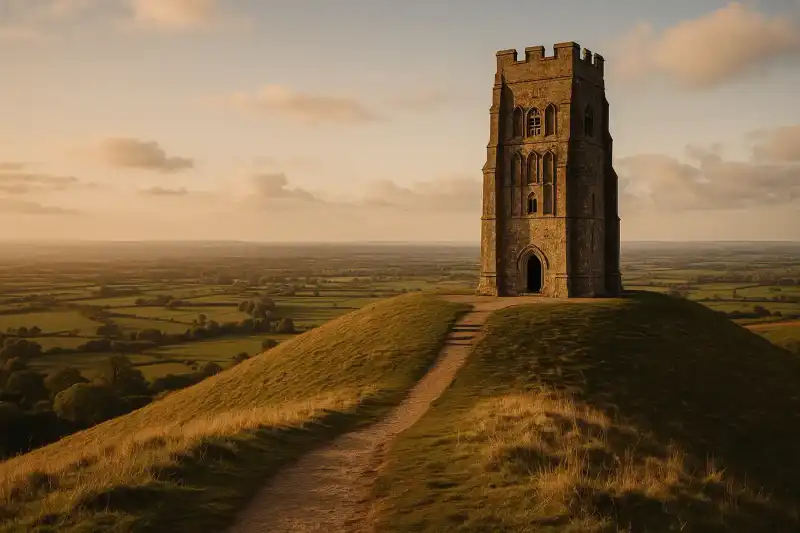
Glastonbury Tor Travel Guide 2026: Best Walk Times, History, and Visit Planning
Early Medieval EnglandPlan a smarter visit to Glastonbury Tor with practical climb timing, weather tips, and context on wh...