Quick Info
Curated Experiences
Nara Day Trip from Osaka or Kyoto
Todaiji Temple Guided Tour
Nara Private Walking Tour
In the ancient Japanese capital of Nara, a building rises above the cedar forests that carpet the hillside of Wakakusa Mountain. The Daibutsuden—the Hall of the Great Buddha—is a structure of almost impossible ambition: the largest wooden building on Earth, sheltering a bronze deity the height of a five-story apartment block. Todaiji Temple is not merely a monument to religious devotion. It is a statement carved in timber and bronze that an eighth-century island nation wished to announce itself to the heavens and, through the divine intercession of the Buddha, secure the protection of the entire realm.
Todaiji draws more than three million visitors per year, yet its scale remains humbling at any crowd level. The moment travelers pass through the soaring Nandaimon Gate and see the roofline of the Daibutsuden emerge above the treeline, something essential about the ambition of the Nara period becomes physically legible. This is a place where the political and the sacred were deliberately fused, where bronze was melted to pacify plagues and foreign threats, and where a tradition of Buddhist scholarship and ritual has endured unbroken for nearly thirteen centuries.
A Temple Born from Crisis
The origins of Todaiji lie in catastrophe. In the 730s, Japan was reeling from a series of devastating smallpox epidemics that killed an estimated one-third of the population and destabilized the economy and military. Emperor Shomu, an ardent Buddhist who believed the religion could serve as a spiritual shield for the nation, responded with an extraordinary act of statecraft and faith.
In 741 CE, Shomu issued an imperial edict ordering the construction of provincial temples (kokubunji) in every province of Japan, with Todaiji designated as their headquarters temple. Four years later he issued an even more audacious command: the casting of a colossal bronze image of Vairocana Buddha—the cosmic Buddha of infinite illumination—to serve as the spiritual center of the network. The decree read, in part, that the emperor wished to extend his compassion throughout the realm by creating a great image of the Buddha. Copper, gold, mercury, and charcoal were requisitioned from every corner of Japan. Skilled foundry workers, many trained in continental techniques brought from Tang-dynasty China and the Korean kingdoms, were assembled at the capital.
The casting began in 747 CE and proved enormously difficult. The statue was cast in sections over several years using a lost-wax technique, with each component melted and poured separately before being assembled. Workers reportedly suffered burns, accidents, and exhaustion in the effort. The Great Buddha was finally consecrated in 752 CE in a ceremony attended by ten thousand monks and priests, as well as diplomatic delegations from across Asia. An Indian monk, Bodhisena, performed the eye-opening ceremony—a ritual painting of the pupils that “awakens” a Buddha image to spiritual life—using a brush attached to a long rope so that assembled dignitaries could each hold a strand and symbolically participate.
The original temple complex was immense, encompassing pagodas over 100 meters tall (which would have been among the tallest structures in the world at the time), dozens of subsidiary halls, dormitories for hundreds of monks, and the Shosoin repository built to house Emperor Shomu’s personal belongings and thousands of imported treasures. Fire—the great enemy of wooden architecture—struck twice. A 855 CE earthquake damaged portions of the complex, and civil wars in 1180 CE and again in 1567 CE brought catastrophic burning. Each time, the temple was rebuilt through extraordinary acts of fundraising and popular devotion, with the monk Chogen raising contributions across Japan after the 1180 fire and completing a new Daibutsuden in 1195 CE.
The present hall dates from 1709, constructed during the Edo period under the patronage of the Tokugawa shogunate. Though reduced to roughly two-thirds the width of the original—a compromise driven by limited resources—it remains the largest wooden building on Earth, a record it has held for over three hundred years.
What to See at Todaiji
The Nandaimon Gate
The approach to Todaiji begins at the Nandaimon, a towering wooden gate rebuilt in 1203 following the 1180 fire. Standing 18.7 meters tall with a double-roofed structure that frames a perfectly composed view of the Daibutsuden beyond, the Nandaimon is a masterwork of the Great Buddha Style (Tenjikuyo) of Buddhist architecture introduced from Song-dynasty China. Within two of its bays stand the Niō guardian figures—paired wooden statues each reaching 8.4 meters in height, carved in 1203 by the sculptors Unkei and Kaikei and their workshops. These ferocious protector deities, mouths open and closed to form the Sanskrit syllables “ah” and “un,” represent the alpha and omega of existence and are widely considered the finest examples of Kamakura-period sculpture anywhere in Japan.
The Daibutsuden (Great Buddha Hall)
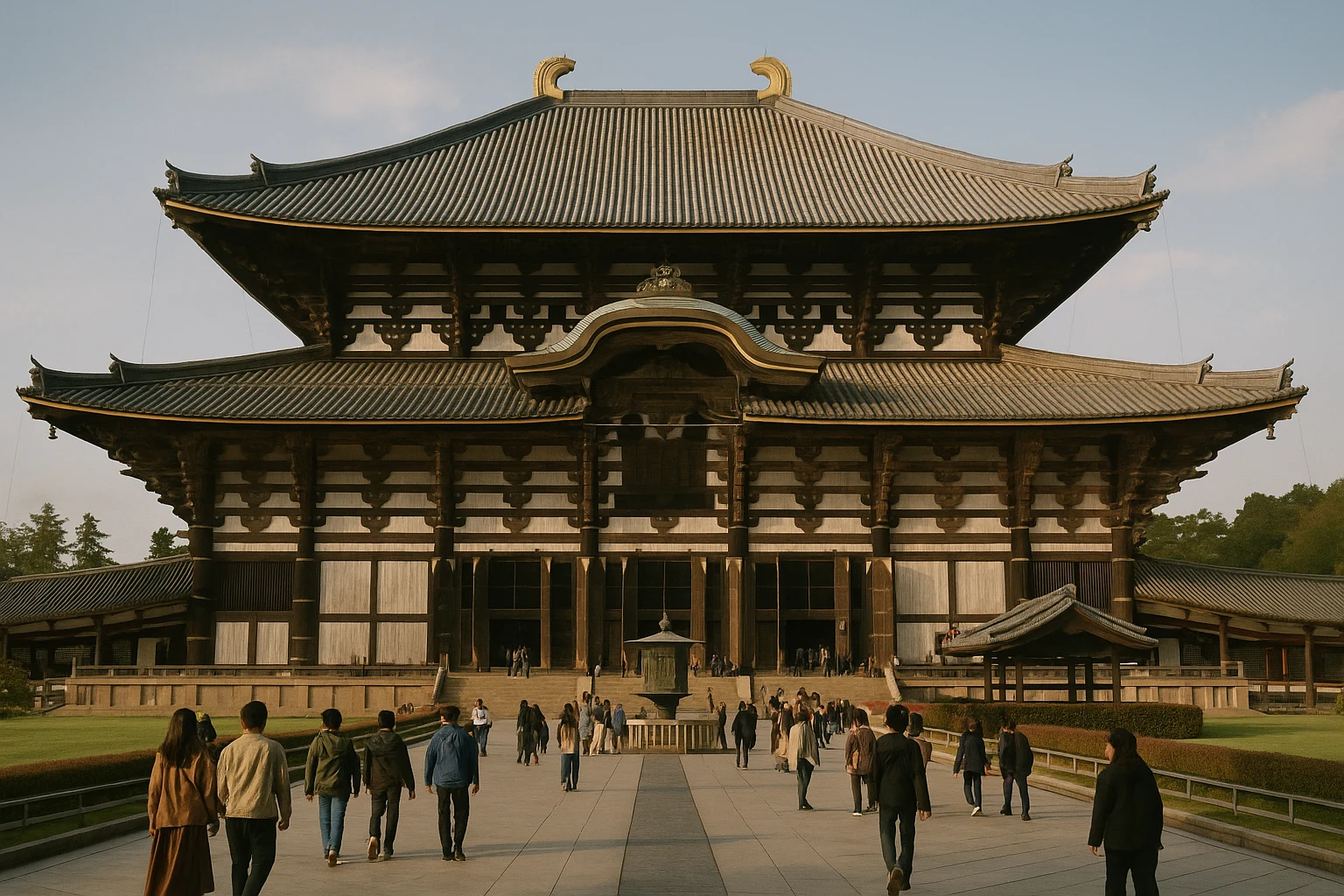
The Daibutsuden is the heart of Todaiji. The present building, completed in 1709, measures 57 meters wide, 50 meters deep, and 49 meters tall—measurements that dwarf most cathedrals and make it immediately apparent why it still holds the record as the world’s largest wooden structure. The exterior is restrained and powerful, its broad hip-and-gable roof sweeping outward over thick timber columns that carry the visual weight of centuries.
Inside, the Daibutsu occupies the center of the hall in a space of genuinely overwhelming scale. The Vairocana Buddha sits in the lotus position, right hand raised in the gesture of fearlessness (abhaya mudra), left hand resting palm-upward in the gesture of offering. The statue reaches 14.98 meters (approximately 49 feet) from base to crown and weighs an estimated 500 metric tons. The face alone is 5 meters tall; the eyes measure 1 meter across. Flanking the Daibutsu are two Bodhisattvas of later manufacture: Nyoirin Kannon on the right and Kokūzō Bosatsu on the left. At the rear of the hall, a carved wooden model of the original eighth-century Daibutsuden offers a sense of the building’s original, far grander scale.
A beloved tradition invites visitors to squeeze through a hole bored through one of the wooden columns at the back of the hall. The opening is the same dimensions as one of the Daibutsu’s nostrils. Local belief holds that those who pass through the opening will receive enlightenment in their next life—a promise that draws long queues of children and adventurous adults alike.
Nigatsu-do and Sangatsu-do
East of the Daibutsuden, a flight of stone steps climbs the forested hillside to two subsidiary halls of exceptional age and character. Nigatsu-do (Second Month Hall) is best known as the site of the Omizutori festival, observed every March since 752 CE without interruption—one of the longest continuously held religious rituals anywhere in the world. During the two-week ceremony, monks perform nighttime fire rituals and draw sacred water from a well believed to connect to a spring in Wakasa Province far to the north. The hall’s wooden veranda offers sweeping views across Nara and is open year-round.
Sangatsu-do (Third Month Hall) is the oldest surviving building at Todaiji, dating to the original eighth-century complex. Its interior houses a remarkable collection of dry-lacquer (kanshitsu) and clay Buddhist statues from the Nara period, including the central Fukukensaku Kannon with its eleven faces and three pairs of arms, framed by a crown of silver filigree. These figures, untouched in their original arrangement, offer the closest experience available of Todaiji as it appeared in 752 CE.
The Shosoin Repository and Todaiji Museum
On the northwestern edge of the compound, the Shosoin is an imperial repository built in 756 CE to house the belongings of Emperor Shomu, donated to Todaiji by his widow after his death. It contains approximately nine thousand objects: lacquerware, musical instruments, glass vessels from Persia, Tang-dynasty textiles, medicinal herbs, and writing implements. The repository itself is closed to visitors, but a selection of its treasures is displayed annually at the Nara National Museum in late October and November. The Todaiji Museum, opened in 2011 on the temple grounds, displays rotating items from the temple’s own collection of sculpture, documents, and ritual objects in a climate-controlled modern facility.
Getting There
Todaiji sits within Nara Park in central Nara, a city approximately 45 kilometers south of Kyoto and 50 kilometers east of central Osaka. From Kyoto, the fastest connection is the Kintetsu Kyoto Line express to Kintetsu Nara Station (about 35–45 minutes, ¥680). JR Yamatoji Line trains connect Osaka Namba to JR Nara Station in about 55 minutes. The Shinkansen does not stop in Nara; travelers on the bullet train network typically alight at Kyoto and connect by Kintetsu.
From either Nara Station, Todaiji is a pleasant 30-minute walk through the northern reaches of Nara Park. City bus lines 1 and 2 stop at Daibutsuden-kasugataisha-mae, a five-minute walk from the Nandaimon Gate. Taxis are available outside both stations and take roughly 10 minutes. The temple grounds are never far: Nara is a compact city, and the Daibutsuden’s roof is visible above the treeline from much of the historic core.
When to Visit
Todaiji is a year-round destination, but timing shapes the experience dramatically. Cherry blossom season—typically late March to mid-April—draws enormous crowds and transforms Nara Park into a canvas of pink and white. The temple is sublime in this setting, but arrive before 9:00 am to experience the grounds before tour buses arrive.
Autumn foliage, peaking in mid-November, rivals spring for beauty and is slightly less crowded. The maples and ginkgos along the approach road turn vivid gold and crimson against the grey-blue of the Daibutsuden’s roof. October also overlaps with the Shosoin Exhibition at Nara National Museum, making this the richest month for serious cultural travelers.
Summer brings humidity and heat but also the Nara Tokae lantern festival in August, when ten thousand lanterns light the paths of Nara Park on summer evenings and the atmosphere becomes ethereal. Winter is the quietest season: mornings are cold and occasionally bring snow, which settles on the Daibutsuden’s great roof in photographs that look almost impossibly composed. Crowds thin to nothing, and the temple becomes a place for reflection rather than sightseeing.
Combining Todaiji with Nearby Sites
Nara’s historic core is compact enough to cover several major sites in a single day. Kasuga Grand Shrine, a ten-minute walk east through Nara Park, is the atmospheric Shinto counterpart to Todaiji, its stone-paved approaches lined with hundreds of stone lanterns donated over centuries by feudal lords. The shrine’s inner precincts, draped in hanging bronze lanterns, feel ancient in a way that complements the Buddhist grandeur of the Daibutsuden.
Kofuku-ji Temple anchors the southern end of Nara Park, its five-story pagoda reflected in Sarusawa Pond in one of Japan’s most-photographed compositions. Its treasure hall (currently in a new museum building completed in 2018) displays extraordinary Nara-period sculpture alongside works from later centuries.
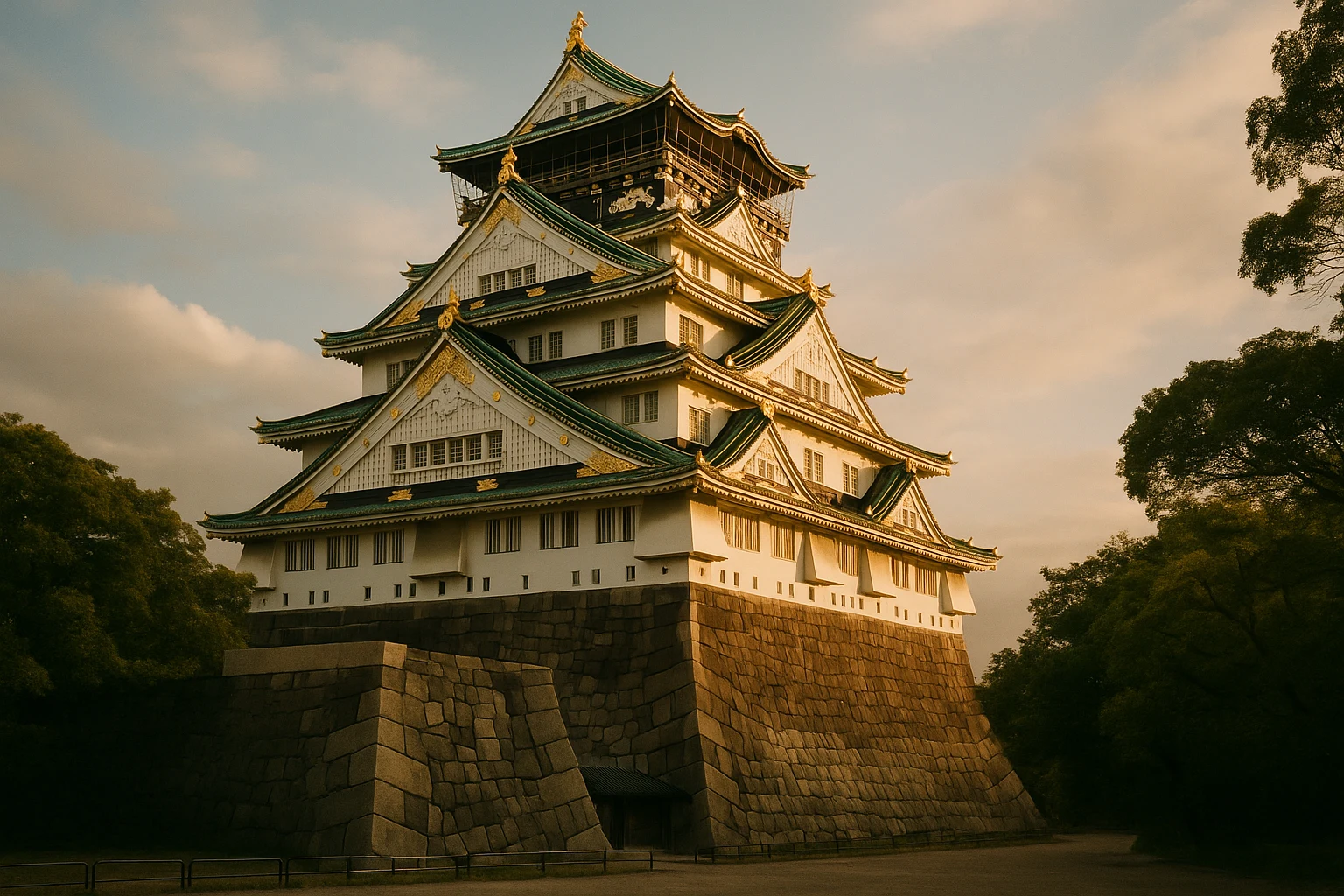
For travelers with a second day, Horyu-ji Temple—a 20-minute bus ride southwest of Nara—preserves wooden structures from 607 CE, making it arguably the oldest surviving wooden architecture anywhere on Earth. The complex provides essential context for understanding what Todaiji’s builders were striving to surpass. Osaka Castle, easily reached by train, offers a compelling contrast: a feudal-era monument of political power rather than religious devotion.
Why Todaiji Still Matters
Todaiji endures not because it is perfectly preserved—it is not; it has burned, been rebuilt, diminished in scale, and adapted across thirteen centuries—but because it demonstrates the extraordinary resilience of a devotional tradition. The Great Buddha was cast as an act of desperation during a plague, and the hall has been rebuilt twice after wars reduced it to ash. Each reconstruction was itself an act of collective will, funded by donations from farmers and merchants and nobles who had never seen the capital.
The temple also marks a pivotal moment in Japanese cultural history: the moment when the island nation fully absorbed continental Buddhist civilization and began to transform it into something distinctly its own. The sculptures in Sangatsu-do, the dry-lacquer technique, the architectural ambition of the original pagodas—all of these represent the height of eighth-century Japanese artistic achievement and remain without peer in the country’s subsequent artistic tradition.
For modern visitors, Todaiji offers something increasingly rare: an encounter with scale that is genuinely humbling. The Daibutsu does not ask to be photographed. It simply sits, as it has for nearly thirteen centuries, in an attitude of limitless equanimity, while tourists and pilgrims and deer pass through the great hall below.
Quick Facts
| Detail | Information |
|---|---|
| Location | Nara, Nara Prefecture, Japan |
| Founded | 745 CE (consecrated 752 CE) |
| Current Hall Built | 1709 CE (Edo period) |
| UNESCO Status | World Heritage Site (1998) |
| Daibutsu Height | 14.98 m (49 ft) |
| Daibutsu Weight | ~500 metric tons |
| Hall Size | 57 m wide × 50 m deep × 49 m tall |
| Record | World’s largest wooden building |
| Admission | ¥600 (Daibutsuden) / Grounds free |
| Opening Hours | Apr–Oct: 7:30–17:30 |
| Nearest Station | Kintetsu Nara (30-min walk) |
| Best For | Buddhist history, architecture, sculpture |
Explore More
Todaiji anchors one of the densest concentrations of ancient monuments anywhere in Japan. The city of Nara served as Japan’s capital from 710 to 784 CE, and nearly every landmark from that era survives. From the lantern-lined approach to Kasuga Grand Shrine to the ancient pagoda of Horyu-ji and the feudal drama of Osaka Castle, the region rewards travelers who look beyond a single morning’s visit. For those seeking to deepen their understanding of Japan’s ancient world, Nara is not a day trip—it is a destination in its own right.
Frequently Asked Questions
What is the Great Buddha at Todaiji?
The Great Buddha (Daibutsu) is a colossal bronze statue of Vairocana Buddha standing approximately 15 meters (49 feet) tall and weighing roughly 500 metric tons. Cast in 752 CE, it remains one of the largest bronze Buddha statues in the world and is housed inside the Daibutsuden hall.
Is Todaiji Temple free to visit?
The temple grounds and the Nandaimon Gate are free to enter. Admission to the Daibutsuden (Great Buddha Hall), where the Daibutsu is enshrined, costs ¥600 for adults. The Todaiji Museum, located nearby on the grounds, charges a separate fee.
How do I get to Todaiji Temple from Nara Station?
Todaiji is about a 30-minute walk from both JR Nara Station and Kintetsu Nara Station. City buses (lines 1, 2) stop at the Daibutsuden-kasugataisha-mae bus stop, a short walk from the gate. Taxis are also readily available.
Can I visit Todaiji on a day trip from Kyoto or Osaka?
Yes. Nara is easily reached from Kyoto in about 45 minutes by the Kintetsu Kyoto Line, or from Osaka in around 35 minutes via the Kintetsu Namba Line. A well-planned day trip allows time for Todaiji, Nara Park's deer, and at least one other nearby shrine or temple.
Are there deer at Todaiji Temple?
Yes. Nara Park surrounds the temple complex, and more than 1,200 wild sika deer roam freely through the grounds. The deer are considered sacred messengers of the Shinto gods and are accustomed to visitors. Shika-senbei (deer crackers) can be purchased nearby to feed them.
What is the best time of year to visit Todaiji?
Spring (late March to early May) and autumn (October to mid-November) are the most scenic seasons, with cherry blossoms or fiery maple foliage framing the temple. Summer brings lush green hills and festive events, while winter offers quiet crowds and the possibility of snow on the Great Hall's roof.
How old is Todaiji Temple?
The original Todaiji was founded in 745 CE by Emperor Shomu and the main hall completed in 752 CE. The current Daibutsuden dates from 1709, rebuilt after fire destroyed the medieval structure. Even so, it remains the world's largest wooden building, though it is only two-thirds the size of the original.