Quick Info
Curated Experiences
Nikko Toshogu Shrine Full-Day Tour from Tokyo
Nikko World Heritage Guided Walking Tour
Toshogu Shrine and Nikko National Park Private Tour
Deep in the cedar forests of Nikko, where mountain mist drifts between ancient trees and the air smells of incense and pine, Toshogu Shrine announces itself not with quiet austerity but with an explosion of color and craftsmanship unlike anything else in Japan. This is the mausoleum of Tokugawa Ieyasu, the warlord who unified a fractured nation and founded a dynasty that would govern Japan for two and a half centuries. Toshogu Shrine stands in Tochigi Prefecture, roughly 140 kilometers north of Tokyo, yet it exists in a world entirely removed from the modern capital — a world of vermilion lacquer, gold leaf, and carvings so dense they seem to breathe. Where most Shinto and Buddhist sacred architecture prizes simplicity and the beauty of unpainted wood, Toshogu defies every convention, layering ornament upon ornament until each structure becomes a three-dimensional encyclopedia of mythology, cosmology, and dynastic propaganda. To walk through its successive gates is to move through a theological argument rendered in craftsmanship: that the Tokugawa line did not merely rule Japan — it was divinely appointed to do so. More than four centuries after its founding, the shrine’s exuberance remains astonishing, and its position among the forested mountains of Nikko National Park gives even its most gilded corners a quality of earned transcendence.
History
The Man the Shrine Was Built to Deify
Tokugawa Ieyasu was born in 1543 into the endless civil warfare of the Sengoku period, an era when samurai clans contested control of a politically shattered Japan. Through six decades of military brilliance, patient alliance-building, and ruthless calculation, Ieyasu outlasted rivals including the great unifiers Oda Nobunaga and Toyotomi Hideyoshi. In 1600, his victory at the Battle of Sekigahara effectively ended the civil wars. Three years later, the emperor appointed him shogun, inaugurating the Edo period. When Ieyasu died in 1616, he left instructions that his remains be temporarily interred at Kunozan in Shizuoka Prefecture but moved after one year to Nikko, where a modest shrine should be built in his honor.
The First Shrine: 1617
The original Toshogu, completed in 1617 under Ieyasu’s son and successor Tokugawa Hidetada, was a relatively restrained structure — significant but not yet the spectacle it would become. It fulfilled Ieyasu’s dying wish and established the site as a place of worship for the deified founder, who was granted the posthumous divine title Tosho Daigongen, meaning “Great Illuminating Incarnation of the East.” Pilgrims began making the journey from Edo almost immediately, and the shrine took on an early political role as a site where the legitimacy of the Tokugawa order was ritually confirmed.
The Great Reconstruction: 1634–1636
The shrine we see today is overwhelmingly the creation of Ieyasu’s grandson, the third shogun Tokugawa Iemitsu, who ordered a complete reconstruction between 1634 and 1636. Iemitsu mobilized extraordinary resources: historical records suggest some 15,000 craftsmen worked on the site over two years, including the finest carpenters, lacquer artists, metalworkers, and sculptors in the country. The total cost was staggering even by the standards of a wealthy shogunate. The result was a complex of more than a dozen structures in an architectural style called gongen-zukuri, which fuses Shinto shrine architecture with Buddhist temple elements, all encrusted with polychrome carvings and finished in gold leaf, vermilion, black lacquer, and vivid pigments. The scale of ambition was deliberate: Iemitsu intended Toshogu to communicate the absolute, divinely sanctioned authority of his dynasty in architectural terms no visitor could misread.
The Tokugawa Legacy and Later History
Toshogu remained a focal point of Tokugawa religious and political life throughout the Edo period, with each succeeding shogun paying ceremonial respects at the shrine. The complex survived the political upheaval of the Meiji Restoration in 1868, which dismantled the shogunate and formally separated Shinto from Buddhism — a policy that forced difficult changes at many syncretic sites like Nikko. Some Buddhist elements were removed, but the core structures survived largely intact. In 1999, Toshogu Shrine and the surrounding sacred complex of Nikko were inscribed as a UNESCO World Heritage Site under the designation “Shrines and Temples of Nikko,” recognizing the exceptional universal value of the ensemble as testimony to the art and architecture of Edo-period Japan.
Key Features
The Stone Torii and Cryptomeria Avenue
Approaching Toshogu from the main road, visitors first pass through a massive stone torii gate dating to 1618, one of the oldest in Japan. The path beyond it runs between rows of colossal cryptomeria cedars — some over 400 years old and towering forty meters or more — planted by the daimyo lord Matsudaira Masatsuna as an offering when he could not afford the lavish material gifts other lords presented at the shrine’s completion. The avenue creates a cathedral-like approach that dramatically heightens the impact of the gilded structures waiting above, framing the transition from the secular world into sacred space.
The Omotemon Gate and Sacred Stables
Ascending stone stairways through the forested hillside, visitors reach the Omotemon, or Front Gate, flanked by two fearsome Nio guardian statues whose muscular forms and painted expressions are meant to ward away malevolent spirits. Just inside the gate, the Sacred Stable — which once housed a white horse presented as an offering to the deity — is decorated with the shrine’s most famous carvings: the three monkeys representing “see no evil, hear no evil, speak no evil.” The monkeys are part of an eight-panel carved frieze depicting a monkey’s journey through life, a teaching attributed to the Tendai Buddhist school, and their inclusion on a horse stable reflects the syncretic character of the entire complex.
The Yomeimon Gate
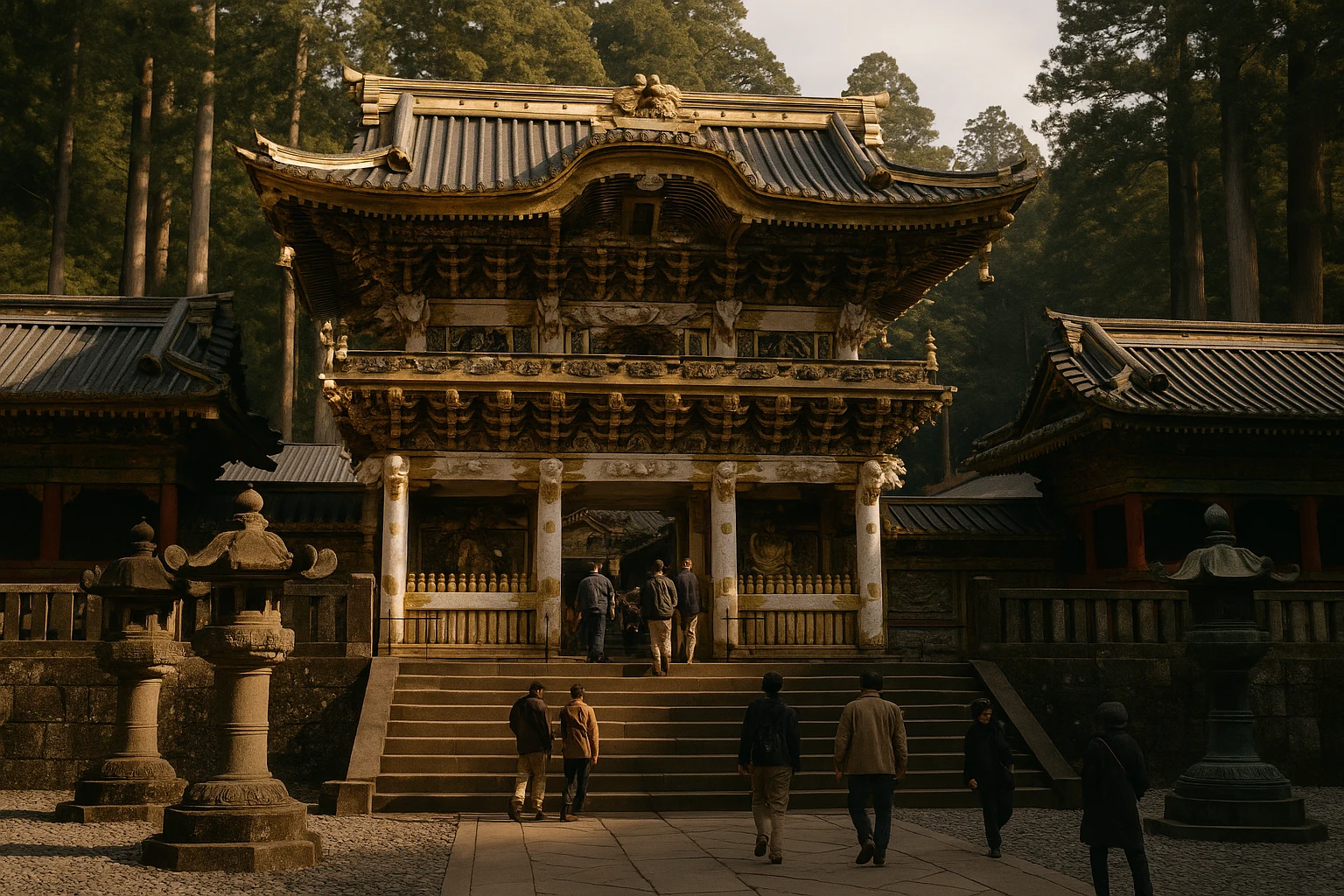
Nothing at Toshogu — and arguably nothing in Japan — quite prepares first-time visitors for the Yomeimon, the gate separating the outer courtyard from the inner precinct. Its name, translating roughly as “Gate of Sunlight” or “Gate That Brightens the Sun,” was said to reflect that a visitor could spend an entire day gazing at it without exhausting its details. More than 500 individual carvings cover every surface: Chinese lions, dancing figures, peonies, cranes, dragons coiling around columns, phoenixes spreading gilded wings above doorways, and human figures representing sages and warriors from Chinese and Japanese mythology. One of the twelve white columns that flank the gate is deliberately carved with its decorative grooves running in the opposite direction from the others — an intentional flaw inserted, according to tradition, because only the gods may achieve perfection, and a flawless structure would invite divine retribution.
The Inner Shrine and Ieyasu’s Tomb
Beyond the Yomeimon lies the Haiden (Oratory) and Honden (Main Hall), accessible only to Shinto priests during formal ceremonies. Visitors may, however, purchase a separate ticket to climb a forested pathway rising steeply behind the main hall to the Oku-sha, or Inner Shrine. Here, surrounded by ancient cedar trees, stands the bronze pagoda housing the actual remains of Tokugawa Ieyasu. The contrast between the tomb itself — simple, green with age, standing in forest silence — and the baroque theatricality of the structures below is profound. Many visitors find this quiet grove the most moving part of the entire complex, the extravagance of the lower precinct finally resolving into genuine solemnity.
The Nemuri-Neko and Sakashitamon Gate
Along the path to Ieyasu’s tomb, visitors pass through the Sakashitamon Gate, above which is carved the Nemuri-Neko, or Sleeping Cat — a small, unassuming sculpture attributed to the legendary craftsman Hidari Jingoro. The cat, portrayed dozing in a shaft of sunlight with sparrows carved on the gate behind it, is widely interpreted as a symbol of peace: even predator and prey coexist in the harmony that Ieyasu’s rule established. The Nemuri-Neko is among the most celebrated single carvings in Japanese art, and prints and reproductions of it appear throughout the Nikko souvenir trade, though the original is easy to miss without looking up at the right moment.
Getting There
Nikko is well connected to Tokyo by both private rail and JR lines, making it a popular and manageable day trip or overnight destination.
Tobu Railway operates the most direct service from Asakusa Station in Tokyo. The Tobu Limited Express Spacia and Revaty trains reach Tobu-Nikko Station in approximately 1 hour 50 minutes, with fares around 2,720 yen one way for a reserved seat. A Tobu Nikko All Area Pass (around 4,000 yen for two days) covers the train and local buses, offering good value for a full day at the shrines.
JR Shinkansen travelers can take the Tohoku Shinkansen from Tokyo Station to Utsunomiya (approximately 50 minutes, 4,490 yen unreserved), then transfer to the JR Nikko Line for another 45 minutes (760 yen) to JR Nikko Station. This route is covered by the JR Pass, making it the preferred option for visitors holding one.
From either Tobu-Nikko or JR Nikko Station, the shrine complex is about 2 kilometers uphill. Local Tobu buses run frequently from both stations to the Nishi-Sando or Omotesando stops nearest the shrine entrance, costing around 300–360 yen. The walk from the stations takes approximately 30–40 minutes and passes through the pleasant town center.
Driving from Tokyo takes about 2 hours via the Tohoku Expressway to the Nikko Interchange. Parking is available near the shrine area but fills quickly on weekends and holidays.
When to Visit
Nikko rewards visits across most of the year, but two seasons stand out for combining comfortable conditions with visual drama.
Spring (mid-April to mid-May) brings cherry blossoms to the lower approaches and fresh green to the cryptomeria avenue, softening the intensity of the gilded structures with delicate color. Temperatures are mild — typically 12 to 20°C — and the mountain air remains crisp. Golden Week (late April to early May) draws large crowds; arriving early in the morning or on weekdays mitigates the queues significantly.
Autumn (mid-October to mid-November) is widely considered the finest season. The surrounding mountains and the trees lining the shrine’s approaches turn brilliant red, orange, and gold, creating a setting that seems designed to flatter the shrine’s own color palette. Temperatures range from 8 to 18°C, and the light in the afternoons has a particular warmth that photographers prize. The Autumn Grand Festival on October 17 includes a procession of a thousand warriors in full Edo-period costume reenacting the original transport of Ieyasu’s remains.
Summer (July–August) is humid but cooler than central Tokyo by several degrees, and the forest shade makes midday visits tolerable. The Nikko area is a traditional retreat from Tokyo’s heat. Winter (December–February) sees occasional snowfall that coats the cryptomeria in white and renders the vermilion and gold structures spectacularly vivid; crowds are at their lowest, and the shrine has an austere, contemplative quality quite different from its busy-season character.
| Quick Facts | |
|---|---|
| Location | Nikko, Tochigi Prefecture, Japan |
| Coordinates | 36.7583° N, 139.5989° E |
| Founded | 1617 (rebuilt 1634–1636) |
| Built by | Tokugawa Hidetada; expanded by Tokugawa Iemitsu |
| Dedicated to | Tokugawa Ieyasu (Tosho Daigongen) |
| Style | Gongen-zukuri (Shinto-Buddhist syncretic) |
| UNESCO | Inscribed 1999 (Shrines and Temples of Nikko) |
| Admission | 1,300 yen adults; inner tomb +520 yen |
| Opening Hours | 9:00–17:00 (Nov–Mar closes at 16:00) |
| Nearest City | Nikko (2 km); Tokyo (140 km) |
| Best Seasons | Late April–May; mid-October–November |
| Time Required | 2–4 hours for the full complex |
Frequently Asked Questions
Where is Toshogu Shrine located?
Toshogu Shrine is located in Nikko, Tochigi Prefecture, about 140 kilometers north of Tokyo in the mountains of central Honshu, Japan.
Who is buried at Toshogu Shrine?
Toshogu Shrine is the mausoleum of Tokugawa Ieyasu (1543–1616), the founder and first shogun of the Tokugawa shogunate, which ruled Japan for over 260 years.
How do I get from Tokyo to Toshogu Shrine?
The fastest option is the Tobu Nikko Limited Express from Asakusa Station in Tokyo to Tobu-Nikko Station, taking about 1 hour 50 minutes. JR Shinkansen to Utsunomiya followed by a local train to JR Nikko Station is also popular and covered by the JR Pass. From either station, buses and taxis reach the shrine in 10–15 minutes.
What is the Yomeimon Gate?
The Yomeimon, or 'Gate of Sunlight,' is the most celebrated structure at Toshogu, covered in over 500 intricate carvings of dragons, angels, flowers, and human figures. Legend holds that one pillar was deliberately carved upside-down to ward off evil spirits through intentional imperfection.
Is Toshogu Shrine a UNESCO World Heritage Site?
Yes. Toshogu Shrine is part of the 'Shrines and Temples of Nikko' UNESCO World Heritage Site, inscribed in 1999 along with Futarasan Shrine and Rinnoji Temple, which together form the sacred complex of the Nikko mountain area.
What is the best time of year to visit Toshogu Shrine?
Late April to early May offers mild weather and spring blossoms, while mid-October to mid-November brings spectacular autumn foliage that frames the gilded structures dramatically. Avoid the peak summer holiday weeks of late July and mid-August when crowds are heaviest.
How much does it cost to enter Toshogu Shrine?
The main shrine complex charges 1,300 yen for adults and 450 yen for children. Climbing to the inner sanctum and Ieyasu's actual tomb behind the main hall costs an additional 520 yen. A combined ticket covering Toshogu, Futarasan Shrine, and Rinnoji Temple is also available.
Nearby Ancient Sites
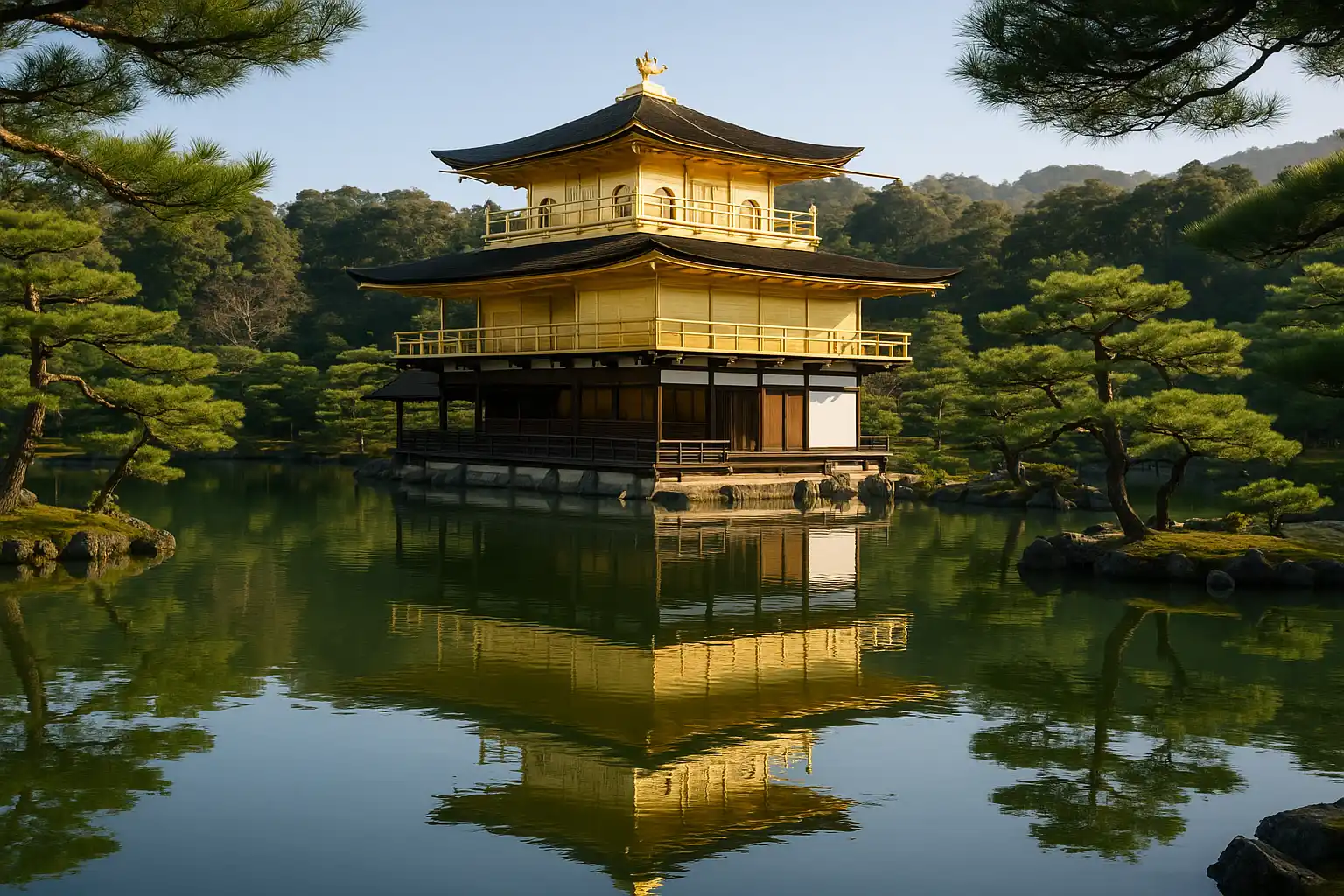
Kinkakuji Temple Japan Travel Guide 2026: Kyoto's Golden Pavilion
Japanese Zen BuddhistVisit Kinkakuji, the Golden Pavilion, Kyoto's most iconic Zen temple. Discover the gold-leaf covered...
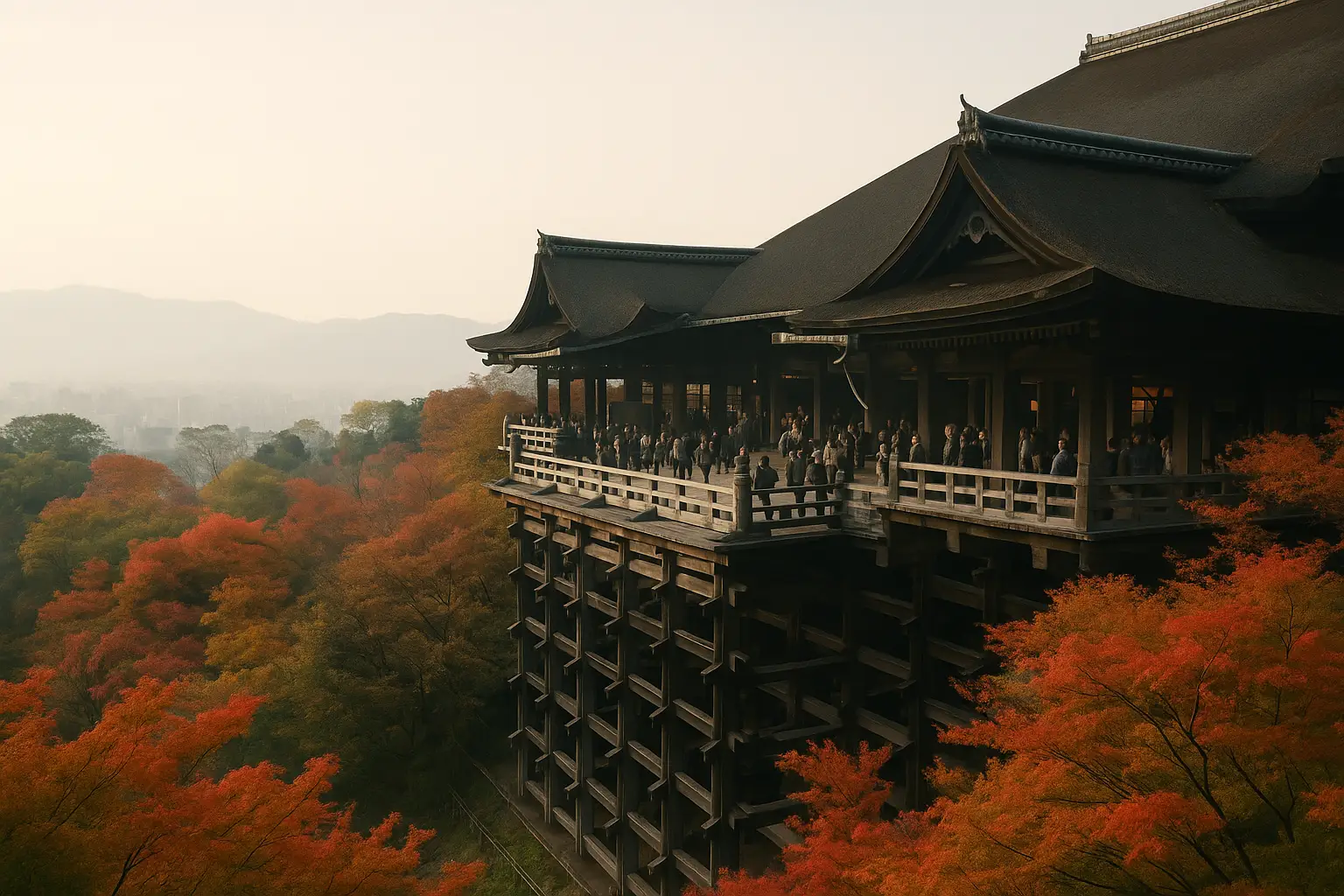
Kiyomizudera Temple Japan Travel Guide 2026: Kyoto's Wooden Stage
Japanese Buddhist (Kita-Hosso)Visit Kiyomizudera, the Pure Water Temple with its famous wooden stage overlooking Kyoto. Explore th...
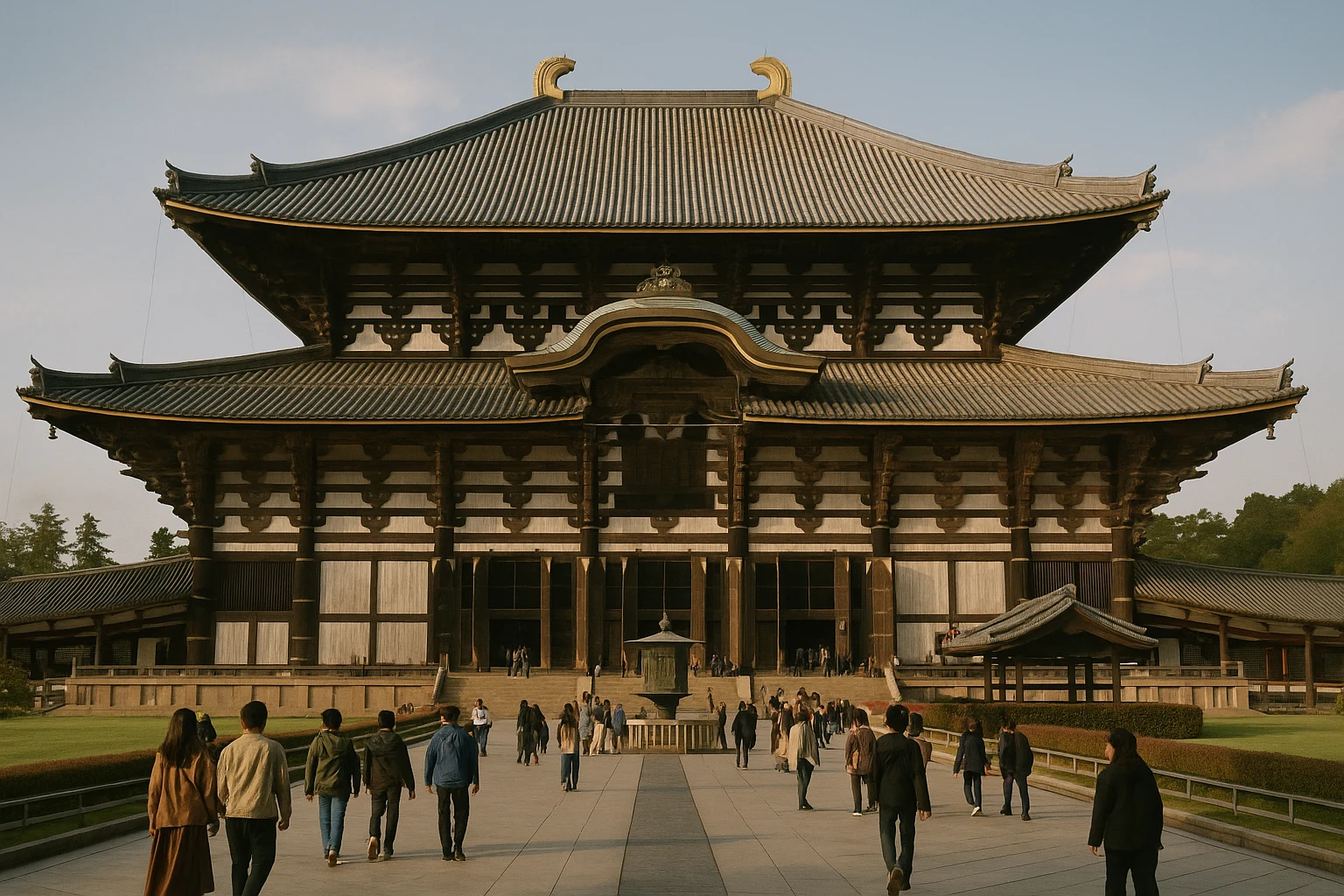
Todaiji Temple
Todaiji Temple in Nara houses the world's largest bronze Buddha and the largest wooden building on E...
Ginkakuji Temple: Kyoto's Silver Pavilion and the Art of Wabi
Explore Ginkakuji Temple in Kyoto, Japan — the Silver Pavilion, sand gardens, and Ashikaga Yoshimasa...
Himeji Castle Japan Travel Guide 2026: The White Heron Castle
Japanese FeudalVisit Himeji Castle, Japan's most beautiful original castle. Explore the White Heron keep, defensive...