Quick Info
Quick Facts
- Location: Northwestern Anatolia near Çanakkale, UNESCO World Heritage Site
- Best for: Legendary archaeology, mythology brought to material evidence, historical significance
- When to visit: April-May, September-October
- Entry fee: Around 300 Turkish Lira
- Crowds: Moderate to high - major international destination
- What to see: Multiple city layers spanning 3,500 years, temples, museum, reconstructed Wooden Horse
The Intersection of Myth and Archaeology
You stand at Troy facing a question that has haunted Western imagination for nearly three thousand years: is Homer’s Trojan War history or myth? The answer, as archaeology has revealed, is both and neither. Troy was real—a substantial city that existed, prospered, and was destroyed multiple times. But Homer’s specific account of the Trojan War, written centuries after the events, blends historical echoes with poetic invention.
Troy is important not because it proves Homer accurate, but because it demonstrates how archaeology, myth, and history intersect. A city was here. It burned. Walls fell. Whether Paris of Troy and Helen of Sparta caused this destruction, or whether different causes and different eras are compressed into epic narrative, remains the central mystery.
The Layers of Troy
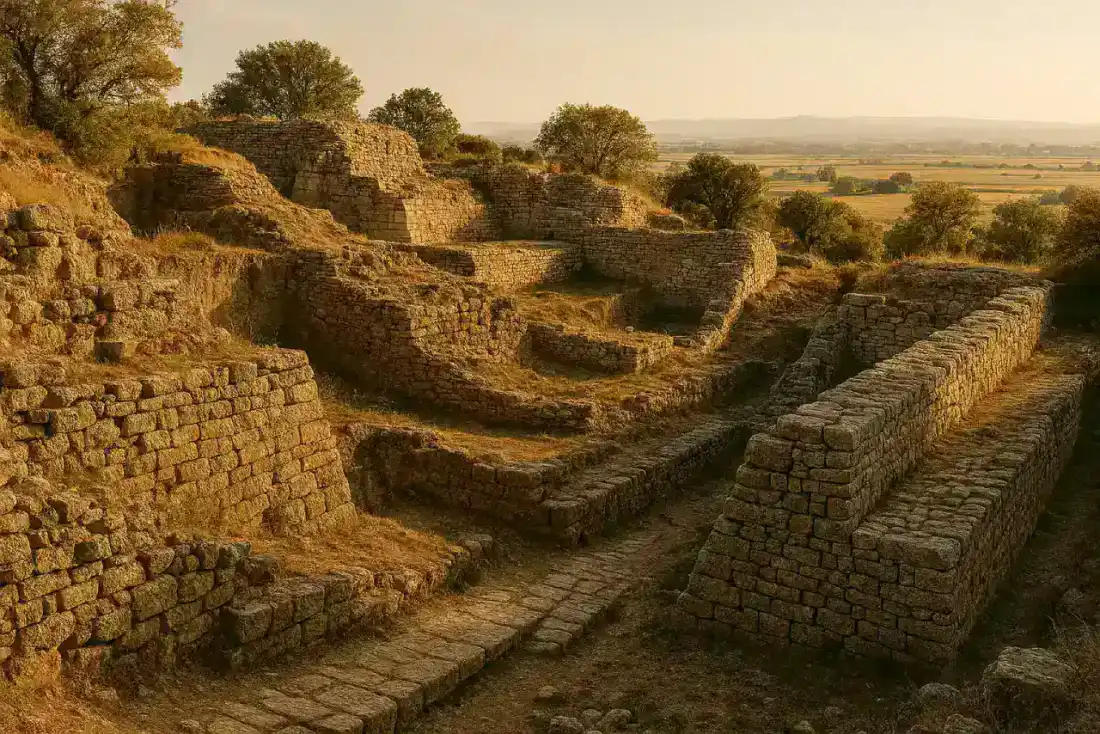
What makes Troy archaeologically extraordinary is not the remains of a single city, but rather a succession of cities built on top of one another, spanning more than three millennia. Nine major layers are distinguishable, each representing a period of settlement, prosperity, destruction, and rebuilding.
Troy I (circa 3000 BCE) was a small fortified settlement—not yet the great city of legend. Successive layers saw Troy expand, develop trade connections, grow wealthy. Troy VIIa (circa 1200 BCE) is the layer most commonly identified with Homer’s Troy—destroyed by siege, the city shows evidence of violent burning and destruction.
But later layers matter too. After the Bronze Age collapse, Troy VII was rebuilt. Greeks reestablished settlement. By the Hellenistic and Roman periods, Troy had become a pilgrimage site—ancients visited to see the legendary city. Alexander the Great came to pay respects. The Romans, claiming descent from the Trojans through Aeneas, invested in rebuilding Troy.
Hellenistic and Roman Troy
After the Bronze Age destruction, Troy lay partly abandoned. But the site was too geographically important—positioned on the Hellespont (Dardanelles) controlling access between the Aegean and the Black Sea—to remain empty for long.
Hellenistic Greeks reestablished a city at Troy, building temples and civic structures. The Temple of Athena was rebuilt. Markets were reopened. The site recovered some commercial importance.
The Romans invested even more heavily. After Augustus made Troy a city under his patronage, substantial rebuilding occurred. Roman temples were constructed. The city grew again. Pilgrims came not to trade, but to encounter the legendary past made visible.
The Sacred Geography
Beyond the material ruins, Troy matters because of geography. The Hellespont (Dardanelles) is a strategic chokepoint—the only waterway connecting the Aegean Sea to the Black Sea. Any power controlling this strait controls access to the wealth of the Black Sea region. The importance of this location in the Bronze Age, the Hellenistic period, and the Roman era cannot be overstated.
Troy’s location meant that whoever controlled it possessed strategic advantage. This geographic significance assured that destruction was often followed by rebuilding. The city repeatedly rose because its location guaranteed that someone would find it worth rebuilding.
The Museum and Artifacts
The Troy Museum is essential to understanding the site. It houses artifacts spanning from the Bronze Age to the Roman period: pottery, tools, jewelry, inscriptions, sculpture. These objects make the layered history concrete. You see the evolution of material culture across millennia.
The museum also displays replica reconstructions showing what the city might have looked like at different periods. These are interpretive tools—helping you visualize space and structure that the ruins alone cannot convey.
The Excavation and Archaeological Method
Heinrich Schliemann’s excavations in the 19th century “discovered” Troy for modern consciousness. Schliemann’s methods were destructive by modern standards—he cut through layers, removed artifacts, and destroyed context in pursuit of finding Homer’s Troy. But his discoveries established Troy as a real place, not just legend.
Later archaeologists, using more careful methods, have revealed much more sophisticated understanding of Troy’s layered history. Modern excavations continue, revealing new details about daily life, trade, fortification strategies, and cultural change across the site’s long occupation.
Visiting Troy
Access: Troy is reached from Çanakkale, about a 30-minute drive south. Buses and organized tours are available.
Best time: April-May or September-October. Summers are hot; winters bring rain.
Duration: 2-4 hours to explore the ruins and museum.
Museum: The Troy Museum is excellent—plan 1-2 hours for serious engagement.
Guides: Local guides provide context for the layers and periods.
Wooden Horse: A modern reconstruction of the legendary Trojan Horse sits near the entrance—popular for photos but not historically accurate to any specific period.
Accessibility: The site covers substantial area on hillside terrain. Comfortable shoes essential.
UNESCO Site Status: The entire area is protected, affecting development and preservation.
Connecting to Bronze Age Aegean
Troy should be understood as part of broader Bronze Age Mediterranean civilization. Visit sites in Greece (Mycenae, Pylos) to understand the cultures that Homer claimed attacked Troy. The Hittite archives from Anatolia reference a kingdom called “Wilusa” (possibly Troy) and mention conflicts in the region. Archaeological evidence suggests that Bronze Age Troy III in conflict with regional powers—though the specifics remain mysterious.
What Troy Teaches
Troy demonstrates how archaeological sites become significant through complex intersections of history, myth, and legend. The city was real. It was destroyed multiple times. But whether specific legendary events occurred there remains unknowable. Archaeology cannot prove or disprove Homer’s account—it can only show what actually happened at the site.
Troy also reveals how places matter across centuries. A location of strategic or cultural significance maintains importance across different epochs. Greeks, Romans, and Ottomans all recognized Troy’s significance. The site draws visitors not because Troy was the greatest city—it wasn’t. But because of its legendary associations and geographic importance.
Standing at Troy, you confront the limits of what archaeology can know. The city is real. The walls are real. The destruction is real. But the causes, the specific events, the human actors—all remain partially obscured, filtered through layers of myth, time, and fragmentary evidence.
That uncertainty is not a weakness of archaeology—it’s its honesty. Troy teaches that history is not transparent. It’s excavated, interpreted, contested. And the greater the legendary significance, the harder it becomes to separate fact from narrative.