Quick Info
At a glance
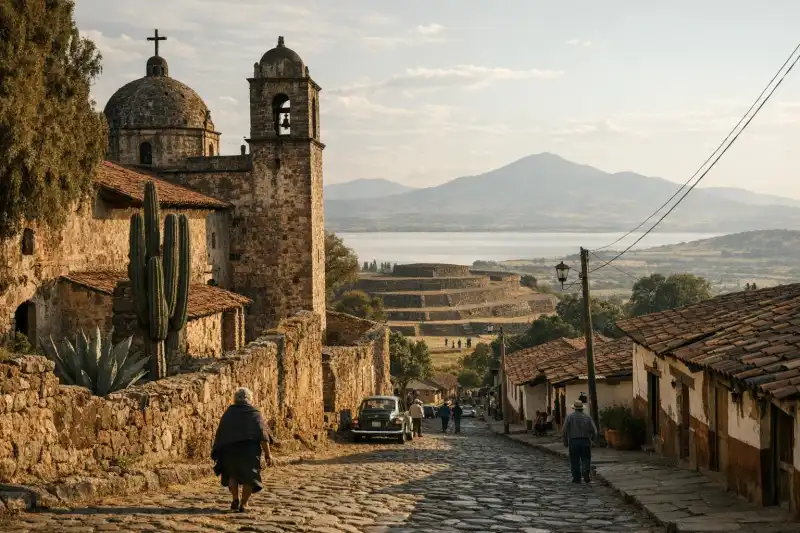
Tzintzuntzan in Mexico rises above the shores of Lake Pátzcuaro with a quiet authority that feels very different from the better-known ruins of central and southeastern Mesoamerica. Instead of towering jungle temples or densely packed urban grids, this former Purépecha capital offers broad platforms, unusual pyramidal forms, open skies, and sweeping views across one of western Mexico’s most beautiful highland lakes. The setting is part of the experience: winds move over the plateau, light shifts across the water, and the landscape helps explain why this place once became the heart of a powerful regional state.
For travelers interested in ancient Mexico beyond the Aztec and Maya worlds, Tzintzuntzan is one of the country’s most rewarding archaeological visits. It tells the story of the Purépecha, also known as the Tarascans in older literature, a people who built one of the strongest states in pre-Hispanic Mexico and resisted Mexica expansion. The site’s famous yácatas, with their distinctive blended circular-and-rectilinear plans, stand as one of the clearest expressions of Purépecha monumental architecture. Yet Tzintzuntzan is not only about ruined foundations. It is also about place, empire, memory, and survival, linked to the nearby colonial town, local crafts, and the living cultural traditions of the Lake Pátzcuaro region. Visiting here feels less like checking off a monument and more like entering a layered historic landscape.
History
Early settlement and the rise of the Lake Pátzcuaro region
Long before Tzintzuntzan became the political center of a major state, the Lake Pátzcuaro basin was already home to settled communities taking advantage of fertile soils, freshwater resources, and natural routes through the highlands of what is now Michoacán. The region’s lakeshore settlements developed in close connection with fishing, agriculture, and trade, and over time these communities formed a cultural landscape with strong local identity. Archaeology suggests that the area was part of broader western Mexican networks, though it retained its own architectural and political character.
The Purépecha world emerged in this wider highland setting. By the Late Postclassic period, roughly from the 13th century onward, political authority in the basin became more centralized. Oral traditions and later colonial-era documents describe shifting centers of power and dynastic foundations, with places such as Pátzcuaro, Ihuatzio, and finally Tzintzuntzan playing important roles. While these traditions mix history and legend, they reflect a real process: the consolidation of authority around the lake and the creation of a state that would soon dominate much of western Mexico.
Tzintzuntzan as imperial capital
By the 14th and especially 15th centuries, Tzintzuntzan had become the principal capital of the Purépecha Empire. Its location was strategic. Set on a terrace overlooking Lake Pátzcuaro, it was both defensible and symbolically commanding. From here, rulers could oversee a core region that was economically productive and politically central. The city developed ceremonial and administrative spaces, among them the great platforms and yácatas that still define the archaeological zone today.
The Purépecha state was one of the strongest political formations in pre-Columbian Mexico. It controlled wide territories in present-day Michoacán and beyond, with influence extending into parts of Jalisco, Guanajuato, Guerrero, and the State of Mexico. It was known for military organization, tribute systems, skilled metalworking, and effective administration. Unlike many Mesoamerican centers more familiar to international visitors, Tzintzuntzan belonged to a polity that was not conquered by the Mexica. In fact, the Purépecha and Mexica were major rivals. Frontier warfare and political tension between the two powers shaped the geopolitics of Late Postclassic central Mexico.
At its height, Tzintzuntzan was more than a ritual center. It was a seat of governance, a place where elite authority was staged architecturally, and a hub in networks of tribute, production, and exchange. Its monumental architecture likely supported ceremonies tied to rulership, dynastic legitimacy, and the sacred landscape of the lake and surrounding hills.
Spanish arrival and colonial transformation
The Spanish conquest of central Mexico dramatically altered the balance of power across Mesoamerica. After the fall of Tenochtitlan in 1521, Purépecha rulers faced a new imperial force. Tzintzuntzan did not experience the kind of prolonged siege associated with some conquest narratives, but the transition to colonial rule was nonetheless profound. Political authority was reshaped, tribute obligations redirected, and Christian institutions introduced. Indigenous elites negotiated, adapted, and suffered under the rapidly changing order.
One of the most visible consequences was the reuse of pre-Hispanic materials in colonial building projects. As happened in many parts of Spanish America, stones from ancient ceremonial structures were taken for churches, convents, and other construction. In Tzintzuntzan, the colonial Franciscan complex became a major landmark, physically and symbolically overlaying the pre-Hispanic capital. This did not erase the older city entirely, but it changed how the landscape was organized and remembered.
Population decline due to disease, forced labor, and colonial disruption transformed the region. Still, Tzintzuntzan remained significant as a town in the new colonial world, even as its role shifted away from imperial capital.
Rediscovery, archaeology, and heritage
Over the centuries, the ancient ceremonial core survived in altered form. Scholars, antiquarians, and later archaeologists gradually documented the ruins and recognized their exceptional importance for understanding Purépecha civilization. Excavation and conservation in the 20th century helped define the site visible today, especially the main platform with its yácatas and associated remains.
Modern interest in Tzintzuntzan has grown not only because of its architecture but because it broadens the story of ancient Mexico. The site challenges the common tendency to reduce pre-Hispanic history to a few famous civilizations. Here, visitors encounter a major western Mexican state with its own political traditions, religion, art, and engineering. Today Tzintzuntzan stands as both an archaeological zone and a cultural landmark, linked to living communities around Lake Pátzcuaro and to renewed appreciation for Purépecha heritage.
Key Features
The most striking elements at Tzintzuntzan are the yácatas, the site’s emblematic pyramidal structures. These stand on a long artificial platform cut into the hillside and shaped to create a commanding ceremonial terrace above the lake. Unlike the square or rectangular pyramids many travelers expect in Mesoamerica, the yácatas are unusual in plan, combining a semicircular front with a rectangular rear section. This gives them a highly distinctive silhouette and marks them as one of the clearest architectural signatures of the Purépecha world. Even in partially restored form, they are visually memorable, especially when morning or late-afternoon light emphasizes their contours.
The great platform itself deserves as much attention as the individual monuments. It is a feat of landscape engineering, turning the slope into a formal sacred and civic space. Walking across it helps visitors understand that Tzintzuntzan was designed for procession, gathering, and display. The broad terrace organizes movement, frames views, and creates a monumental stage from which rulers and priests could perform rituals tied to authority and cosmology. The relationship between architecture and topography is one of the site’s strongest qualities. Rather than dominating the landscape by height alone, Tzintzuntzan works through placement, horizon, and visual control.
Scattered around the main area are foundations and remains of additional structures that hint at a larger ceremonial and administrative complex. These include plazas, subsidiary platforms, and areas thought to have supported elite or ritual activity. While the surviving ruins are not as densely built as those at some major central Mexican cities, they invite a more interpretive kind of visit. You begin to see how monumental architecture, open spaces, and the natural setting worked together. The site rewards slow walking and careful looking.
One of Tzintzuntzan’s greatest features is the view. From the archaeological zone, Lake Pátzcuaro spreads below, and the surrounding hills help define the basin that sustained the Purépecha heartland. This outlook is not merely scenic. It is historical evidence in landscape form. The capital’s position above the water reflects strategic thinking, ceremonial symbolism, and practical command over a core region. The lake was a source of food, communication, and identity, and the city’s relationship to it was central to Purépecha power.
Visitors should also pay attention to construction details. The surviving stonework reveals a different building tradition from the masonry seen at sites associated with the Maya or Mexica. The yácatas once supported temples made in part from perishable materials, so what remains today is only part of the original architectural effect. Still, the bases and revetments provide insight into Purépecha design choices and engineering methods. The emphasis on platform architecture rather than extreme verticality contributes to the site’s distinct atmosphere.
Beyond the ruins themselves, Tzintzuntzan benefits from being embedded in a broader cultural landscape. The nearby town is known for its colonial convent, artisan traditions, and connections to the annual Day of the Dead season around Lake Pátzcuaro. This means a visit can extend naturally from archaeology into living heritage. Few places in Mexico offer such an accessible combination of pre-Hispanic capital, colonial architecture, lakeside scenery, and contemporary regional culture within a short distance.
Another appealing feature is the site’s relative calm. Compared with Mexico’s busiest archaeological destinations, Tzintzuntzan often feels spacious and unhurried. That quieter atmosphere makes it easier to imagine the ceremonial terrace in use and to appreciate details that might be lost in a crowd. For travelers who prefer places where the landscape still shapes the mood, this is a major advantage.
Getting There
Tzintzuntzan is easiest to reach from Pátzcuaro or Morelia in the state of Michoacán. From Pátzcuaro, the site is roughly 17 to 20 kilometers away, depending on your starting point. Local buses and colectivos running toward Tzintzuntzan or Quiroga are usually the most budget-friendly option, with fares commonly around MXN 20 to 40 per person. Travel time is often 25 to 40 minutes. A taxi from Pátzcuaro is faster and more convenient, generally costing around MXN 180 to 300 one way, though rates vary by season and negotiation.
From Morelia, the state capital, Tzintzuntzan is about 60 to 70 kilometers away. Direct driving time is usually around 1 hour to 1 hour 20 minutes. Buses from Morelia to Pátzcuaro are frequent and affordable, often around MXN 80 to 140, after which you can transfer to a local bus or taxi. A direct taxi or private transfer from Morelia will be much more expensive, often in the MXN 1,000 to 1,800 range depending on vehicle type and waiting time. Renting a car can be an excellent choice if you want to combine Tzintzuntzan with Pátzcuaro, Quiroga, or other villages around the lake.
Road access is straightforward, and many travelers visit as part of a loop around Lake Pátzcuaro. Parking is typically available near the archaeological zone. If using public transport, it is wise to confirm the last return departures, especially on Sundays or local holidays when schedules may thin out. Carrying cash in small denominations is useful for fares, entrance fees, snacks, and taxis.
When to Visit
Tzintzuntzan can be visited year-round, but the most comfortable months are generally the dry season from November through April. During this period, days are often sunny and mild, making it easier to walk the exposed archaeological terrace. Morning visits are especially pleasant, with softer light, cooler temperatures, and clearer views across Lake Pátzcuaro. Photographers often prefer early morning or late afternoon, when the yácatas gain more texture and the site’s elevated setting becomes especially dramatic.
The rainy season, usually from May to October, brings greener landscapes and a more lush appearance to the hills around the lake. Showers are often concentrated in the afternoon, so starting early is a good strategy. Paths may be a little slick after rain, but the site remains rewarding, and visitor numbers can be lower. If you enjoy moody skies and vivid vegetation, this can be a beautiful time to come.
One of the most culturally intense periods in the wider region is late October through early November, around Day of the Dead. During this season, nearby towns and islands around Lake Pátzcuaro attract many visitors for cemetery vigils, offerings, and related traditions. It is an unforgettable time to experience the area, but accommodation prices can rise, roads can be busier, and advance booking becomes essential. Tzintzuntzan itself can be combined with these festivities, though travelers should expect more movement across the region.
For the quietest archaeological visit, choose a weekday outside major Mexican holiday periods. Bring sun protection in any season, as the exposed platform offers limited shade. The highland climate can also shift quickly, so a light layer is useful even on warm days.
| Quick Facts | Details |
|---|---|
| Location | Tzintzuntzan, Michoacán, Mexico |
| Civilization | Purépecha |
| Main significance | Former imperial capital and ceremonial center |
| Best-known monuments | The yácata pyramids |
| Setting | Terrace above Lake Pátzcuaro |
| Approximate founding as capital | Late Postclassic period, c. 14th century CE |
| Closest major city | Morelia |
| Closest travel base | Pátzcuaro |
| Typical visit length | 1.5 to 3 hours |
| Best time of day | Early morning or late afternoon |
| Ideal season | November to April |
| Good to combine with | Pátzcuaro, Quiroga, Lake Pátzcuaro villages |
Guided tours: worth it?
Most travelers can visit Tzintzuntzan independently. Compare a tour only if you want a tighter history-focused visit, easier logistics, or a guide who can answer questions on the spot.
Best for
- Short visits where a planned route saves time
When to go self-guided
Go independently if you prefer setting your own pace, reading as you go, and checking official hours or ticket rules directly before you arrive.
What I’d avoid
Skip paid tours that bundle unrelated stops you do not actually want. The best option should either save meaningful planning time or add historical context you would miss on your own.
Pátzcuaro and Tzintzuntzan Day Tours
Useful when: you want to compare guided formats before deciding
Michoacán Cultural Tours
Useful when: you want to compare guided formats before deciding
Morelia to Pátzcuaro and Tzintzuntzan Excursions
Useful when: you want to compare guided formats before deciding
Some tour links are affiliate links, which may earn Ancient Travel a small commission at no extra cost to you. I try to surface options that make practical sense for the site—not just anything bookable.
Frequently Asked Questions
What is Tzintzuntzan famous for?
Tzintzuntzan is famous for being the ceremonial and political capital of the Purépecha Empire and for its distinctive yácata pyramids overlooking Lake Pátzcuaro.
Where is Tzintzuntzan located?
Tzintzuntzan is in the state of Michoacán in western Mexico, on the northeastern shore of Lake Pátzcuaro, not far from the towns of Pátzcuaro and Quiroga.
How much time do you need to visit Tzintzuntzan?
Most visitors spend 1.5 to 3 hours at the archaeological zone, though a half day is ideal if you also want to explore the town, former convent, and lakeside viewpoints.
Can you visit Tzintzuntzan on a day trip from Morelia?
Yes. Tzintzuntzan is commonly visited as a day trip from Morelia, often combined with Pátzcuaro, Quiroga, or nearby craft villages around Lake Pátzcuaro.
What are the yácatas at Tzintzuntzan?
The yácatas are the site’s signature stepped pyramidal platforms, notable for their unusual mix of rectangular and rounded forms associated with Purépecha ceremonial architecture.
Is Tzintzuntzan worth visiting?
Yes. Tzintzuntzan is one of the most important Purépecha archaeological sites in Mexico and offers impressive ruins, lake views, and a less crowded experience than many larger destinations.
Nearby Ancient Sites
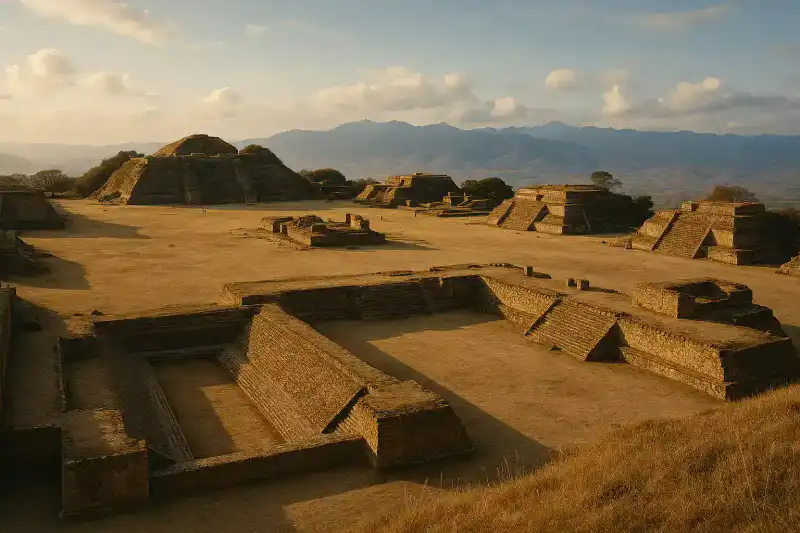
Monte Albán Mexico Travel Guide 2026: Zapotec Capital Above Oaxaca
ZapotecExplore Monte Albán, the ancient Zapotec capital perched above Oaxaca. Discover the Grand Plaza, bal...
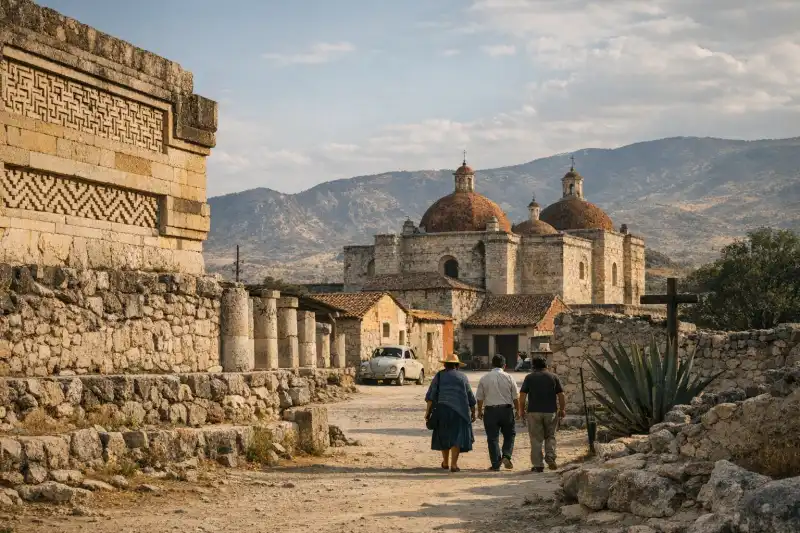
Mitla
Zapotec and MixtecExplore Mitla, Mexico’s Zapotec ceremonial city, famed for intricate stone mosaics and ancient tombs...
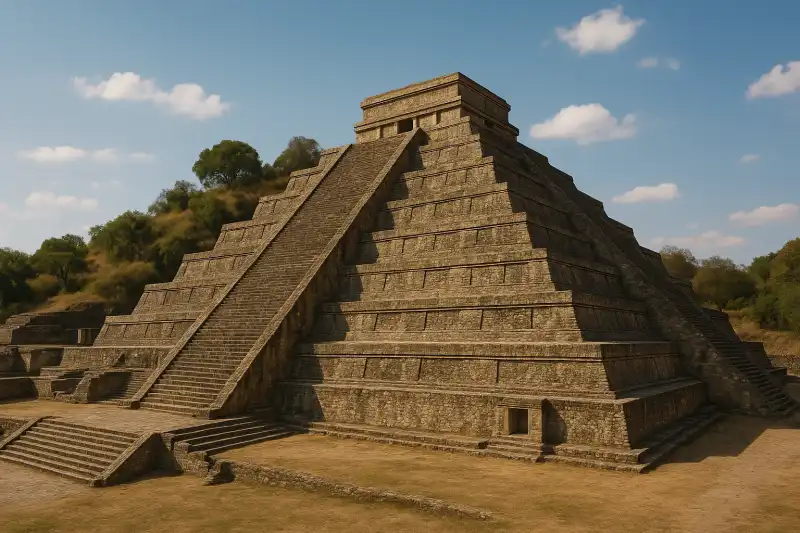
Great Pyramid of Cholula Travel Guide 2026: Tlachihualtepetl Essentials
Preclassic and Postclassic MesoamericanPlan a smart visit to the Great Pyramid of Cholula with key context, timing advice, and practical fi...