Quick Info
At a glance
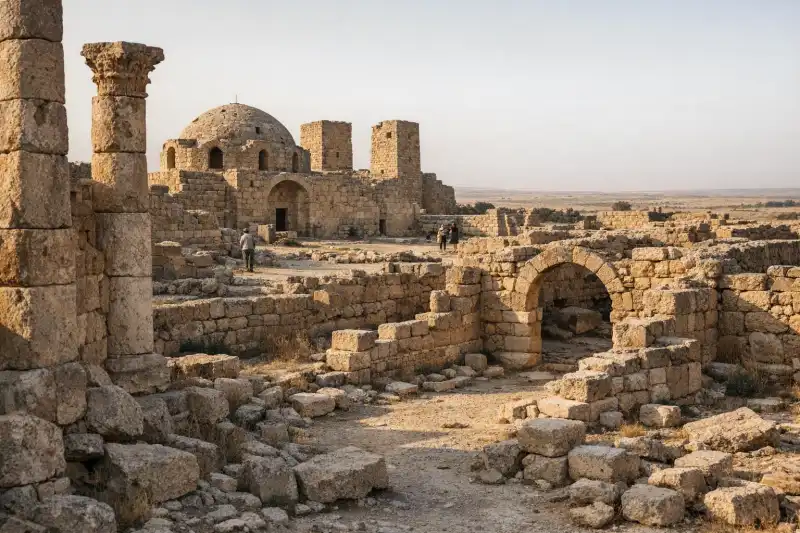
Umm ar-Rasas in Jordan rises from the plateau southeast of Madaba as a quiet field of stone walls, broken arches, church foundations, and one of the most remarkable mosaic pavements in the Near East. At first glance, the site can seem austere: a broad archaeological enclosure set in dry open country, where the wind moves across grasses and black basalt fragments and where the horizon feels almost as important as the ruins themselves. Yet that stillness is part of its power. Unlike heavily urbanized ancient sites, Umm ar-Rasas preserves the atmosphere of a frontier settlement shaped by empire, faith, trade, and adaptation over centuries.
Known in antiquity as Kastron Mefaa, the site reflects a long sequence of occupation from the Roman era through the Byzantine and early Islamic periods. What survives today is not a single monument but an archaeological landscape. Visitors walk among military remains, domestic quarters, courtyards, cisterns, churches, and chapels that once served a substantial town at the edge of cultivated land and desert. The most celebrated treasure is the Church of Saint Stephen, whose floor mosaic preserves vivid representations of towns in Jordan, Palestine, and Egypt. Nearby stands the unusual stylite tower, linked to a tradition of pillar-dwelling ascetics. Together, these features make Umm ar-Rasas one of Jordan’s most rewarding sites for travelers interested in the transition from the classical world to late antiquity and the early medieval Middle East.
History
Roman origins on a frontier landscape
Umm ar-Rasas began as a strategic settlement in the Roman period, probably in the 3rd century CE, when the empire strengthened its control over routes and agricultural zones east of the Jordan Valley. Its ancient name, Kastron Mefaa, suggests a fortified camp or military post. This was a region where movement mattered: caravans crossed semi-arid lands, pastoral communities shifted with the seasons, and imperial authorities needed to monitor communication lines linking central Jordan with the wider provinces of Arabia and Palestine.
The earliest phase of the site likely centered on defense and administration. Roman frontier policy in this part of the empire did not always rely on massive walls alone; it also depended on networks of smaller garrisons, roads, and local alliances. Umm ar-Rasas fit into that system. Its setting allowed oversight of surrounding terrain while also supporting settled life through agriculture and water management. Cisterns and built storage spaces indicate that survival here depended on careful organization, not just military presence.
Byzantine expansion and the flourishing of a Christian town
By the 5th and 6th centuries, Umm ar-Rasas had changed dramatically. What may have started as a military settlement evolved into a prosperous Christian town with numerous churches, residential buildings, and public spaces. This transformation mirrors broader developments in the eastern Mediterranean, where many Roman frontier communities became more urbanized and deeply integrated into Christian ecclesiastical networks.
The Byzantine period is the golden age of the site. Archaeological work has revealed at least a dozen churches or chapels in and around the settlement, an extraordinary concentration that points to both population density and religious importance. Some of these buildings were modest, while others were richly decorated. Mosaic floors became a distinctive expression of piety, patronage, and civic identity. At Umm ar-Rasas, they reached a particularly high standard.
The most famous example is the Church of Saint Stephen, dated by inscription to 785 CE but rooted in a Byzantine artistic tradition that remained active beyond the formal end of Byzantine political control. Its mosaic floor depicts personifications and named cities across the region, offering not only artistic beauty but also a map-like statement of cultural memory. The town’s churches show that Umm ar-Rasas was not isolated; it was connected intellectually, artistically, and commercially to a broad Christian world stretching across the Levant.
Early Islamic continuity and adaptation
One of the most important aspects of Umm ar-Rasas is that it did not simply end with the Byzantine period. After the Muslim conquest of the Levant in the 7th century, the settlement continued to function. This continuity is crucial for understanding Jordan’s early Islamic history. In many places, older Christian communities, urban habits, and craft traditions persisted under new rulers. Umm ar-Rasas offers material evidence of that transition.
The Church of Saint Stephen itself belongs to this era of continuity, dating to the Abbasid period. Its existence demonstrates that Christian communities remained active and capable of commissioning major artworks even after political change. The mosaic inscriptions and iconographic choices suggest adaptation rather than abrupt rupture. Daily life likely involved interaction between different religious and social groups across a changing administrative landscape.
At some point, however, the settlement declined. Scholars connect this process to a combination of regional economic shifts, earthquake damage, changing trade routes, and the gradual contraction of settled life in marginal zones. Like many towns in late antique and early medieval Jordan, Umm ar-Rasas was vulnerable to environmental and political changes that slowly altered its viability.
Rediscovery, archaeology, and UNESCO recognition
For centuries, the ruins remained largely abandoned, known locally but not widely studied. Modern archaeological attention brought the site back into historical focus, especially through excavations that exposed the churches, domestic quarters, inscriptions, and mosaics. These investigations revealed Umm ar-Rasas as one of the most informative sites for the study of late antiquity in the Levant.
Its importance was recognized internationally when UNESCO inscribed Umm ar-Rasas as a World Heritage Site in 2004. The designation reflects not only the beauty of the mosaic floors but also the significance of the site as a rare record of cultural continuity between Roman, Byzantine, and early Islamic periods. Today, Umm ar-Rasas stands as one of Jordan’s quieter but more intellectually rich destinations: less monumental than Petra, less urban than Jerash, yet uniquely revealing in the story it tells about frontier society, Christian art, and the long transformation of the ancient Near East.
Key Features
The defining experience of Umm ar-Rasas is spatial rather than theatrical. This is not a site dominated by a single grand temple or amphitheater. Instead, its appeal lies in walking through an entire settlement and gradually learning to read its layers. The enclosed archaeological zone contains a dense concentration of ruins: low stone houses, collapsed walls, streets, courtyards, and churches that together evoke a once-living town. The architecture is often modest in scale, but the cumulative effect is powerful. You begin to sense how people organized domestic, religious, and communal life in a dry upland environment.
The star attraction is the Church of Saint Stephen. Protected today by a shelter, its mosaic floor is among the finest in Jordan. The workmanship is delicate and assured, with geometric borders, vegetal motifs, animals, human figures, and, most famously, a sequence of labeled city representations. These include places in Jordan as well as cities in Palestine and the Nile Delta, creating a visual network of sacred and urban geography. For visitors, the mosaic is rewarding at two levels: from a distance, it impresses through scale and pattern; up close, individual tesserae and inscriptions reveal the skill of the artists and the ambitions of the patrons. It is a masterpiece not because it is ostentatious, but because it preserves a world of memory in stone.
Beyond Saint Stephen, other ecclesiastical remains show how central Christianity was to the town. Church plans, apses, side chambers, and traces of liturgical arrangements survive in enough detail to suggest active congregational life. Some of the floors are fragmentary, but even these remnants help visitors understand that Umm ar-Rasas was once a notable religious center. The number of churches also points to successive phases of construction, renovation, and adaptation over time.
One of the site’s most unusual monuments stands outside the main enclosure: the stylite tower. Rising alone in the landscape, it is traditionally associated with ascetic holy men who lived or practiced devotion atop pillars or towers, following a form of spirituality known elsewhere in the late antique Near East. Whether viewed as a direct habitation structure or as part of a wider cult landscape, the tower gives Umm ar-Rasas a striking visual identity. Against the open sky, it becomes a reminder that the site’s history is not only urban and administrative but also deeply spiritual, shaped by forms of devotion that can seem astonishing to modern visitors.
The site also rewards attention to less dramatic features. Water systems, including cisterns, were essential for sustaining life here and reveal the practical intelligence behind settlement in this environment. Domestic architecture, though ruined, suggests ordinary routines of cooking, storage, work, and family life. Paved areas and street lines indicate movement through the town and the relation between sacred and secular space. Archaeology at Umm ar-Rasas is not about isolated masterpieces alone; it is about reconstructing how an entire community functioned.
The landscape itself is another key feature. The surrounding plateau helps explain the site’s frontier character. Light changes rapidly across the stones, and in the early morning or late afternoon the textures of masonry, mosaic shelter roofs, and open ground become especially photogenic. Unlike lush river valleys or mountain sanctuaries, Umm ar-Rasas belongs to a harsher setting, one where resilience and careful planning were essential. That context gives emotional force to the remains. The ruins are not merely relics of vanished buildings; they are evidence of centuries of successful human adaptation in a demanding place.
Getting There
Umm ar-Rasas is usually reached by road, most commonly from Amman or Madaba. From Amman, the drive is around 70 kilometers and typically takes 1 to 1.5 hours depending on traffic and your exact starting point. From Madaba, travel time is often 40 to 50 minutes. Renting a car is the easiest option, especially if you want to combine the visit with Madaba, Mount Nebo, or other central Jordan sites. Daily car rental rates in Jordan often start around 25 to 40 JOD for a basic vehicle, with extra costs for insurance and fuel.
Taxis can also work, particularly from Madaba or Amman, though they are more practical if hired for a round trip with waiting time. From Amman, a private taxi for a half-day or day excursion may cost roughly 35 to 60 JOD depending on negotiation, season, and whether multiple stops are included. From Madaba, fares are usually lower, often in the 20 to 35 JOD range for a return outing. It is wise to agree on the full price before departing.
Public transportation to the site itself is limited and not especially convenient for independent visitors. Buses or shared transport may get you part of the way toward Madaba or nearby villages, but the last segment often requires a taxi. For most travelers, organized day tours are the simplest alternative. Tours from Amman frequently bundle Umm ar-Rasas with Christian heritage sites and can be cost-effective if you prefer not to navigate rural roads yourself. Entrance fees and opening times can change, so check current details before setting out, and carry water, sun protection, and some cash.
When to Visit
Spring and autumn are generally the best times to visit Umm ar-Rasas. From March to May, the weather is usually mild, skies are often clear, and the surrounding landscape can show brief seasonal greenery that softens the site’s otherwise dry setting. Temperatures during these months are comfortable for walking among exposed ruins, and the light is excellent for photography. Autumn, especially from late September through November, offers similar advantages, with warm days and cooler mornings and evenings.
Summer visits are certainly possible, but the site can become intensely hot, particularly from June through August. Because Umm ar-Rasas is open and only partly shaded, midday sun can be draining. If you travel in summer, aim to arrive early in the morning, wear a hat, and bring plenty of water. The advantage of summer is clearer logistics and long daylight hours, but comfort can be a real issue, especially for visitors planning several outdoor stops in a single day.
Winter is quieter and can be rewarding if you prefer fewer visitors and softer light. Daytime temperatures are often manageable, but cold winds, overcast skies, and occasional rain can make the site feel more exposed. The plateau setting means weather changes are noticeable, and footing may be less pleasant after wet conditions.
Whatever the season, the best daily timing is usually early morning or late afternoon. These hours offer lower temperatures, better shadows for reading the stonework, and more atmospheric views of the stylite tower and church ruins. Midday tends to flatten the landscape visually and can make a historically subtle site feel harsher than it deserves. For travelers who want to appreciate both the archaeology and the mood of the place, timing matters almost as much as season.
| Quick Facts | Details |
|---|---|
| Location | Madaba Governorate, Jordan |
| Ancient name | Kastron Mefaa |
| UNESCO status | World Heritage Site |
| Main periods | Roman, Byzantine, Early Islamic |
| Best-known feature | Mosaic floor of the Church of Saint Stephen |
| Approximate distance from Amman | 70 km |
| Suggested visit length | 1.5 to 3 hours |
| Best seasons | Spring and autumn |
| Ideal for | Archaeology lovers, mosaic enthusiasts, Christian heritage travelers |
Guided tours: worth it?
A guide can be genuinely useful at Umm ar-Rasas, especially if you want help with transport, timing, tickets, or understanding a large site without losing half the day to logistics.
Best for
- Travelers who want transport, timing, or entry logistics handled
- Short visits where a planned route saves time
When to go self-guided
Go independently if you already have transport and tickets sorted, enjoy moving at your own pace, and are comfortable checking the latest official rules before you arrive.
What I’d avoid
Skip paid tours that bundle unrelated stops you do not actually want. The best option should either save meaningful planning time or add historical context you would miss on your own.
Madaba, Mount Nebo & Umm ar-Rasas Tours
Useful when: you want to compare guided formats before deciding
Jordan Christian Heritage Tours
Useful when: you want to compare guided formats before deciding
Day Trips from Amman to Madaba and Umm ar-Rasas
Useful when: transport or pickup logistics matter
Some tour links are affiliate links, which may earn Ancient Travel a small commission at no extra cost to you. I try to surface options that make practical sense for the site—not just anything bookable.
Frequently Asked Questions
What is Umm ar-Rasas known for?
Umm ar-Rasas is best known for its extensive Roman, Byzantine, and early Islamic ruins, especially the mosaic floor of the Church of Saint Stephen and its striking stylite tower.
Is Umm ar-Rasas a UNESCO World Heritage Site?
Yes. Umm ar-Rasas was inscribed as a UNESCO World Heritage Site in 2004 for its exceptional archaeological remains and early Christian monuments.
How far is Umm ar-Rasas from Amman?
Umm ar-Rasas is roughly 70 kilometers south of Amman, and the drive usually takes about 1 to 1.5 hours depending on traffic and route.
Do I need a guide to visit Umm ar-Rasas?
A guide is not strictly necessary, but hiring one or visiting with a tour can greatly enrich the experience because many of the site's historical layers are subtle and spread across a wide area.
How much time should I allow for Umm ar-Rasas?
Most visitors spend 1.5 to 3 hours exploring Umm ar-Rasas, though archaeology enthusiasts may want longer to study the churches, mosaics, and surrounding ruins.
Can I visit Umm ar-Rasas on a day trip?
Yes. It is commonly visited as a day trip from Amman or combined with Madaba, Mount Nebo, and other sites in central Jordan.
Nearby Ancient Sites
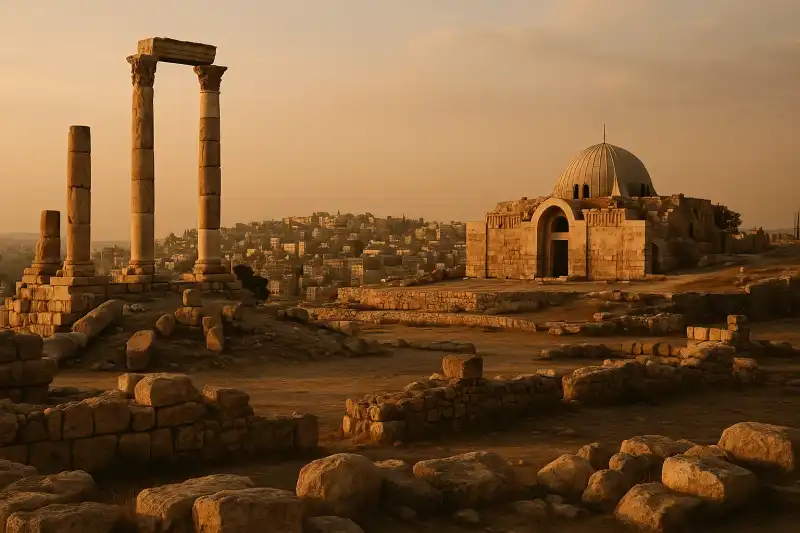
Amman Citadel Jordan Guide 2026: Temple of Hercules & Ancient Rabbah
Ammonite-Roman-UmayyadExplore Jordan's ancient citadel overlooking modern Amman. Discover the Temple of Hercules, Umayyad ...
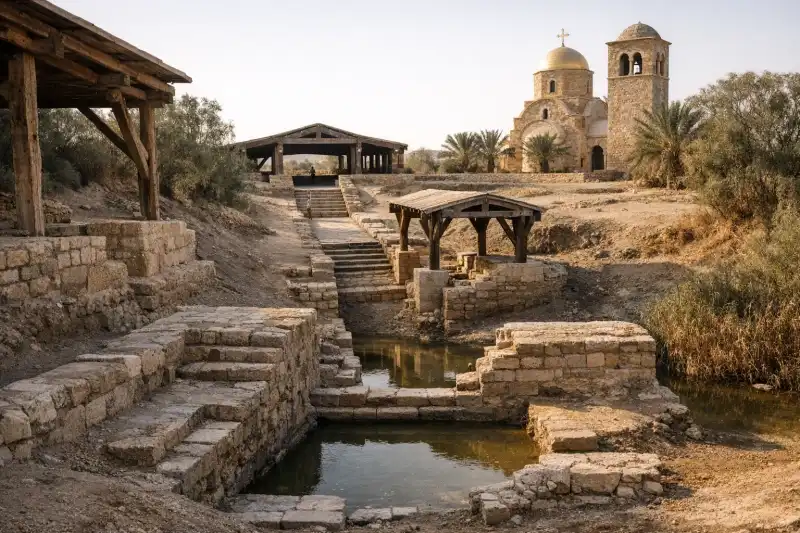
Bethany Beyond the Jordan
Bethany Beyond the Jordan in Jordan is an archaeological and religiously significant site believed t...
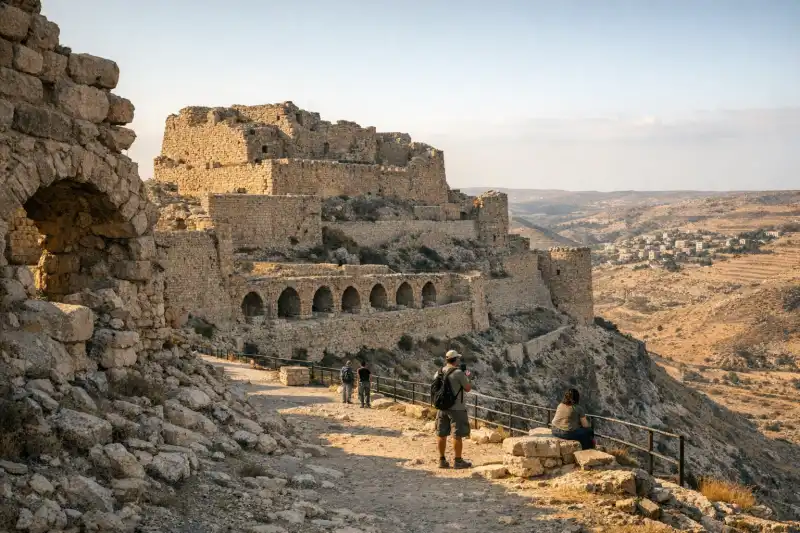
Kerak Castle
Crusader, Ayyubid, Mamluk, OttomanA vast Crusader fortress in Jordan, Kerak Castle crowns a hilltop with tunnels, towers, and sweeping...
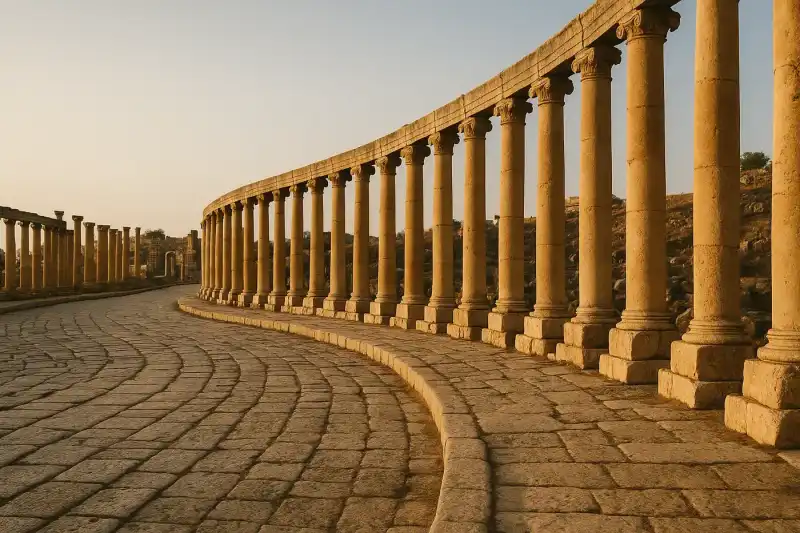
Jerash: The Pompeii of the East and Jordan's Best-Preserved
Roman / NabataeanDiscover Jerash, Jordan's remarkable Roman ruins. Walk the colonnaded streets of ancient Gerasa, exp...